

Wuhan and Over 10 Other Cities Urgently Integrate Online Consultation into Medical Insurance During Pandemic, Breaking Key Bottleneck for Internet Healthcare
On February 26, WeDoctor Internet General Hospital enabled online follow-up visit settlements through medical insurance in Wuhan, becoming the first platform-based internet hospital in Wuhan to be included in the medical insurance payment system. Just three days earlier, the Wuhan Medical Insurance Bureau had announced 18 service measures for the epidemic period, one of which was to support the inclusion of “Internet+” medical services in medical insurance coverage.
In addition, three public hospitals in Wuhan have also integrated their internet hospital services with the medical insurance payment system.
During the COVID-19 pandemic, internet healthcare experienced another surge, with online consultation and diagnosis becoming standard offerings at physical hospitals. Medical insurance reimbursement, long regarded as a bottleneck in the development of internet healthcare, was urgently introduced and accompanied by accelerated upgrades to information systems. Adhering to the principle of “settling claims where conditions permit, and creating conditions where they do not,” this initiative ensured that patients undergoing online follow-up visits could also benefit from medical insurance coverage.
The integration of medical insurance has further completed the closed loop of online consultation, prescription issuance, payment settlement, and medication delivery, which not only facilitates patients but also represents another significant step forward for internet healthcare as a whole.
On February 23, the Wuhan Healthcare Security Administration announced 18 measures to support epidemic prevention and control as well as routine medical security coverage. Notable provisions included expanding the number of designated retail pharmacies for outpatient severe (chronic) diseases under medical insurance to 50, and incorporating “Internet+” medical services into medical insurance reimbursement.
At this point, all residential communities in Wuhan had been under closed-off management for 12 days, making it increasingly urgent for patients with chronic diseases to secure follow-up consultations and medication refills through internet-based healthcare services.
Prior to this, a large number of brick-and-mortar hospitals in Wuhan and across China had already launched online outpatient services. The National Health Commission prominently displayed a list of links on the epidemic prevention and control section of its official website, showcasing the “Internet + Healthcare” services offered by each province. For issues arising from public panic during the epidemic, as well as common minor ailments, extensive channels have been established to provide guidance or recommendations.
However, as the closed-off management of residential communities in Wuhan will continue, it is imperative for medical insurance to step in to address the full-process online healthcare needs of patients with chronic diseases.
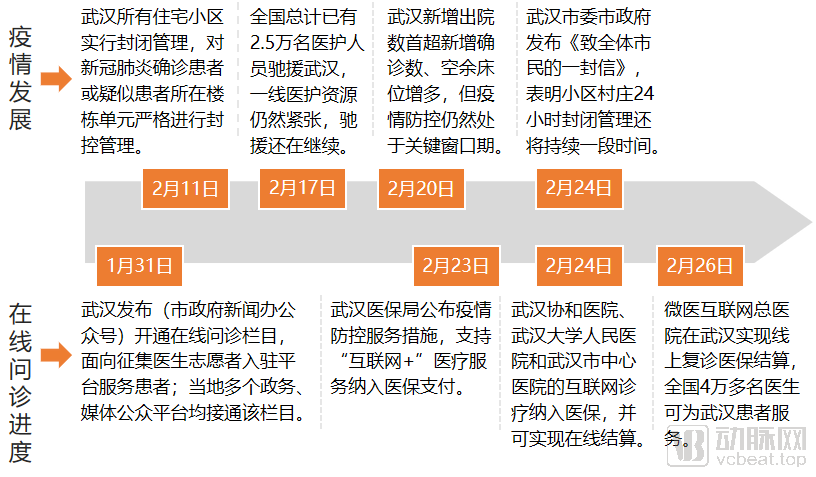
Timeline of Wuhan’s Epidemic Control Milestones and the Launch of Internet-Based Medical Consultations. Source: Official Website of the Wuhan Municipal Health Commission; Graphic by VCBeat.
In the chart above, we have outlined several key milestones of the epidemic alongside the implementation progress of online consultations and medical insurance settlements. These epidemic milestones indicate that, although Wuhan has seen frequent positive developments in patient treatment and a decline in new cases, it remains in a critical window period; medical resources are still strained, and inconveniences in routine medical care will persist.
The progress made in several areas of internet-based diagnosis and treatment demonstrates that, to address the aforementioned issues, Wuhan has successively introduced medical insurance measures on the basis of extensively providing online consultations, thereby enabling patients with chronic diseases to complete the entire healthcare process online.
On February 24, internet-based medical services at Wuhan Union Hospital, Renmin Hospital of Wuhan University, and Wuhan Central Hospital were included in the medical insurance coverage. Patients can receive online consultations and make payments through medical insurance from home, with medications delivered to their doorstep via offline distribution.
On the 25th, the Wuhan Healthcare Security Administration decided to include WeDoctor Internet General Hospital in the medical insurance payment system. The technical departments of both parties worked closely together and completed the system upgrades on the 26th, achieving interface integration among the medical insurance department, the internet hospital, and designated pharmacies. The entire upgrade process was completed within 12 hours, and the system now supports functions such as identity verification for internet diagnosis and treatment services, clinical services, and online fee settlement.
When patients with severe (chronic) diseases in Wuhan outpatient clinics consult via the WeDoctor Internet General Hospital, they can follow the "Internet Hospital Portal" WeChat official account or enter the Wuhan Zone of the WeDoctor Internet General Hospital for online follow-up consultations. Physicians will issue prescriptions and recommendations based on the patients' conditions.
After the Internet Hospital completes prescription review, it pushes the prescription information to designated retail pharmacies for outpatient severe (chronic) diseases under medical insurance. The pharmacy confirms the prescription and delivery address, reviews the prescription, verifies the insured person’s information, processes medical insurance settlement, prints the medical insurance settlement receipt, and generates a payment code for the patient’s out-of-pocket expenses. After the patient makes the payment, they may entrust the community with medication delivery, while home delivery by the pharmacy is encouraged.
In addition, WeDoctor Internet General Hospital’s Cloud Pharmacy has established forward-deployed cloud pharmacy warehouses in Wuhan, entrusting nationally renowned commercial companies with sorting and packaging, and engaging logistics providers such as SF Express for citywide delivery, including doorstep delivery to patients’ residential communities.
Currently, WeDoctor Internet General Hospital provides services for ten major chronic and severe conditions: hypertension, diabetes, vascular interventional procedures, hepatitis B, hepatitis C, liver cirrhosis, malignant tumors, chronic obstructive pulmonary disease (COPD), post-kidney transplantation care, and Parkinson’s disease.
During the pandemic, consultation and treatment fees were covered by WeDoctor Internet General Hospital, while drug prices remained fully consistent with those of major public hospitals. For medications eligible under regulations, costs were settled between medical insurance providers and pharmacies, with patients only required to pay their out-of-pocket portion. This marked Wuhan’s first platform-based internet hospital integrated into the medical insurance payment system.
If public hospitals’ internet hospitals have, to some extent, met the consultation and medication needs of patients with chronic diseases—primarily by having local doctors serve local patients—then WeDoctor’s Internet General Hospital has supplemented Wuhan with a substantial pool of physician resources.
It is reported that since the outbreak of the epidemic, WeDoctor Internet General Hospital’s “Real-Time Assistance Platform for COVID-19” has mobilized more than 40,000 doctors across China, all of whom are available to provide full support to Wuhan and alleviate the pressure on its offline medical services.
Over the past month, more than 40,000 medical personnel (including nurses) from across China were dispatched to support Wuhan. This means that WeDoctor was able to mobilize a number of doctors equivalent to those deployed in offline relief efforts to serve Wuhan within a short period. In this regard, the role of platform-based internet hospitals in the flexible allocation of medical resources has been fully leveraged.
In addition to Wuhan, multiple provinces and municipalities also included internet-based medical consultations in the scope of medical insurance reimbursement during the pandemic.
As early as September 2019, the “Administrative Measures for Internet Hospital Services for Major Outpatient Diseases in Yinchuan City (Trial)” were issued. Insured individuals in the locality who are eligible for major outpatient disease benefits for hypertension and diabetes may autonomously select one internet hospital to sign up with for medical care.
After patients consult doctors online, fees are settled in real time, with patients only required to pay their out-of-pocket portion. For urban employee basic medical insurance, the reimbursement rate for policy-covered medical expenses is 75%. For urban and rural resident basic medical insurance, the reimbursement rates for policy-covered medical expenses are 50%, 60%, and 65% for Tier 1, Tier 2, and Tier 3 coverage levels, respectively.
For hospitals, online outpatient services for major diseases are subject to disease-specific maximum payment caps, which are bundled with offline physical medical institutions and implemented in accordance with the unified annual disease-specific maximum cap standards for outpatient major diseases issued by the Ningxia Hui Autonomous Region.
During the pandemic, patients in Yinchuan can continue to seek medical care and obtain reimbursement by following the aforementioned procedures.
Our search of publicly available information revealed that multiple provinces and municipalities, including Zhejiang, Tianjin, Jiangsu, and Shanghai, temporarily incorporated online medical consultations into their medical insurance coverage during the pandemic.
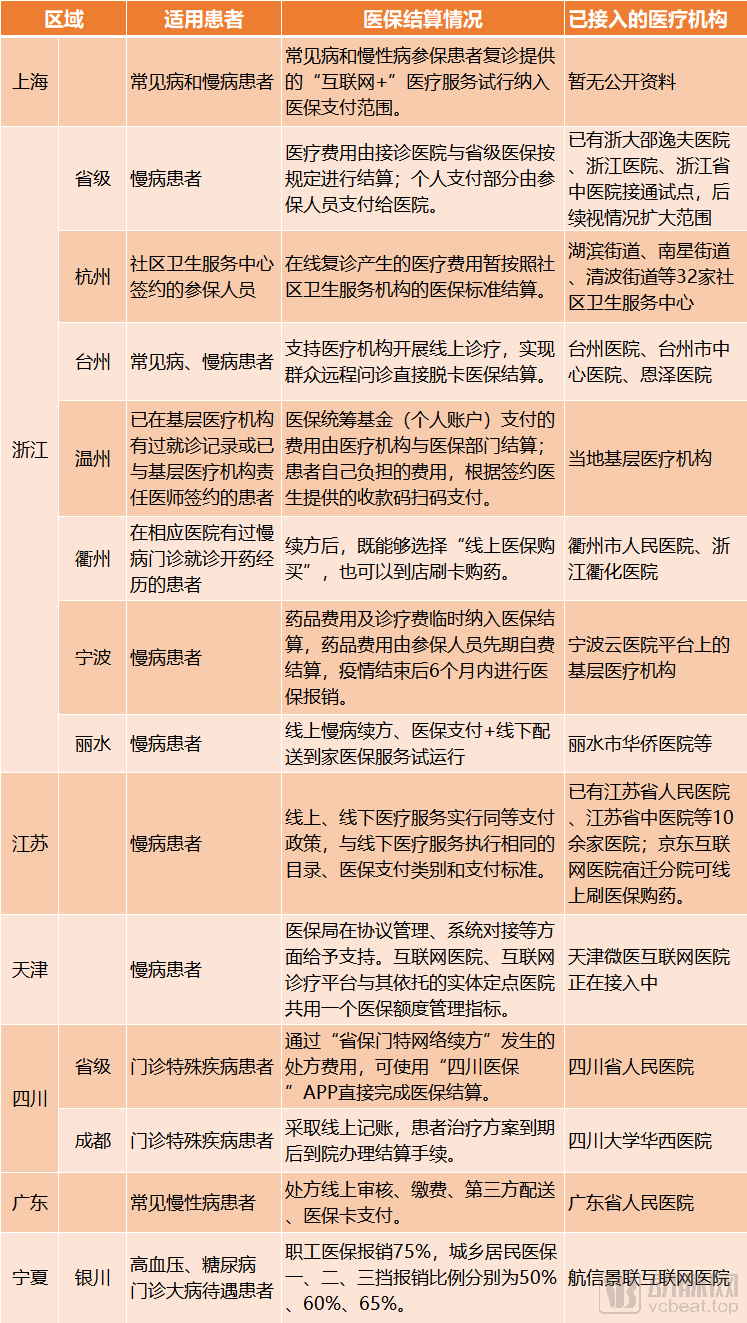
Regions Outside Wuhan That Have Included Online Consultations in Medical Insurance (May Be Incomplete Due to Limitations in Statistical Channels)
Source: Local healthcare security administrations, official websites and WeChat accounts of health commissions; graphic by VCBeat.
Online settlement via information systems; no post-hoc settlement without a system.
Before the pandemic, few physical hospitals had established internet hospitals, and even fewer supported online medical consultation reimbursement through medical insurance. Among the cities shown in the chart above, Yinchuan, Hangzhou, Wenzhou, Quzhou, and some hospitals in Jiangsu and Guangdong provinces can realize online settlement of medical insurance.
For online consultations that have been included in medical insurance coverage but for which online settlement has not yet been implemented, the healthcare security authorities are also accelerating the upgrading of information systems.
For example, on February 14, the Tianjin Municipal Healthcare Security Administration issued the "Notice on Supporting Designated Medical Institutions in Conducting Internet Diagnosis and Treatment Services During the Prevention and Control of the Novel Coronavirus Pneumonia Epidemic." The healthcare security authorities will promptly publish the interface specifications for medical insurance settlement management of internet diagnosis and treatment services. Designated medical institutions shall upgrade their internal systems in accordance with these interface specifications and may also integrate with the "Jin Yi Bao" APP to enable online medical insurance payments. The healthcare security authorities will promptly upgrade the medical insurance system to differentiate online processes—such as review, aggregation, payment, and financial transfer of medical expense claims submitted via the internet—from the offline operations of physical hospitals.
The Notice on Carrying Out Certain “Internet+” Medical Services During the Prevention and Control of COVID-19, issued by Jiangsu Province on February 19, also stated that designated medical institutions with the necessary conditions are encouraged to take the lead in pilot initiatives, work closely with local medical insurance handling agencies, make maximum use of existing system resources, and carry out system upgrades at the fastest possible pace to meet the functional requirements for patient identity authentication, diagnosis and treatment services, and online fee settlement associated with “Internet+” medical services.
However, medical insurance settlement involves the integration of multiple systems, including those of the medical insurance authorities, hospitals, pharmacies, and patient information systems. This entails a significantly heavier workload compared to the rapid deployment of fever clinics, meaning that not all healthcare institutions can quickly complete the necessary system upgrades.
At this time, measures in some regions reflect the principle of “settling claims where conditions permit, and creating conditions to enable settlement where they do not,” meaning that if system upgrades cannot be completed rapidly, reimbursement can be processed retroactively.
In Jiangsu Province, if the information system is unable to process settlements within a short period, internet hospitals are required to provide electronic invoices. Patients may complete fee settlement through methods such as reimbursement by mail, scheduled reimbursement, or deferred reimbursement.
In Ningbo, Zhejiang Province, regulations stipulate that insured individuals must initially pay for medication costs out-of-pocket, with medical insurance reimbursement processed within six months after the end of the pandemic. West China Hospital of Sichuan University, on the other hand, adopts an online bookkeeping system following patient follow-up visits, requiring patients to visit the hospital afterward to complete settlement procedures.
Multiple Regions Emphasize Consistency Between Online and Offline Services, and Between Initial and Follow-up Consultations
In the specific implementation phase, most regions emphasize consistency between online and offline patient services, with public medical institutions serving as the primary providers.
For patients to undergo online follow-up consultations and claim medical insurance reimbursement, they must have prior outpatient visit records at the medical institution’s physical clinic or be enrolled patients under the contracted responsibility physician. In other words, patients cannot arbitrarily or frequently change their designated healthcare provider.
This regulation, on the one hand, draws reference from the commonly used offline designated treatment models for chronic diseases; on the other hand, as internet-based medical consultation remains a novel practice, it is also a risk-mitigation measure for medical institutions to provide online follow-up consultations to patients solely based on their initial in-person prescriptions.
Of course, the most pragmatic reason still stems from the total budget management of medical insurance. The National Healthcare Security Administration, in its policies on medical insurance for internet-based healthcare, requires healthcare security departments at all levels to “rationally determine total budget control targets.”
Tianjin’s policy has clearly stated that internet hospitals and online diagnosis and treatment platforms share a single medical insurance quota management indicator with the physical designated medical institutions on which they rely. The annual quota is determined at the beginning of the year, and subsequently, the medical insurance quotas among medical institutions are adjusted based on factors such as the healthcare-seeking flow of insured patients and medical service capacity. Yinchuan has implemented similar policies.
Under this premise, if there is excessive patient flow for follow-up visits at hospitals, the management of medical insurance quotas will become more challenging.
From this perspective, while the model of conducting initial consultations offline and follow-up visits online at our hospital has indeed reduced medical risks and facilitated health insurance management, a significant issue remains: some medical institutions currently lack the capability to provide online consultation or settlement services. Consequently, patients at these institutions are unable to access the full suite of services, including online follow-up visits, prescription issuance, and medication delivery.
During the emergency phase of epidemic prevention and control, it was impossible to address every aspect comprehensively. In the future, only by popularizing online follow-up consultations and achieving interoperability of information among medical institutions can patients benefit to the greatest extent.
Regarding specific reimbursement standards, cities such as Yinchuan and Hangzhou have published reimbursement ratios, while Jiangsu Province mandates that online and offline medical services be subject to equivalent payment policies, adhering to the same formulary, health insurance payment categories, and payment standards as offline medical services.
In some regions, the medical insurance payment standards have not been explicitly announced. In accordance with the policy principles of the National Healthcare Security Administration, it is highly likely that the same reimbursement policies will apply to both online and offline services. However, consultation fees are an exception. As stipulated, when public medical institutions provide internet-based follow-up consultations, services rendered by medical personnel of different levels are all charged at the price for general outpatient consultation items. Therefore, the reimbursement standards implemented for online and offline services may differ.
Furthermore, multiple regions have indicated that online outpatient services were “temporarily” included in medical insurance settlement during the pandemic. Ningbo, Zhejiang Province, explicitly stipulated that this measure would remain in effect “during Level III or higher responses to major public health emergencies.” In some other areas, the duration of this policy has not been clearly defined.
If the aforementioned measures were largely emergency responses during the pandemic, what is the current overall progress in promoting medical insurance reimbursement for internet-based healthcare? Next, we will examine the policy advancements across various provinces and municipalities.
On August 30, 2019, the National Healthcare Security Administration issued the “Guiding Opinions on Improving Pricing and Medical Insurance Reimbursement Policies for ‘Internet+’ Medical Services,” establishing the principles for defining internet-based medical service items, pricing, and medical insurance reimbursement. The pricing of medical service items is primarily managed at the provincial level, under a three-tier administrative framework involving national, provincial, and municipal authorities. Specifically:
The National Healthcare Security Administration is responsible for standardizing the principles of project establishment, project names, service connotations, pricing units, pricing instructions, coding rules, etc.;
Each provincial-level healthcare security department is responsible for establishing medical service pricing items applicable to its respective region, based on advancements in medical technology and local conditions;
Municipal-level healthcare security departments accept applications for the establishment of fee-charging items; those meeting the access criteria are submitted to the provincial-level healthcare security department for centralized review and decision-making.
To date, multiple provinces and municipalities have implemented corresponding measures in the aforementioned areas. We have summarized them as follows:
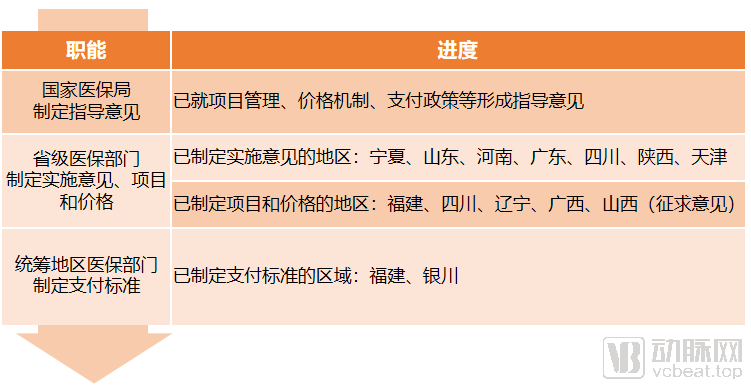
Progress in the Implementation of Medical Insurance Policies for Internet Healthcare, Source: Public Information, Chart by VCBeat
Provinces and Municipalities That Have Issued Implementation Opinions on Medical Insurance
Following the issuance of guidelines on medical insurance coverage for internet-based healthcare by the National Healthcare Security Administration, seven provinces and municipalities have formulated their respective implementation plans, introducing new measures based on overarching principles.
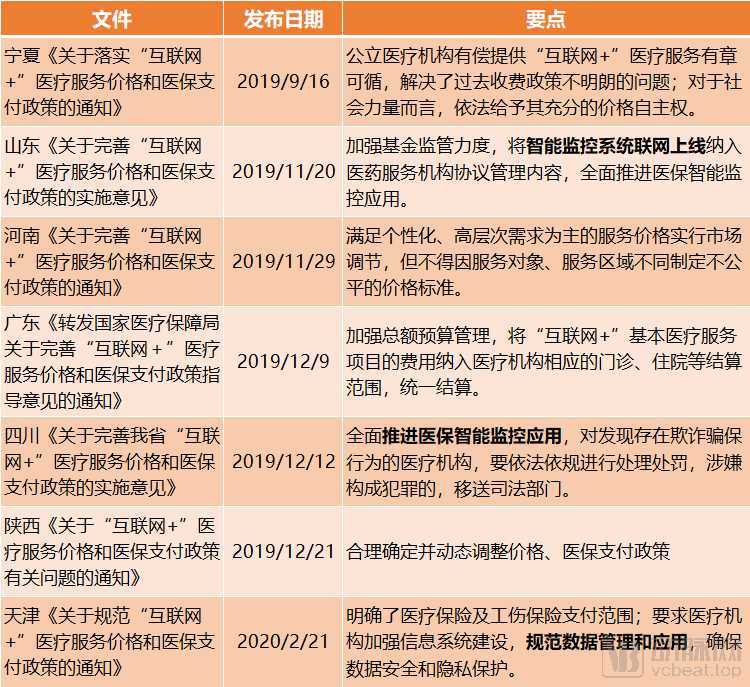
Provinces and municipalities that have issued implementation opinions. Source: Official websites of local medical insurance bureaus; graphic by VCBeat
For example, both Shandong and Sichuan provinces have mentioned the need to leverage intelligent monitoring systems to strengthen oversight of fund operations. Collecting multi-dimensional data from designated medical institutions and insured individuals for intelligent monitoring is a crucial measure to standardize online diagnosis and treatment practices and enhance the efficiency of medical insurance supervision.
According to the regulations on medical insurance coverage, internet-based medical service items must meet five conditions:
First, the services must be permitted by the health industry regulatory authorities to be delivered via “Internet Plus” models, with clear clinical pathways and well-defined technical specifications. Second, they must provide direct services to patients. Third, the service delivery process must be conducted remotely through the Internet or other digital media. Fourth, the services must achieve functions equivalent to their offline counterparts. Fifth, the services must have a substantial impact on disease diagnosis and treatment.
Simple patient consultations and physician recommendations clearly do not meet these criteria. Complete diagnostic and treatment processes, as well as standardized clinical pathways, may become part of the monitoring scope. Of course, the most direct purpose of standardized care and intelligent monitoring is to prevent insurance fraud.
Notably, Tianjin’s policy on health insurance coverage for internet-based medical services was jointly issued by the Tianjin Municipal Healthcare Security Administration, the Tianjin Municipal Health Commission, and the Tianjin Municipal Human Resources and Social Security Bureau. Among the aforementioned provinces and municipalities, Tianjin is the only one that explicitly addresses the applicability of workers’ compensation insurance. When internet-based diagnosis and treatment services are identical in content to offline services covered by basic medical insurance and workers’ compensation insurance, and are priced according to the fee schedules of public hospitals, they shall be included in the reimbursement scope upon filing with the Healthcare Security Administration and the Human Resources and Social Security Bureau, and reimbursed in accordance with relevant regulations.
Since work-related injury insurance has a separate catalog of diagnostic and treatment items, with its coverage also including rehabilitation services, this initiative in Tianjin may expand the variety of internet-based medical service offerings.
Provinces and Municipalities That Have Issued Project Pricing
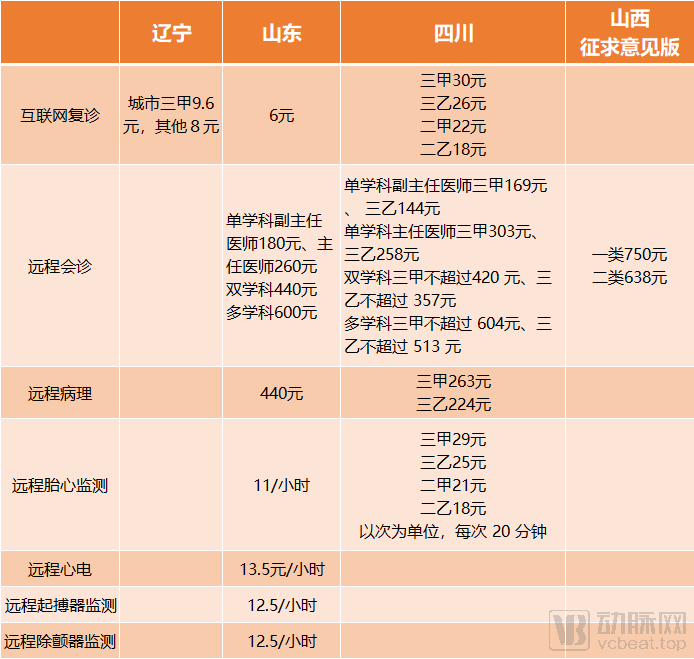
Selected Provinces and Cities with Established Service Items and Pricing, Source: Official Websites of Local Healthcare Security Administrations, Chart by VCBeat
Under the existing policy framework, provinces such as Sichuan, Shandong, and Liaoning have published lists of internet-based medical consultation services and their corresponding prices. In addition to consultation fees for follow-up visits for common and chronic diseases, these lists also cover fees for various remote consultations, diagnoses, and monitoring services.
In the past, telemedicine faced significant issues with underutilized equipment. On one hand, remote consultations were constrained by technological and network limitations; unstable connections or lagging could impair video transmission, potentially leading to missed or incorrect diagnoses. On the other hand, remote consultations incurred substantial costs in staffing, equipment maintenance, and network fees. Another contributing factor was the level of support from medical insurance.
Telemedicine involves three parties: the patient, the inviting institution, and the invited institution. Regarding the allocation of costs, Sichuan Province has provided detailed case studies in its policy interpretation to illustrate this matter.
For example, a patient may initiate an application at their local offline hospital and, through an internet-based platform, invite specialists from major cities to provide online consultations (remote consultation). The patient is only required to pay the corresponding fees to the local offline hospital. The fees are determined based on the pricing standards of the invited party’s hospital, while the revenue distribution between the two hospitals is subject to mutual negotiation. For instance, if a patient receives care at a Grade II Class A hospital in Guang’an City and requests a remote consultation with a specialist from a Grade III Class A hospital in Chengdu, the patient need only pay the “remote consultation” fee set by the Grade III Class A hospital to the Grade II Class A hospital in Guang’an.
Provinces and municipalities that have established pricing for telemedicine consultations and remote monitoring services have all included them within the scope of medical insurance coverage, although payment standards still need to be refined by each pooling area.
In the six months since the National Healthcare Security Administration issued its policies on internet-based medical insurance, most of the regions that have implemented corresponding measures, as mentioned earlier, are also those that began exploring the field of internet healthcare at an early stage.
In addition, Fujian Province issued its medical insurance payment policy in early August 2019, prior to the introduction of national policies by the National Healthcare Security Administration. The policy included 30% of the fees for remote consultations within the scope of medical insurance coverage, with a cap of no more than RMB 90 per session. However, remote diagnostic services (i.e., remote imaging diagnosis, remote pathological diagnosis, etc.) and follow-up consultation fees at internet hospitals were not yet covered by medical insurance.
Next, the practical experience gained in these regions will serve as an important reference for other provinces and municipalities.
During the pandemic, the entire internet healthcare industry conducted large-scale consultations and free clinics, providing effective user education. Hospitals and doctors have placed greater emphasis on online services, while health authorities at all levels have refined policies to vigorously promote internet-based diagnosis and treatment.
Existing or temporary medical insurance reimbursement measures have enabled online consultations to complete the entire process from diagnosis to medication dispensing, thereby fostering deeper user habit formation and further promoting industry development.
First, although the number of medical institutions capable of processing health insurance settlements via internet hospitals is far lower than those offering fever clinics and COVID-19 consultation services—due to limitations in information system integration and considerations for the operational security of the health insurance fund—if the involvement of health insurance during the pandemic can not only guide chronic disease patients to seek medical care in an orderly manner and prevent cross-infection in offline settings, but also enhance patient management efficiency for medical institutions and maintain the stable operation of the health insurance fund, then these temporary measures are poised to become long-term policies.
Second, in regions that have encouraged medical institutions to expedite the upgrade of their information systems, close collaboration between healthcare security authorities and medical institutions has enhanced operational efficiency and strengthened the infrastructure for online healthcare security settlement, ensuring its sustainable use in the future.
Third, the outbreak may also accelerate the pace of policy improvement in regions where relevant regulations are not yet fully established. For example, officials from the Anhui Provincial Healthcare Security Administration visited the Internet Hospital of the First Affiliated Hospital of Anhui Medical University for research and stated that internet-based diagnosis and treatment play a positive role in alleviating the pressure on outpatient services and facilitating home-based medical care for the public. They indicated that they would carefully consider the hospital’s applications for approval of internet-based follow-up consultation projects and patient reception initiatives, and would promptly study and propose relevant policy recommendations.
Fourth, although health insurance policies have generally had a greater promotional effect on internet hospitals operated by public hospitals, enterprise-led platform-based internet hospitals can still shoulder critical responsibilities at key moments. As demonstrated by WeDoctor’s emergency relief efforts, relevant authorities place greater emphasis on the role of platform-based internet hospitals in integrating medical resources—a capability that is difficult for public hospitals to replicate.
Ultimately, regardless of hospital type, the integration of medical insurance systems has led to broader adoption of online follow-up consultations by patients, physicians, and healthcare institutions, thereby enhancing the overall social value and influence of the industry. This rising-tide-lifts-all-boats dynamic enables platform-based internet hospitals to better explore sustainable profitability models.