

KEENON Robotics Expands into Healthcare with Technology-Derived Solutions Following IPO Filing

KEENON Robotics
Indoor Unmanned Delivery Robot: Independent R&D and Manufacturer
"Whatever the service industry needs, Keenon develops."
2020 marked the 10th anniversary of Keenon Robotics. Having already established a strong reputation in the catering industry, Keenon had intended to leverage the “Chinese New Year’s Eve dinner” season to secure several major orders, but its plans were disrupted by the sudden outbreak of the pandemic.
With the widespread cancellation of Chinese New Year’s Eve dinners and large-scale closures in the foodservice industry, the resulting damage to the sector inevitably rippled through companies across its supply chain, including providers of food delivery robots. By the end of 2019, Keenon Robotics had launched multiple models of food delivery robots tailored to diverse dining scenarios, with deployments already implemented at over 1,000 well-known restaurants, including Haidilao, Banu Tripe Hot Pot, and Grandma’s Home.
Shanghai Keenon Robotics Co., Ltd. is a high-tech enterprise headquartered in Shanghai, specializing in the research and development, production, and sales of indoor autonomous delivery robots. The company’s product portfolio encompasses various types of intelligent robots, primarily deployed in restaurants, hotels, shopping malls, KTV venues, food delivery, express courier services, and hospital pharmaceutical distribution.
In the medical field, the demand for robotic applications is growing rapidly. An article by VCBeat, “The Value of Robots in Fighting COVID-19 Becomes Prominent: What Other Growth Opportunities Exist in This Industry?” shows that the market size of medical robots in China increased from RMB 390 million in 2016 to RMB 410 million in 2017, and reached USD 510 million in 2018. The future market still holds significant potential for growth.
Among these, logistics robots play a particularly prominent role in medical delivery. Logistics account for the majority of hospitals’ daily operational costs; it is estimated that hospitals in China currently allocate approximately 46% of their budgets to logistics-related activities, with 27% spent on materials and equipment and 19% on labor. As healthcare system reforms—such as the separation of pharmaceutical prescribing from dispensing—continue to deepen, hospital administrators are increasingly focusing on optimizing internal hospital structures and reducing operational costs.
The outbreak of COVID-19 has heightened awareness of the role of logistics and delivery robots, leveraging this pandemic to enable Keenon Robotics to formally expand from the consumer sector into the healthcare industry.
On January 25, 2020 (the first day of the Lunar New Year), two passengers on flight TR188 from Singapore to Hangzhou Xiaoshan International Airport, who were confirmed to be infected with the novel coronavirus, were transferred to the First People’s Hospital of Xiaoshan District, while 219 other passengers were placed under centralized quarantine and observation at the Party School of the Hangzhou Municipal Committee. To improve meal delivery efficiency and reduce the risk of cross-infection during delivery, Keenon deployed 16 food-delivery robots to provide meals and supplies to those under quarantine.
All meals are sourced from the Party School canteen, placed in fully sealed transparent containers, and delivered to individual rooms by food delivery robots, which provide voice prompts to remind recipients to collect their meals. To meet the requirements of medical settings, Keenon Robotics pioneered contactless delivery services by eliminating the click-to-confirm step, minimizing human-robot interaction, and broadcasting voice messages on epidemic prevention knowledge, thereby achieving truly contactless service and preventing cross-infection. To date, the company has deployed nearly 100 food delivery robots, serving more than 10 provinces and municipalities across China, including nearly 100 hospitals and quarantine facilities.
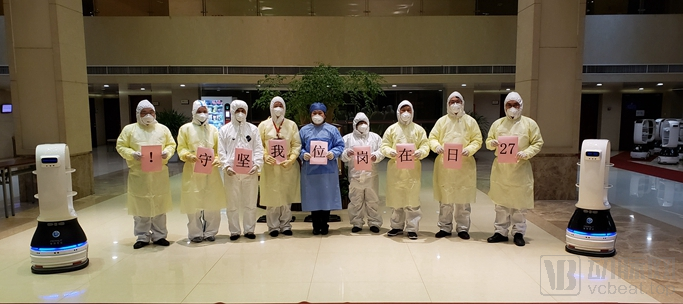
Group photo of Keenon Robots fully deployed at a severe-case isolation site (Image source: Provided by the enterprise))
Li Tong, CEO of Keenon Robotics, stated that the company’s primary consideration in deploying robots to support epidemic-affected areas was to replace medical personnel in delivering supplies and medications, thereby maximizing patient “isolation” and effectively preventing cross-infection among healthcare workers. Medical staff at the Wuhan Shipailing Fangcang Hospital remarked, “By using food delivery robots to handle simple yet labor-intensive tasks such as meal distribution, order verification, and medication delivery, healthcare workers can have more time to rest. This not only reduces their workload but also prevents cross-infection between hospital staff and patients, thereby lowering the risk of epidemic transmission.”
Compared with traditional manual delivery, medical delivery robots can reduce the error rate of material distribution to zero. The robots can work for more than 12 hours a day, effectively reducing the time healthcare workers spend on simple and repetitive tasks. Li Tong stated that, depending on the size and specifications of the ward, one medical delivery robot can currently replace the workload of four healthcare workers, while one meal delivery robot is equivalent to the workload of two healthcare workers. They can provide 24/7 contactless delivery services to 20 wards on the same floor, ensuring round-the-clock availability.
For Keenon Robotics, the core mobility technology behind medical delivery robots is straightforward; hospital logistics robots represent an application of autonomous driving technology within the healthcare sector. Keenon Robotics has dedicated years to advancing indoor unmanned delivery, successfully tackling the complex environment of the food and beverage industry. For instance, restaurants feature high pedestrian traffic, numerous obstacles such as chairs, tables, and pillars, narrow aisles, and complex conditions involving lighting, shadows, and floor surfaces.
Starting from complex dining scenarios, Keenon Robotics’ self-developed commercial-grade indoor positioning and navigation system deeply integrates multiple sensors, including LiDAR, machine vision, depth vision, and sonar, enabling robots to operate more efficiently and stably in complex environments such as restaurants. Having conquered this challenging environment, deploying the technology in hospital settings represents a straightforward replication for Keenon, leveraging its advanced capabilities in a less demanding context.
However, the hospital environment presents unique challenges. To achieve strong performance in hospital logistics, it is essential to consider factors such as “cargo compatibility, material security, safety and efficiency, vertical transportation within the facility, in-hospital Internet of Things (IoT), closed-loop material management, and the ratio of payload capacity to battery range.” These are precisely the core issues that Keenon Robotics systematically addressed and resolved in the post-pandemic era.
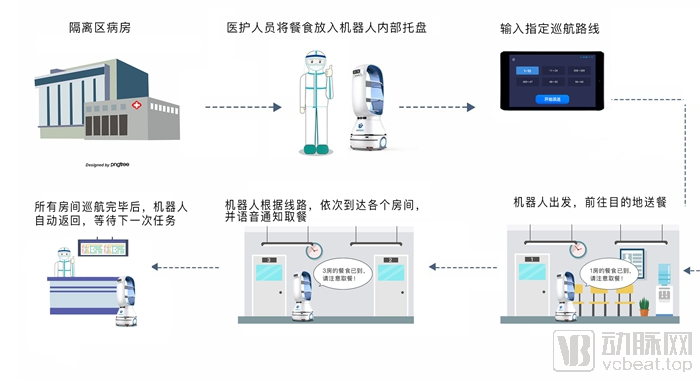
Flowchart of Keenon Robots’ Hospital Usage (Image Source: Provided by the Company)
In addition to the technological advantages mentioned above, mass production capability is another core competitive strength of Keenon Robotics. While industry-wide production capacity remains limited, Keenon’s autonomous delivery robots offer enterprises a high cost-performance ratio. This advantage stems from Keenon’s comprehensive and integrated supply chain, which enables large-scale mass production and reduces manufacturing costs.
In addition to meal delivery robots, Keenon has also launched disinfection robots. Li Tong stated, “This product was developed to address challenges such as the difficulty of hospital disinfection, staff shortages, and the need for comprehensive cleaning.” Equipped with Keenon’s new generation of fully autonomous positioning and navigation solutions, the robot utilizes laser SLAM technology combined with multiple sensors to achieve fully autonomous navigation and movement. It can identify objects in its environment to enable autonomous obstacle avoidance. The robot features an integrated short-wave UVC germicidal ultraviolet lamp and employs an ultra-dry fog disinfection method that minimizes condensation. It autonomously performs 360-degree, no-dead-angle disinfection around target areas, making the disinfection process safer and more efficient. With intelligent end-to-end operation and separation of humans and machines, the robot ensures personnel safety.
In the wake of this sudden epidemic, Keenon Robotics will continue to maximize the potential of “labor replacement” by launching several new products annually. With multiple models poised for mass production, Keenon anticipates annual sales reaching tens of thousands of units. The company is also steadily advancing the large-scale global deployment of its products while exploring their application in a broader range of scenarios.