

How Can Technology Aid Triage Amid Severe Bed Shortages in Fangcang Hospitals?

YITU
Provider of Full-Stack Intelligent Healthcare Product Solutions
In the days leading up to the Year of the Rat, Dr. Fang Cong traveled to Wuhan for business. Amidst a hectic schedule, the Wuhan native headed straight to the hospital without even having time to visit her elderly parents and children. At that time, although she vaguely sensed that this was an “unusual pneumonia,” she could not have anticipated that Wuhan would go into “lockdown” just three days later...
At that time, Wuhan was already shrouded in an eerie atmosphere. Frontline doctors had detected the circulation of an unusual virus, yet life went on as usual for many: residents still flocked to “Guo Zao” (the traditional early-morning breakfast) and late-night snacks. Some shops had already closed their doors, with owners preparing reunion dinners for the upcoming Spring Festival or embarking on their journeys home. At this juncture, not everyone was focused on the epidemic; the general public remained largely undisturbed, carrying on with their peaceful daily lives.
On January 20, taking advantage of the Monday workday, Fang Cong visited Wuhan Union Hospital with some concerns. Although the authorities had not yet officially characterized the virus at that time, Wuhan Union Hospital was already busier than usual. From the outpatient hall to the radiology department, some passersby were already wearing masks; apart from this, there were no other obvious signs of abnormality. As a healthcare professional, Fang Cong wore a mask when he went to Wuhan Union Hospital that day.
Dr. A, an old friend of Fang Cong, had witnessed the adoption of Yitu Medical’s AI-assisted system at Wuhan Union Hospital, where chest CT imaging across all campuses was largely interpreted using a “physician + AI” model. Unlike previous meetings that focused on product performance, Dr. A’s immediate reaction upon seeing Fang Cong at the hospital that day was to urge her to leave promptly. With early signs of the outbreak emerging, he advised her to wear a mask, take proper protective measures, and depart from the hospital as soon as possible.
The next day, Academician Zhong Nanshan confirmed that human-to-human transmission of the novel pneumonia existed. Meanwhile, Fang Cong, having concluded his business trip, boarded an early-morning flight back to Hangzhou. The moment he landed in Hangzhou, it was destined that this Spring Festival would no longer be peaceful.
“No one anticipated that the pandemic would erupt so rapidly, or that the SARS-CoV-2 virus would be so highly contagious.”
Upon returning to Hangzhou, Fang Cong voluntarily initiated self-isolation, sensing that “something was not right” and believing that “we need to do something.” At this juncture, Yitu Healthcare rapidly mobilized its preparedness efforts for the epidemic response. However, with the Spring Festival approaching, some employees had already begun their leave and returned home. On Chinese New Year’s Eve, Ni Hao, President and CEO of Yitu Healthcare, contacted Shi Yuxin, Deputy Director of Shanghai Public Health Clinical Center, expressing the hope to leverage an artificial intelligence analysis system to alleviate the excessive workload borne by medical staff. A project was immediately established, and a COVID-19 task force was assembled. A team of more than 100 members began working remotely from different locations to deliberate on strategies for supporting Wuhan in the “epidemic battle.” During the conference calls, a series of questions arose urgently: What do doctors currently need? How can data be obtained? How should workstations be deployed?
After consolidating opinions, YITU Medical decided to prioritize the development of an intelligent evaluation system for COVID-19, addressing the urgent need to improve physicians’ diagnostic efficiency. As for the workstations, they could seek assistance from colleagues in Wuhan for deployment. The issue of data acquisition—whether to directly seek help from partner hospitals in Wuhan or to source data from outside Wuhan—became one of the focal points of the meeting discussion.
As a key designated facility for treating COVID-19 patients in the Shanghai region, the Shanghai Public Health Clinical Center—being on the front lines—faced immense pressure. The center sought to rapidly deploy artificial intelligence technology and develop AI software specifically targeted at SARS-CoV-2, aiming to alleviate the substantial burden caused by the surge in CT scans within its radiology department. With aligned objectives, Yitu Medical immediately commenced the research and development of its “AI + Chest CT for COVID-19” software.
The primary challenge in the early stages of research and development remained data-related. Although the Shanghai Public Health Clinical Center conducted examinations on a large number of suspected cases, the number of confirmed cases was relatively limited. Furthermore, most patients with confirmed diagnoses presented with mild clinical conditions; while pulmonary lesions were present, they were not pronounced. Naturally, these subtle lesions are precisely those prone to being overlooked by physicians, thereby constituting a key focus for AI applications.
“Severe cases with extensive ‘white lung’ were rare in the early stage; many patients presented only with minor ground-glass opacities on lung imaging. Overall, the number of COVID-19 cases in Shanghai was not substantial,” Fang Cong told VCBeat. “The small-sample learning algorithm we advanced in 2019 proved invaluable in this context. By leveraging this model, we were able to develop an effective algorithm through iteration with only a limited number of samples. From Chinese New Year’s Eve to the fourth day of the Lunar New Year—a span of just four days—our AI algorithm was deployed in the Department of Radiology at Shanghai Public Health Clinical Center.”
Furthermore, although the severity of the outbreak in Wuhan far exceeded that of any other city, CT imaging revealed virtually no differences in lesions of comparable severity across different regions. The radiological features resembled those of SARS and were distinctly different from other types of pneumonia. It was precisely due to the high similarity of imaging findings across diverse locations that YITU’s remote development efforts faced minimal obstacles.
During the initial product design phase, Yitu Healthcare’s primary objective was to implement the “AI-assisted diagnosis” functionality of its “AI + COVID-19 Chest CT” software, aiming to help physicians improve diagnostic efficiency and accuracy. However, as the system became more deeply integrated into frontline clinical practice, Yitu Healthcare’s chest CT system has continued to evolve.
Fang Cong stated, “Many fever clinics perform hundreds of CT scans daily, while core hospitals in Wuhan exceed four-digit figures. What AI can do is streamline image analysis and report writing, assisting physicians in interpreting images and automatically entering valid diagnostic information into report templates. With AI empowerment, the time required for physicians to analyze individual images has been reduced from 10 minutes to just 1 minute. Clinical validation has demonstrated a screening sensitivity of 97.3% and a specificity of 99.0%.”
However, diagnosis is only the first step. Physicians must also stratify patients based on the severity of their symptoms and conduct regular follow-ups. “In Wuhan, critical-care beds are currently in extremely short supply, and makeshift hospitals designated for isolating patients with mild to moderate symptoms are overcrowded, leaving many patients waiting for bed availability. Under these circumstances, physicians need to make precise assessments within a very short timeframe to allocate patients to the most appropriate medical facilities according to their condition. For patients already admitted, physicians must perform regular follow-ups to monitor changes in ground-glass opacities on imaging studies over time, promptly adjust treatment plans for those whose symptoms worsen, and transfer patients whose symptoms alleviate or who have recovered. All these tasks require us to provide physicians with detailed quantitative imaging information as a basis for clinical decision-making.”
Without artificial intelligence, effective triage is difficult to achieve relying solely on manual delineation by physicians or judgment based on clinical experience. “For senior physicians to manually delineate pulmonary lesions in confirmed cases, it takes anywhere from 2–3 hours to as long as 5–6 hours. In contrast, by analyzing whole-lung density curves, comparing the histogram of lesion areas with the baseline CT value histogram of healthy individuals, and performing slice-by-slice lesion detection with pixel-level multi-color rendering, we enable more intuitive analysis of the mixed-density lesions commonly seen in COVID-19. The entire process can be completed in just a few seconds.”
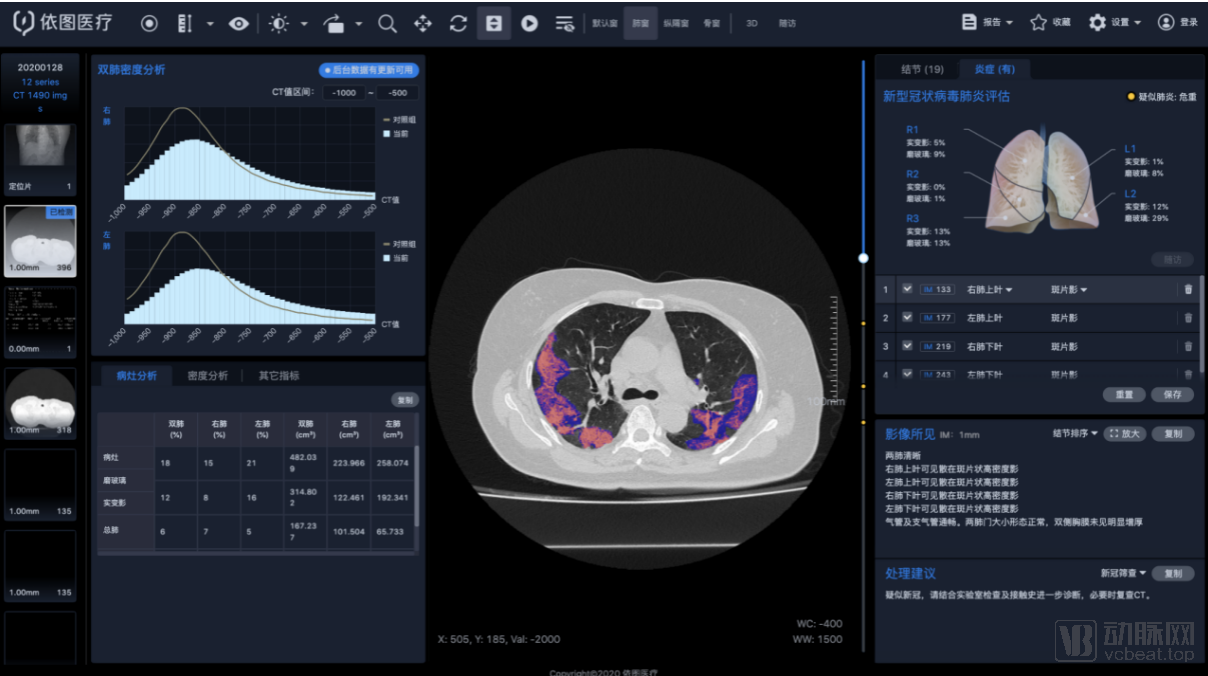
According to feedback from the Shanghai Public Health Clinical Center, clinical validation has demonstrated that the system’s quantitative analysis closely aligns with physicians’ assessments (R = 0.87, p < 0.001 in correlation analysis), indicating highly stable diagnostic quality. Leveraging this performance, physicians used the software to triage a large number of patients with mild symptoms to makeshift hospitals, thereby enabling more patients to receive timely treatment.
The situation at frontline hospitals is critical, yet people in home isolation also need care.
January to March each year marks the flu season. Even without contracting the novel coronavirus, people are highly susceptible to catching colds during this period. However, during critical times, rushing to the hospital at the first sign of coughing or runny nose may not be the best course of action. Amidst the pandemic, genuine information and misinformation are intertwined; news needs time to settle before its veracity can be determined. In such circumstances, people’s judgment naturally lacks a reliable benchmark.
To address the aforementioned issues, help boost public confidence in epidemic prevention and control, and alleviate stress, YITU Healthcare has developed “Dr. Xiao Yi for COVID-19 Prevention” based on speech recognition, natural language processing, and medical knowledge graph technologies. This solution provides the general public with science popularization, intelligent consultation, and triage services related to COVID-19, while offering governments intelligent monitoring and analysis of regional epidemic situations.
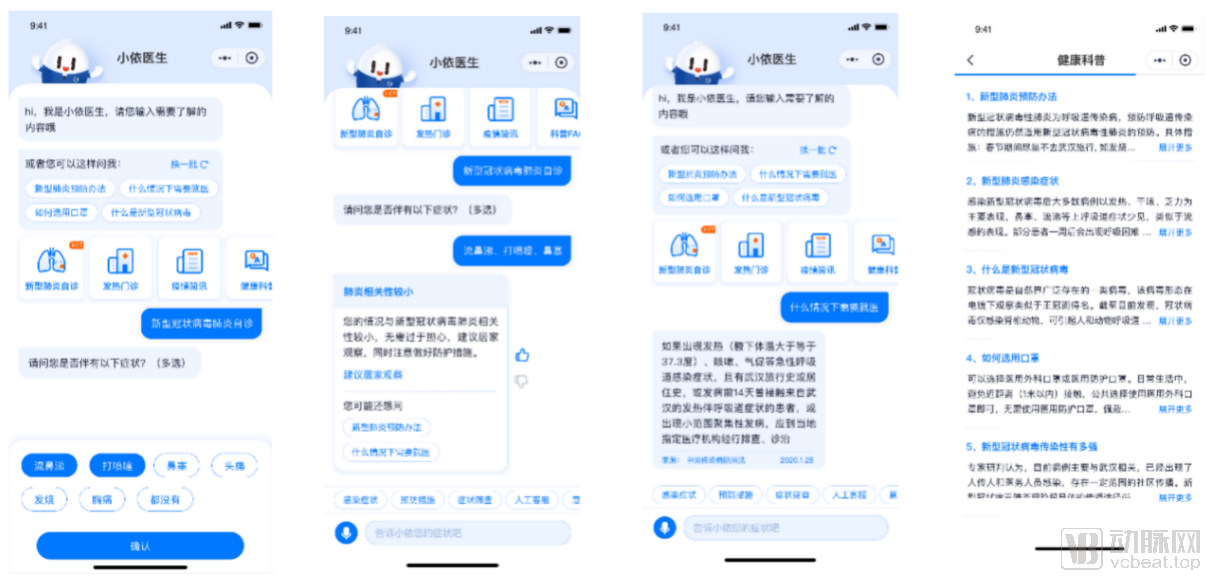
Powered by YITU Medical’s medical knowledge base, this mini-program provides patients with healthcare recommendations and relevant health education based on their reported symptoms and physical information. If a patient’s condition resembles that of a COVID-19 case, the mini-program will immediately provide registration access to the nearest fever clinic. Furthermore, the pre-consultation feature can significantly reduce the duration of contact between doctors and patients.
Currently, the “Intelligent Evaluation System for Chest CT in Novel Coronavirus Pneumonia” has been deployed and is playing a positive role in dozens of hospitals across more than ten provinces and municipalities nationwide, including Renmin Hospital of Wuhan University, Union Hospital Affiliated to Tongji Medical College of Huazhong University of Science and Technology, Zhongnan Hospital of Wuhan University, the First People’s Hospital of Jingzhou City in Hubei Province, the People’s Hospital of Shiyan City in Hubei Province, Shanghai Public Health Clinical Center, Shanghai Seventh People’s Hospital, Zhejiang Provincial People’s Hospital, the Second Affiliated Hospital of Zhejiang University School of Medicine, the First Affiliated Hospital of Wenzhou Medical University, Lishui Central Hospital in Zhejiang Province, and Beijing Anzhen Hospital Affiliated to Capital Medical University. Moreover, the demand for deployment from hospitals across China is increasing daily, and the system is expected to play an even greater role in more designated hospitals for the treatment of COVID-19 patients in the future.
“Dr. Xiao Yi for Novel Coronavirus Pneumonia Prevention and Control” has, to date, been deployed across dozens of medical institutions in more than ten provinces, including Shanghai, Zhejiang, Guangdong, Sichuan, Guangxi, Jiangsu, and Hebei. It has also been launched on numerous local government WeChat official accounts and national internet platforms, where it has played an active role. Examples include Shanghai’s “One-Net Compliant Handling” platform and the Xuhui District Government’s WeChat official account.
On February 5, Yitu Medical brought its mature “AI+CT” imaging software back to Wuhan Union Hospital, completing deployment within 24 hours of the system’s release. Coincidentally, on the same day, the National Health Commission issued the Fifth Trial Version of the Diagnosis and Treatment Protocol for Novel Coronavirus Pneumonia, which defined suspected cases in Hubei Province with characteristic imaging findings as “clinically diagnosed cases.” “After CT imaging was explicitly highlighted by the authorities, the daily diagnostic volume reached a new peak,” said Fang Cong. “Some hospitals even required patients to undergo a CT scan upon admission.”
Yet precisely because of this, the YITU team, which gave up reuniting with their families during the Spring Festival, felt an even stronger sense of purpose in their work. Amidst all the accolades, what moved Fang Cong most was a WeChat message from a radiologist: “I rely on YITU to save lives every day.” This is perhaps the highest praise YITU could receive.
“Recalling my visit to the hospital on the 20th, Dr. A said to me, ‘Why are you still here? Leave Wuhan immediately.’ These small gestures have continued to inspire me—those on the front lines remained fearless in the face of danger, yet urged others to evacuate quickly to protect their families and friends... As fellow healthcare professionals, we too should contribute in our own ways.”
To date, Wuhan has been under lockdown for over a month, and doctors have continued to stand on the front lines, ultimately bringing about a precious turning point in the epidemic.
Meanwhile, tech companies have also stood firmly behind them, offering support through the power of technology.
When asked what, besides the intense rush to meet project deadlines and the fight against the epidemic, had been most memorable over the past month, Fang Cong thoughtMy daughter in Wuhan: “Yesterday she told me via voice message, ‘Mom, I’m getting some fresh air on the balcony today.’ Her grasp of ‘prison’ jargon is already quite sophisticated.”
Whether physicians or healthcare entrepreneurs, every individual who dares to go against the current is both great and ordinary.
Every moment during the fight against the epidemic is worth remembering.