

Redefining the Clinical Value of Wearable Monitoring Data: How HiSeReg Builds a Closed-loop Cardiopulmonary Rehabilitation Service
Cardiopulmonary rehabilitation is not merely physical training; it restores patients' right to live again.
Chronic Obstructive Pulmonary Disease (COPD) is one of the diseases with the highest morbidity and mortality rates worldwide. Respiratory diseases, led by COPD, have been listed by the World Health Organization as one of the "four major chronic diseases" globally, alongside cardiovascular and cerebrovascular diseases, malignant tumors, and diabetes and metabolic disorders.
COVID-19 is an acute respiratory infectious disease. Given the limited capacity of hospitals, most close contacts can only opt for home-based medical observation or designated-site medical observation, such as in temporarily established facilities within communities, hotels, stadiums, and other locations.
Home-based or temporarily established medical observation sites lack essential medical testing equipment and devices. Healthcare workers monitor temperature changes of observed individuals through scheduled phone calls or WeChat, relying on one-on-one communication for data collection. There is a shortage of digital, networked, and intelligent health information acquisition tools, as well as medical-grade platforms capable of real-time monitoring and centralized management of large populations. Consequently, regulatory authorities are unable to obtain real-time, comprehensive oversight of epidemic prevention and control information.
To this end, Beijing Hi-Think Rigor Technology Co., Ltd. (hereinafter referred to as “Hi-Think Rigor”), leveraging its years of technological accumulation, rapidly launched the NCP Medical Observation and Information Supervision Platform. This platform enables individuals under isolation to monitor their health status and share data in real time with healthcare professionals; assists medical staff in providing centralized, medical-grade monitoring of observed individuals; and facilitates regulatory authorities in gaining a comprehensive, real-time overview of epidemic prevention and control developments.
As mentioned earlier, the NCP Medical Observation and Information Supervision Platform was developed by Hisreg based on IoT big data cloud technology. It mainly consists of three functional modules: the Health Declaration System for Medical Observation, the Remote Monitoring and Smart Management System, and the Smart Surveillance System.
Observed individuals enter their physical health information via the “NCP Medical Observation” app, with data automatically uploaded to a cloud-based system. After automated statistical analysis, the information is aggregated and reported to regulatory authorities at all levels. “This enables regulatory agencies to have a clear, real-time overview of the number of individuals under isolation within their jurisdiction, their distribution, confirmation status regarding infection, and the current stage of isolation,” added Zheng Jiewen, Founder and CEO of HealthSig. For individuals in poor health or those with underlying conditions, HealthSig provides medical-grade wearable devices for vital signs monitoring. These devices track dynamic vital sign data in real time and offer features such as abnormality alerts and health status assessments.
As the pandemic situation gradually improves, issues concerning the prognosis and rehabilitation of patients with COVID-19 have come to the forefront. The “Guidance on Respiratory Rehabilitation for Pneumonia Caused by the 2019 Novel Coronavirus (First Edition)” states that respiratory functional rehabilitation, physical functional rehabilitation, and psychological reconstruction are three key components of respiratory rehabilitation interventions.
To address these three challenges, Hi-Regal has launched “FREE Breathing,” an out-of-hospital cardiopulmonary rehabilitation product that enables patients with chronic cardiopulmonary diseases to access medical-grade rehabilitation guidance anytime and anywhere outside the hospital, providing seamless, full-cycle rehabilitation management across both in-hospital and out-of-hospital settings. Patients can use wearable devices and a smartphone app in home or outdoor environments, leveraging the “Hi-Cloud Service” big data AI platform to deliver interactive breathing exercises, breathing retraining, multidimensional health status assessments, as well as real-time monitoring, early warnings, and quantitative evaluation of outcomes throughout the entire training process. Furthermore, Hi-Regal collaborates with the Chinese Academy of Sciences to incorporate mindfulness training techniques, offering psychological interventions to help patients alleviate anxiety and tension.
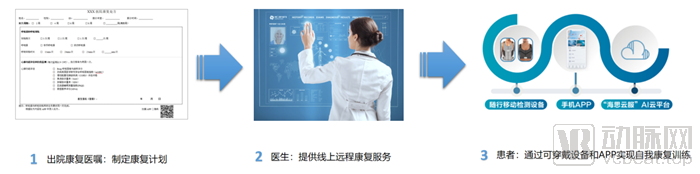
"Tools for Patient Self-Rehabilitation Training""Free Breathing" (Image from the company)
Integrating wearable devices into clinical services and establishing a complete business model is no simple task. In Zheng Jiewen’s view, data should not be merely visualized; the uniqueness of Hisireg lies in its refusal to act as a mere “mover” of data. Instead, it aims to be a “decoder” of clinical data, leveraging big data and AI to conduct in-depth analysis and interpretation of clinical issues.
“For example, Haisirui focuses on the field of respiratory medicine, obtaining patients' basic vital signs data and electronic medical record data. Through data integration, we can extract valuable information to predict patients' health risks, assist doctors in making diagnostic and treatment decisions, and evaluate medication.”
Currently, the Haisirui product line comprises three major segments: the SensEcho Smart Ward System, the SensEcho Cardiopulmonary Rehabilitation Support System, and the “Haisi Cloud Service” Big Data AI Analytics Platform.
SensEcho Smart Ward Core System:The system comprises low-load medical-grade mobile monitoring devices, a visual software service system, and a backend big data AI platform. Its core technology originates from the world’s leading BME laboratories at MIT and Harvard’s Rey Institute, and has been developed over ten years by a top-tier domestic R&D team in collaboration with clinical experts. The system is designed for continuous vital signs monitoring of inpatients in general wards, centralized patient information management, and clinical decision support, thereby providing healthcare professionals with services such as patient safety alerts, disease risk management, and data-driven clinical research. Currently, Hisense Rigor (Haisiruige) has established multiple model wards in top-tier tertiary hospitals across China.
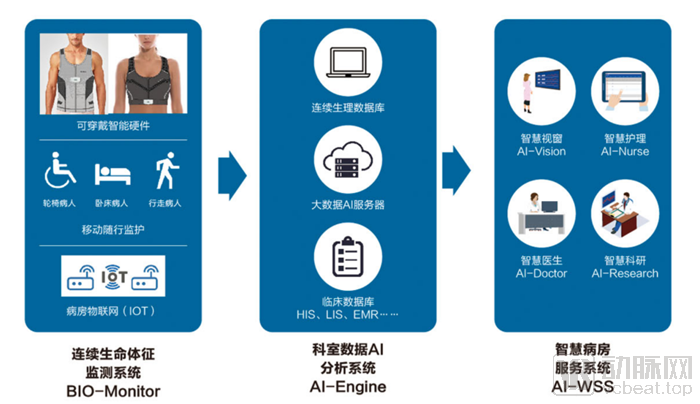
SensEcho Smart Ward Core System (Image from the company)
SensEcho Cardiopulmonary Rehabilitation Support System:This is a real-time analysis system designed to provide cardiopulmonary function assessment, rehabilitation training guidance, and quantitative evaluation of rehabilitation outcomes for patients with cardiopulmonary diseases. By leveraging technologies such as wearable sensing devices, the Internet of Things (IoT), and data visualization, the system enables real-time monitoring of key cardiopulmonary physiological parameters, risk early warning, outcome evaluation, and personalized longitudinal comparison during cardiopulmonary rehabilitation training. It provides medical professionals with objective evaluation metrics and quantitative analytical tools, thereby integrating the entire data chain of rehabilitation treatment and achieving full-cycle management of cardiopulmonary rehabilitation patients across pre-hospital, in-hospital, and post-hospital stages.
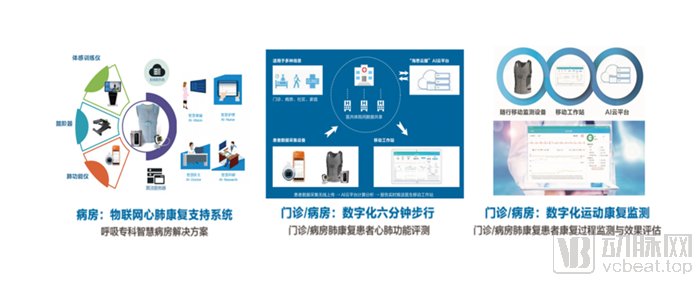
Cardiopulmonary Rehabilitation Support System Product Line(Image from the company)
“Haisi Cloud Service” Big Data AI Analytics Platform:Leveraging a big data architecture underpinned by three core capabilities—mobile data acquisition, clinical data parsing, and platform data services—this platform offers a comprehensive suite of product solutions for patient-centric mobile data collection, data interoperability, big data storage, and in-depth data analytics across both in-hospital and out-of-hospital settings. It provides integrated hardware, software, and computing data value-added services to B2B pharmaceutical and insurance companies, as well as B2C medical and elderly care service providers. Haisirui has expanded its application scenarios from the healthcare sector to select specialized industries, including the military, public security, and supervisory commissions.
From wearable devices to visualization software systems and big data platforms, Haisi Ruige has established a product portfolio based on the “hardware + software + algorithms” model, completing its transformation from a medical device manufacturer to a clinical data analysis platform provider and further to an information technology service provider. Zheng Jiewen stated that Haisi Ruige will expand its market presence across all three product lines, aiming to increase the number of smart ward pilot sites to 10 by 2020 and to roll out its cardiopulmonary rehabilitation system product line to 100 hospitals across China.
In the long term, Haisirui will leverage its accumulated clinical data and algorithms to gradually expand into consumer-facing chronic disease rehabilitation management. Meanwhile, through its interactive data service platform, it will provide integrated “hardware, software, and algorithm” solutions to relevant enterprises, progressively extending its services to pharmaceutical companies, insurers, and other players in the health services sector.
Haisiruige, established in 2014, is a high-tech enterprise specializing in the research and development of medical-grade wearable hardware, Internet of Things (IoT), big data, and artificial intelligence technologies. With independent intellectual property rights and its own brand, the company integrates R&D, production, sales, and services. It primarily provides integrated solutions comprising hardware, software, algorithms, and data services for disease monitoring, assessment, rehabilitation, and management. For hospitalized patients, it offers smart ward solutions to support clinical decision-making. For chronic disease rehabilitation, it provides monitoring, assessment, and rehabilitation methods driven by continuous data. For out-of-hospital patients, it delivers personalized health status monitoring, disease risk prediction, and rehabilitation guidance. For industry applications, it offers an integrated service platform for continuous physiological data acquisition, in-depth data analysis, and data application.
In fact, the Hisugar team began its technological R&D and clinical application research on wearable devices as early as 2010.
Zheng Jiewen, Founder and CEO of Hisignal, holds a Ph.D. in Biomedical Engineering and has previously worked at China’s top military medical research institutions and medical device research organizations. Drawing on more than a decade of research into battlefield injury monitoring, assessment technologies, and equipment within the realm of military health service support, he recognized that human vital signs data hold substantial clinical value. Such data can not only characterize physiological abnormalities in real time but also predict trends in disease progression and health development.
However, the form factor of bedside monitoring devices failed to meet the practical needs of scenarios such as monitoring patients who are ambulatory within the hospital or managing the health of populations outside the hospital setting. Moreover, data utilization was limited to simple alarms and information display. At that time, wearable devices began to emerge in the medical field. Zheng Jiewen became one of the earliest scholars in China to propose applying wearable technology and continuous physiological data analysis to support clinical diagnosis and treatment for general inpatients.
As an “industry veteran” with extensive experience in the full-lifecycle development of large-scale software platforms and team management, co-founder He Maoqing previously served for many years at China’s top military-industrial institutions. The multiple research achievements he led have been widely adopted and have operated stably across numerous military-industrial and authoritative research institutes. He has participated in and witnessed the emergence, construction, and practical implementation of hospital-based Internet of Things (IoT) solutions. Drawing on his years of R&D experience, he has developed unique insights and forward-looking perspectives on unlocking the clinical value of medical big data and advancing medical IoT infrastructure.
Haisirui currently boasts an interdisciplinary professional technical team of nearly 50 members, integrating expertise in science, engineering, and medicine. The company has established close “industry-academia-research” collaborations with leading domestic and international research institutions such as MIT and Harvard. As Scientific Advisor to Haisirui, Peng Zhongkang leverages his position at the international forefront to guide the team in breaking through advanced biomedical signal analysis technologies and to oversee the implementation of a “clinically derived, clinically applied” R&D model.
Peng Zhongkang is an Associate Professor at Harvard Medical School and a world-renowned expert in biomedical engineering. He established the “Theory of Biological System Complexity” and is the pioneer of internationally recognized techniques such as Detrended Fluctuation Analysis (DFA) and Multiscale Entropy (MSE). More than 150 of his academic papers have been published in prestigious international journals, accumulating over 25,000 citations.
Since its inception, Haisi Ruige has raised over RMB 40 million in financing, achieving a valuation of RMB 210 million, and was ranked among the Top 100 on the China Digital Healthcare List, a sub-list of the 2019 Future Healthcare 100. It is reported that Haisi Ruige will launch its third round of financing in 2020. Interested institutions may contact the financing assistant, Xiao Yun, at: DongMai_Investent.