

Genmab Reports 77.4% Revenue Surge Driven by Antibody Pipeline; Expands R&D Through Strategic Collaborations and Proprietary Platforms

Genmab
Differentiated Antibody Therapy Developer
Recently, the Danish listed company Genmab released its 2019 annual financial report. In 2019, Genmab achieved revenue of DKK 5.366 billion (approximately USD 792 million), representing a year-on-year increase of 77.4% compared to 2018 (DKK 3.025 billion, approximately USD 447 million). The revenue growth was primarily driven by its core co-developed pipeline products: ofatumumab (Arzerra, with net sales of USD 17 million in the U.S. market in 2019) and DARZALEX (with net sales of USD 2.998 billion in the U.S. market in 2019).
Genmab was founded in February 1999 and is headquartered in Copenhagen, Denmark, focusing on the research and development of innovative antibody drugs for cancer. One year after its establishment, the company rapidly secured nearly $50 million in financing. In 2000, Genmab went public in Copenhagen and Frankfurt, raising DKK 1.56 billion (approximately $226 million) through its IPO, which set a record for European biotechnology companies at the time. In July 2019, Genmab listed on the Nasdaq, raising $505.9 million in its IPO. Currently, Genmab has three collaboratively developed pipelines on the market, with a market capitalization of $14.8 billion, making it one of Europe’s leading biotechnology companies.
Genmab was co-founded by Florian Schonharting, Donald Lee Drakeman, and Jan GJ van de Winkel, with Florian serving as the company’s CEO and Winkel as its CSO. Genmab is a European spin-off of the U.S. biotechnology company Medarex, retaining Medarex’s antibody business. In 2009, Medarex was acquired by Bristol-Myers Squibb for $3.2 billion; however, this acquisition did not affect Genmab’s independent development.
Collaborative R&D is a common model in cancer drug development, and Genmab is no exception. Under Florian’s leadership, Genmab began extensively seeking partnerships to co-develop its pipeline after going public. In 2002, Genmab announced antibody drug development collaborations with multiple biotechnology companies, including Bionomics, Paradigm Therapeutics, ACE BioScience, Semaia, and JARI Pharmaceutics BV. These collaborations covered pipelines in hematologic malignancies, infectious diseases, and immune-mediated disorders. Pharmaceutical giants such as Roche, Amgen, and GSK (GlaxoSmithKline) also extended partnership offers to Genmab. In 2002, Roche invested $20 million in Genmab, gaining access to its core research platform and clinical development rights for its monoclonal antibody pipeline, including RG1507, a monoclonal antibody for sarcoma and non-small cell lung cancer (this program was discontinued in 2009). In 2003, Amgen partnered with Genmab to jointly develop AMG 714, a monoclonal antibody for the treatment of rheumatoid arthritis.
During this period, Genmab also launched its core antibody drug development platform, Humax-TAC, and the UniBody antibody drug discovery platform. In 2006, Genmab entered into a collaboration with GSK (GlaxoSmithKline) to jointly develop and commercialize ofatumumab (Arzerra), a monoclonal antibody drug based on the UniBody platform.
Under the terms of the agreement, GSK will invest DKK 2.033 billion (approximately USD 357 million) to acquire the global exclusive license from Genmab for ofatumumab and its CD20-targeting antibody therapies. Prior to 2008, Genmab will solely bear the research and development costs for ofatumumab and two other oncology pipeline candidates. Starting in 2008, GSK and Genmab will share the R&D costs equally, with GSK responsible for the manufacturing of ofatumumab and obtaining all commercialization rights.
Despite Genmab’s robust pipeline and the initiation of R&D for more than ten candidates in a short period, the company saw little output for several years. This aggressive early-stage pipeline expansion strategy imposed a substantial financial burden on Genmab. Furthermore, financing difficulties intensified in the aftermath of the 2008 financial crisis. Over the decade following 2000, Genmab secured only $23 million in targeted investment from GSK in 2009, with no other significant capital inflows, gradually plunging the company into distress.
It was not until 2010, when co-founder Jan G.J. van de Winkel assumed the role of CEO, that Genmab began to emerge from its financial difficulties. Dr. Winkel brings over 20 years of R&D experience in the antibody field and previously served as Vice President and Scientific Director at Medarex Europe. In contrast to Florian, Dr. Winkel prioritized products over technology per se. He first renegotiated Genmab’s R&D collaboration agreement with GSK for the CD20 monoclonal antibody Arzerra (ofatumumab), reducing the post-launch 50:50 sales profit-sharing ratio. Under the revised terms, GSK assumed responsibility for developing autoimmune disease indications while collaborating with Genmab on oncology indications. As a result, Genmab received a $90 million upfront payment from GSK, alleviating the burden it had previously borne by covering all R&D expenses during the development phase.
In 2014, ofatumumab received FDA approval as a first-line treatment in combination with chlorambucil for patients with chronic lymphocytic leukemia (CLL) who were not suitable for fludarabine-based therapy. Arzerra was approved in Europe as a first-line treatment for CLL in combination with chlorambucil or bendamustine for patients ineligible for fludarabine treatment. Arzerra became Genmab’s first marketed product, which also alleviated the burden for the subsequent development of Darzalex (daratumumab), a blockbuster monoclonal antibody for multiple myeloma. In 2015, Novartis acquired all remaining rights to ofatumumab, including the rights to develop and commercialize potential indications for ofatumumab.
Genmab possesses four antibody drug development platforms: the HuMAb platform for unconjugated antibodies based on UltiMAb, the DuoBody bispecific antibody platform, the HexaBody enhanced antibody platform, and the HexElect hyper-enhanced antibody platform. Furthermore, Genmab has entered into a collaboration with ADC Therapeutics (ADCT) to jointly develop antibody-drug conjugates (ADCs) based on the company’s HuMax-TAC technology.
The HuMAb platform utilizes the UltiMAb transgenic mouse technology to introduce human genes into mice, enabling the direct production of fully human antibodies by the transgenic mice, rather than generating them through genetic engineering techniques. The UltiMAb platform was developed by Medarex and licensed to Genmab. The HuMAb platform facilitates rapid antibody generation and allows for the screening of specific antibodies based on desired binding properties and mechanisms of action. Genmab has extensively optimized this platform to automate antibody generation and HuMAb characterization processes, thereby developing an effective pipeline of antibody-based therapeutics.
The DuoBody platform is designed for the research and development of bispecific antibodies, enabling the rapid and large-scale generation of such molecules. Monoclonal antibodies bind to target molecules via two identical, highly specific binding regions located at the tips of their arms. In bispecific antibodies, these two binding regions are distinct, with each capable of binding to different epitopes on the same antigen. Consequently, compared with monoclonal antibodies, bispecific antibodies can bind more specifically to certain target cells or bridge target cells with human immune cells, thereby facilitating the destruction of the target cells.
HexaBody is a proprietary technology platform independently developed by Genmab, designed to enhance the therapeutic efficacy of antibodies. While antibodies eliminate pathogens and tumor cells through various cytotoxic mechanisms, the HexaBody platform augments their killing capacity without compromising their regular structure or specificity. This technology holds significant potential for antibody enhancement and can be widely applied in the development of antibody-based therapeutics for cancer and infectious diseases.
HexElect Antibody Platform is Genmab’s latest proprietary patented technology, which effectively and selectively targets only cells co-expressing two specific targets by combining two HexaBody molecules. The HexElect platform maximizes therapeutic efficacy while minimizing potential drug toxicity, paving the way for safer and more effective products.
Currently, Genmab is developing approximately 20 pipeline candidates through its four antibody drug development platforms, all of which are in the preclinical stage.
Under the leadership of Dr. Winkel, Genmab has more actively pursued technologies, products, and partnerships in the biopharmaceutical sector. It has established collaborations of varying scales with a diverse range of entities, including biotech startups, biotechnology companies, academic research centers, and blue-chip pharmaceutical companies with strong backgrounds and outstanding performance. Partners include Novartis, Bristol-Myers Squibb, Janssen Pharmaceuticals, ADC Therapeutics, Seattle Genetics, Immatics Biotechnologies GmbH, BliNK Biomedical, Agenus Inc., Humabs BioMed, CureVac AG, Novo Nordisk, and H. Lundbeck A/S.
On one hand, Genmab addresses its technological gaps by securing license-in agreements, while simultaneously leveraging its proprietary platforms to independently develop innovative pipelines. For instance, through its collaboration with Seattle Genetics, Genmab obtained access to antibody-drug conjugate (ADC) technology and will share commercialization rights for the collaborative pipeline with Seattle Genetics. In its partnership with BioNTech, Genmab will pay a $10 million upfront fee; BioNTech will provide patented antibodies targeting key immunomodulatory targets, while Genmab will contribute its DuoBody® technology platform. For jointly developed candidate drugs, development costs and commercialization rights will be shared equally in the future.
On the other hand, Genmab secures R&D and operational funding through license-out deals, while also advancing its pipeline via collaborations. These include HuMax-IL8, co-developed with Bristol Myers Squibb; the JNJ series, jointly developed with Janssen Pharmaceuticals; and ADCT-301, an antibody-drug conjugate (ADC) co-developed with ADC Therapeutics. Genmab is entitled to receive milestone payments and royalties on net sales from these collaborative pipelines. Consequently, in addition to maintaining six in-house drug development pipelines (where it holds over 50% of development and commercialization rights), Genmab has expanded its portfolio to include more than ten additional candidates through co-development, bringing its total pipeline to nearly 20 programs.
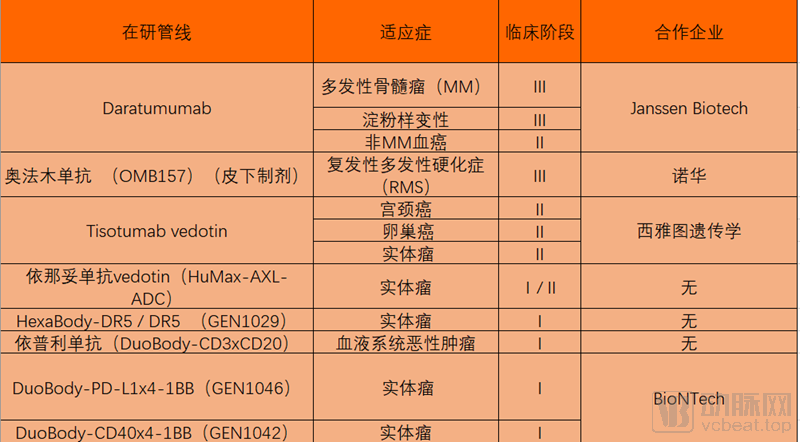
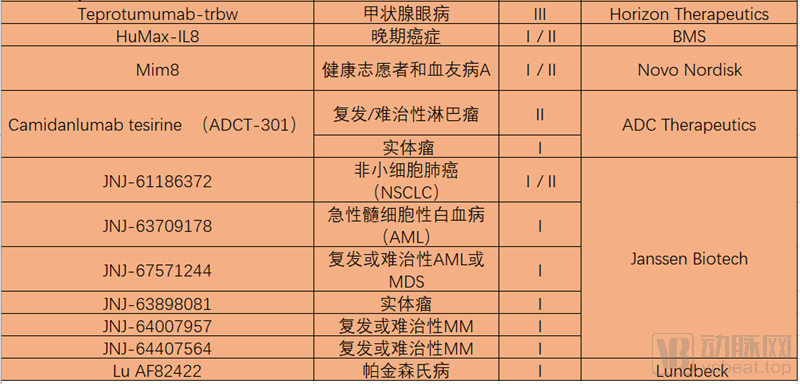
Genmab’s Pipeline
It is worth noting that Genmab also entered into collaborations with CureVac AG and Tempus in 2019. CureVac AG, which specializes in mRNA vaccine development, partnered with Genmab to combine its proprietary mRNA drug development platform with Genmab’s antibody drug development platform. Tempus is dedicated to advancing precision medicine through AI-driven approaches, having built one of the world’s largest cancer databases by integrating genomic data with clinical data. Clearly, Genmab is not content with traditional methods of developing cancer antibody drugs; instead, it is seeking to accelerate antibody drug development by leveraging advanced mRNA therapies and artificial intelligence in healthcare.
Among these, Darzalex (daratumumab), a blockbuster drug developed by Genmab and Janssen Pharmaceuticals of Johnson & Johnson, has had a particularly tumultuous journey. In August 2012, Genmab announced that it had entered into a global licensing and development agreement with Janssen for Darzalex. Under the terms of the agreement, Genmab granted Janssen an exclusive worldwide license to develop and commercialize daratumumab, a humanized CD38 antibody.
In 2015, DARZALEX® received U.S. FDA approval for the treatment of multiple myeloma. In 2016, DARZALEX® was approved by the FDA in combination with lenalidomide and dexamethasone or bortezomib and dexamethasone for the treatment of patients with multiple myeloma who have received at least one prior therapy.
In 2017, Japan’s Ministry of Health, Labour and Welfare approved DARZALEX (daratumumab) for use in combination with lenalidomide and dexamethasone or with bortezomib and dexamethasone for the treatment of adults with relapsed or refractory multiple myeloma. Since its market launch, Darzalex has been widely adopted in the first-line treatment setting, driving a surge in sales, with global revenue reaching $2.025 billion in 2018.
The good times did not last. In 2016, MorphoSys filed a lawsuit against Genmab and Janssen, alleging that Darzalex infringed its patents covering antibodies with certain characteristics targeting CD38. Given that Darzalex had been approved and launched in the U.S. market, and considering that MorphoSys had already filed patents for antibodies with certain characteristics targeting CD38 as early as 2005, the company believed that the sale of Darzalex in the United States would infringe upon its patent rights.
Patent disputes in biopharmaceutical companies often lead to substantial compensation claims, causing Genmab’s stock price to plummet by more than 10%. Although a district court ruled MorphoSys’s patent lawsuit invalid, MorphoSys delayed reaching a settlement with Genmab, keeping Genmab at the center of the controversy until a settlement was finally reached among all parties in January 2019. In July 2019, Genmab successfully listed on the NASDAQ.
In 2020, TEPEZZA (teprotumumab) received FDA approval for the treatment of thyroid eye disease (TED), becoming Genmab’s third marketed product. The drug was initially co-developed by Genmab and Roche. In 2012, River Vision Development Corporation obtained the rights to develop and commercialize the drug. In 2017, Horizon acquired River Vision for $145 million and continued the drug’s development. In 2013, teprotumumab was designated by the U.S. FDA as an orphan drug for the treatment of Graves’ ophthalmopathy. Tepezza is currently the first and only FDA-approved medication for the treatment of TED.
Overall, Genmab’s current pipeline portfolio primarily consists of three categories. First, pipelines derived from its four proprietary antibody drug platforms, which are in the preclinical research stage and constitute Genmab’s core competitiveness. Second, pipelines developed through license-in collaborations, where Genmab holds 50% or more of the commercialization rights, serving as a key factor for its future successful monetization. Third, pipelines developed through license-out collaborations, in which Genmab retains limited ownership interests, being eligible only for milestone payments and royalties on net sales after market launch.
It is evident that Genmab advances the development of its core pipeline and mitigates R&D risks through a diversified research and development strategy. Its three marketed products—ofatumumab, Darzalex, and TEPEZZA—were all developed through license-out collaborations. Leveraging this approach, Genmab successfully listed on the NASDAQ and allocated the proceeds from its initial public offering (IPO) to the development of its core pipeline. This represents an innovative R&D strategy, and it remains to be seen how far Genmab can go in the future, which continues to warrant our anticipation.