

JAMA Study Reveals Post-Discharge RT-PCR Positivity in Recovered COVID-19 Patients, Highlighting Viral Complexity and Need for Enhanced Follow-Up Protocols

Infervision
Artificial Intelligence Product Developer
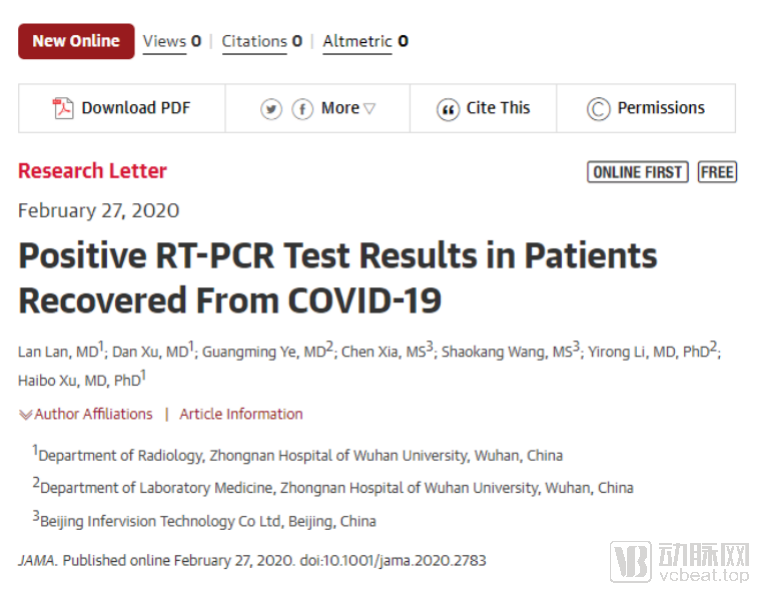
On February 26 (Beijing time), the Journal of the American Medical Association (JAMA), a top-tier medical academic journal, published research findings from a team led by Professor Xu Haibo, Director of the Department of Radiology at Zhongnan Hospital of Wuhan University, in collaboration with the medical AI company Infervision. The study confirmed that four patients with COVID-19 tested positive for SARS-CoV-2 via PCR nucleic acid testing 5–13 days after hospital discharge. Over the subsequent 3–5 days, the research team conducted repeated PCR nucleic acid tests on these four patients using kits from different manufacturers, and all results remained positive.
In this study, the four tracked patients were all infected healthcare workers who maintained strict home isolation after discharge; no secondary transmissions occurred following their release from the hospital.

As of February 28, Hubei Province was reporting more than 2,000 newly recovered COVID-19 patients per day. To date, the cumulative number of recovered patients in Hubei has exceeded 23,000, while the national cumulative total has surpassed 32,000. When adding the more than 40,000 currently active confirmed cases across China, the total number of cases exceeds 70,000. Among this large population of recovered individuals, how many will experience a return to positive test results after discharge, as reported in the JAMA paper? Will they remain infectious? These are questions of significant public concern and pose new challenges for epidemic prevention and control.
In fact, there have been related reports from various regions: for instance, a patient in Shandong was discharged on February 1 and tested positive again for PCR nucleic acid upon follow-up examination 10 days later. Another patient in Sichuan was discharged on February 10 and also tested positive for PCR nucleic acid nine days later. On February 27, Academician Zhong Nanshan also pointed out that the most critical issue regarding these patients who tested positive again after discharge is whether they are contagious to others, which requires further observation.
After more than a month of intensive nationwide efforts, the COVID-19 outbreak has been significantly contained. Daily new cases have plummeted, with many regions reporting zero new infections, while the number of recovered patients has continued to rise. However, have these recovered patients truly lost their infectiousness? How should this increasingly large population of recovered individuals be managed and monitored to prevent reinfection and a resurgence of viral transmission?
In the Post-Pandemic Era, It Cannot Be Ignored.
Notably, the “Diagnosis and Treatment Protocol for Novel Coronavirus Pneumonia (Trial Version 6)” (hereinafter referred to as “Protocol Version 6”), issued by the National Health Commission on February 19, added a new section on “Precautions After Discharge” compared with Version 5. It requires that information on discharged patients be shared with local and primary healthcare institutions, recommends 14 days of home isolation, and schedules follow-up visits at 2 and 4 weeks after discharge. The JAMA article pointed out that the discharge criteria and post-discharge management for COVID-19 patients (as outlined in Version 5) may need to be re-evaluated, which is fully consistent with the latest clinical guidelines.
It is foreseeable that as the number of discharged COVID-19 patients continues to rise, primary healthcare institutions will face increasing pressure in monitoring and managing these patients, posing a significant challenge to grassroots hospitals. They must be capable of timely and accurate monitoring, follow-up, and response to the actual conditions of patients, even under constraints of limited resources and experience, and may need to handle emergency situations.
As we know, the current epidemic has spurred the rapid growth of industries such as “cloud-based remote work” and “online education.” In fact, the ability of internet and cloud technologies to transcend physical distances can deliver even greater value in epidemic monitoring and prevention. For instance, cloud computing and artificial intelligence can be leveraged to rapidly empower primary healthcare institutions, enabling timely collection and upload of patient follow-up data, electronic health record management, and intelligent monitoring with early warning capabilities. This is particularly important because patients who test positive for SARS-CoV-2 via PCR after discharge pose a certain risk of further disease transmission. Once again, technological forces such as cloud computing and artificial intelligence are set to play a pivotal role.
Professor Xu Haibo, Director of the Department of Radiology at Zhongnan Hospital of Wuhan University and corresponding author of the paper, has pointed out that CT is a large, stable medical device. It is faster and more accurate, with simple operation that is less susceptible to variations in manual handling, thus offering relatively greater stability. In contrast, viral nucleic acid testing is influenced by multiple factors, such as the sample volume collected during manual sampling and the detection sensitivity of the test kits used for nucleic acid assay.
In fact, the two detection methods are not mutually exclusive. As the gold standard for diagnosing COVID-19, nucleic acid testing plays an irreplaceable role. However, in early screening, CT scans offer timeliness and stability that nucleic acid testing cannot match. Director Xu Haibo revealed that in current clinical practice in Wuhan, patients who test positive for COVID-19 on CT but negative on nucleic acid tests are also placed in isolation for treatment. It is precisely because CT can provide rapid and stable results that it buys valuable time for epidemic prevention and control. If nucleic acid test results were used as the sole criterion for isolation, the slow turnaround time, coupled with the possibility of multiple negative results before a positive one appears, could easily lead to the spread of the epidemic.
In the Sixth Edition of the Diagnosis and Treatment Protocol, quantitative progression on imaging has been incorporated as a criterion for identifying severe cases. The advent of AI has made quantitative analysis of CT images simpler and faster. Director Xu Haibo believes that the description in the discharge criteria of the Sixth Edition—“significant improvement in acute exudative lesions on pulmonary imaging”—remains somewhat vague. If this were replaced with more precise quantitative descriptors, it might refine the discharge criteria and reduce the number of patients who test positive again after discharge.
In the battle against this epidemic, another key player is artificial intelligence (AI). Taking InferRead, the intelligent AI-assisted screening and epidemic monitoring system for pneumonia pioneered by Infervision at the outset of the outbreak, as an example, this AI product not only assists physicians in rapidly identifying pneumonia lesions on CT images but also performs quantitative intelligent analysis of various data parameters, such as lesion volume and density, thereby helping clinicians assess disease progression and treatment efficacy.
At a time when a large number of COVID-19 patients have been cured and discharged but still require close monitoring, CT, as a simple and rapid diagnostic tool, continues to play a vital role. Augmented by AI-enabled intelligent monitoring, early warning systems, and smart data analytics, along with cloud-based data sharing and real-time connectivity, the “CT + AI + Cloud” model will become the optimal approach for the follow-up, tracking, management, and monitoring of COVID-19 patients in the post-pandemic era.