

Yuanxin Rehabilitation Files IPO Prospectus to Advance China's Integrated Rehabilitation Healthcare System
Rehabilitation medicine is one of the four internationally recognized branches of medicine (preventive, clinical, rehabilitation, and healthcare). In China, due to various reasons, rehabilitation medicine has not been fully recognized, resulting in a relatively slow development of the domestic rehabilitation industry.
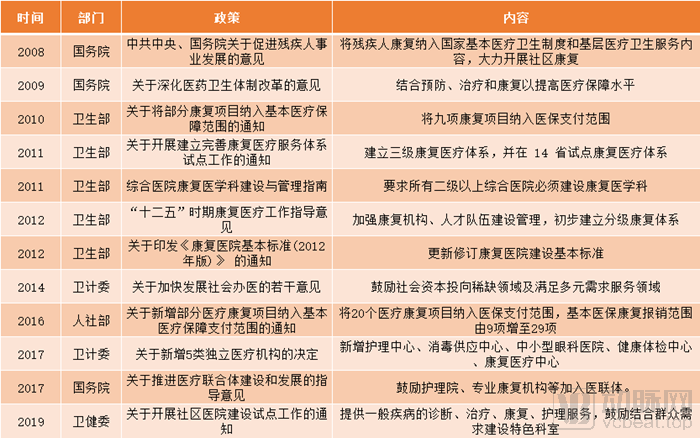
Key Rehabilitation Policy Documents in Recent Years (Source: Compiled by VCBeat from Publicly Available Data)
In recent years, guided by national policies, the rehabilitation medical industry has received increasing attention from all sectors of society, attracting investors, entrepreneurs, and researchers to enter the field. The influx of these stakeholders has also driven the domestic rehabilitation medical industry from its initial promotion phase toward deeper development in a period of standardized regulation.
According to forecasts by relevant institutions, based on short- to medium-term market capacity estimates and the level required to basically meet China’s rehabilitation needs, the industry’s current compound annual growth rate (CAGR) is no less than 18%. It is projected that by 2022, the scale of China’s rehabilitation medical industry will reach RMB 103.3 billion.
Currently, China has gradually established a three-tier rehabilitation service system covering rehabilitation departments in general hospitals, specialized rehabilitation hospitals, and rehabilitation medical centers/home-based rehabilitation. However, due to the shortage of rehabilitation professionals, the lack of norms and standards, regional disparities, and patients’ limited knowledge of self-rehabilitation, this system largely remains at the policy level.
Against this backdrop, in 2016, Yuanxin Group entered the rehabilitation industry by undertaking the “Chinese Rehabilitation Medicine Standards” research project of the Traditional Chinese Medicine Rehabilitation Research Center under the National Administration of Traditional Chinese Medicine. Committed to integrating superior resources both within and outside the industry, Yuanxin Group aims to establish itself as a leading health platform enterprise centered on precision rehabilitation. By providing rehabilitation medical technology services to G-end (government), B-end (hospitals, communities, and other institutions), and C-end (patients/users), it promotes the development and implementation of China’s rehabilitation medical service system.
Yuanxin Builds a Comprehensive Rehabilitation Service System
How to achieve comprehensive rehabilitation? How can patients at different stages achieve effective coordination? How can "tiered diagnosis and treatment" be implemented in the field of rehabilitation? How can the rehabilitation service system be streamlined?
To address these issues, Yuanxin leverages its talent and technological advantages to enter the rehabilitation market by providing solutions for rehabilitation departments and hospitals, thereby facilitating effective collaboration among government (G), business (B), and consumer (C) stakeholders.
Yuanxin has developed a targeted product suite, “One Platform, Two Systems,” tailored to the characteristics of medical institutions such as rehabilitation departments in general hospitals, specialized rehabilitation hospitals, and community hospitals. This suite comprises the Rehabilitation Clinical Medical Technology Service Platform, the Rehabilitation Tiered Diagnosis and Treatment System, and the Primary Care (Community) Intelligent Rehabilitation Service System.
Yuanxin establishes long-term partnerships with medical institutions to help rehabilitation departments in general hospitals and specialized rehabilitation hospitals build an integrated clinical management system encompassing assessment, treatment, protocol development, and case management. This includes establishing a comprehensive, precise, and visualized analytical framework as well as an efficient and convenient operational control system. Additionally, Yuanxin assists community healthcare providers in building their capacity to deliver basic rehabilitation services—such as assessment, appointment scheduling, rehabilitation guidance, and referral coordination—thereby addressing their shortcomings in technology and talent.
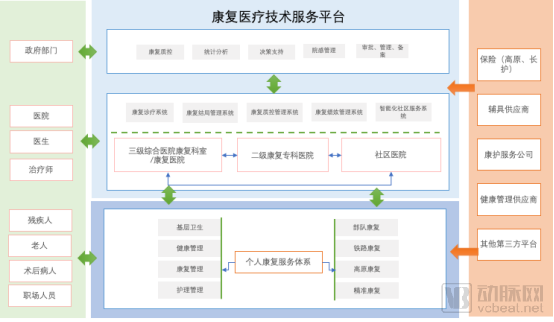
Yuanxin Rehabilitation Medical Technology Service Platform (Source: Provided by the company)
In terms of overall architecture, Yuanxin aims to build a regional rehabilitation service system. By collaborating with relevant government departments in various regions, it incorporates medical technology standards, expert resource allocation, tiered diagnosis and treatment management, as well as government-assisted and safety decision-making into the entire system. This is achieved through establishing unified rehabilitation standards and specifications, standardized rehabilitation information protocols, long-term and convenient assistance channels, vertically integrated rehabilitation scenarios, and an effective quality control and supervision system. These efforts ensure the gradual construction of a rehabilitation medical service system that is rationally laid out, clearly stratified, functionally comprehensive, and highly efficient, based on the integration of high-quality medical resources and the strengthening of primary-level rehabilitation service capabilities.
For example, the Beijing Primary Rehabilitation Medical Service Information Platform project, which Yuanxin participated in planning, designing, and constructing, was led by Beijing Xiaotangshan Hospital in collaboration with 19 secondary hospitals and community hospitals across various districts and counties of Beijing to promote the development of a regional rehabilitation service system. Leveraging the expertise of specialists from rehabilitation hospitals to support primary care institutions, Yuanxin provided an integrated suite of standardized rehabilitation medical technology services, including online and offline training, clinical rehabilitation operations, intelligent primary rehabilitation services, tiered diagnosis and treatment services, home-based rehabilitation services, and rehabilitation quality control management.
On the patient side, Yuanxin has developed a personal home-based rehabilitation and health management system for patients. This ensures that patients can access timely, systematic, and continuous services—including prevention, treatment, rehabilitation, nursing care, and health promotion—outside the hospital setting through the use of a mobile app.
In summary, through its comprehensive product portfolio, Yuanxin has established quality control and regulatory oversight channels connecting governments, hospitals, and patients; enabled interoperability among tertiary, secondary, and community hospitals; and integrated service pathways spanning institutions, communities, and home care. This creates a closed-loop rehabilitation service ecosystem with a complete service chain across various application scenarios.
Industry-Academia-Research Integration Services: Facilitating the Implementation of Research Projects
In addition to providing patient care, healthcare institutions are also responsible for medical research, education and training, and preventive health services. Scientific research is a crucial pathway for advancing the overall technical standards of the healthcare industry. It helps healthcare institutions and medical professionals continuously improve the quality of care, service delivery, and clinical expertise. Furthermore, it serves as an effective mechanism for strengthening medical disciplines and cultivating high-caliber medical talent. The synergistic integration of research and education—where research informs teaching and teaching promotes research—is of significant importance in enhancing the academic standing and influence of hospitals and physicians within the industry.
However, rehabilitation medicine in China remains in its early stages of development, with relatively weak capabilities in scientific research, education, and clinical practice. To address this issue, Yuanxin leverages its strong integration capabilities across industry, academia, research, and application to combine specialized knowledge in rehabilitation medicine with cutting-edge technologies such as big data, artificial intelligence, and virtual reality. By establishing information platforms and specialized databases, the company enables data collection, organization, analysis, and comparison, thereby achieving breakthroughs in rehabilitation assessment, formulation of rehabilitation plans, and diagnostic and therapeutic techniques, while launching scientific research and innovation initiatives focused on single or multiple disease types.
When these validated innovations are reapplied in clinical settings, they can significantly enhance the efficacy of rehabilitation treatments, improve the quality of rehabilitation services, and reduce the learning curve for rehabilitation medical technologies. This helps hospitals achieve cost reduction and efficiency gains, thereby securing both social and economic benefits.
For example, through research projects such as “AI-Driven Decision-Making for Pre-hospital Transfer and Early Rehabilitation in Acute Stroke,” “Clinical Application of Integrated Traditional Chinese and Western Medicine in Cerebral Infarction, a Major National Disease,” and “Research and Demonstration of Home-Based Rehabilitation Techniques for Common Chronic Diseases among the Elderly Guided by Individualized Exercise Prescriptions,” Yuan Xindu has established in-depth collaborations with relevant medical institutions, universities, and research institutes.
Meanwhile, by supporting various research projects, government departments can aggregate and analyze extensive data from these initiatives to provide data-driven support for policy formulation and implementation. Additionally, they can identify medical technologies that demonstrate significant efficacy, are easily scalable, highly targeted, and technologically advanced, thereby facilitating their widespread adoption across healthcare institutions at all levels.
It is reported that Yuanxin has established a renowned expert advisory team, including experts such as Chen Lidian, Jin Rongjiang, and Wu Liang, as well as an expert committee composed of nearly 100 distinguished experts. Additionally, more than 100 experts holding senior positions (such as vice chairpersons or above) in various provincial-level academic societies have joined the initiative. These experts will provide robust intellectual support and capacity building in policy research, project-based studies, and the translation of research outcomes into practical applications.
Looking ahead, Yuanxin will continue to integrate departmental construction and operations, rehabilitation robotics, the Internet of Things (IoT) for rehabilitation, and telerehabilitation into the development of its rehabilitation medical service system. By continuously consolidating and enhancing the service offerings of this system, Yuanxin aims to establish a distinctive “four-in-one” business model encompassing basic public health, rehabilitation, personal health management, and nursing care, thereby contributing to the growth and advancement of China’s rehabilitation healthcare sector.