

Tencent's Healthcare Ambition: Building a Connected, AI-Driven Medical Ecosystem
In mid-January 2020, in San Francisco, USA, Neil Shen, Global Executive Partner at Sequoia Capital, engaged in a dialogue with Robert Nelsen, Co-Founder of Arch Venture Partners, at a healthcare summit.
“Amazon, Walmart, Google, Alibaba, Tencent... these giants will all become some type of healthcare company in the future,” said Robert Nelsen.
Investors have a keen eye. Indeed, the BAT trio—Baidu, Alibaba, and Tencent—has been highly active in the healthcare sector in recent years. Baidu focuses on data, Alibaba on operations, and Tencent on connectivity; each has long been strategically positioning itself within the healthcare landscape.
On January 26, during the COVID-19 pandemic, Tencent officially launched the Medical Health module on the WeChat Pay page (commonly known as the “WeChat Nine-Grid”), bringing its vision of providing medical services to over 1 billion users closer to reality.
After reviewing Tencent’s invested, self-developed, and partnered enterprises and products, VCBeat has found that, leveraging its social platforms such as WeChat and QQ, and supported by technologies including AI, big data, and cloud computing, Tencent has built a vast healthcare empire encompassing medical services, hospital management, health insurance, and pharmaceutical R&D and distribution.
A Tencent-style healthcare dream is gradually becoming a reality in China.
In the early stages of Tencent’s entry into the healthcare and medical industry, it primarily appeared as an investor in large-scale financing rounds within the sector.
Leading a RMB 1 billion investment in Waterdrop’s Series C financing, leading a RMB 1 billion investment in Simpai Group’s Series D+ financing, and leading a USD 200 million investment in Haodf Online’s Series D financing—Tencent has emerged as an investor in dozens of industry unicorns, including Gengmei, DXY, Tisu Technology, Senyi Intelligence, Penguin Almond, Keep, and Miaoshou Doctor.
By analyzing Tencent’s external investment portfolio, it is evident that its investments in the healthcare sector are primarily concentrated in three sub-sectors: medical technology, mobile health, and offline medical services. In the field of medical technology, Tencent has established an industrial chain spanning from data entry points to medical big data integration and finally to technical solutions. The comprehensive coverage of the mobile health niche, combined with offline medical service institutions, provides scenario-based support, thereby creating a closed-loop industry ecosystem that integrates online and offline channels as well as business-to-business (B-end) and consumer-facing (C-end) segments.
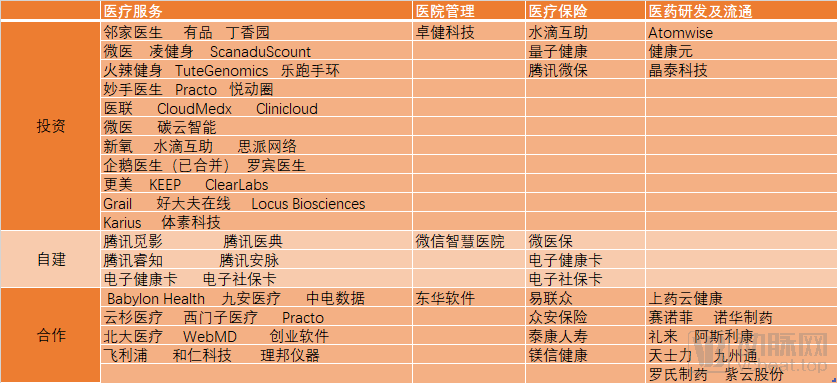
(Tencent's Healthcare Landscape)
In terms of collaboration, Tencent has also been highly active. Late last year, Tencent announced a deep partnership with the multinational pharmaceutical company Sanofi. According to the strategic cooperation memorandum, both parties will focus on key disease areas such as rare diseases, neurological disorders, and diabetes. By deeply integrating the internet and pharmaceutical industries, they aim to meet patients’ needs in early screening and standardized management throughout the entire course of disease through digital solutions.
Furthermore, Tencent has entered into a series of collaborations with renowned institutions and enterprises, including Philips, the Statistical Information Center of the National Health Commission, Novartis, GE Healthcare, and Beijing Hospital. An overview of its partnership landscape reveals that Tencent is cooperating with medical providers, health insurance entities, pharmaceutical companies, and government bodies across multiple domains. These areas include home healthcare, disease management, pharmaceutical distribution, drug research and development, medical science popularization, and mobile health insurance payments. By integrating resources from the B-side (medical institutions), G-side (government), and C-side (end users), Tencent is continuously strengthening its layout in the healthcare ecosystem.
Beyond investment and collaboration, Tencent has never abandoned its aspiration to act as “a product manager.” In recent years, Tencent’s healthcare business has placed significant emphasis on building in-house capabilities, showing a stronger inclination to leverage its technological and platform advantages to intensify exploration of proprietary business models.
Tencent’s healthcare business can be divided into B-side services supported by the internet and C-side services focused on resident health through Tencent Medical Encyclopedia. Artificial intelligence runs through both sectors, simultaneously driving improvements in medical processes. In addition to Teng Ai Doctor, Tencent’s online consultation platform that was shut down on March 10, 2019, Tencent’s proprietary healthcare products include WeChat Smart Hospital, the smart hardware product Tang Daifu (Glucose Master), the insurance platform Wei Bao, the medical science popularization platform Tencent Medical Encyclopedia, and the medical AI platform Tencent Miying. Furthermore, Tencent has proposed building a “triangular security defense system” integrating data, products, and services for the healthcare industry, based on its cybersecurity risk monitoring and quantitative assessment system—Tencent Anmai, to help enhance efficiency and quality in the medical and health sector.
The concept of the WeChat Smart Hospital can be traced back to 2013. The initial Version 1.0 of the WeChat Smart Hospital leveraged the online capabilities of WeChat Official Accounts, focusing on content, community engagement, official account integration, appointment registration, and the flow of information services. It enabled information queries, basic payments via Official Accounts, and patient data collection, thereby providing hospitals with an on-site service system centered around Official Account content services and essential medical services.
By 2018, WeChat Smart Hospital had been upgraded to version 3.0. Leveraging Mini Programs and Official Accounts as the unified service entry points, it achieved comprehensive implementation of medical insurance, commercial insurance, blockchain technology, and AI within hospitals. This established a core hospital-based service system that refined patient-hospital connectivity, fully integrated medical expense payment channels, enhanced security through blockchain technology and risk-control big data, and upgraded the ecosystem collaboration model with hospitals and core healthcare service providers.
Tencent Medical Encyclopedia is a professional medical science popularization platform under Tencent. By introducing high-quality overseas medical and health content and collaborating with renowned Grade 3A hospitals and experts, it systematically presents scientific knowledge in the medical field in a contextualized and easily understandable manner.
Tencent Miying is Tencent’s first product to apply artificial intelligence technology to the medical field, with its focus divided into AI medical imaging and AI-assisted diagnosis and treatment. Currently, Tencent Miying has enabled the use of AI medical image analysis to assist physicians in screening for diseases such as esophageal cancer, pulmonary nodules, diabetic retinopathy, breast cancer, and glaucoma. It can also leverage an AI-assisted engine to help physicians identify and predict risks for more than 700 diseases.
In 2019, at Tencent’s Global Digital Ecosystem Summit, Ding Ke, Vice President of Tencent, disclosed the progress of the company’s healthcare initiatives: As of May 2019, more than 38,000 medical institutions had established their own Official Accounts or Mini Programs on WeChat, and approximately 110 million users had utilized various healthcare services available on the platform. In terms of patient services, Tencent Medipedia covered 1,000 diseases over the past year; regarding services for physicians and hospitals, AI-based medical imaging solutions had served nearly 1.6 million patients.
Compared with other internet giants, Tencent’s WeChat is transforming from a social tool into a service-oriented platform. This transformation is reflected in the “integration” of various services, with healthcare being a key segment.
At the 2019 World Artificial Intelligence Conference, Ma Huateng publicly revealed that smart healthcare would be Tencent’s future development focus.
During the COVID-19 pandemic, Tencent Healthcare’s capabilities were fully demonstrated; for the company, the outbreak undoubtedly served as a major trial by fire.
In addition to launching the “Medical and Healthcare” service on the WeChat “Pay” page for users across China at the earliest opportunity, Tencent Healthcare has established an online end-to-end decision-making toolkit for individuals to respond to COVID-19. With the support of competent authorities, including the National Health Commission and local health commissions, as well as the Chinese Center for Disease Control and Prevention, it has rolled out a series of features: timely access to authoritative epidemic information (epidemic map, queries for confirmed cases in the same residential community or on the same travel itinerary), science-based guidance on proper prevention, self-assessment tools for suspected symptoms, free online consultations with physicians for professional advice, and a map of fever clinics to facilitate appropriate medical care.
While providing the public with authoritative and timely information on healthcare and epidemics, these features also function like a funnel, breaking down user needs layer by layer. They address milder health concerns through online channels and ultimately guide more severe cases requiring in-person care quickly and precisely to appropriate offline hospitals. This maximizes hospitals’ ability to achieve precise patient intake, conserves medical resources, and improves the efficiency of resource allocation and utilization. Furthermore, this comprehensive integration of online and offline services is effectively combined with WeChat’s social platform, ensuring full and immediate reach to the general population.
Beyond Tencent’s own platforms, including Tencent Health, Tencent Medical Encyclopedia, QQ Browser, Tencent KanDian, and Tencent Video, Tencent Healthcare has joined forces with stakeholders across various sectors to strengthen the joint epidemic response. It provides free, open APIs for a range of epidemic-related service tools, enabling integration by more WeChat Official Accounts, Mini Programs, and mobile apps. Currently, the COVID-19 Service Platform, the Epidemic Toolkit, and other epidemic-related service tools have been integrated into the National Government Service Platform, government departments such as the health commissions and centers for disease control and prevention in 17 provinces across China, as well as the official WeChat Official Accounts and Mini Programs of partners including the Bank of China.
Meanwhile, leveraging its robust capabilities in cloud computing, AI, and big data, Tencent has opened up its technologies to accelerate R&D efforts by scientific research institutions in areas such as viral mutation prediction, antiviral drug screening, and vaccine development, thereby providing strong technical support for the fight against the epidemic.
The following are Tencent’s specific measures to respond to the COVID-19 pandemic:
1. WeChat Launches Medical and Health Services on Its “Pay” Page, Featuring a “COVID-19 Pandemic Zone”
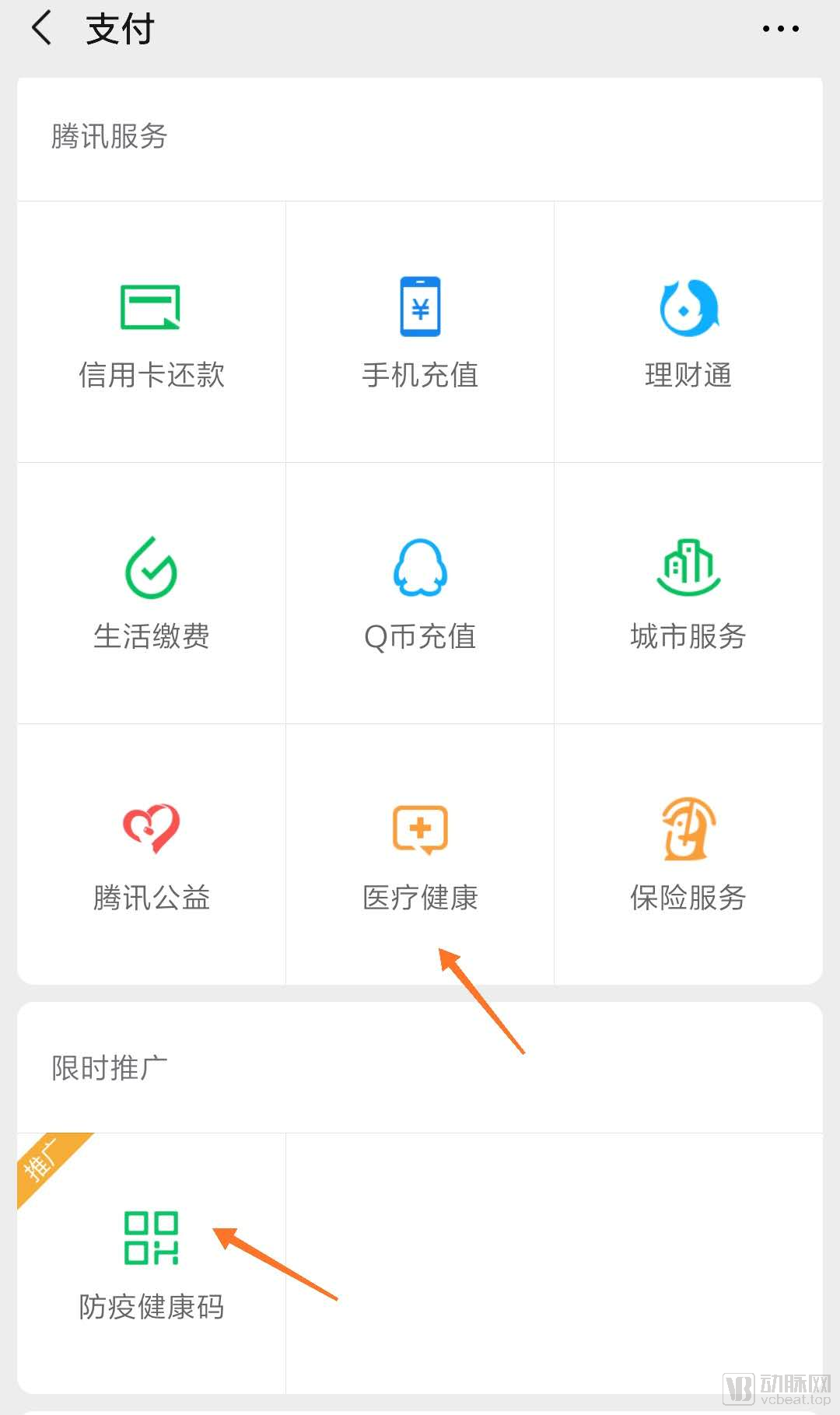
On January 26, Tencent added the “Medical and Healthcare” service to the “Pay” page of WeChat for users across China. Through this entry point, users can access the “Tencent Health” mini-program and enter the “National Novel Coronavirus Pneumonia Epidemic Dynamics” section. This marks one of the few instances where WeChat Pay has rolled out a new Tencent service to its nationwide user base. The “National Novel Coronavirus Pneumonia Epidemic Dynamics” section integrates authoritative medical science popularization, 24-hour real-time epidemic statistics from the National Health Commission, and a map of fever clinics, providing users with timely, accurate, and authoritative epidemic information in a one-stop manner. As the epidemic evolved and user needs grew, the section’s features were continuously enriched, with the successive launch of functions such as self-assessment for fever symptoms, free online consultations, travel companion tracking, an epidemic-affected community map, and guides for reserving face masks. These additions have established a comprehensive online platform for epidemic prevention and control, helping users stay informed about epidemic developments and scientific knowledge, conduct self-assessments and consult with doctors online, and make well-informed decisions throughout the entire process of responding to COVID-19.
As of February 6, the dedicated zone served over ten million users daily, with core service interfaces being called more than one billion times per day.
2. 100 Experts Join Forces to Systematically Disseminate Authoritative Knowledge on COVID-19
Tencent Medical Dictionary leverages an “Internet + Authoritative Experts” model to accelerate the public dissemination of authoritative knowledge on COVID-19, guide individuals in proper health protection, and help mitigate unwarranted panic through a scientific and rational approach. It promptly mobilizes hundreds of experts to popularize medical knowledge about COVID-19 through diverse formats, including articles with illustrations, videos, and live streams. The related knowledge is systematically organized into stages such as prevention guidelines, examination and diagnosis, and treatment advances. Additionally, it features dedicated sections for trending topics, rumor debunking, specialized information for the elderly, children, and pregnant women, and self-assessment tools, enabling users to access targeted disease-related information in a one-stop manner.
Meanwhile, Tencent has leveraged its comprehensive content ecosystem platforms—including WeChat’s Top Stories, QQ Browser, Tencent KanDian, and Tencent News—to reach a vast user base and provide science-based guidance on protective measures. As of February 4, the special section on the novel coronavirus outbreak in Tencent Medical Dictionary had published more than 500 original popular-science articles and rumor-refuting pieces, over 70 educational videos, and four live-streamed educational sessions.
3. Launch of Fever Clinic Map
To help citizens seeking medical care quickly locate the appropriate hospitals, multiple teams within Tencent—including Tencent Health, the WeChat Team, Tencent Maps, and Tencent News—collaborated under the guidance of the Publicity Department of the National Health Commission to obtain first-hand, authoritative outpatient information and rapidly launch the “National Fever Clinic Map.” As of February 4, the map covered 357 cities, providing information on more than 12,000 hospitals, including 11,637 hospitals with fever clinics and 1,960 designated hospitals for medical treatment.
“National Fever Clinic Map” has also been upgraded to version 2.0: In addition to providing “fever self-assessment” and consultation guidelines, it now allows users to view real-time details for selected hospitals, including real-time patient flow data to help identify nearby hospitals with the shortest wait times; it also displays hospital operating hours and dynamic announcements, enabling users to better plan their medical visits.
4. Partnering with Five Major Platforms, 10,000 Doctors Provide Free Online Consultations
On January 30, Tencent joined forces with five major internet healthcare service platforms—WeDoctor, Haodf Online, Penguin Almond, Medlinker, and DXY—to provide free online medical consultations in response to the novel coronavirus (2019-nCoV) outbreak. Together with tens of thousands of licensed physicians from across China, they offered services including home protection guidance, triage recommendations, and psychological counseling, delivering real-time, authoritative online advice to the public and helping to alleviate pressure on offline hospitals.
The online free clinic service platform has launched access points on multiple Tencent-owned platforms, including Tencent Medical Encyclopedia, Tencent Health, QQ Browser, Tencent KanDian, and Tencent Video. It has also been integrated into government-sponsored initiatives such as the “Shen i Nin” mini-program and the “i Shenzhen” app, both hosted by the Shenzhen Municipal Government.
Within 48 hours of its launch, the online free clinic service platform reached one million users across China. The majority of users were from Hubei, Guangdong, and the Jiangsu-Zhejiang-Shanghai region. The most frequently consulted departments were "Respiratory Medicine" and "Infectious Diseases," with inquiries primarily focusing on influenza prevention, common cold, cough, and fever. On the platform, major medical service providers recruited tens of thousands of licensed physicians from across the country via the internet. These doctors provided rapid text-and-image online consultations through WeChat, answering hundreds of thousands of queries in total. This initiative helped reduce the risk of cross-infection associated with inappropriate offline medical visits.
5. Launch of the COVID-19 Symptom Self-Check Tool and Open Access Integration
For users experiencing physical discomfort or who have had contact with confirmed cases, proper self-isolation and seeking medical attention are key to receiving appropriate treatment and preventing the spread of the epidemic. The “AI-Assisted Self-Check Tool for COVID-19 Symptoms” enables users to accurately assess their condition before seeking medical care. Under the guidance of the Chinese Preventive Medicine Association, all AI decision-making logic within the “AI-Assisted Self-Check Tool for COVID-19 Symptoms” has been reviewed by experts to ensure the reliability of AI-assisted judgments. Meanwhile, experts will also participate in AI data annotation to improve the accuracy of AI-assisted assessments.
Furthermore, the “Fever Self-Check” tool has also released open access guidelines to facilitate local health commissions, hospitals, and various information service providers in offering intelligent self-check services to a broader user base through convenient channels such as WeChat Official Accounts and mini-programs, thereby helping to reduce the risk of cross-infection caused by inappropriate medical consultations.
6. Tencent Opens Up “Epidemic Prevention Toolbox” for Integration via Official Accounts, Mini Programs, and Apps
In response to the severe situation of COVID-19 prevention and control, Tencent Health and the Tencent Medical Encyclopedia mini-program have launched a specialized “Epidemic Prevention Toolkit” feature, which supports open access for various official accounts, mini-programs, and apps.
This “epidemic toolkit” includes fever clinics, an epidemic map, self-assessment for COVID-19 symptoms, identification of patients in the same residential community, tracking of patients with overlapping travel itineraries, mask-wearing guidelines, and an intelligent Q&A system on epidemic-related knowledge.
7. Launched the “COVID-19 Pandemic Service Platform” to support health commissions at all levels in launching online pandemic prevention and control services
To comprehensively support governments and medical institutions in strengthening epidemic prevention and control, Tencent has launched the “COVID-19 Epidemic Service Platform.” This platform provides an aggregated suite of epidemic-related services to health commissions at provincial and municipal levels, district and county health bureaus, centers for disease control and prevention, and medical institutions across China, enabling rapid integration with WeChat Official Accounts, Mini Programs, and mobile apps.
“COVID-19 Epidemic Service Platform” is a localized, comprehensive solution for epidemic prevention and control, designed for healthcare administrative agencies across various regions. The platform rapidly adapts to local epidemic prevention services and medical resources while integrating Tencent’s service capabilities. It provides the public with three core epidemic service tools: authoritative epidemic information release, online epidemic consultation, and intelligent convenience services. Specific features include: official local epidemic information releases, real-time local epidemic updates, navigation maps for local designated (fever) outpatient clinics, online consultation for fever symptoms at local hospitals, local proactive reporting and provision of epidemic clues, national epidemic trends, COVID-19 science popularization, epidemic rumor refutation, an intelligent epidemic assistant, self-check for fever symptoms, and an online free clinic platform.
Currently, outside of Tencent’s own platforms, the “Tencent COVID-19 Service Platform” and various epidemic-related service tools have served health commissions and centers for disease control and prevention in over 40 agencies across 17 provinces and municipalities, including Hubei, Guangdong, Beijing, Hunan, Shaanxi, Shandong, Henan, Hebei, Jiangsu, Anhui, Jiangxi, Jilin, Liaoning, Heilongjiang, Inner Mongolia, and Qinghai. The public can access the dedicated COVID-19 information sections through corresponding WeChat Official Accounts and Mini Programs.
This outbreak has undoubtedly placed the healthcare industry in the spotlight, amplifying public anxiety and concern over the scarcity of medical resources. On the other hand, in the aftermath of the pandemic, online demand for healthcare services is poised to surge further. Both user habits and market acceptance have reached a new level, indicating that there remains substantial room for the internet to transform and empower the healthcare sector.
According to data from the National Bureau of Statistics, China's total population reached 1.40005 billion by the end of 2019, among which the population aged 60 and above was 253.88 million, accounting for 18.1% of the national total. China has already entered an aging society, indicating that the health industry will undoubtedly become a vast market in the future, with its scale projected to exceed RMB 16 trillion by 2030.
Nevertheless, as one entrepreneur put it, “All companies in the internet healthcare sector, regardless of size, are still in the early stages of this market.”
The Ship Has Been Launched: Tencent’s Healthcare Dreams Are Setting Sail.