

UBTECH Deploys AI-Powered Robots in Shenzhen Hospitals, Set to Export Smart Epidemic Prevention Solutions Overseas
The capabilities of robots were put to practical use in the prevention and control of the COVID-19 pandemic. Some hovered over major traffic arteries, serving as capable assistants to traffic police; others operated around the clock in hospital corridors, performing repetitive tasks such as disinfection, sterilization, and logistics transport. In hospital lobbies, triage robots handled temperature screening and patient guidance. Throughout the fight against the epidemic, robots were deployed across a wide range of scenarios, including epidemic prevention, disinfection, logistics, and patrol.
The surge in the robotics industry during this outbreak has also demonstrated that the value of robots extends beyond merely reducing human labor intensity; they constitute a critical infrastructure for the automation and intelligent development of public health systems.
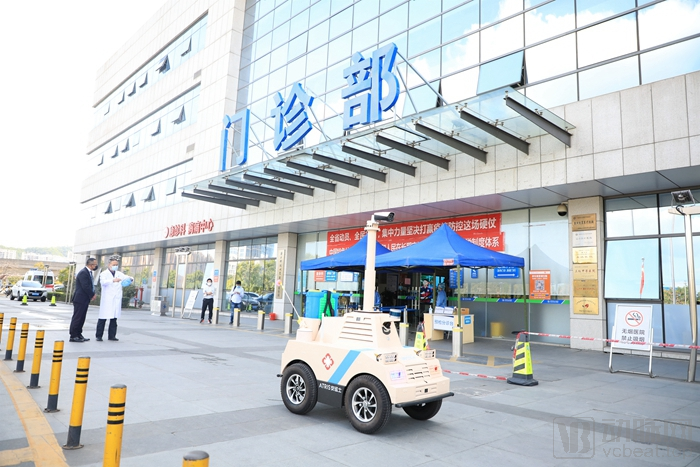
Shenzhen Third People’s Hospital, also known as Shenzhen’s “Xiaotangshan” Hospital, has deployed indoor epidemic prevention robots AIMBOT (Zhi Xun Shi), outdoor epidemic prevention robots ATRIS (An Xun Shi), and medical consultation robots Cruzr from UBTECH Robotics, Inc. in its halls and surrounding areas. These robots are on duty at the fever clinic, general outpatient clinic, outpatient department, and inpatient department, respectively.
UBTECH’s epidemic prevention robots, powered by a backend AI platform, enable unified scheduling, efficient coordination, and centralized feedback to deliver services such as indoor temperature monitoring and disinfection, outdoor epidemic control and disinfection, as well as health education and patient guidance, thereby safeguarding the health and safety of frontline healthcare workers with AI.
As a global leader in artificial intelligence and humanoid robotics, UBTECH Robotics was founded in March 2012. The company provides industry-specific solutions across sectors such as AI education, smart retail, smart industrial parks, smart healthcare, and campus security. Currently, UBTECH operates five research institutes worldwide and launched ROSA, the world’s first large-scale commercially deployed service robot operating system, in 2018. UBTECH has established strategic partnerships with international giants including Amazon, Tencent, Disney, Apple, and iFlytek, and has jointly set up research laboratories with prestigious universities such as Tsinghua University, Huazhong University of Science and Technology, and the University of Sydney.
How AI-Driven Robots Are Making an Impact in Healthcare Settings: VCBeat (WeChat ID: vcbeat) Interviews Wang Yong, Vice President and Advisor to the CEO of UBTECH Robotics.
After February 20, 2020, as the epidemic prevention and control situation grew increasingly tense, UBTECH Robotics immediately established an emergency technical task force. Initially, UBTECH’s R&D personnel went to Shenzhen Third People’s Hospital to investigate the practical needs for epidemic prevention and control. As the only designated hospital in Shenzhen for treating patients with COVID-19, it admitted more than 400 COVID-19 patients at its peak during the most critical period, while also handling a significant volume of patients in its general outpatient clinics.
UBTECH Robotics has observed that the high density of foot traffic in hospitals has further intensified the challenges of temperature screening at entrances and exits, as well as providing informational consultations. Traditional methods—such as one-on-one manual temperature checks, dedicated staff for inquiries, and personnel-conducted disinfection—are not only inefficient but also increase the risk of infection for frontline healthcare workers.
After gaining a clear understanding of the frontline epidemic prevention needs in hospitals, UBTECH Robotics commenced intensive research and development efforts. In the initial phase of the project, due to restrictions imposed by pandemic control measures, samples of certain components were completely unavailable; consequently, the UBTECH technical team proceeded with design work based solely on drawings and specifications.
“The fight against the epidemic has entered a critical phase, undoubtedly presenting us with heavy responsibilities and tight deadlines. It would be unrealistic to claim that we encountered no difficulties; however, no member of our team ever considered backing down. A strong sense of mission united us all, working day and night, ultimately enabling us to deliver the project within an exceptionally short timeframe.”
For the essential infrared temperature measurement function in epidemic prevention and control, UBTECH’s epidemic prevention robots utilize dual-camera systems combining infrared and visible light, integrated with AI analysis, to instantly identify anomalies in mask wearing and abnormal body temperatures across the entire field of view for multiple individuals. When calibrated with a blackbody reference source, the temperature measurement deviation is ≤±0.3°C, meeting the national standards for epidemic prevention temperature screening equipment, with a measurement efficiency of up to 200 people per minute.
In terms of environmental disinfection, leveraging UBTECH Robotics’ self-developed U-SLAM 3D navigation and obstacle avoidance system, the UBTECH smart epidemic prevention robot can perform comprehensive, scheduled disinfection operations in designated areas at fixed times and locations, and is capable of operating 24/7.
In less than 20 days, UBTECH Robotics leveraged the “Shenzhen Speed” to complete the entire process from R&D and deployment to implementation at Shenzhen Third People’s Hospital, establishing a comprehensive, full-cycle epidemic prevention service system for the hospital.
Specifically, the AIMBOT indoor epidemic prevention robot, the ATRIS outdoor epidemic prevention robot, and the Cruzr medical consultation robot are deployed at fever clinics, general outpatient clinics, and the perimeters of outpatient and inpatient departments, respectively.
In key indoor scenarios such as fever clinics, the indoor epidemic prevention robot AIMBOT (Zhi Xunshi) can perform tasks including abnormal temperature monitoring, mask-wearing detection, crowd density monitoring, epidemic prevention announcements, and environmental disinfection and sterilization.
Around the perimeters of outpatient and inpatient departments, the outdoor epidemic prevention robot ATRIS (Anxunshi) integrates security patrol and epidemic control capabilities. It enables rapid mobile deployment and patrol operations in outdoor environments, providing functions such as body temperature measurement, mask detection, environmental disinfection, and remote intercom, thereby assisting staff in epidemic management.
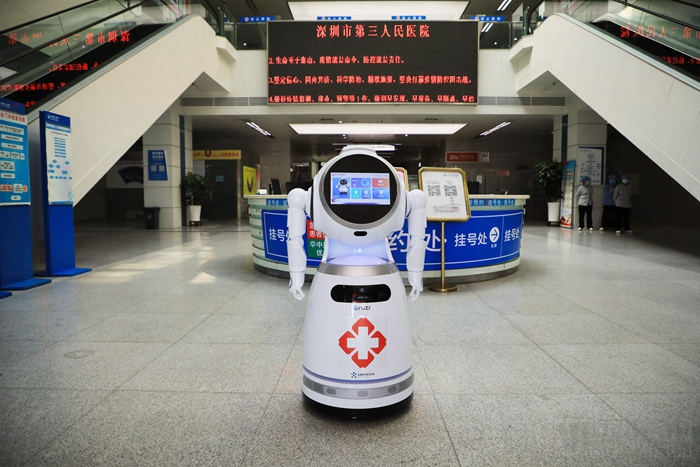
“With the launch of its smart epidemic prevention solution, UBTECH Robotics has taken a leading position in the industry. In this real-world deployment, the solution effectively helped healthcare workers alleviate work pressure, improve operational efficiency, and mitigate the risk of cross-infection between medical staff and patients.”
In addition to hospital settings, UBTECH’s 5G robot “Huang Tiantian” has also participated in epidemic prevention and control efforts at the Hezhou Expressway Checkpoint in Shenzhen. Serving as an auxiliary police officer at the checkpoint, it operates 24/7 to remind passing drivers to scan QR codes and register in advance. In this way, “Huang Tiantian” has helped Shenzhen save the manpower of four police officers and reduce the risk of infection caused by close personal contact. The 5G auxiliary police robot “Huang Tiantian” was jointly developed by the Bao’an Branch of the Shenzhen Municipal Public Security Bureau and partners such as UBTECH Robotics, Inc. It is the first auxiliary police robot in China to meet practical operational needs at grassroots police stations.
As the pandemic erupts globally, in this era of a “community with a shared future for mankind,” combating the COVID-19 epidemic is no longer merely the responsibility of a single country or government, but a collective endeavor for the entire world.
Prior to the pandemic, UBTECH Robotics’ Cruzr robot and its solutions had already been deployed in China, Europe, Oceania, Southeast Asia, and other regions. At Princess Alexandra Hospital in Queensland, Australia, Cruzr provides patient consultation services in 26 languages, facilitating communication between local non-English-speaking patients and physicians regarding medical conditions and treatment plans.
Currently, UBTECH’s smart epidemic prevention solutions are being progressively deployed and implemented in hospitals across China. China’s current epidemic prevention measures serve as a global model. In response to the urgent trend of the pandemic’s worldwide spread, dozens of overseas partners from countries such as Singapore, Thailand, and South Korea have expressed their demand for collaboration with UBTECH. UBTECH’s smart epidemic prevention solutions are poised to rapidly support global efforts, delivering the “Chinese solution” to countries and regions heavily affected by the epidemic.
In 2008, UBTECH began by developing core servo actuators and subsequently laid out its strategic focus on the core technologies of artificial intelligence and robotics. Currently, it has established advantages in key technological areas such as robotic hardware, motion control algorithms, machine vision, and robot operating systems. This includes being the first to commercialize existing technologies and exploring applications across various fields centered around these core technologies. Moving forward, UBTECH will continue to focus on commercial applications of humanoid robots, seeking integration with traditional industries.