

How the UK's Smart Healthcare System Aided the National Response to the Global COVID-19 Pandemic

The Phoenix Partnership
A company focused on medical software development, system integration, and providing technical services
The novel coronavirus is spreading rapidly worldwide, and the United Kingdom is no exception. As of March 8, 2020, there were 273 confirmed cases in the UK, with more than 23,000 people having undergone testing for the virus. Compared to countries such as Italy, South Korea, and Iran, which have experienced a surge in infections, the epidemic situation in the UK remains relatively stable.
It is worth noting, however, that the operation of the UK’s public health system differs significantly from that of China. Quarantine is one of the primary measures in epidemic prevention and control; however, in the UK, quarantine involves restrictions on personal liberty and cannot be implemented efficiently or rapidly. Under the Public Health (Control of Disease) Act 1984 and the Health and Social Care Act 2008, local governments have numerous statutory obligations and powers to control the spread of infectious diseases. The Secretary of State may also enact regulations to prevent or control outbreaks or the spread of infection. Individuals who violate these laws shall be subject to penalties enforced by the courts.
Although the UK released its latest national epidemic prevention policies and measures against the novel coronavirus in early March, the National Health Service (NHS) currently relies primarily on civil contracts with individuals under isolation to persuade them to voluntarily comply with quarantine requirements. Given the limited enforceability of such civil contracts, the monitoring and prevention of infectious disease outbreaks in the UK depend more heavily on leveraging digital health infrastructure to provide real-time, comprehensive big data support to healthcare and disease control institutions at all levels, thereby enabling precise and rapid responses in epidemic prevention and control efforts.
The United Kingdom established the National Health Service (NHS) in 1948. The NHS is funded by the government’s Department of Health and Social Care, meaning that it is financed and paid for through the national budget. Under this healthcare system, anyone with legal residency status is entitled to free medical care. The NHS is responsible for diagnosing and treating individuals with infectious diseases and bears broad responsibilities in preventing and controlling such diseases, including implementing health programs, preventing disease transmission, investigating local communities, and monitoring the emergence or spread of infectious diseases.
An independent agency, Public Health England (PHE), was also established under the Department of Health and Social Care. As the lead agency in the UK for addressing public health emergencies, PHE participates in the prevention and control of infectious diseases at the organizational level by formulating policies and standards.
Electronic Health Records (EHR) serve as a critical entry point for population health and public health data analysis by the NHS and PHE. Unlike in China, the UK’s healthcare informatics market is highly concentrated, with a high penetration rate of electronic medical records. Notably, The Phoenix Partnership (TPP), a UK-based healthcare information technology company, stores the electronic medical records of more than two-thirds of the country’s population, hosting health records for 50 million patients (the total UK population was 66.49 million in 2018).
These massive volumes of electronic health record (EHR) data originate from hospital systems, primary care systems, mobile devices such as smartphones, and applications on Internet of Things (IoT) devices. The encrypted data are hosted in a centralized database on a private cloud. The database exports structured data to public health authorities, facilitating their monitoring of potential health threats.
Of course, in addition to structured information, the database also provides personalized handling for patients requiring extra attention or care. For example, during the pandemic, the database recorded data such as age, address, and medical history for high-risk groups—including elderly individuals with compromised immunity, patients with respiratory conditions, and those with chronic underlying diseases—enabling healthcare professionals to provide targeted and appropriate care.
Leveraging these structured yet personalized data and emerging AI machine learning algorithms, a unique smart healthcare system has been developed. This system can integrate services with healthcare organizations such as the NHS, for example, by providing information including names, addresses, and electronic prescription services to support the NHS’s population health statistics.
Prior to the outbreak, public health departments typically maintained multiple “lines of defense” to prevent potential threats. The UK’s National Screening and Immunisation Programme served as the foremost line of defense. Leveraging smart healthcare systems, it was possible to clearly access records of each individual’s previous vaccination dates and locations, past medical history, or to assess the baseline immune status of specific populations. This enabled the prioritization of vaccination for high-risk groups based on these data, particularly when resources were limited.
Meanwhile, smart healthcare systems can also support vaccine research. For instance, if a patient contracts a novel respiratory virus after having previously received an influenza vaccine, it is possible to investigate whether the vaccination confers additional resistance against this new virus.
Furthermore, within national screening and immunization programs, smart healthcare systems can provide a geographic perspective on population immunity. For instance, if patient data are concentrated in specific locations, the system can analyze disease incidence and potential immune status information for patients in those areas. Through comparative analysis, it can identify regions with low vaccination coverage and high disease prevalence, thereby enabling targeted surveillance and allocation of medical resources to these areas.
In many countries, clinicians are obligated to promptly report information on infectious disease outbreaks, thereby enabling disease control agencies to maintain effective routine surveillance. To address this challenge, a series of “trigger points” can be preconfigured within smart healthcare systems. Once a clinician enters clinical data into the system that resembles the characteristics of an infected individual, the system immediately issues an alert for the suspected case. This prompts the clinician to file a disease notification and potentially provide additional details, such as the patient’s travel history, facilitating rapid reporting to public health centers for timely prediction and assessment of outbreak trends.
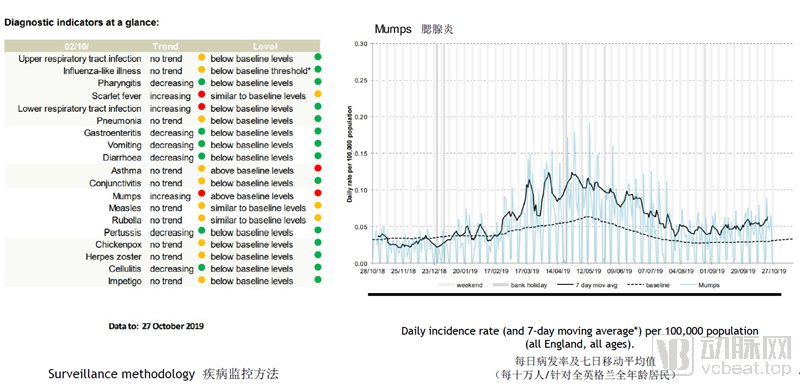
UK Public Health England: Mumps Surveillance
For example, the figure above illustrates one approach used by Public Health England to monitor mumps through a smart healthcare system. Interestingly, Public Health England had not previously anticipated the emerging trend in mumps incidence. Furthermore, the smart healthcare system detected rising incidence rates of diseases such as measles and rubella during specific periods. When combined with immunization data, these findings indicated that vaccination coverage for measles, mumps, and rubella (MMR) in the United Kingdom was lower than expected. By leveraging epidemiological data reported from across the country, it is possible to gain insights into seasonal trends in disease incidence and to classify and issue early warnings for outbreak risks associated with various diseases.
Smart healthcare systems can also analyze the appointment and consultation records of confirmed infected individuals to trace and locate close contacts, enabling timely isolation and observation.
During an outbreak, minimizing close contact between individuals is essential. This is particularly critical for healthcare institutions with a high concentration of patients, where reducing interactions between healthcare providers and patients, as well as among patients themselves, is undoubtedly an effective strategy to prevent cross-infection.
However, during the pandemic, numerous patients still needed to seek medical consultation and guidance from physicians, while healthcare professionals also needed to monitor the health status and vital signs of certain patients.
By using the mobile app of a smart healthcare system, patients or their family members can manually enter various vital signs, such as body temperature and blood pressure, into electronic health records. In the future, data may even be automatically collected and uploaded via health monitoring devices connected to smartphones. This enables healthcare professionals to remotely monitor home-based patients and keep track of their health status in real time. Furthermore, the video-based teleconsultation feature provided by the app can meet general primary care needs, allowing more patients with mild conditions to avoid visiting healthcare facilities during the pandemic and thereby reducing the risk of cross-infection associated with seeking medical care.
Another major advantage of telemedicine is that it ensures physicians can continue to practice even if they are under quarantine or unable to enter healthcare facilities due to the spread of an epidemic. Thus, via mobile networks or Wi-Fi connections, healthcare professionals can remotely access electronic medical record data within smart healthcare systems from any location. This capability enables a larger number of healthcare workers to sustain their critical roles during epidemics.
Based on previous experience with epidemic outbreaks in the UK, public health authorities have found it highly challenging to update triage protocols and treatment plans in real time at the onset of an outbreak and to ensure their consistent implementation across healthcare institutions. However, with smart healthcare systems, health authorities can now update triage protocols in real time within the system, effectively controlling the spread of the epidemic and providing patients with more timely care.
As can be seen, smart healthcare systems play a significant role in the prevention, monitoring, and assisted diagnosis and treatment of epidemics in the UK. As a provider of smart healthcare systems, The Phoenix Partnership (TPP) has been involved in the UK’s epidemic prevention and control efforts since the outset of the outbreak. TPP is also collaborating with healthcare institutions in multiple countries to provide new approaches to epidemic control through digital healthcare infrastructure.
About TPP
TPP (The Phoenix Partnership), founded in 1997, is a UK-based healthcare software company specializing in health informatics. Integrating business operations, services, and data into a unified foundational platform, it provides comprehensive informatics solutions to health administrative authorities, healthcare institutions, research organizations, and patients. TPP is the preferred provider of healthcare solutions and services for the UK’s National Health Service (NHS).
TPP’s medical software, SystmOne, leads the trend in smart healthcare services in the UK and is the most trusted integrated health and care software platform in the country. Over 7,000 NHS healthcare organizations and more than 200,000 healthcare professionals in the UK use SystmOne, which centrally hosts over 50 million health records, covering more than 70% of the UK population.
SystmOne delivers flexible, secure, efficient, and cost-effective integrated informatics solutions through a Software-as-a-Service (SaaS) model, encompassing medical software development, system deployment, monthly maintenance updates, and 24/7 after-sales technical support.