

CarniTech Files IPO Prospectus: Delivering Customized Patient Engagement Solutions for Global Pharma
The traditional pharmaceutical connection model of “enterprise–distributor–representative–physician–patient” is linear, making it highly susceptible to market conditions and policy changes. With technological advancements, pharmaceutical companies can leverage internet-based approaches to diversify connectivity, reaching end users (physicians and patients) directly and enabling broader participation.
Shanghai Kaning Information Technology Co., Ltd. (hereinafter referred to as “Kaning Tech”), established in June 2017, is dedicated to customizing Internet-plus patient service system solutions for pharmaceutical companies, helping them achieve the strategic transformation from “products” to “services.”
To date, Kaning Technology has established partnerships with multiple pharmaceutical companies such as Merck and Fresenius, specialized disease associations focused on pain management and Parkinson’s disease, and major physician groups. Its existing products and services cover a wide range of therapeutic areas, including cardiovascular diseases, nephrology, dermatology, pediatrics, and ophthalmology.
Kaning Technology not only assists pharmaceutical companies in their upgrade and transformation, but also ensures that every patient receives effective health management services.
“The Innovator’s Prescription” points out that the biggest problem with the current business model for chronic diseases is that it entrusts doctors and hospitals with chronic disease management. In reality, chronic disease management is fundamentally about ensuring long-term medication adherence among patients with chronic conditions.
Professor Sun Lingning once shared a case study on patient management. Five or six years ago, when internet penetration was not yet widespread, she led a national-level project focused on hypertension management in remote regions such as Qinghai and Xinjiang. The project involved making four telephone calls per month to remind patients to take their antihypertensive medications on schedule. After a three-month pilot period, the blood pressure control rate in the target area increased by 30%.
Traditional hospital-based, assembly-line-style consultations fail to meet the needs of patients with chronic diseases. Patient health is only one aspect; in fact, patient management is a multi-stakeholder endeavor that yields mutual benefits.
From the Patient's Perspective:Through continuous patient services, help patients consistently and systematically cooperate with doctors in active treatment, maintain a positive mindset, adjust their diet, adhere to exercise routines, and improve their quality of life.
From a physician's perspective:Patient management can improve treatment efficacy, reduce patient attrition, and enhance physicians’ professional visibility.
From the perspective of pharmaceutical company operations:Patient management services enhance patient retention, ensure adherence to treatment regimens, and reduce attrition, thereby boosting profitability and strengthening the product’s reputation.
From the government's perspective:Patient management services can reduce various complications caused by chronic diseases, decrease the frequency of medical visits, and thereby alleviate the pressure on health insurance.
Driven by the demands of various stakeholders and supported by policy initiatives, patient management has garnered increasing attention from all sectors of society, giving rise to a number of companies in this field. However, Gong Huijuan, CEO of Kaning Technology, told VCBeat, “Most existing patient service products rely on physicians to directly deliver patient care. Yet, due to physicians’ heavy workloads, this model is difficult to implement in practice.”
Technology should not add to the burden of doctors. Kaning Technology positions itself as a tools company, adopting a “Patient + Digital + Service” model that enables the system to automatically interact and communicate with patients, thereby completing 90% of patient service tasks. The remaining 10% is handled by physician assistants (service specialists), namely pharmaceutical representatives.
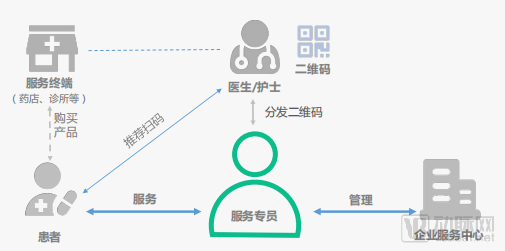
In this patient service ecosystem, Kaning Technology connects doctors, patients, and enterprises through “patient services.” Service specialists use a mobile app to assist doctors in delivering membership-based services, doctors leverage WeChat Service Accounts to easily manage their patients, and patients receive professional support via WeChat, thereby creating a virtuous closed-loop system.
Acquiring a new customer costs five times as much as retaining an existing one, and each satisfied user represents an average of eight potential customers. For pharmaceutical companies, this system helps retain customer bases and enhance brand reputation on one hand, while on the other, the collection of clinical case data facilitates further product research and development as well as market promotion.
In the pursuit of greater efficiency, decentralization and de-platformization have become inevitable trends in the mobile internet era. With a heightened awareness of brand identity, enterprises increasingly aspire to be the rule-makers rather than being manipulated by third-party platforms.
Unlike other companies, Kaning Technology is committed to customizing products for enterprises. Acting as a “consultant,” it conducts in-depth market analysis and clinical research, and proposes solutions tailored to the specific needs of each enterprise.
For example, Kaning Technology developed a smart guidance system for desensitization therapy, named "Minshi Yiyun," for Merck & Co. During preliminary market research, Kaning Technology learned that the product under development by Merck was an injectable formulation. This product requires intradermal injection of allergen extracts. Desensitization injections start with a low dose and gradually increase the dosage to build tolerance to the allergens. Treatment with this therapy generally takes at least 2–3 years.
Gong Huijuan told VCBeat that the dosage and injection intervals for each session during treatment are tailored to each patient’s individual condition; in some cases, a single patient’s medical records can fill an entire room. Moreover, patients have limited engagement throughout the course of treatment.
Minshi Medical Cloud, developed by Kaning Technology, standardizes treatment protocols and implements intelligent management of patient records upon enrollment. Prior to injection, the system pushes visit reminders and highlights key precautions. Post-injection, it manages adverse reactions, intelligently schedules subsequent injections, and provides precautionary alerts, while maintaining continuous patient follow-up throughout the process until treatment completion.
Another example is “CKD Cloud Care,” a patient service system for individuals with chronic kidney disease (CKD) developed by Kaning Technology for Fresenius Kabi. The platform facilitates patient management through nutritional guidance, medication management, CKD-related health education, daily monitoring, regular check-ups, and health consultations. Within six months of its launch, the product had deployed 52 follow-up specialists, onboarded more than 1,700 nephrologists, gained over 38,000 new WeChat followers, and registered more than 19,000 patients.
Gong Huijuan told VCBeat, “As a small company, we were willing to invest more effort than our competitors in thoroughly understanding customer needs to win project bids. Ultimately, the medical department considered the final product to have exceeded expectations. However, due to our small size, the procurement department was initially reluctant to purchase our product. It was only with the endorsement of the medical department that our Minshi Medical Cloud was able to go live.”
To date, Kaning Technology has customized over a dozen products for large pharmaceutical companies and, by extracting common features, has developed a SaaS product with functional modules applicable to prevalent chronic diseases. This SaaS solution is offered to leading physicians and small- and medium-sized pharmaceutical enterprises in China. It is reported that some organizing committees, physician groups, and domestic small- and medium-sized pharmaceutical companies have already begun subscribing to Kaning Technology’s SaaS product.
In terms of future planning, Kaning Technology will continue to promote its SaaS products on a large scale to pharmaceutical companies, physician groups, and pharmacies.
In response to the epidemic, Kaning Technology urgently convened its technical department and developed a product: a 14-Day Home Observation Diary.
For individuals with prior exposure risks and those returning from other regions who are required to undergo home observation, this tool provides a convenient way to record key information such as body temperature, symptoms, and contact history. It helps residents successfully complete their home observation period while maintaining continuous records, which can also be used to report to employers, community authorities, hospitals, and other institutions.
As a compact functional service unit, the Home Observation Log is primarily utilized through integration with various WeChat Official Accounts. During the pandemic, Kaning Technology opened up access permissions, allowing any interested Official Accounts to integrate and use the service free of charge. The company received over 100 integration requests, and a total of 8,392 individuals used this feature for home-based observation.
The need for home-based monitoring is not limited to the pandemic period; all non-hospitalized patients with acute or chronic progressive diseases require home observation and tracking of disease progression. Therefore, by adjusting the specific parameters monitored, home observation logs can be applied across various disease areas. These logs can be used independently or integrated with various disease management WeChat official accounts to provide layered, value-added services.