

Breaking Through DRG/DIP: A Nearly RMB 1B Global First-in-Class Interventional Blockbuster Emerges with IPO Filing

Jinkui Medical
Developer and Manufacturer of Congenital Heart Disease Treatment Devices

Source: Medical Device Business Review
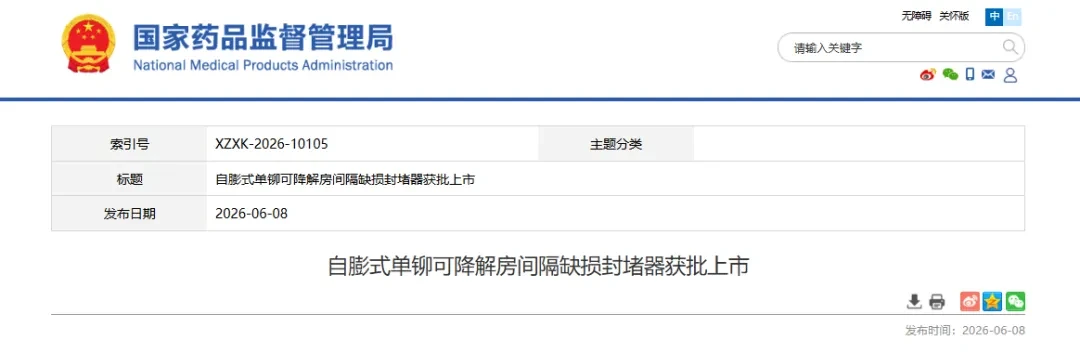
On June 8, the National Medical Products Administration officially approved the market registration of the innovative product, the self-expanding single-anchor biodegradable atrial septal defect occluder, independently developed by Jinkui Medical. Official information indicates that this isThe world’s first biodegradable atrial septal defect occluder with self-expanding and shape-recovery properties, for transcatheter interventional treatment of atrial septal defect (ASD).
The significance of this approval goes far beyond the three words “biodegradable.”
What truly deserves attention is,In the mature market for atrial septal defect (ASD) occluders, a biodegradable solution that is closer to being "clinically substitutable" has emerged for the first time.At this juncture, traditional metal occluders are increasingly being included in centralized volume-based procurement, and the logic of market competition is also evolving.
Atrial Septal Defect (ASD) Closure Is Not a Niche Market
It is an opportunity for upgrading under mature surgical procedures.
Atrial septal defect (ASD) is one of the most common congenital heart diseases in clinical practice, accounting for approximately 10% to 15% of all congenital heart defects. Transcatheter interventional closure has long become the mainstream treatment approach, with a mature procedural technique, well-established physician awareness, and clear hospital pathways.
This means that atrial septal defect occluders are not a new product category requiring education from scratch, but rather a mature market with established clinical validation and reimbursement foundations.
Public data shows that,In 2023 alone, the number of ASD occluder implantations reached 58,000 cases.Based on the terminal price of approximately RMB 10,000 to 15,000 for mainstream domestically produced occluders,The annual terminal market size corresponding to the single indication of atrial septal defect alone has already reached approximately RMB 580 million to RMB 870 million.; based on a median price of RMB 12,500, the market size is estimated at approximately RMB 730 million.
If further projected using the industry-specific calculation model, as the case volume increases,The terminal market for ASD occluders is expected to reach the RMB 1.2 billion level by 2025, and may approach RMB 2 billion by 2027.
In other words, this is not a small and fragmented niche category, but ratherMature sectors with a solid foundation for genuine volume growth and the capacity to support blockbuster products.
More importantly, this market is not driven solely by new cases but inherently offers room for generational product transitions.
CurrentMainstream products remain nickel-titanium alloy occluders.Its advantages are clear: mature self-expanding performance, stable delivery and deployment, and well-established operator familiarity.However, the drawback is equally clear: permanent indwelling.
The nickel-titanium occluder remains permanently in the body after implantation.Long-term risks may include nickel ion elution, allergic reactions, arrhythmias, associated thrombosis, and tissue erosion.
For pediatric patients, the long-term presence of permanent foreign bodies may also compromise the space available for future reintervention.
Therefore,The true highlight of this market has never been “whether there is still demand,” but rather whether there are superior products capable of capturing share from the mature, existing market.
The biodegradable direction has been stalled for many years.
The Challenge Has Never Been "Degradation"
Biodegradable occluders are not a new concept. Over the past several years, both domestic and international companies have been actively developing this technology, as its clinical value is well established:If the device can gradually degrade after completing occlusion, reducing permanent metal residue, it has the potential to address the long-term issues associated with traditional products.
But why has this sector remained hot, yet failed to produce any true blockbuster products?
The core issue lies not in “whether it can degrade,” but in “whether it can continue to function as stably as metal after degradation.”
Occluders are, first and foremost, high-requirement interventional implants that must fulfill the demands of compressed delivery, precise deployment, stable expansion, adequate apposition, and long-term fixation. Nitinol has become the mainstream material not merely because it can seal defects, but also due to its well-established shape memory and self-expanding properties.
Yet most biodegradable polymer materials have long been stuck at this stage:Insufficient support, weak rebound, and limited self-shaping capability. As a result, while the concept is valid, its intraoperative performance falls short of mainstream products, leading to high physician education costs and slow market adoption.
In other words,The biggest divergence in the biodegradable sector in the past was not about direction, but product strength.
Jinkui Medical's Breakthrough This Time
It lies in its first approach to “substitution logic”
The key to Jinkui Medical’s latest product lies not merely in its “biodegradability,” but in the synergistic combination of three features: self-expansion, single-rivet fixation, and biodegradability.
The most core component is the self-expanding stent graft.This is also a key point specifically emphasized by the National Medical Products Administration (NMPA). It means that the device can be compressed for delivery during the procedure, and automatically expands and conforms to the tissue after deployment. The overall operational logic is closer to the metallic occluders with which physicians are already familiar.
This point is crucial.
Whether interventional devices can truly achieve volume growth depends not only on being “new,” but more importantly on being “user-friendly.” The closer they are to existing, well-established procedural techniques, the easier it is to shorten the cycle for expert education and market adoption.
Next is the single-rivet structure.Compared with the common double-rivet design, the single-rivet design exerts less mechanical compression on atrial septal tissue, theoretically helping to reduce irritation to fragile tissues and the risk of related complications, making it more attractive for pediatric patients and certain cases with complex defects.
That is to say,This time, Jinkui Medical is not simply developing a “biodegradable” device, but is attempting to simultaneously address two challenges that have historically been difficult to reconcile:
Approaching the Stability and Operational Experience of Metal Occluders
Avoid the Long-Term Burden of Permanent Metallic Implants
If both of these points can be consistently delivered in clinical practice, it will no longer be just a story of innovation, but one of replacement.
The Real Variable Has Arrived
Metallic Stents Included in Volume-Based Procurement, While Biodegradable Stents Remain in the Window Period
This approval also carries a stronger commercial highlight: the timing is particularly significant.
As the centralized procurement of structural heart disease occluders by alliances advances in multiple regions, the pricing structure of traditional metal occluders is being reshaped.
The inter-provincial alliance procurement documents led by Fujian Province have included atrial septal defect occluders and their delivery systems within the scope,However, it is explicitly stated that biodegradable occluders and their delivery systems are not included.
This means that in the near future, traditional metal occluders are likely to enter a more pronounced phase of price competition, where success will depend on winning bids, cost control, and channel efficiency;
andBiodegradable products remain outside the scope of centralized procurement for now, preserving opportunities to maintain the premium pricing and differentiated competitive logic characteristic of innovative medical devices.
Metal Products: Gradually Moving Towards Price Restructuring
Biodegradable Products: Competing for Performance Definition Rights and Alternative Entry Points
This is also the most significant aspect of Jinkui Medical’s recent approval that deserves emphasis.It is not merely about having an additional registration certificate, but ratherIn a mature market where pricing logic is undergoing transformation, we have secured an entry ticket that could redefine value distribution.
Competitors have begun ranking.
The competitive baseline in the sector is rising.
From an industry perspective, the biodegradable occluder sector is no longer an uncharted territory.
In recent years, Lepu HeartTech has progressively advanced its fully bioresorbable product lines for ventricular septal defect (VSD), patent foramen ovale (PFO), and atrial septal defect (ASD) closure under the MemoSorb® series, pioneering a relatively comprehensive indication portfolio. LifeTech Scientific is also advancing the research and development of its bioresorbable ASD occlusion system. Meanwhile, Wuyou Tiaodong’s bioresorbable PFO occluder system received regulatory approval for market launch in March 2026.
Whose product more closely approximates the intraoperative performance of metallic occluders?
Who can provide more robust long-term clinical data
Who Can Faster Establish Head Centers, Expert Consensus, and Model Cases
From this perspective, the industry significance of Jinkui Medical’s recent approval lies inIt has raised the baseline for competition in the sector from “whether it can degrade” to “whether it can balance degradability and performance.”
In the past, the race among biodegradable occluders was about “who could develop them first”; going forward, the competition will be about “who can establish them as the mainstream solution first.”
Amid the backdrop of metal occluders being progressively included in centralized procurement and the price system being reshaped, the approval of a biodegradable product that more closely meets substitution criteria clearly holds significance beyond the mere market launch of a single product.
If subsequent clinical data, expert education, and market introduction continue to deliver on expectations, Jinkui’s world-first self-expanding, single-anchor bioresorbable atrial septal defect (ASD) occluder is likely to represent not only a breakthrough in product innovation but also a pivotal turning point in the congenital heart disease interventional occluder market, shifting the competitive landscape from price-based to value-based competition.