Three Key Pipelines Halted: Setback for Chinese Innovative Drug's Global Expansion

Genmab
Differentiated Antibody Therapy Developer

Johnson & Johnson
Medical Device R&D and Manufacturer

Recently, multiple media reports stated that the clinical trial of GEN1286, an EGFR/c-Met bispecific antibody ADC developed by Profang Bio, has been suspended.
GEN1286 is one of the core pipelines that Danish pharmaceutical company Genmab acquired when it purchased Proven Bio. According to the clinicaltrials.gov website, the clinical trial information for GEN1286 was updated on January 15th. Originally planned to recruit approximately 260 participants, the number has been changed to 23 patients already enrolled. Moreover, this clinical study is now in the state of "ongoing but not recruiting," indicating that the trial recruitment did not meet the expected target.
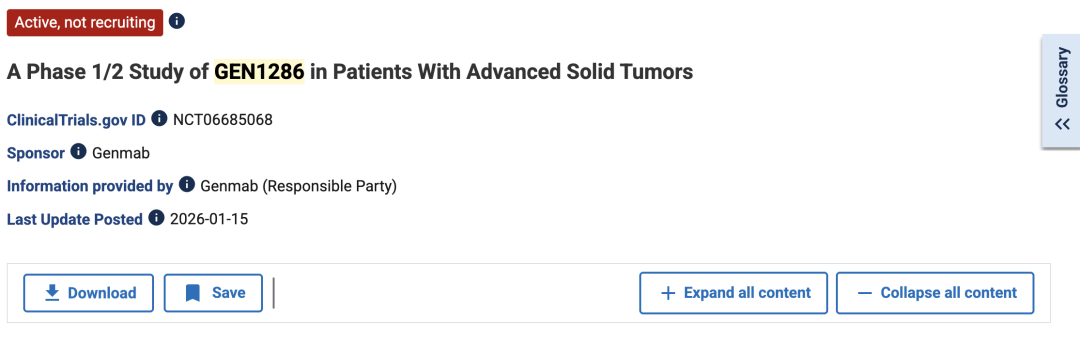
Source: clinicaltrials.gov website
To know, thisAlready Terminated After Genmab Acquired Profcure BiologicsClinicalThe third ADC product.In 2024, Genmab announced the acquisition of Provention Bio for $1.8 billion in an all-cash deal.Set a record for Chinese biotech companies being acquired by overseas pharmaceutical enterprisesM&ANew Record。However, just over a year after the acquisition, Genmab successively announced that it would no longer proceed with clinical trials for two ADCs targeting PTK7 and CD70. The situations were slightly different: the first two projects were explicitly terminated, while GEN1286 was put on hold for enrollment.
Once standing at the forefront of the overseas expansion wave, Proforma Bio's individual journey is highly representative and warrants vigilance across China's biotech industry. In 2025, China's innovative drug BD set a new record.In all peopleProspect2026On the occasion,The forerunners are demonstratingThe Harsh Test After Early Pipeline BD。

Gradually Sinking Pipeline
GEN1286, which has been suspended from enrollment this time,The most well-knownTargetThe drug is Johnson & Johnson's Amivantamab, which gained fame after head-to-head trials against Osimertinib.
The difference between the two is that amivantamab is an EGFR/c-Met bispecific antibody,GEN1286 is an EGFR/cMet bispecific antibody.ADC, which belongs to the "upgraded version."Most people outside only know that Amivantamab was developed by Johnson & Johnson, but they don't know that Genmab was also involved. In 2012, Johnson & Johnson collaborated with Genmab, utilizing Genmab's bispecific antibody platform for drug development, and Amivantamab is one of the outcomes.
Amivantamab is a key product cultivated by Johnson & Johnson, with an expected sales peak of $5 billion. However, Pro方 Bio's GEN1286 may outperform Amivantamab, so Genmab is naturally focusing on its development. In November 2024, Genmab initiated clinical research for this EGFR/c-Met bispecific antibody ADC in patients with solid tumors and has also registered the clinical trial in China.

However, in the end, GEN1286 was shelved. Genmab did not provide detailed reasons for halting the clinical trial. But from the number of participants, GEN1286 was put on hold before Genmab could even reach a point to read any significant clinical data.
The reason may lie more in Genmab's own strategic adjustments.One year after acquiring Provention Bio, in September 2025, Genmab acquired Merus for $8 billion in cash. Merus also has an EGFR/c-Met bispecific antibody in its pipeline, which is currently in Phase I/II clinical trials, albeit with slow progress. However, following the acquisition, Genmab's strategy clearly shifted, streamlining the development of two ADCs targeting CD70 and PTK7, as well as a PD-L1/4-1BB bispecific antibody. The two ADCs originated from Provention Bio and were terminated due to slow patient enrollment in clinical trials and poor performance in clinical trials, respectively.
Additionally, Genmab may have noticed that the sales of Amivantamab are not performing well.In 2025, the combined revenue of Amivantamab and Lazertinib reached $734 million, far from the $5 billion sales peak.。This may have lowered Genmab's confidence in EGFR/c-Met bispecific drugs, making the future of Proven Bio's ADC uncertain. Naturally, Genmab will focus its efforts on variants with greater clinical and commercial potential.

Successful Overseas Expansion, Then What?
The only pipeline that Genmab has now obtained from Provention Bio is the FRα-targeted ADC drug Rina-S. This was also the asset Genmab valued the most, essentially accounting for the vast majority of the $1.8 billion acquisition price. On January 23, Genmab advanced Rina-S into Phase 2 clinical trials for non-small cell lung cancer.
After all, MabPlex has been acquired, and the subsequent operations are decided by others. However, the successive shelving of the original three pipelines is worth the industry's attention and even vigilance.
By 2025, the total amount of China's innovative drug outbound licensing transactions exceeds 130 billion US dollars, with over 150 licensing deals reached, setting a new historical record.The upfront payments have exceeded the amount of financing that pharmaceutical companies raised in the primary market. January 2026 has not yet ended, but Chinese innovative drug companies have already reached about 10 overseas licensing BD deals.

Cooperation inevitably involves risks. As of 2026, quite a few Chinese innovative pharmaceutical companies have already run aground. Apart from ProFound Therapeutics,Recently, the same fate has befallen HBM (Harbour BioMed) and Yilian Biotech.MSLN ADC,Clinical trials were also suspended by Pfizer.The collaboration on PD-L1/VEGF by Immune-Onc (Yimeng Oncology) has also been terminated.
This is actually the norm in the buying and selling of innovative pipelines in the pharmaceuticals industry. According to statistics from VbData, as of April 2025,Completed External BD Transactions in 2020Return Rate"Up to 40%"。The reasons for the suspension or termination of clinical projects vary. On one hand, it may be due to poor clinical performance or changes in the competitive environment; it could also be because of adjustments in the partner company’s business strategy, or the other party's clinical progress being less efficient than expected, among other factors.
How many pipelines will remain after the trials of time, truly reflecting the value of China's innovative drugs. The product's foundation is the most important cornerstone, but another key aspect is:Have China's innovative drug products been effectively developed and utilized by partners overseas?This is the core challenge that China's innovative pharmaceutical companies inevitably face.
Facing strong partners, Chinese innovative pharmaceutical companies need to take the initiative in cooperation to ensure their pipelines are not overlooked; while for relatively smaller overseas partners, the key challenges lie in guaranteeing clinical efficiency and commercial promotion. All of these test the wisdom of China's innovative pharmaceutical enterprises.
Going overseas is far more complex than simply selling a product. 
Author丨Yang Xixia
Editor: Jiang Yan, Jia Ting
Operation|Li Muzi
Illustration | Visual China
Statement: Original content by Jian Shi Ju, please do not reprint without permission.

Record High Incidence of Rabies, but the "King of Rabies Vaccines" Isn't Making Money