

How Blue Dragonfly's Infection Control Closed-Loop Solution Gained Adoption in Over 6,000 Hospitals
The inception of informatization for hospital-acquired infection control in China dates back to 1986.
At that time, under the leadership of the Department of Medical Administration of the Ministry of Health, the National Hospital Infection Surveillance Network was established, with 16 hospitals from nine provinces and municipalities across China joining the network. Although the number of participating hospitals increased over time, informatization management of the surveillance network had not yet been implemented.
In 1998, Xiangya Hospital of Central South University was entrusted by the Ministry of Health to oversee the operational management of the National Hospital Infection Surveillance Network. The following year, it successfully developed the first version of the “Hospital Infection Management Computer System,” which began to be implemented in selected member hospitals of the National Hospital Infection Surveillance Network.
In 2002, as healthcare institutions across China gradually adopted the computer-based management software of the National Healthcare-Associated Infection Surveillance Network, the development of informatics for healthcare-associated infection control in China entered a period of relative stability.
In 2003, the SARS outbreak shattered the calm. Infection control practitioners in China had to accelerate technological updates and leverage information technology to enhance infection surveillance capabilities. In 2006, the domestic internet healthcare company “Health 160” established a Hospital Infection Control Division, focusing on the research, development, and sales of hospital infection control software.
With the advancement of hospital infection management and the implementation of computerized information systems in hospitals, the informatization of hospital infection control has become an inevitable trend. Recognizing the broad prospects of hospital infection control software in the information technology market, Health 160 decided to establish a dedicated company to operate this business. In 2014, Blue Dragonfly Network Technology Co., Ltd. was founded in Changsha, Hunan Province.
Health 160 is headquartered in Shenzhen, so why did Blue Dragonfly choose to establish its base in Changsha?
First, Xiangya Hospital of Central South University in Changsha established the National Training Base for Hospital Infection Surveillance and Management, boasting a robust foundation in hospital infection informatics. Second, Health 160 has deeply cultivated the field of hospital infection control and is one of the earliest enterprises to develop hospital infection software, having established a close collaborative partnership with Xiangya Hospital.
Over the past six years, Blue Dragonfly has leveraged its robust foundational strengths to achieve rapid growth. With infection surveillance and public health monitoring of infectious diseases as its core businesses, the company has accumulated more than 20 independent software copyrights and established a comprehensive closed-loop system for infection prevention and control (IPC), encompassing IPC monitoring, process intervention, supervision and evaluation, as well as education and training.
Early Warning and Intervention: Two Key Entry Points for Healthcare IT Companies into the Hospital Infection Control Market
From the perspective of the development of information technology in hospital infection control, early efforts focused on retrospective monitoring through statistical methods. With the advancement of the hospital infection control sector, between 2010 and 2015, hospitals saw a growing demand for early warning systems, aiming to mitigate medical risks through real-time alerts.
Blue Dragonfly’s Closed-Loop Hospital Infection Control Solution addresses the clinical challenges of infection prevention and control (IPC) participation, transitioning from “one-dimensional IPC” to “multi-dimensional IPC.” It is one of the few products in China that offers a comprehensive hospital infection control solution.
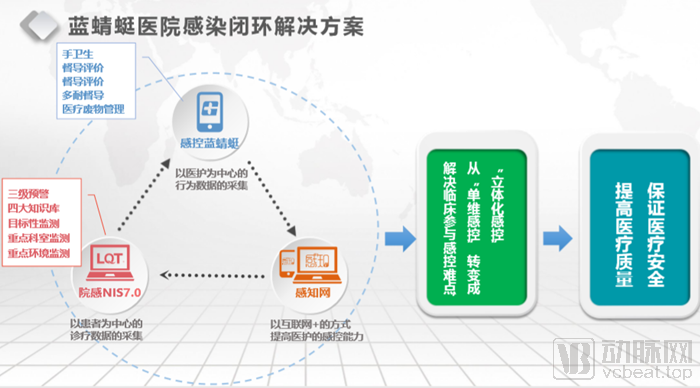
Blue Dragonfly Hospital Infection Control Closed-Loop Solution (Image from the company)
The Blue Dragonfly Hospital Infection Control Closed-Loop Solution consists of Infection Control 7.0, the Blue Dragonfly APP, and the Sensing Network.
Infection Control 7.0 is a data collection tool for healthcare-associated infection (HAI) professionals to gather patient diagnosis and treatment data within hospitals. It is a risk-prevention-based infection surveillance platform that provides early warnings of potential infection risks through outbreak alerts, infection alerts, and risk alerts. The system focuses on surgical site monitoring, bacterial monitoring, infection monitoring, occupational exposure monitoring, and ICU/KICU monitoring.
Gankong Blue Dragonfly focuses on monitoring the behavior of healthcare workers. Healthcare-associated infection (HAI) events are not solely introduced by patients; inadequate hand hygiene and non-compliant instrument handling by medical staff can also lead to infections. Infection prevention and control (IPC) professionals supervise healthcare workers’ hand hygiene practices and implement measures for preventing and controlling multidrug-resistant organisms (MDROs), thereby reducing the risk of infection. They continuously improve processes, track and follow up on identified issues, and conduct supervisory evaluations and stratification across various departments. Additionally, IPC personnel can use handheld PDAs for scanning to enable intelligent management of medical waste.
Ganzhi Network is the online knowledge platform of Lan Qingting, offering services such as Q&A on infection prevention and control (IPC), resource downloads, online learning, and online examinations. The Lan Qingting operations team comprises over 15,000 IPC and public health professionals. It operates the Lan Qingting IPC Lecture Hall, providing online knowledge training to IPC and infectious disease-related personnel across China, with cumulative service exceeding one million person-times.
“Ganzhiwang is a platform for healthcare-associated infection (HAI) prevention and control professionals to access and discuss knowledge on HAI. Centered on issues related to hospital-acquired infections, HAI professionals across China can exchange insights and raise questions here, thereby building a comprehensive question bank.”
Infection control practitioners provide data and information, which Blue Dragonfly organizes and analyzes to build a knowledge base. This process generates learning reports and matches them with corresponding training materials, enabling infection control practitioners and clinical healthcare workers to learn about infection prevention and control during fragmented time slots. Ultimately, this creates an integrated training system encompassing learning, practice, and assessment.
“Sourced from the people, applied for the people. Enhancing the infection prevention and control capabilities of hospital infection control practitioners will in turn strengthen their surveillance capacity in practical work, thereby helping hospitals improve their overall infection prevention and control performance,” said Peng Fang, CEO of Blue Dragonfly.
Blue Dragonfly’s series of products in the field of healthcare-associated infection (HAI) control are supported by four core knowledge bases, covering HAI prediction, risk analysis and early warning, multidrug-resistant organism identification, and outbreak alerting. Blue Dragonfly places great emphasis on patents and intellectual property rights, and currently holds more than 20 software copyrights.
Blue Dragonfly has also assembled a team of senior professionals in product architecture, R&D, and mid-to-senior-level marketing. It operates its own customer service centers in multiple provinces across China and has established a comprehensive after-sales service system. To date, Blue Dragonfly’s hospital infection control product series has served more than 6,000 users nationwide.
In 2013, when Blue Dragonfly was still part of the Healthcare-Associated Infection Control Division of Health 160, it conducted a review of potential opportunities in hospital informatization during the information system evaluation with the former National Health and Family Planning Commission.
They found that, as a risk-mitigation department, the hospital’s infection prevention and control (IPC) unit received limited institutional attention. Staffing for hospital infection management was scarce and predominantly composed of part-time personnel who, in addition to their clinical duties, were also responsible for other tasks such as infectious disease surveillance, leaving them stretched thin. Blue Dragonfly identified potential market opportunities in this gap.
Compiled from public sources; graphic by VCBeat
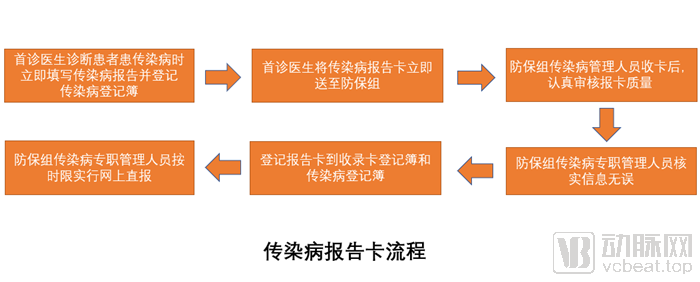
On one hand, regarding the reporting of infectious diseases, the reporting mechanisms in many medical institutions remain at an early stage, such as relying on paper-based submissions and lacking dedicated information systems to facilitate the process. This leads to frequent occurrences of underreporting, misreporting, and duplicate reporting, which not only hinders the preservation of infectious disease data but also significantly impedes statistical efficiency and data analysis efforts.
To address the aforementioned pain points, Blue Dragonfly (then part of the Healthcare-Associated Infection Control Division of Health 160) launched an infectious disease surveillance system in 2013, achieving electronic monitoring of infectious diseases within hospitals. In 2015, Blue Dragonfly enhanced the existing system by adding early warning capabilities.
Blue Dragonfly Real-Time Monitoring Solution for Infectious Diseases and Public Health is an AI-powered early warning system based on big data. Its functional modules include intelligent prediction, intelligent case reporting, and direct online reporting. For unknown infectious diseases, it also provides symptom surveillance and intelligent early warning capabilities.
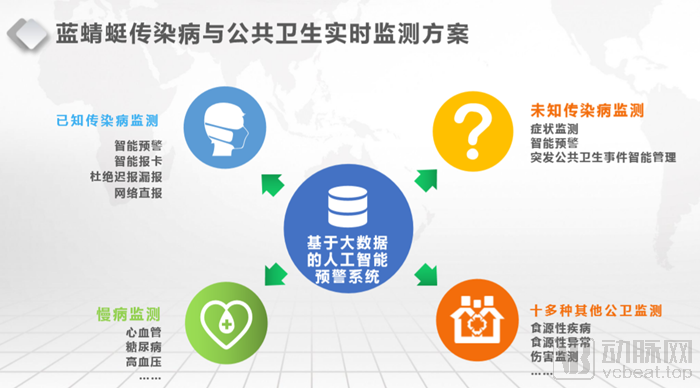
Blue Dragonfly Real-Time Monitoring Solution for Infectious Diseases and Public Health (Image from the company)
Intelligent prediction, intelligent case reporting, and online direct reporting have been developed for known infectious diseases; symptom surveillance and intelligent early warning are implemented for unknown infectious diseases.
Peng Fang used COVID-19 as an example to provide an explanation. As a novel infectious disease, COVID-19 presents with clinical symptoms such as cough, fever, and pulmonary opacities (white lung). The Blue Dragonfly Real-Time Monitoring System for Infectious Diseases and Public Health compares and screens patient symptoms against the known clinical manifestations of pneumonia. If no matching criteria are found, it can be inferred that the patient is suffering from a novel pulmonary infectious disease.
Blue Dragonfly’s infectious disease solution also features a noteworthy “diagnosis-triggered, mandatory reporting” function. By embedding its services into Hospital Information Systems (HIS) or Electronic Medical Record (EMR) systems, Blue Dragonfly uses intelligent diagnosis to determine whether a case falls under the category of reportable infectious diseases or other notifiable conditions. The system automatically prompts the completion of the required report, thereby preventing delayed or missed reporting.
During the fight against COVID-19, Blue Dragonfly actively responded by leveraging its strengths to serve hospitals and the public. On one hand, it updated prevention and control techniques, knowledge, and popular science content on its internet platform to help the general public access information on epidemic prevention and control. On the other hand, in accordance with the national diagnostic criteria for COVID-19, it organized hospital infection warning personnel to develop an early screening and warning system based on collected clinical patient data. This system, an upgrade to the original hospital infection control system, now covers five to six hundred hospitals.
According to statistics from the National Health Commission, by the end of November 2019, there were 1.014 million medical and health institutions across China, including 34,000 hospitals. Peng Fang, CEO of Lan Qingting Network, stated that more than 20,000 hospitals nationwide need to adopt infection control software, but only one-quarter have implemented such systems. “There is still significant market potential to be tapped in the field of infection prevention and control informatics.”
Moving forward, Blue Dragonfly will continue to refine its hospital infection control software, expand its market reach, and provide more hospitals with comprehensive and user-friendly closed-loop solutions for hospital-acquired infection management, while prioritizing infectious disease symptom surveillance as a key focus area.
Peng Fang revealed that Blue Dragonfly will continuously upgrade its algorithmic models and expand product application scenarios, striving to become a service provider within the big data ecosystem. Institutions interested in the company should contact Xiao Yun, the financing assistant, at: DongMai_Investent