

We-Med's Aurora DSA Receives CE Certification, Paving the Way for Global Expansion

WeMed
Interventional Medical Device Provider
Against the backdrop of multinational corporations monopolizing over 70% of China’s high-end medical device market, “domestic substitution” has remained the central theme in recent policy and industry discourse. The new healthcare reform has been implemented for a full decade, with a series of intensified policies significantly boosting the development of domestically produced medical devices. Currently, China has basically achieved domestic substitution in the low- and mid-end medical device segments, ranking first globally in production volume across various product categories within these tiers. However, progress in the high-end medical device sector remains arduous.
Among high-end medical devices, Digital Subtraction Angiography (DSA) systems, which are essential imaging navigation equipment for interventional procedures, have long been monopolized by multinational corporations. The three multinational giants collectively known as “GPS”—GE, Philips, and Siemens—command 92% of the domestic market share. Against this backdrop, the localization of DSA technology in China faces significant challenges.
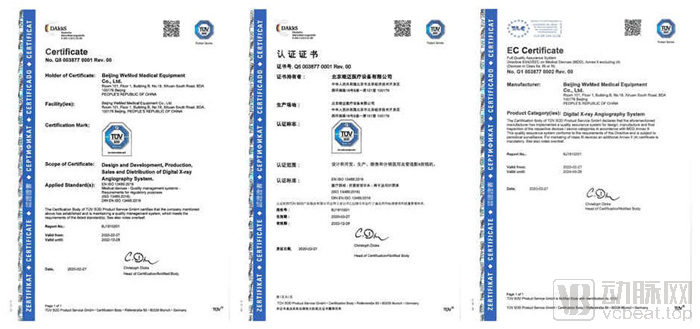
Beijing WeMed Medical Equipment Co., Ltd., committed to building China’s “leading interventional brand,” has recently secured EU CE certification for its Aurora DSA system, marking the first DSA product from China to receive such approval. As a domestic manufacturer, how did WeMed break through? VCBeat conducted an exclusive interview with Tian Wei, Marketing Director at WeMed, to provide insights on this achievement.
Interventional medicine is one of the three major clinical pillars, alongside traditional internal medicine and surgery. Due to its advantages over surgical procedures—including minimal invasiveness, high efficacy, rapid onset of action, strong reproducibility, and lower costs—interventional therapy has gradually become the preferred treatment option for many patients.
As an indispensable component of interventional diagnosis and treatment, Digital Subtraction Angiography (DSA) is recognized by the industry as the "gold standard" for interventional therapy due to the real-time nature and accuracy of its imaging. It is also one of the most effective methods for detecting vascular diseases. Typically, under DSA guidance, physicians can introduce specialized precision instruments, such as catheters and guidewires, into the human body to diagnose pathological conditions and perform localized treatments.
Founded in Beijing in 2014, WeMed was established by Yang He, a graduate of the Department of Electronics at Peking University with a master’s degree from the Chinese Academy of Sciences and over ten years of experience in the high-end medical imaging industry. The company’s technical team comprises R&D engineers from GE, Philips, Siemens, and renowned domestic medical device manufacturers, possessing top-tier industry expertise.
In its second year after establishment, WeMed positioned itself as a provider of interventional diagnostic and therapeutic equipment (DSA) and solutions. “The Aurora product is the culmination of our five-year dedicated R&D efforts in DSA,” introduced Tian Wei.
“Aurora” Next-Generation Floor-Mounted Intelligent 7-Axis Flat-Panel DSA is an innovative intelligent digital subtraction angiography (DSA) system with multiple patents. Equipped with the internationally leading third-generation large-field-of-view flat-panel detector, it shares the same pedigree as GE Healthcare’s Discovery IGS 730 and Siemens’ ARTIS pheno series. Leveraging its large-field-of-view flat-panel detector, this device perfectly supports cardiac, neurovascular, and non-vascular catheter-based (interventional) procedures, making it an ideal medical facility for multi-specialty hybrid operating rooms.
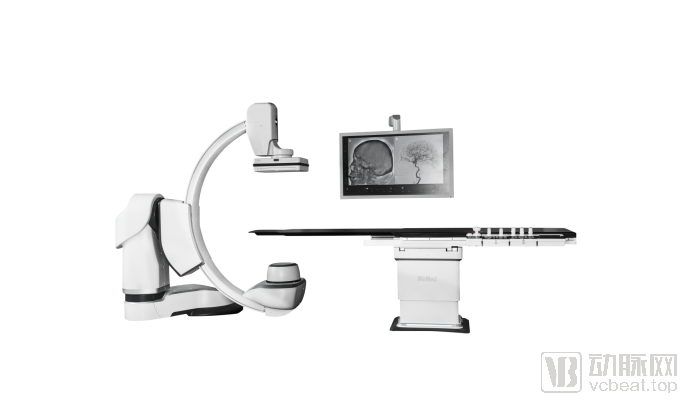
Aurora DSA
The core advantages of the Aurora DSA product include three intelligent technologies, four user-centric designs, and five high-end technologies. With high-definition imaging and agile, stable performance, it ensures clinical treatment safety and surgical efficiency.
“Our domestically produced DSA system offers distinct advantages over comparable products. First, its ‘floor-mounted intelligent seven-axis’ design employs robotic multi-axis linkage technology, providing extensive coverage and a wide range of angles for greater operational flexibility, while reducing the required installation footprint to as little as 20 square meters. This better supports hybrid and composite surgical procedures. Second, we have achieved low-dose, high-definition imaging: when capturing ultra-high-definition 16-bit images, the system intelligently calculates exposure parameters to automatically minimize radiation exposure to medical staff. Furthermore, it comes fully equipped with premium features, including a liquid metal X-ray tube, a large-screen display, an intelligent floating catheterization table, rotational DSA, and 3D-DSA,” introduced Tian Wei.
He stated that the Aurora DSA system is currently undergoing clinical trials at several renowned hospitals, including Beijing Tiantan Hospital, the First Affiliated Hospital of Zhengzhou University, Zhengzhou Central Hospital, and the Affiliated Hospital of Hebei University, and has received positive feedback from many clinicians.
Han Xinwei, Director of the Interventional Department at the First Affiliated Hospital of Zhengzhou University, stated in an exclusive interview with VCBeat that the “domestic substitution” of high-end medical devices is a current trend. With the continuous development and breakthroughs of Chinese-made medical devices, clinical acceptance of these products is steadily increasing.
“The clinical performance of WeMed’s Aurora DSA is excellent, with usage effects virtually indistinguishable from those of comparable foreign products, fully meeting clinical needs,” said Han Xinwei, Director of the Interventional Department at the First Affiliated Hospital of Zhengzhou University. He expressed optimism about the development of high-end domestically produced medical devices.
“Previously, domestically produced high-end medical devices were scarce and of insufficient quality, resulting in low utilization rates. Now, the quality of domestic products has improved significantly, and we believe that more products will achieve import substitution in the future,” said Han Xinwei, Director of the Interventional Department at the First Affiliated Hospital of Zhengzhou University.
Tian Wei introduced that behind the journey from “0” to “1” lies WeMed’s persistent commitment to innovation and continuous breakthroughs.
In product R&D, we foster mutual exchange and introduce advanced international technologies to achieve globally competitive standards. In manufacturing, we leverage scaled procurement across the supply chain to significantly reduce product costs. Beyond the Aurora DSA system, WeMed has built a comprehensive portfolio of interventional product lines—including large-scale Digital Subtraction Angiography (DSA) systems, mobile C-arm angiography units (mid-C), surgical C-arms (small-C), and interventional robots—backed by years of expertise in the R&D, design, and commercialization of digital vascular imaging products.
“The Aurora Flat-Panel DSA has obtained EU CE certification, providing a significant boost to WeMed’s expansion into the international market,” said Tian Wei.
He stated that WeMed had already embarked on its global strategic layout as early as 2016. Through various means, including international mergers and acquisitions, it became the holding company of Italy’s EC Company, thereby achieving an international strategic presence in product R&D, manufacturing, and marketing. EC Company is a well-known European enterprise specializing in interventional imaging equipment, with over forty years of sales experience across 27 countries worldwide and nearly 10,000 units installed globally.
“After Aurora DSA obtained the EU CE certification, its international market sales will leverage the Italian company’s global distribution channels. We are highly confident in our product,” said Tian Wei.