

QIAGEN: A Global Leader in Molecular Diagnostics Acquired by Thermo Fisher Scientific for $11.5 Billion
QIAGEN
Technology provider of molecular testing solutions and R&D, producer of molecular diagnostic products
On March 3, 2020, German molecular diagnostics developer QIAGEN was acquired by instrumentation giant Thermo Fisher Scientific for $11.5 billion. The transaction marked the largest healthcare industry acquisition announced to date that year, driving QIAGEN’s share price up by 20.7%.
QIAGEN was founded in 1986, with its core business spanning molecular diagnostics, applied testing, and sample preparation. The company offers more than 500 products, including various reagents, consumables, and automated purification workstations. QIAGEN operates over 35 offices in more than 25 countries and reported global revenue of $1.526 billion in 2019. The company was listed on the NASDAQ in the United States in 1996 and on the Frankfurt Stock Exchange in Germany in 1997. In the “Top 10 Global Sequencing Giants of 2018” ranking published by GEN website in April 2019, Thermo Fisher Scientific and QIAGEN ranked second and sixth, respectively.
However, by the fourth quarter of 2019, QIAGEN experienced significant turmoil. In early October, Peer M. Schatz, who had served as CEO for 27 years, stepped down from his positions as Chief Executive Officer and Chairman of the Managing Board, subsequently assuming the role of Special Advisor to the Supervisory Board. Thierry Bernard, Senior Vice President of the Molecular Diagnostics business segment, was appointed Interim Chief Executive Officer.
Subsequently, QIAGEN reported weak financial results for the third quarter of 2019, with year-over-year growth of 3%, falling short of the expected 4%-5%. Sales in China declined by 24% in the third quarter, offsetting an 11% growth in other parts of the Asia-Pacific region. Specifically, sales of molecular diagnostics in China decreased by 2%, while revenue from co-development projects in companion diagnostics dropped by 37%. This directly reversed the net profits of $45 million and $60 million from the previous two quarters into a net loss of $161 million, dealing a heavy blow to QIAGEN. Amid the decline in third-quarter performance and the departure of its CEO, QIAGEN’s stock price fell by more than 20%, forcing the company to adjust its business strategy.
To navigate out of its predicament, current CEO Thierry Bernard decided to collaborate with CFO Roland Sackers to restructure the business. This involved suspending the in-house development of the GeneReader NGS sequencing system and instead entering into a 15-year partnership agreement with sequencing giant Illumina to develop and commercialize oncology IVD kits, while slowing down the development of IVD kits in the fields of cardiology, genetic diseases, infectious diseases, inflammatory diseases, and autoimmune diseases. QIAGEN also plans to transform its global operational structure into a regional manufacturing structure, expanding its business service centers in Wroclaw, Poland, and Manila, the Philippines. As part of this restructuring, QIAGEN recognized $277 million in restructuring charges in advance.
Amid poor performance, the CEO’s departure, and business restructuring, news emerged in mid-November 2019 that QIAGEN was considering being acquired. For a time, potential acquirers such as Siemens Healthineers, Thermo Fisher Scientific, Danaher, and Agilent Technologies were frequently analyzed and reported by the media. Although QIAGEN had held discussions with multiple companies, no potential buyer submitted a definitive offer. By January 2020, after evaluating several acquisition proposals, QIAGEN ultimately decided to remain independent, stating: “The Board has completed its strategic review of all acquisition proposals and determined that remaining independent is currently the best choice for the company.” In fact, QIAGEN had previously indicated that the offers received were less than ideal. As acquisition rumors gradually subsided, the company’s stock price fell by more than 20%.
If one focuses solely on the negative news of the past few months, QIAGEN may not appear to be an attractive acquisition target; however, from a long-term perspective, as the first German company to conduct an IPO and list on the NASDAQ, QIAGEN still holds substantial potential in its comprehensive business capabilities.
QIAGEN positions itself as a leading provider of Sample to Insight automated solutions, which encompass the automated isolation and purification of DNA, RNA, and proteins from blood, tissue, and other biological materials, as well as the automated analysis and reporting of results using bioinformatics software and knowledge bases. Since 2001, QIAGEN has offered PAXgene, its first automated product that integrates sample collection, stabilization, and purification steps.
Thermo Fisher Scientific has experienced rapid growth since its inception, reaching a market capitalization of over $110 billion by 2020 to become the most valuable company in the life sciences sector—a feat made possible by decades of numerous industry acquisitions, large and small. The development philosophy of QIAGEN, the target of this acquisition, aligns closely with that of Thermo Fisher Scientific. Since 2002, QIAGEN has acquired 26 companies in the life sciences field. Notably, in 2005, it acquired Shenzhen Piji Biotechnology, one of China’s earliest enterprises engaged in the development and production of molecular diagnostic reagents, thereby laying the foundation for its growth in the Chinese molecular diagnostics market.
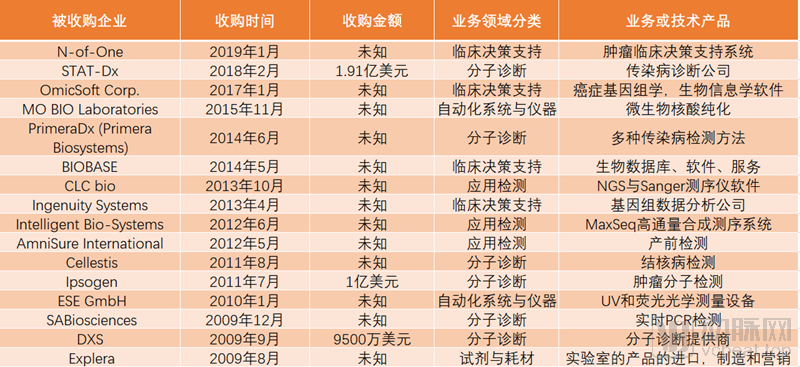
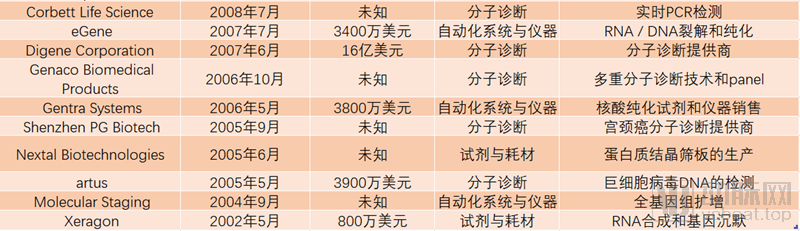
QIAGEN's Acquisition History
Among its various business segments, QIAGEN’s core operations stem from consumables sales, which account for 90% of total revenue. The stability of its customer base in these areas has secured QIAGEN a solid position in the fields of molecular diagnostics and life sciences. Additionally, QIAGEN maintains diverse business lines, including automated systems and instruments, molecular diagnostics, and applied testing. In 2019, approximately 48% of net sales were generated from the molecular diagnostics segment, while 52% came from the life sciences segment. According to forecasts by Evaluate, QIAGEN’s overall revenue is projected to grow at an annual rate of 7% through 2024. Within the molecular diagnostics sector, QIAGEN has demonstrated particularly strong performance in infectious disease molecular diagnostics. Evaluate predicts that sales in the molecular diagnostics business will grow at an annual rate of 11% through 2024.
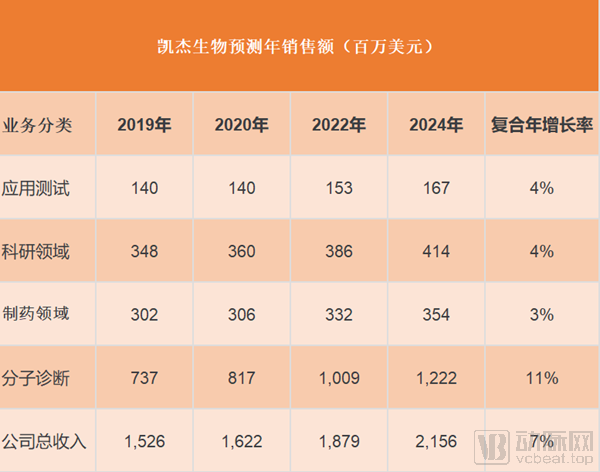
Data Source: EvaluateMedTech
Through 26 acquisitions, QIAGEN has acquired leading technologies for various infectious diseases. In 2005, QIAGEN acquired artus, whose CMV RGQ MDx Kit is the only FDA-approved product for quantitative PCR detection of cytomegalovirus (CMV) DNA in human EDTA plasma.
In October 2006, QIAGEN acquired Genaco Biomedical Products. Genaco had developed multiple test products for respiratory infections, bacterial infections, and other pathogenic infections. Genaco’s proprietary Tem-PCR technology enables the simultaneous detection of a large number of potential markers for pathogens and disease biomarkers.
In 2011, QIAGEN acquired Cellestis, gaining access to its QuantiFERON technology, which can be used for the detection of tuberculosis and cytomegalovirus. In 2017, QIAGEN’s full-year sales reached $1.42 billion, a year-on-year increase of 6%. Among these, sales of the QuantiFERON instrument, used for latent tuberculosis testing, grew by 24% in 2017. QIAGEN projected that QuantiFERON sales would exceed $300 million in 2020.
QuantiFERON-TB Gold (QFT) is the world’s first approved IGRA reagent for the auxiliary diagnosis of tuberculosis infection. Since its launch in 2001, it has undergone four iterative updates. In 2017, the FDA approved QIAGEN’s QFT-Plus, a blood test for detecting latent tuberculosis (TB) infection, cementing QIAGEN’s leading position in this field.
In June 2014, QIAGEN acquired the infectious disease testing company PrimeraDx, which possesses a range of infectious disease detection technologies, including scalable target amplification routine technology.
In the field of molecular diagnostics for infectious diseases, QIAGEN has launched an automated or semi-automated portfolio of molecular diagnostic products for pathogens including BK virus, CMV, EBV, hepatitis B virus, HCV, HIV, HSV, Mycobacterium tuberculosis, and VZV.
Since the outbreak of the novel coronavirus, QIAGEN has begun deploying its QIAsymphony modular instruments and NeuMoDx integrated PCR systems, along with SARS-CoV-2 tests developed for automated laboratories. On February 26, 2020, QIAGEN N.V. announced that it had shipped its newly developed QIAstat-Dx Respiratory SARS-CoV-2 Panel to China. The new assay kit enables detection of the novel coronavirus SARS-CoV-2 and provides rapid sample testing during public health emergencies. Meanwhile, the QIAstat-Dx test system has also been delivered to healthcare institutions in Europe, Southeast Asia, the Middle East, and other regions.
Beyond its infectious disease business, QIAGEN also holds significant potential in the molecular diagnostics field for hematologic malignancies. Francis deSouza, CEO of Illumina, once stated, “QIAGEN already possesses the commercial capability to bring products to market across many clinical areas. Collaborating with QIAGEN will accelerate our expansion of various products into diverse clinical fields.”
Since 2013, QIAGEN has successively acquired Ingenuity Systems, a genomic data software company; OmicSoft Corp., a bioinformatics software company; and N-of-One, a provider of oncology clinical decision support services. These acquisitions have expanded and strengthened its genomic databases, enhanced its bioinformatics capabilities, and solidified the position of QIAGEN Clinical Insights (QCI) as the largest genomics knowledge base to date.
In July 2011, QIAGEN acquired a 47% equity stake in its competitor, the French molecular diagnostics company Ipsogen, for approximately $100 million, and subsequently launched an offer to acquire the remaining shares. Headquartered in Marseille and founded in 1999, Ipsogen has developed a portfolio of molecular diagnostic products for hematologic malignancies, covering 15 biomarkers. Multiple products have received European Union approval, enabling cancer diagnosis, prognosis, and monitoring.
In June 2007, QIAGEN merged with the molecular diagnostics company Digene Corporation. Digene Corporation’s flagship product, the digene HPV Test, received FDA clearance in 1999 for cervical cancer screening and is considered the gold standard for detecting human papillomavirus (HPV), the causative agent of cervical cancer.
These acquisitions in the fields of bioinformatics and oncology molecular diagnostics have enabled QIAGEN to establish a strong presence in bioinformatics, HPV testing, and hematologic malignancy testing. QIAGEN’s molecular diagnostic products cover the entire continuum of care: screening of asymptomatic individuals (prevention), diagnosis of patients with suspected diseases, and treatment optimization for confirmed cases (personalized medicine).
At the preventive level, QIAGEN, following its merger with Digene Corporation, has become a leading enterprise in the HPV testing field with its digene HPV test technology. HPV testing represents one of the largest and fastest-growing markets in women’s health, which QIAGEN expects to exceed $1 billion.
At the diagnostic level, QIAGEN currently offers more than 80 molecular diagnostic test products, over 40 of which have received CE marking. QIAGEN’s portfolio includes assays for detecting individual pathogens, such as influenza virus, HIV, or HCV, as well as multiplex tests capable of simultaneously detecting multiple different pathogens in a single run, such as the assay for 15 hematologic malignancy biomarkers acquired through its purchase of Ipsogen.
At the level of personalized medicine, QIAGEN offers 20 diagnostic test products based on diverse technologies. For example, these tests can detect mutations associated with common side effects of AIDS therapies, as well as tumor biomarkers such as B-RAF (expressed in melanoma, lung cancer, and thyroid cancer), EGFR (expressed in non-small cell lung cancer), and PI3K (expressed in colorectal, breast, liver, lung, central nervous system, and genitourinary tumors).
From Thermo Fisher Scientific’s perspective, the acquisition of QIAGEN can bolster its diagnostics business, particularly by addressing weaknesses in molecular diagnostics for infectious disease testing. Compared with healthcare giants such as Siemens Healthineers (with $460 million in molecular diagnostics sales in 2019) and Danaher ($650 million in molecular diagnostics sales in 2019), Thermo Fisher still lags in this segment, reporting $340 million in molecular diagnostics sales in 2019.
Certainly, against the backdrop of rising global health risks from infectious diseases, QIAGEN’s first-mover advantage in specialized molecular diagnostics for oncology and infectious diseases will undoubtedly make it a favored partner among healthcare giants.