

Digital CRO: An Irreversible Trend? Why Upstream Players Command $5.8 Billion Valuations
Clinical trials represent the final hurdle that drugs must clear before market approval, with their success or failure directly determining whether a medication can ultimately be marketed and sold. Consequently, pharmaceutical companies place great emphasis on clinical trials, sparing no effort in allocating resources to ensure their smooth conduct. However, amid the impact of the COVID-19 pandemic, clinical trials for conditions other than COVID-19 have encountered significant obstacles. Comprehensive isolation measures have severed physical contact between investigators and participants, severely affecting patient follow-up visits, medication dispensing, and treatment adherence.
In this context, the digital clinical trial ecosystem, built upon tools such as CTMS, EDC, ePRO, and PV, enables the online flow of information between subjects and investigators, ensuring the steady progress of clinical trials during the pandemic. It is the digital CRO industry that provides these digital services. The acquisition of a leading upstream company in this sector in mid-2019 for $5.8 billion (approximately RMB 41.2 billion at the current exchange rate) further indicates that the industry has already achieved a considerable scale.
So why has digital CRO become a future trend? How exactly does digital CRO empower every stage of clinical trials? And what specific measures did they implement during the pandemic?
With the formal implementation of the new Drug Administration Law, the Marketing Authorization Holder (MAH) system has been officially rolled out nationwide. The clarification of responsible entities has once again drawn widespread attention to the CRO industry, which is closely tied to innovative drug R&D.
The CRO sector is generally divided into two segments: preclinical CROs and clinical CROs. Preclinical CROs primarily assist pharmaceutical companies in completing preclinical drug development; only drugs that pass preclinical research proceed to clinical trials. Clinical CROs, on the other hand, address pharmaceutical companies’ needs for clinical trials by leveraging their expertise in trial design and organization to help these companies conduct higher-quality clinical trials more quickly and at lower cost.
In the preclinical CRO sector, we have witnessed the rapid rise of many domestic enterprises, such as WuXi AppTec, Pharmaron, and Medicilon. However, when measured by market capitalization alone, companies in China’s clinical CRO sector still lag significantly behind the leading players in the preclinical CRO space.
From a global perspective, the two largest CRO companies in the world, Covance and IQVIA, both derive their primary revenue from clinical-stage CRO services. According to IQVIA’s recently released 2019 annual report, its total revenue in 2019 approached $11 billion, with R&D Solutions contributing $5.788 billion, accounting for more than half of its total revenue.
With the development of China’s innovative drug industry, there will be an increasing demand for clinical trials. Meanwhile, following China’s accession to the ICH, more global clinical trials are incorporating sites within China. These factors indicate that the domestic clinical trial market is continuously expanding, which undoubtedly presents a significant opportunity for the clinical CRO sector.
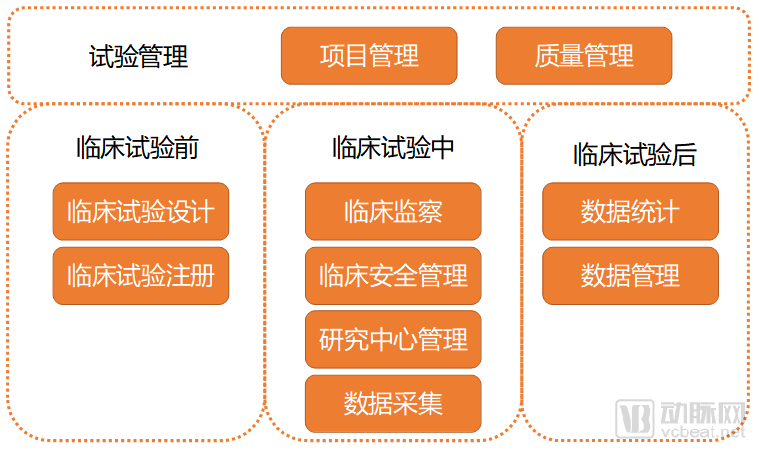
Many people may not understand how the professional capabilities of a clinical CRO can support an entire clinical trial. In reality, from clinical trial design and execution to post-trial data management, there is a complex system of Standard Operating Procedures (SOPs). China promulgated the Good Clinical Practice (GCP) for Drug Clinical Trials in 2003 as the regulatory framework for clinical trials, which has remained in effect ever since.
Throughout the overall clinical trial process, in addition to investigators and subjects, a large number of other personnel are also involved.
Pre-clinical trial design and regulatory submission activities are managed by a specialized medical team, which must possess thorough familiarity with relevant clinical trial regulations and ensure the scientific rigor, completeness, and safety of the trials.
Various personnel are involved in different aspects of clinical trial execution, such as Clinical Research Associates (CRAs) who ensure that trials operate in compliance with regulations, Quality Assurance (QA) auditors who oversee and manage the clinical trial process, and Clinical Research Coordinators (CRCs) who participate in and coordinate trial progress. All these relevant personnel must be familiar with and understand the Standard Operating Procedures (SOPs) for clinical trials to ensure their successful completion.
Upon completion of the clinical trial, a specialized team shall conduct statistical analysis, data structuring, and related analyses of the clinical trial data in accordance with authorized protocols, ultimately drawing conclusions for the clinical trial.
Therefore, the successful execution of a clinical trial requires not only the participation of healthcare professionals and patients but also robust support from an extensive clinical trial team behind the scenes. For most pharmaceutical companies, establishing a complete in-house clinical research team would entail prohibitive costs, which is precisely where the value of clinical Contract Research Organizations (CROs) lies.
Our analysis of clinical CROs reveals that the industry is heavily labor-intensive. Wherever there is significant manpower involvement, there are opportunities for digital solutions to add value. In fact, digital tools are playing an increasingly important role in clinical trials, and it is digital CROs that provide these services.
The client base of digital CROs extends beyond pharmaceutical companies to include clinical CROs and clinical trial institutions (primarily hospitals). By leveraging digital technologies, digital CROs empower these stakeholders in clinical trials, enhancing the accuracy, safety, and efficiency of trials, ultimately achieving a win-win outcome for patients, pharmaceutical companies, clinical trial institutions, and other parties involved.
On the global stage, digital CROs are no longer a novel concept. The industry features both clinical CRO giants like IQVIA and startups such as Science37. Although China started later in this field, its digital CRO sector has seen rapid growth in recent years, with several companies already achieving notable success.
IQVIA stands as a benchmark case in the digital transformation of clinical CROs. Its predecessor, Quintiles, consistently focused on the digital transformation of the CRO industry during its merger and acquisition activities. For instance, the 2011 acquisition of Outcome Sciences, an observational research company, and the 2014 acquisition of Encore Health Resources, an electronic health record (EHR) implementation and consulting firm, demonstrated Quintiles’ forward-looking vision in driving digital advancement within the CRO sector.
Following the merger of Quintiles and IMS Health to form IQVIA, the company has continued to ramp up its investments in digital transformation, such as acquiring Advanced Health Media, a cloud-based platform for clinical trials, in 2017, and investing in Cota Healthcare in 2018. In 2019, leveraging real-world evidence to help Ibrance secure a new indication marked that this clinical CRO giant had completed its digital transformation and taken the lead into the next era.
Although traditional CROs possess a strong first-mover advantage in industry resources, the gap in management systems between digital CROs and traditional CROs means that not all traditional CROs can successfully complete their digital transformation. Therefore, the current landscape of the digital CRO industry presents a prime opportunity for startups to thrive.
Science37 uses its own digital operating model, Metasite, to connect all participants in clinical trials. The core of the model isCloud Services Mobile PlatformNetwork Oriented Research Assistant(NORA)。This patient-centric platform provides services for clinical trials.Comprehensive Coverage from Patient Recruitment to Completion of Remote TrialsSupport, and the removal of geographic constraints. Through this digital operational model, Science 37 has demonstrated its ability to enhance the effectiveness and speed of clinical trials while recruiting a diverse pool of participants.
In China, some enterprises have also joined this ranks, becoming leaders in the field of digital CRO.
HLT (Happy Life Technology)is a medical artificial intelligence enterprise that providesHigh-Quality Big Data Technology and AI-Empowered Innovative Pharmaceutical Research Solutions。HLT boasts an EDC product line validated by the professional organization NNIT and a distinguished team of clinical research experts. It provides pharmaceutical companies with full-lifecycle product solutions, encompassing clinical trials, drug launch strategies, and real-world studies focused on drug safety, efficacy, cost-effectiveness, and indication expansion. These services accelerate new drug development and enhance drug accessibility.
Since its inception, HLT has been deeply committed to medical artificial intelligence, developing unique data structuring and standardization technologies. The company has built carriers and platforms featuring multiple innovative technological applications, serving numerous renowned hospitals, government agencies, and large multinational pharmaceutical companies, thereby providing clients with high-quality intelligent medical data technology solutions.
Upstream of digital CROs are technology-driven companies that provide digital clinical trial solutions. The acquisition of Medidata Solutions, a leading player in this field, by Dassault Systèmes for $5.8 billion in 2019 indirectly demonstrates that the downstream digital CRO industry has already begun to take shape.
Medidata’s founders initially identified the need for the digitization of clinical trial data, which led to the creation of OceanTek, Medidata’s predecessor, a company that developed web applications for managing clinical data.
Medidata’s final annual report prior to its acquisition showed that the company maintained a compound annual growth rate (CAGR) of 17.4% from 2014 to 2018, with total revenue reaching $636 million in 2018. Its gross margin remained consistently above 85%, while its net profit margin stayed at approximately 10%.
The key to Medidata’s success lies in its straightforward subscription model and its early foresight into cloud services. Medidata offers only subscription-based software and does not directly participate in the conduct of clinical trials. This approach broadens its target customer base, and pharmaceutical companies prefer this “contactless” service model.
At a time when internet infrastructure was still underdeveloped, many peer companies opted for a “hardware + software” service model. Medidata, however, placed its trust in the capabilities and value of cloud computing and built its own cloud service platform.
From an industry development perspective, Medidata’s cloud-based software service model focuses on digital CRO services, and its revenue data clearly indicates that this sector still holds significant growth potential.
In addition to Medidata, other foreign companies such as Phase Forward (acquired by Oracle for $685 million in 2010) and Viedoc have also been providing continuous support to digital CROs. Most of these companies were founded around the year 2000, growing amidst the global wave of healthcare digitalization and ultimately establishing a firm foothold in meeting the demands of digital CROs.
Digital solutions consistently aim to enhance clinical trials by improving the efficiency, security, standardization, and accuracy of clinical trial-related data flow. This helps reduce the burden of clinical trial management, improve trial quality and safety, and ultimately lower the cost of conducting clinical trials.
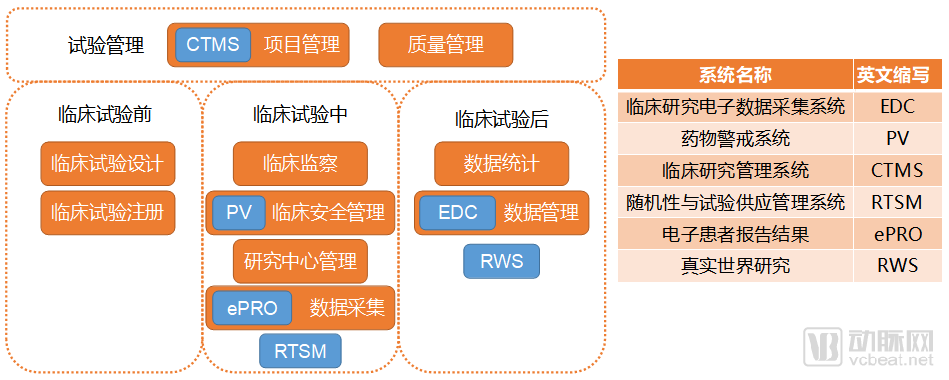
Over the past two decades, management systems for clinical trials have kept pace with digitalization, with digital solutions emerging across multiple stages of the clinical trial process.
1. Clinical Trial Management System (CTMS)
In the overall management of clinical trials, Clinical Trial Management Systems (CTMS) have become essential tools for conducting clinical trials. Relevant personnel involved in clinical trials (primarily Clinical Research Associates, CRAs) upload their monitoring-related information based on their authorization, including enrollment status, follow-up details, adverse event reports, and monitoring activities.
CTMS systems are particularly critical in multi-center clinical trials, as they enable the interconnection of information across multiple sites and deliver it in real time to clinical trial managers based on authorization. This online information transmission method significantly streamlines the workload of project managers and administrators.
CTMS is the overall management system for clinical trials, which often integrates functions relevant to specific use cases. Since all work related to CRAs is stored and reported through the CTMS system, many CTMS systems also integrate performance management features.
2. Pharmacovigilance System (PV)
Clinical safety management encompasses multiple aspects, including subject inclusion criteria, trial preparation, and subjects’ mental health, with pharmacovigilance (PV) being the most critical component. Pharmacovigilance activities extend from the clinical trial phase of a drug through to its post-marketing stage. The newly revised Drug Administration Law explicitly states that “the State shall establish a pharmacovigilance system to monitor, identify, assess, and control adverse drug reactions and other harmful reactions associated with drug use.”
Pharmacovigilance systems enable enterprises to collect, store, analyze, and utilize drug-related information online, assist in risk control and clinical trial management, and even generate individual case safety reports (ICSRs) for electronic submission in compliance with the requirements of national regulatory authorities.
3. Electronic Patient-Reported Outcomes (ePRO)
Patient-Reported Outcomes (PROs) represent a novel category of outcomes that have gained prominence in recent years as part of the shift toward patient-centered care. The U.S. Food and Drug Administration (FDA) defines PROs as “any report coming directly from patients about how they feel or function in relation to a health condition and its therapy.” In clinical practice, PROs are typically employed for indicators that are either well understood by patients or more readily assessed from the patient’s perspective. Common approaches include evaluating patients using PRO scales, with data collected through self-administered questionnaires, face-to-face interviews, or telephone interviews.
Electronic Patient-Reported Outcomes (ePRO): It is evident that ePRO shifts the offline processes of PROs to an online platform, enabling the assessment of patient-reported outcomes to be completed digitally. The widespread adoption of smartphones has made ePRO systems more convenient. Patients need only download a mobile application to independently complete PRO data collection or do so in consultation with their physicians.
4. Electronic Data Capture (EDC) System for Clinical Research
Electronic Data Capture (EDC) System for Clinical Research is a platform software designed for the collection and transmission of clinical trial data. It has been widely adopted abroad, replacing traditional paper-based case report forms.
Paper-based Case Report Forms (CRFs) lack sufficient reliability and security, and the prolonged cycles for data collection and subsequent statistical analysis significantly impede the progress of clinical trials. The emergence of electronic CRF (eCRF) systems has transformed paper-based case records into online databases. Electronic Data Capture (EDC) systems offer a broader scope, incorporating additional functionalities such as randomized drug dispensing systems, drug transportation management systems, and sample management systems. After Clinical Research Coordinators (CRCs) enter the relevant information into the EDC system according to the required format, other clinical trial participants can access and review the data on the system at any time.
5. Randomization and Trial Supply Management System (RTSM)
RTSM systems have evolved rapidly in recent years with the widespread adoption of double-blind trials. Due to the opacity of information in double-blind trials, a dedicated system is required to ensure accuracy during trial execution. RTSM systems facilitate key functions in clinical trials, including patient randomization, drug allocation, and drug resupply.
6. Real-World Study (RWS)
Empowered by big data, real-world studies (RWS) have developed rapidly and have now become a critical component of drug research. Data collected from studies involving clinical populations constitute the primary component of real-world data (RWD), while RWS based on RWD has emerged as a key element in pharmaceutical research. It can be used to guide clinical trial design, precisely identify target populations, and conduct post-marketing drug re-evaluation and indication revisions. Real-world evidence (RWE), appearing as a supplement to clinical trial evidence, plays a significant role in facilitating drug approval processes.
How to Conduct Clinical Trials Smoothly Amid the Tightening Epidemic?
Clinical trials related to COVID-19 have been proceeding in an orderly manner; however, the situation for other clinical trials remains grim under the shadow of the pandemic. How should physicians conduct follow-ups? How can patients obtain their medications? How can patient adherence be ensured? These have become urgent issues to address in clinical trials. In this context, digital CROs have immediately demonstrated their value, facilitating the orderly conduct of clinical trials during the pandemic.
HLT (Happy Life Technology) recognized early in the pandemic’s development the potential impact on clinical trials and immediately initiated its first task: a risk assessment related to the pandemic.
In light of the characteristics of the current epidemic, HLT has assessed and updated the risks associated with relevant clinical trial components, such as the impact of enrollment pauses on timelines; large-scale protocol deviations resulting from local patient testing; potential pneumonia-related adverse events (AEs) or serious adverse events (SAEs) in specific regions; and the impact of home isolation on compliance. These issues have been influenced to varying degrees by the special circumstances during the epidemic, making it essential for sponsors to promptly understand their potential implications.
Following a comprehensive assessment, HLT promptly communicated and provided training to the sponsor, project team members, and management regarding the impact of the pandemic and the revised project plan through online channels such as remote conferences. Meanwhile, HLT continuously monitored the execution of clinical trials and reported progress to the sponsor.
“HLT holds distinct advantages in the IT sector. By leveraging multiple internal management systems, including a Clinical Trial Management System (CTMS), an Electronic Data Capture (EDC) system, and an electronic Trial Master File (eTMF) system, the company maintained high operational efficiency during the pandemic,” Mr. Wang Guobin, Vice President of Clinical Operations at HLT, told VCBeat.
During the pandemic, the most critical measure was to minimize personnel gatherings. For projects in their initiation phase, HLT actively communicated with various centers to facilitate remote project establishment and ethics submissions, thereby advancing project timelines appropriately while reducing interpersonal contact and gatherings.
For patients already enrolled, visits and re-consenting must be completed while avoiding congregation, with comprehensive documentation of their relevant diagnosis and treatment. Based on project progress, HLT leverages a digital clinical trial management platform (including EDC, CTMS, ePRO, etc.) to implement intelligent remote management. By utilizing software for online monitoring of patient compliance and follow-up, HLT strives to maximize subject medication safety and therapeutic benefit, thereby minimizing subject dropout and protocol deviations.
Leveraging its expertise in electronic data capture and processing for clinical trials, remote monitoring, and algorithm-driven digital auditing, HLT has also opened up additional digital value-added services to its partners. “HLT’s eSource technology enables clinical trial sites to automatically transfer patient diagnosis and treatment data from Hospital Information Systems (HIS) and Electronic Medical Records (EMR) into Electronic Data Capture (EDC) systems. Clinical trials utilizing HLT’s eSource technology experienced no disruption in data collection during the pandemic. Once integrated, the entire process of clinical trial data collection and quality control is conducted in the cloud. Additionally, HLT’s iGCP system effectively supported remote work at clinical trial sites during the pandemic. Services such as remote Source Data Verification (rSDV), made available to sponsors through the iGCP system, have been very well received. These solutions have adeptly addressed the needs of clinical trials under special circumstances, highlighting the value of digital CROs in facilitating clinical trial operations during the pandemic,” said Dr. Peng Tao, Chief Data Scientist at HLT.
Drug Research Society, an innovative CRO technology platform, ensured the orderly conduct of clinical trials during the pandemic by addressing information flow.
As one of the largest platforms for professionals in China’s clinical research industry, the Drug Research Society APP has long been collecting publicly available key behavioral data required for conducting clinical trials—such as updates on institutions, ethics committees, and investigators—from across China and the entire industry. This data is integrated to form a Clinical Research Decision Support Database, which is openly shared with all industry practitioners via the APP, WeChat Official Account, and the Trial.Link platform. While frontline professionals contribute data, they can also conveniently access critical information needed for their work, thereby enhancing operational efficiency.
Therefore, the first initiative undertaken by Drug Research Society during the pandemic was to provide free, industry-wide access to the Trial.link Clinical Study Portal and the Clinical Research Decision Support Database starting February 4, facilitating bidirectional online matchmaking between sponsors and clinical trial sites across the industry.
Subsequently, based on its own collected data, YaoYanShe launched the “Real-Time Map of Institutional Guidelines During the Pandemic” and the “Institutional Direct Access” column, helping the entire industry stay updated with first-hand information during the pandemic.
On the other hand, the clinical research team at Yao Yan She rapidly deployed its own remote follow-up system. “The Yao Yan She clinical research team is fully committed to addressing challenges in clinical trial projects, prioritizing the interests and safety of participants above all else. Under strict safety protocols, we strive to assist participants in completing their follow-up visits and ensure adherence to their medication regimens,” said Peng Yitian, co-founder of Yao Yan She.
On February 6, YaoYanShe launched its integrated hardware-enabled remote clinical trial solution, facilitating comprehensive interaction between investigators and participants across different locations and enabling remote patient visits. Meanwhile, investigators can access medical records and imaging data anytime and anywhere via the system platform to provide remote diagnosis and treatment.
Yao Yan She’s hardware-centric solution enables comprehensive interaction between two participating sites within the same trial, facilitating remote patient follow-up, provided that informed consent is obtained from participants and ethical and regulatory requirements are met. This approach allows investigators to assess physiological parameters that patients cannot measure or describe themselves, without the need for physical contact. Following the follow-up visit, the research center can deliver investigational drugs to participants in a timely manner via logistics providers qualified for pharmaceutical distribution, ensuring temperature-controlled transportation throughout the entire process to maintain treatment continuity.
Although the epidemic situation in China has improved, digital CROs have already demonstrated their value to domestic pharmaceutical R&D enterprises and clinical trial institutions within just two months. As clinical trials continue to expand, the overall market size of the clinical CRO industry is expected to grow further, with digital CROs exhibiting strong market competitiveness.