

Baisheng Biotech Files IPO Prospectus: Empowering Oncology Pathology Diagnosis with IHC and TCT Solutions
Pathological examination of tumors has long been the gold standard for cancer diagnosis. Pathology provides clinicians with far more information than a simple binary determination of cancer presence. Through pathological analysis, physicians can directly ascertain multiple dimensions of information, including the origin of cancer cells, degree of malignancy, and extent of spread. By delivering precise pathological data, this process plays a critical role in guiding patient treatment and prognosis.
Tumor pathological testing can be achieved through immunohistochemistry (IHC), a technique that utilizes antigen-antibody reactions to perform localization, qualitative, and quantitative analysis of specific protein components in tissue sections. In routine tumor pathological diagnosis, approximately 15% of cases are difficult to diagnose definitively based solely on hematoxylin and eosin (H&E) staining. These indeterminate cases require further testing via immunohistochemistry, which can achieve an accuracy rate of over 90%. Consequently, the practical value of immunohistochemistry in tumor diagnosis and differential diagnosis has been widely recognized.
“However, China’s oncology pathology testing and diagnostic technologies are generally at a relatively basic stage,” said Tan Ruizheng, founder of Baisheng Biological. “Moreover, there is a significant shortage of pathology professionals in our country.” Dr. Tan holds a degree in Business Administration from Toulouse Business School in France and has 18 years of experience in the pharmaceutical and medical device industries, with a strong focus on R&D innovation, technological advancement, and management reform. During his studies in France, Dr. Tan engaged in extensive academic collaborations in pathology with the Medical Innovation Centers of Toulouse University and Toulouse Business School.
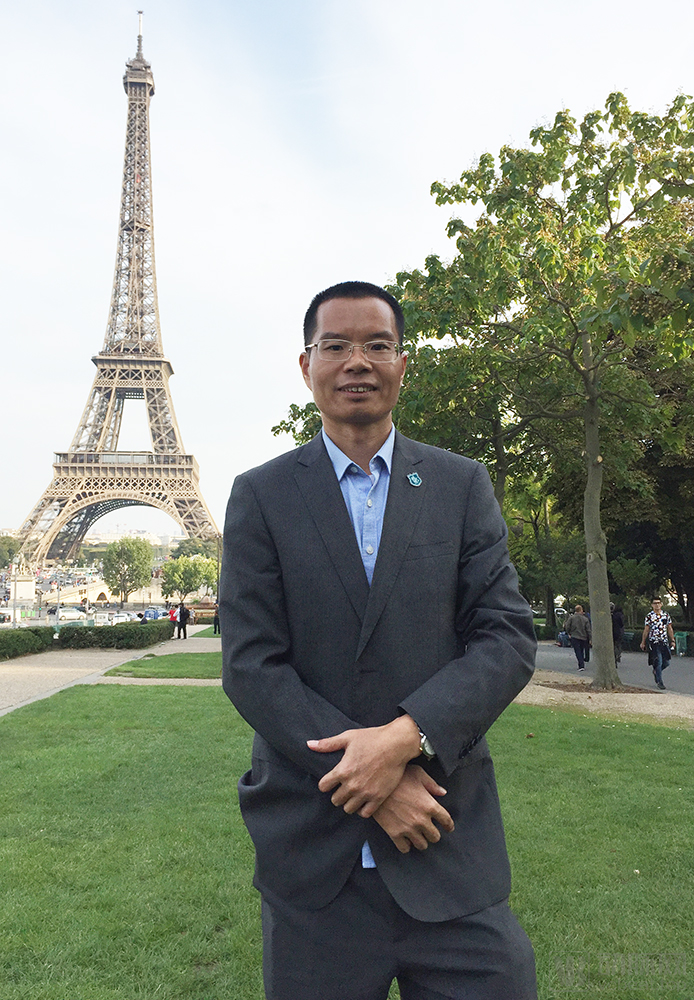
Baisheng Biologicals Founder, Tan Ruizheng
Baisheng Biotech is Tan Ruizheng’s second entrepreneurial venture. Previously, he served as Deputy General Manager of Guangzhou Yuanda Pharmaceutical Technology Co., Ltd., accumulating extensive experience in pharmaceutical sales management and operational management. Baisheng Biotech, fully named Baisheng (Guangzhou) Biological Products Co., Ltd., is a biotechnology company specializing in immunohistochemistry, molecular pathology, and genetic diagnosis. The company exclusively provides diagnostic instruments for tumor pathological diagnosis along with their corresponding reagents. Currently, 263 of its products have obtained production licenses from the China Food and Drug Administration (CFDA).
“The market potential for pathological diagnosis is substantial; the immunohistochemistry segment alone is valued at RMB 12 billion,” said Tan Ruizheng. “This market is growing at an annual rate of approximately 15%, and many niche areas remain underdeveloped. For instance, molecular pathology and genetic testing are currently concentrated in top-tier tertiary hospitals, but their expansion to county-level hospitals is inevitable. Given the year-on-year rise in cancer incidence in China, and the fact that definitive cancer diagnosis relies on pathological examination, this represents a significant industry opportunity.”
Immunohistochemistry helps physicians determine whether a patient has a tumor, identify the tumor type, and guide treatment decisions and selection of therapeutic modalities. The high efficiency, high quality, low cost, and low failure rate of immunohistochemistry testing instruments are critical to the timeliness and accuracy of each test, enabling pathologists to obtain accurate information promptly, accelerate the issuance of pathology reports, and reduce patients’ waiting time for results.
Complementing its portfolio of hundreds of immunohistochemistry (IHC) reagents for tumor pathology, Baisheng Biological has developed two core staining instruments: the “BMark Fully Automated IHC Stainer” and the “BMart Fully Automated Special Stainer.”
The fully automated immunohistochemistry (IHC) stainer, BMark, can simultaneously process 240 tissue sections in a single run, achieving an efficiency eight times that of imported instruments. Its staining time is significantly shorter than that of comparable products, with the entire procedure completed within three hours. Tan Ruizheng briefly explained the underlying principle: “Unlike conventional horizontal slide placement, our BMark fully automated IHC stainer adopts an inclined vertical orientation for slides, allowing more slides to be accommodated within the same footprint, thereby enabling the simultaneous processing of several times the sample volume.”
Furthermore, to achieve more efficient sample detection, Baisheng Biological’s BMark fully automated immunohistochemistry stainer employs a multi-channel robotic arm for liquid handling. Compared with conventional stainers operated by single-channel robotic arms, this design improves efficiency by more than fourfold. In addition to the increased number of liquid-handling channels, Tan Ruizheng highlighted another factor contributing to the high efficiency of the BMark fully automated immunohistochemistry stainer: Baisheng’s robotic arms have abandoned the traditional “motor-driven movement” approach and instead incorporate AI intelligence, utilizing more precise rail-based parallel motion technology. This enables rapid and accurate liquid handling while maintaining a very low failure rate.
According to Tan Ruizheng, the BMark fully automated immunohistochemistry stainer can reduce reagent costs by 30% and labor costs by 75%, with an overall machine failure rate significantly lower than that of similar products, not exceeding 1%.
“Baisheng Bio’s ‘BMark Fully Automated Immunohistochemistry Stainer’ employs a novel secondary antibody technology, incorporating multiple small-molecule enzymes for layered reactions. This ensures precise chromogenic localization, uniform coloration, and clean backgrounds in immunohistochemistry, thereby avoiding diffuse and spread-out staining,” said Tan Ruizheng. “The BMart Fully Automated Special Staining System addresses 99% of staining needs, reduces labor costs by 80%, and improves staining quality by three to fourfold.”
For specific cancer types, Baisheng Biological’s diagnostic reagents enable precise, multi-dimensional diagnosis. The company has already promoted its various diagnostic reagents to Grade A tertiary hospitals across China, including the Second Affiliated Hospital of Guangzhou Medical University, Nanfang Hospital, Chongqing 985 Hospital, Sanjiu Brain Hospital, the Affiliated Hospital of Southwest Medical University, and Baoding No. 2 Central Hospital, among others, and has achieved profitability.
Tan Ruizheng estimates that in five years, the penetration rate of immunohistochemistry instruments will reach 80%, with 80 million slides processed annually and a market value of RMB 30 billion, indicating enormous market potential. In the field of special staining, the current market size is RMB 1.2 billion, with an annual growth rate of 20%. In five years, as the industry shifts toward instrument-based staining, the market capacity is expected to reach RMB 2.5 billion, demonstrating significant development potential.
In terms of business model, Baisheng Company primarily adopts a direct sales approach, targeting high-quality benchmark hospitals with payment terms of 3 to 6 months. The goal is to maximize profits and enhance brand value. As a supplementary strategy, the company utilizes agency distribution, leveraging local distributors’ extensive resources to rapidly expand market reach. This channel operates on a cash-on-delivery basis to ensure healthy corporate cash flow. Agency distribution mainly focuses on regions such as Northwest China, Northeast China, and Western China.
Baisheng Biological is located in the Nansha Industrial Incubator of Guangdong Medical Valley, a hub for industrial clusters. The company holds Class I medical device manufacturing qualifications and has filed records for 263 products. Its core team comprises pathology professionals with postdoctoral, doctoral, and master’s degrees, as well as overseas-educated experts. The company has applied for two invention patents and six utility model patents. Focusing on the pathology industry, Baisheng Biological has launched the world’s first high-throughput immunohistochemistry stainer, revolutionizing traditional immunohistochemistry technology.
Regarding the decision to establish operations at Guangdong Medical Valley, Tan Ruizheng also shared his considerations: “Guangdong Medical Valley employs an advanced operational model and has a dedicated team for efficient coordination. The park addresses numerous issues for settling startups, including environmental protection, fire safety, and hazardous waste disposal, which would otherwise be time-consuming and labor-intensive for companies to handle on their own. With the park’s support, startups like ours can operate with greater ease and confidence, free from many concerns.”
It is reported that Baisheng Biological has launched a new round of financing, aiming to raise RMB 30 million. The proceeds will be primarily used for purchasing instruments, recruiting high-end talent, product research and development, market promotion, and other related activities.