

Yizhun Intelligence Secures Nearly RMB 100 Million Series B Funding to Accelerate AI Medical Product Development and Commercialization
MEDICAL AI
AI-Assisted Medical Imaging Diagnosis System Developer
VCBeat (WeChat ID: vcbeat) has learned that Beijing Medical Standard Intelligent Technology Co., Ltd. (abbreviated as MEDICAL AI), a medical imaging AI company, has completed its Series B financing round of nearly RMB 100 million. This round was led by the Wondfo Industrial Fund managed by Sanmei Investment, with participation from Xiaomiao Langcheng, existing shareholders Hannon Venture Capital and Qingsong Fund. Tianchao Capital served as the financial advisor.
MEDICAL AI was established in November 2017 as a company specializing in artificial intelligence-assisted medical imaging diagnosis. As early as 2014, its team members began researching machine learning algorithms and applying them to computer-aided diagnosis of medical images, making them among the earliest pioneers in this field in China. During the “human-versus-machine” era of medical AI, the team participated in the LUNA16 International Pulmonary Nodule Detection Challenge and won first place, becoming the first champion team from the Asia-Pacific region.
Since its inception, MEDICAL AI has been deeply engaged in frontline clinical practice. The company has launched an intelligent pulmonary nodule detection system, an intelligent mammography detection system, and an intelligent multi-disease lung detection system. In collaboration with IBM Watson, it has also created an artificial intelligence research platform for medical imaging (the Darwin Intelligent Research Platform). Its products have been deployed in more than 400 hospitals across China.
According to MEDICAL AI, the funds from this round will be primarily invested in product research and development to expand the company’s existing AI product portfolio, enabling its AI detection systems to cover diseases across multiple organs within single anatomical regions. Specifically, MEDICAL AI will develop artificial intelligence products tailored to specific diseases based on various imaging modalities, including CT, MRI, mammography, conventional X-ray, and ultrasound. Furthermore, MEDICAL AI will provide customized imaging AI detection systems for its core strategic partners, offering differentiated product development and upgrades that precisely meet their scenario-specific needs.
In 2015, medical artificial intelligence was in its nascent stage. Engineers from various industries enthusiastically brought their algorithms into the healthcare sector, and within just one year, investors took notice of the sparks ignited by this emerging industry.
Data from VCBeat’s 2019 China Artificial Intelligence Report further validates the market’s upward trend. According to the report, a total of 49 financing deals occurred in the medical AI sector in 2019, with over RMB 7 billion flowing into this field.
Today, the AI medical imaging market is undergoing new changes. After four years of development, this niche sector has now entered a phase of deep-water complexity. As the anticipated explosion of concentrated commercialization has yet to materialize, capital is becoming increasingly cautious about this track. Early-stage investors with a preference for AI or healthcare have already been absorbed by the first wave of startups, while more conservative mid-to-late stage investors are holding their funds and waiting on the sidelines until commercialization matures.
Meanwhile, the pace of product development has lagged behind, and the survival-of-the-fittest dynamics of the medical products market have begun to emerge. While building an early-stage model is relatively easy, creating a product with genuine clinical utility for physicians is considerably more challenging. Taking pulmonary nodules as an example, there were hundreds of teams working on this technology in 2017; however, today only four or five products have achieved paid procurement by hospitals. The remaining teams are facing significant pressure.
On the other hand, market demand for AI-powered medical imaging is surging. In China, medical imaging data is growing at an annual rate of 30%, whereas the number of radiologists is increasing by only 4% per year. Meanwhile, imaging resources are unevenly distributed across regions, with significant disparities in diagnostic capabilities. Healthcare institutions are urgently seeking to enhance their access to high-quality radiology expertise. AI-assisted imaging diagnostic products primarily leverage technologies such as computer vision to enable rapid image interpretation and intelligent diagnosis, thereby addressing the fundamental pain points of healthcare institutions.
The integration of medical imaging and AI played a significant role during the pandemic. Tier-3 Grade-A hospitals on the front lines in Wuhan, temporarily constructed Fangcang shelter hospitals, and fever clinics across various regions all shouldered massive volumes of imaging analysis tasks. This sudden surge in demand exacerbated the existing shortage of radiologists. Leveraging its technological expertise in pulmonary AI, MEDICAL AI launched an “AI+CT” diagnostic product for COVID-19 within just two weeks. By deploying servers and implementing online upgrades, the company facilitated system implementation for dozens of users, significantly alleviating the diagnostic burden on radiology departments nationwide.
The upward trajectory of the medical AI imaging industry is likewise driving the growth of individual enterprises. The recent investment in MEDICAL AI by industrial capital can be viewed as another attempt by investors to facilitate the practical implementation of AI. Having weathered the pandemic, MEDICAL AI has not only accelerated product deployment but also gained greater recognition from hospitals.
。
Prior to the large-scale commercialization of AI in medical imaging, enterprises had limited options in product design and needed to rely more on R&D personnel, R&D strategies, and marketing efforts to establish industry advantages. Among these, the choice of R&D strategy is most critical, as it directly influences hospitals’ recognition of the enterprise.
In response, MEDICAL AI integrates both horizontal and vertical strategic frameworks to select the optimal R&D approach. From a horizontal perspective, MEDICAL AI prioritizes coverage of major disease categories, enabling related products to be rapidly iterated and launched into the market. Taking breast cancer as an example, MEDICAL AI has developed AI-powered products for mammography, ultrasound, and magnetic resonance imaging (MRI), providing comprehensive solutions for imaging-based diagnosis and treatment across the entire breast care continuum.
From a longitudinal perspective, MEDICAL AI emphasizes the depth of medical AI’s impact by systematically addressing practical challenges in individual anatomical regions. Taking the lungs as an example, building upon its intelligent detection of pulmonary nodules, MEDICAL AI has integrated six common pulmonary diseases into a single system, covering the vast majority of pulmonary lesions and enabling AI to detect lung abnormalities with physician-like proficiency. AI solutions designed through this model align more closely with clinical diagnostic and treatment workflows, thereby naturally enhancing hospital stickiness to the enterprise.
Supported by two core approaches, MEDICAL AI has developed diagnostic systems including an Intelligent Pulmonary Nodule Detection System, an Intelligent Mammography Detection System, and an Intelligent Multi-Disease Lung Detection System. Building on this foundation, the company collaborated with IBM to launch the “Darwin Intelligent Research Platform,” an AI-powered scientific research platform. The Intelligent CT Lung Detection System can automatically annotate multiple types of lung lesions, providing metrics such as location, maximum diameter, volume, and benign/malignant status. The Intelligent Mammography Detection System achieves comprehensive breast disease screening within 20 seconds, with a lesion detection rate of 93% and a benign/malignant classification accuracy of 94%. It provides physicians with complete, structured text-and-image reports for AI-assisted breast diagnosis, including BI-RADS categorization and benign/malignant analysis, significantly improving screening efficiency. The Darwin Intelligent Research Platform enables physicians to rapidly conduct omics and deep learning research. Its integrated design for annotation, modeling, and validation substantially lowers technical barriers, while rich chart visualizations and statistical metrics enhance the depth and professionalism of academic publications.
Nowadays, MEDICAL AI has obtained NMPA approval, and its products have been deployed in more than 400 hospitals across China.
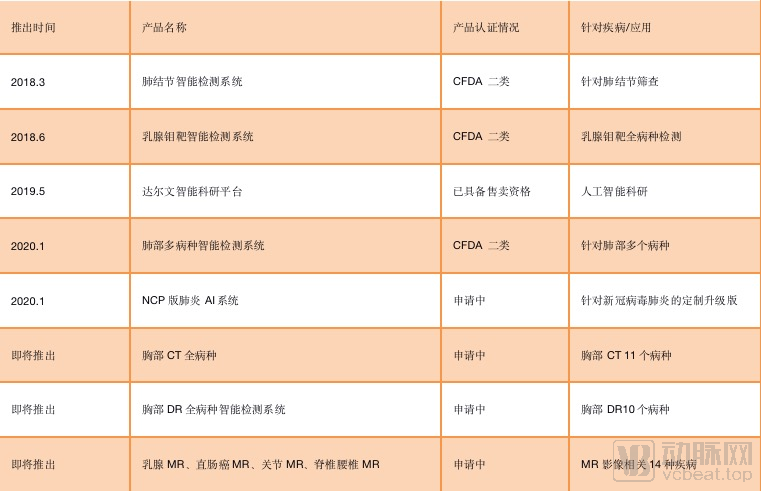
Current Status of MEDICAL AI Products
Lu Chenchong, Founder and CEO of MEDICAL AI, told VCBeat: “AI medical imaging has entered deep waters. How do we navigate through them? I believe we must firmly leverage MEDICAL AI’s two core advantages to solidify our commercialization efforts. The first is our robust R&D team. All three products launched in 2019 have generated revenue, fully demonstrating our R&D team’s ability to deliver market-ready solutions. In other words, every product developed has been successfully commercialized—a rare achievement. The second advantage is our commercialization team, composed of veterans from the medical imaging industry. This team possesses profound market insights, a deeper understanding of customers and distribution channels, and achieves a penetration efficiency akin to one person doing the work of ten, enabling rapid product commercialization. These two strengths are the core reasons why we are favored by the capital market. I am confident that by steadfastly leveraging these advantages, we will navigate the deep waters, learn to swim, and thrive in the vast blue ocean of AI medical imaging.”
It is worth noting that the investor in this round, Sanmei Investment, is a form of industrial capital. Industrial capital possesses the advantage of deep industry understanding, enabling it to integrate resources along the vertical axis of the industrial value chain, pursue horizontal expansion through mergers and acquisitions based on considerations of scale and risk diversification, or make forward-looking layout across the industrial chain driven by strategic transformation needs.
Regarding this financing round, Sanmei Investment stated: "Medical AI is a key investment focus for Sanmei Investment. Against the backdrop of uneven distribution of high-quality medical resources and the accelerated implementation of tiered diagnosis and treatment, the application of medical artificial intelligence has brought new directions and momentum to the healthcare sector. We remain optimistic about the application prospects and market demand for AI in medical imaging and assisted diagnosis. In just over two years since its establishment, Medical Standard Intelligence (Yizhun Intelligent) has built a diverse product portfolio and achieved outstanding performance in product iteration, market expansion, and commercial deployment, earning recognition from top-tier hospital clients and healthcare industry partners. Through this investment in Medical Standard Intelligence, we are bullish on its entrepreneurial team, which is deeply committed to the industry and possesses balanced core competencies, as well as its potential to grow into a leading enterprise in medical AI. We believe that through continuous innovation, the company can deliver ultimate technology, products, and solutions to healthcare customers. Meanwhile, Sanmei Investment will leverage its extensive industry and industrial resources to empower and facilitate the business development of Medical Standard Intelligence."
Xiaomiao Langcheng, the co-investor, believes that the medical imaging AI industry has a market potential of tens of billions, with individual disease markets reaching several billion. The sector boasts high gross margins and highly standardized products, offering significant growth prospects. The decision to invest in MEDICAL AI was based on the founding team's multifaceted advantages in industry understanding, industry resources, and talent acquisition. Within just two years of establishment, the company achieved commercialization ahead of competitors, ranking among the top tier in terms of product line diversity and installation volume, while maintaining parity or even a leading edge in product technology.
Liu Xiaosong, Partner at Qingsong Fund, stated: “Our investment in MEDICAL AI is the result of Qingsong’s 10,000 hours of industry research.” The Qingsong team began tracking MEDICAL AI as early as the seed round, spent two years conducting in-depth industry research, and ultimately made the investment. Facts have proven that although MEDICAL AI entered the market later than its competitors, it quickly overtook them on the curve, demonstrating strong future potential!