

Yijin Health: Empowering Hospitals with 5G-Enabled Dynamic Temperature Monitoring System and Innovative Insurance Solutions for Healthcare Worker Safety
On the morning of January 23, Ge Dongfei, Technical Manager at Yijin Health, was roused from his sweet dreams by a ringing phone in a residential community in Pinghu City, Zhejiang Province. Still groggy, he lost all traces of sleepiness after answering the call. General Manager Chen Jing instructed him: “Get ready to deploy to the front lines at any moment!”
It turned out that Chen Jing had just received a call from the Shanghai Public Health Clinical Center (hereinafter referred to as the “Public Health Center”), requesting Yijin Health to rapidly install its intelligent temperature monitoring systems at the center on a large scale. As one of the first designated centralized isolation and treatment facilities for novel coronavirus pneumonia in Shanghai, the Public Health Center sought to deploy Yijin Health’s intelligent temperature monitoring system hospital-wide as soon as possible to mitigate risks such as infection.
In fact, the intelligent monitoring system developed by Yijin Health can monitor vital signs such as body temperature, blood oxygen saturation, electrocardiogram (ECG), heart rate, respiration, and sleep. During the pandemic, the most widely used component was the body temperature monitoring module. To expedite the installation of the intelligent system at the Public Health Center, Chen Jing urgently recalled the company’s management team from their holidays and rushed to Shanghai.
"The epidemic is a command, and prevention and control are our responsibilities—this is not just an empty slogan. After receiving the notice, Ge Dongfei comforted his worried wife, kissed his newborn child, and then headed to the Shanghai Public Health Clinical Center. Ge Dongfei said, 'When I was about to leave, my mother held my hand and shed tears, but what could I do? In the face of the epidemic, we must contribute whatever we can.'"
Upon learning of the situation, Chen Jing was filled with remorse. Her voice choking with emotion, she told VCBeat, “Even now, recalling this incident fills me with sorrow. I am truly sorry to the elderly patient.”
The installation task was under an extremely tight deadline. At 3:00 PM that day, after confirming the requirements with the Public Health Center, Yijin Health immediately contacted its upstream and downstream partners to urgently procure Bluetooth repeaters and other necessary supplies. By 9:30 PM, the Yijin Health team began the formal installation of the equipment and system.
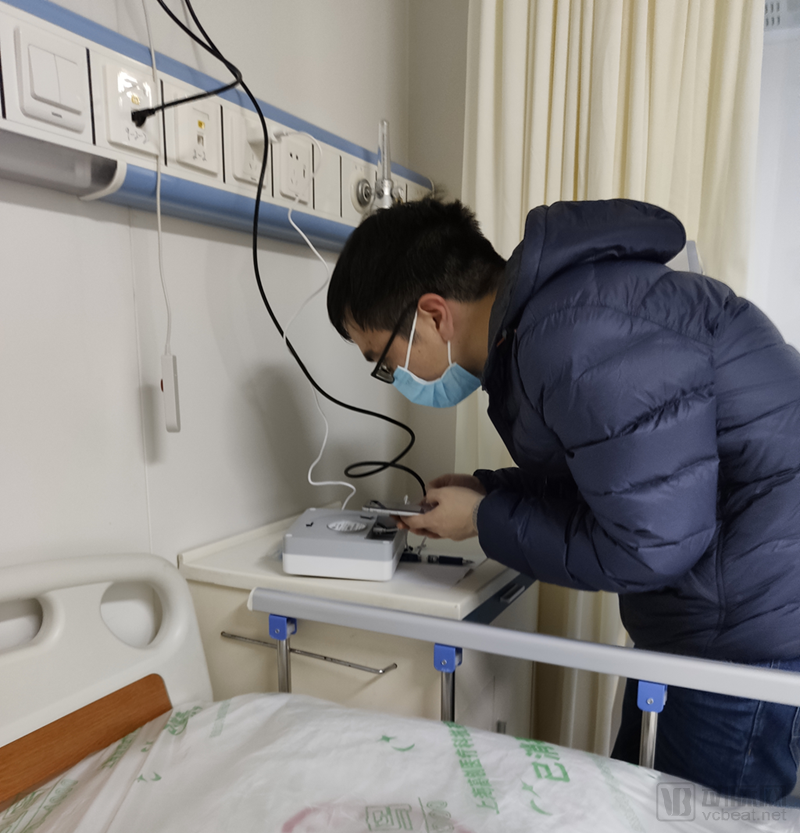
Yijin Health Team Installs and Debugs Equipment; Photo Provided by the Company
Chen Jing stated, “This is our first time working with negative-pressure isolation wards, which presents certain technical challenges and an extremely tight timeline. We must have all equipment and systems installed and operational before the first batch of patients arrives. As we had not previously conducted pilot deployments in negative-pressure wards, we were uncertain whether the original deployment plan would be affected by signal interference in such environments or whether the system’s stability would withstand these challenges. To address this, we doubled our investment in manpower, material resources, and equipment.”
Fortunately, the results were satisfactory. By 2:30 a.m., the installation tasks in Ward A3 of the Public Health Clinical Center had been completed, and the system was operating smoothly. The Yijin Health team could not afford to rest; they rushed back to Hangzhou by 3:00 a.m. to prepare the next batch of supplies. With their task list fully booked, they had to go all out.
As of now, Yijin Health has deployed more than ten systems for public health centers. Around the Spring Festival, Yijin Health joined forces with its partner, Weiling Information, to deploy the system at multiple medical institutions, including Dongyang People's Hospital, Shengzhou First People's Hospital, Zhengzhou No. 1 People's Hospital Infectious Disease Hospital, and Ningxia Maternal and Child Health Hospital.
The installation of the intelligent monitoring system provides healthcare staff at the Public Health Center with an added layer of protection: they can monitor patients’ body temperatures in real time without physical contact. This significantly reduces the risk of infection among healthcare workers.
“By simply attaching Bluetooth temperature patches to patients’ axillae, their body temperature data is transmitted in real time to the nurses’ computers,” introduced Zhang Lin, Deputy Director of the Nursing Department at the Public Health Clinical Center. “Yijin Health’s intelligent monitoring system can connect to dozens of Bluetooth temperature patches.”
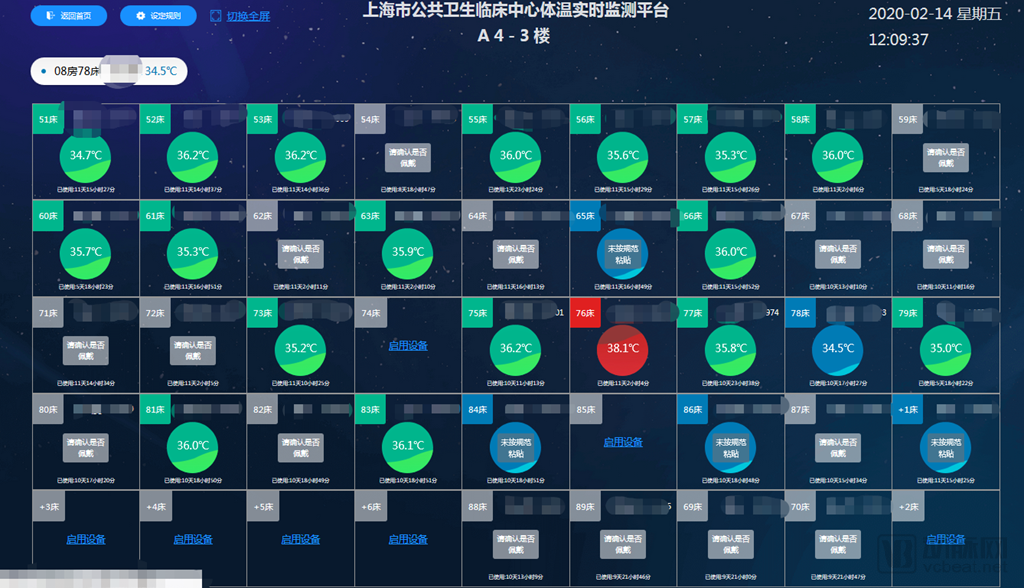
Public Health Center Real-Time Body Temperature Monitoring Platform
With this system, medical staff can monitor each patient’s temperature changes in real time without frequently entering and exiting the ward. If a patient’s temperature exceeds the preset threshold, the system will automatically issue an alert to the medical staff.
Chen Jing stated, “Without the intelligent monitoring system, healthcare workers would need to don isolation gowns to frequently measure patients’ vital signs, such as body temperature. This not only consumes their physical energy but also increases the risk of exposure. By contrast, the intelligent monitoring system not only reduces the risk of infection between medical staff and patients but also enables healthcare workers to better manage patient care. Furthermore, according to estimates from the Public Health Center, the deployment of this system is equivalent to increasing the healthcare workforce by 20%.”
To date, the Public Health Center has achieved zero infections among its medical staff. Yijin Health’s intelligent monitoring system has contributed to this accomplishment.
Furthermore, Yijin Health has partnered with China Potevio to leverage its 5G technology in developing the “5G Dynamic Body Temperature Monitoring System.” This system uploads aggregated temperature monitoring data to a smart healthcare data acquisition platform, enabling advanced analysis and management of epidemic-related data.
The 5G Dynamic Body Temperature Monitoring System integrates multiple advanced technologies, including wireless electronic flexible temperature patches, 5G transmission technology, and a smart healthcare data cloud platform, to enable remote body temperature monitoring for patients. Currently, the system has been deployed in community epidemic prevention, enterprise resumption of work, and centralized quarantine settings in cities such as Tianjin and Chongqing.
Chen Jing stated, “Yijin Health’s recent initiative has set two precedents in the vital signs monitoring industry. First, we have pioneered the commercial application of domestic flexible materials in the medical field. Second, we have explored with China Potevio the application of 5G technology in intelligent monitoring.”
In fact, Yijin Health has consistently positioned itself as a technology-driven health insurance service provider. The implementation of intelligent monitoring aims to better serve hospitals and patients. In addition to intelligent monitoring, Yijin Health also provides patients with services such as a perioperative patient management system, mobile hospital platforms, and laboratory test result interpretation.
Among these, the perioperative patient service system provides preoperative education, surgical tracking, and postoperative guidance for patients. The system delivers content through text, images, and other media to help patients and their families gain a comprehensive understanding of the surgical procedure, recognize surgical risks, and effectively cooperate with medical staff. Meanwhile, healthcare professionals can use the system to conduct preoperative psychological assessments and address patient inquiries, thereby improving work efficiency and reducing workload. Chen Jing stated, “Currently, this system is being piloted at the Shanghai Public Health Clinical Center. We will continue to refine the product and expect to roll it out nationwide in the second half of this year.”
Mobile Hospital provides users with medical and health information services, such as appointment scheduling, report inquiries, physician consultations, inpatient services, and post-discharge follow-up. Laboratory result interpretation leverages technologies like artificial intelligence to rapidly establish personal electronic medical records and health profiles for users, while interpreting various clinical indicators based on medical data to help patients better understand their health status.
As a health-tech insurance service provider, Yijin Health has launched a range of innovative insurance products. One such innovation is its HIV Prevention Insurance.
Chen Jing stated, “There are three reasons for innovating HIV prevention insurance. First, healthcare workers face the risk of occupational exposure during their work (occupational exposure refers to being exposed to hazardous factors due to professional duties, which may potentially harm health or endanger life). Second, doctors who contract HIV through occupational exposure experience an infection window period, leaving a gap in insurance coverage. Third, although healthcare workers can take medication after occupational exposure to prevent infection and disease onset, such incidents have a significant psychological impact on physicians.”
Therefore, Yijin Health negotiated with insurance companies to include coverage for occupational exposure in HIV scenarios under employer liability insurance, providing a basic safety net for healthcare workers dedicated to treating patients and saving lives. On February 26, 2019, an associate chief physician in Shanghai received a claim payout under this policy.
Senior insurance industry experts have stated that this is rare on the international stage. By providing insurance coverage for medical personnel treating individuals living with HIV, this innovative insurance service not only advances insurance offerings but also demonstrates humanistic care toward physicians.
Chen Jing stated, “In addition to HIV prevention insurance, we have developed a variety of innovative insurance products for healthcare professionals. In the event of an accident involving a patient at a hospital, the insurance company will step in to provide appropriate compensation, eliminating the need for physicians to expend time and energy on cautious handling. This not only safeguards healthcare workers but also helps mitigate doctor-patient conflicts.”
In the future, Yijin Health will collaborate with insurance institutions such as PICC, CPIC, and China United Insurance to establish a Big Data InsurTech Research Institute, conducting cutting-edge research and positioning for the future.
In terms of intelligent monitoring, Yijin Health is currently collaborating with China Potevio to provide intelligent monitoring systems for Wuhan Fangcang Shelter Hospitals. This year, Yijin Health plans to install intelligent monitoring systems in hundreds of hospitals across China. In the future, Yijin Health will work with China Potevio, Shanghai Public Health Clinical Center, and Shanghai Internet General Hospital to establish standards for 5G medical private networks.
Chen Jing concluded, “We will launch our Pre-A financing round this June, raising RMB 50 million.”