

Shangyi Renjia Files IPO Prospectus: Pioneering Integrated Internet TCM Platform with Self-Grown Herbs, Owned Clinics, and Proprietary Digital Ecosystem
Health is the essence of the broader health industry.
Compared with “medical treatment,” “prevention” and “healthcare” cover a broader scope and are core components of the Greater Health concept.
Traditional Chinese medicine excels most in preventive healthcare. In recent years, as medical insurance costs have continued to rise, the state has placed increasing emphasis on preventive care, issuing a series of policy documents, regulations, and measures to revitalize and develop traditional Chinese medicine, thereby providing policy support and financial guarantees for its advancement.
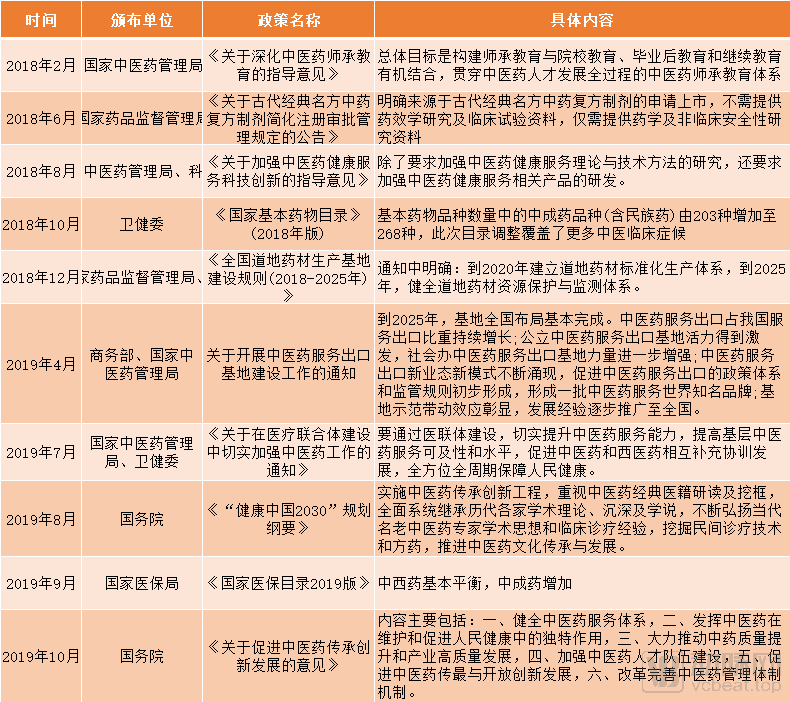
Summary of Key Policies in the Field of Traditional Chinese Medicine Over the Past Three Years (Compiled by VCBeat Based on Public Information)
In 2018, the scale of China’s internet healthcare market reached RMB 49.1 billion, with traditional Chinese medicine (TCM) accounting for a relatively small share, leaving significant room for growth. National policies supporting privately run medical institutions, multi-site practice by physicians, relaxed control over public hospitals, and the integration of internet healthcare into the national medical insurance system have further promoted the development of “Internet + TCM.”
Against this backdrop, Shangyi Renjia was established. Leveraging high-quality supply chain resources and its premium TCM clinic chain, Yizhentang, the platform integrates these strengths to restore traditional TCM diagnostic and treatment practices through full-course interventions and time-honored herbal processing methods, thereby harnessing internet technology to make TCM accessible to the general public.
Since its launch in 2017, the platform has cumulatively reached nearly one million users across China who are accustomed to Traditional Chinese Medicine (TCM) conditioning. It has registered nearly 30,000 physicians, over 90% of whom are from Grade A tertiary hospitals, and has provided services to more than one million patient visits.
The development of the internet-based Traditional Chinese Medicine (TCM) sector is still in its early stages, with no unified path for growth. As the TCM industry carries China’s long history, there is ongoing debate within the field regarding how to balance innovation with preservation.
In the eyes of Cao Xueli, CEO of Shangyi Renjia, this is essentially a matter of scale and boundaries. She believes that the core of Traditional Chinese Medicine (TCM) lies in TCM theory and herbal medicine; innovating around this “core” risks undermining the essence of TCM. Therefore, Shangyi Renjia has focused its innovation on service models and revenue models.
Leveraging its deep industry insights, Shangyi Renjia adopts a hybrid model that integrates an online platform with offline medical clinics. The online channel serves as the entry point for users and physicians, providing support for offline appointment scheduling, patient education, and physician training. Meanwhile, the offline clinics, as physical entities, deliver services such as medication delivery and initial diagnosis and treatment to complement the online platform. This integrated approach enables mutual traffic generation and reciprocal support between the online and offline channels.
Unlike other internet-based TCM enterprises, Shangyi Renjia operates its own TCM clinics. Once online TCM practitioners have accumulated a sufficient patient base, they can invest in offline clinics to become clinic shareholders and entrepreneurs, thereby establishing their personal professional brands and facilitating the commercialization of their skills, knowledge, products, and experience.
Cao Xueli stated that Shangyi Renjia addresses the issue of patients accessing traditional Chinese medicine (TCM) services nearby, with the goal of having one TCM practitioner available within every ten kilometers. Consequently, its clinics are positioned as “small yet exquisite.” It is reported that Shangyi Renjia’s clinics in provincial capitals cover 500 square meters, those in prefecture-level cities cover 200 square meters, and those at the county level cover 100 square meters.
In addition to its self-operated clinics, Shangyi Renjia has established its own supply chain, encompassing Chinese herbal medicine cultivation, modern Chinese medicine preparations, and standardized Chinese herbal formula granules, thereby granting the company a significant advantage in cost control.
In terms of team structure, Shangyi Renjia’s management team possesses extensive experience in “Internet + Traditional Chinese Medicine (TCM)” and has established dedicated teams comprising physician assistants, over one hundred licensed pharmacists, professional customer service representatives, and specialized operations personnel. Shangyi Renjia has entered into a strategic partnership with Hongri TCM Physician Group. Reportedly, this physician group brings together three National TCM Masters, more than 20 nationally renowned senior experts, over 20 provincial- and municipal-level renowned senior experts, and more than 20 TCM heritage inheritors.
To date, the Shangyi Renjia platform has registered nearly 30,000 TCM practitioners, with 60% holding the title of associate chief physician or higher. Furthermore, Shangyi Renjia has undertaken the development of internet hospital infrastructure for over 100 public TCM hospitals and established strategic partnerships with primary healthcare associations in Shanxi and Guangdong provinces to build online platforms specifically tailored to primary care settings.
In terms of future planning, Shangyi Renjia will continue to pursue large-scale expansion and the layout of offline medical clinics.
Following the outbreak, China implemented the most comprehensive, stringent, and thorough prevention and control measures, while fully leveraging the role of Traditional Chinese Medicine (TCM) in patient treatment. The diagnosis and treatment guidelines issued by the National Health Commission were revised from the third to the seventh edition, with the number of TCM prescriptions increasing to ten. Various regions also adopted integrated treatment approaches combining TCM and Western medicine. By early March, TCM was used in the treatment of 92.58% of confirmed cases nationwide, while the proportion of patients receiving TCM at Wuhan’s makeshift hospitals reached 99.9%. Clinical observations conducted across four provinces demonstrated that the Qingfei Paidu Decoction, a TCM formula for clearing the lungs and eliminating toxins, achieved an overall efficacy rate exceeding 90%.
As the COVID-19 outbreak has been characterized as a global pandemic, China’s experience in combating the epidemic is garnering increasing attention, with many countries beginning to learn from China’s approach. Zhang Boli, an expert from the Central Guidance Group, President of Tianjin University of Traditional Chinese Medicine, and an academician of the Chinese Academy of Engineering, stated that “the experience of using Traditional Chinese Medicine (TCM) to treat COVID-19 should be a highlight of the Chinese solution.” Tong Xiaolin added that TCM practitioners have been engaged in the international frontline of the fight against the epidemic for some time; in early March, they established connections with Iran and Italy through the World Federation of Acupuncture-Moxibustion Societies.
In this process, the role of “Internet + Traditional Chinese Medicine (TCM)” is self-evident. Online TCM consultations alleviate the pressure on offline clinical visits and expand the scope of services; they save time for medical care, prevent delays in treatment and cross-infection, and help alleviate public anxiety.
This epidemic has brought new opportunities to the development of Internet-based Traditional Chinese Medicine (TCM), allowing people to better recognize the role of TCM and presenting a rare opportunity for patient education. Meanwhile, leveraging internet platforms has enabled TCM to reach a wider audience and achieve greater growth.
Shangyi Renjia’s TCM Internet Healthcare Platform also joined the anti-epidemic efforts at the earliest opportunity, fully leveraging the advantages of its internet hospital. Through urgent preparations and in collaboration with the People’s Daily client and Health Times, it mobilized nearly 10,000 professional TCM physicians from Grade A tertiary hospitals.
On January 29, Shangyi Renjia officially launched the “Shangyi Renjia Free Clinic: 10,000 TCM Practitioners Providing Online Care” section, offering 28 days of free comprehensive online medical consultations to people across China. It is reported that in addition to patients with suspected pneumonia and those experiencing anxiety, the service also addresses medication needs for patients with chronic diseases and provides routine follow-up care for established patients through Shangyi Renjia’s basic medical services.
Meanwhile, leveraging the supply chain advantages of Shangyi Renjia’s full industry chain, its online dispensing center remains open during the Spring Festival to provide timely medication supply and delivery services to people across China.
In addition, on February 10, on the eve of companies’ resumption of work, Shangyi Renjia launched corporate free clinic services. On one hand, it provided Professor Jiang Liangduo, a renowned TCM master in Beijing, with a prescription for COVID-19 prevention to enhance employees’ immunity and reduce their risk of infection. On the other hand, it offered free general consultations with TCM experts from tertiary hospitals and home delivery of traditional Chinese medicine formula granules via SF Express, thereby facilitating worry-free return to work for enterprises.
It is reported that during the event, page views of the free clinic service increased nearly tenfold, reaching a cumulative total of close to 10 million, while registered users grew thirteenfold year-on-year. Consultation services were provided to more than 70,000 patients.