Deepin Medical Files IPO Prospectus: Powering End-to-End Smart Nursing Solutions Across 300+ Tier-3 Hospitals and 500,000 Beds
In 2020, Suzhou Depin Medical Technology Co., Ltd. celebrated its 10th anniversary.
A Decade of Honing a Single Sword. During this period, Depin Medical pioneered the “Holistic Nursing Solution” industry from scratch (0 to 1), while also creating a model for corporate development: providing in-depth services to nearly 500 hospitals across China, supplying over 10,000 sets of modern smart holistic nursing solution systems and products, covering nearly 500,000 hospital beds, and consistently achieving an annual revenue growth rate of over 45–50%.
Looking back on its development journey, from its beginnings on the shores of Taihu Lake to its listing on the National Equities Exchange and Quotations (NEEQ), and further to securing China’s first “Mass Entrepreneurship and Innovation Bond,” Depin Medical has garnered favor from investors such as SND Venture Capital and Shenzhen Fortune Capital. It has firmly established itself as a leader in the medical nursing industry.
“A company’s first year depends on luck; its tenth year depends on management.” Since its inception, Suzhou Depin Medical Technology Co., Ltd. has been committed to empowering nursing care and striving to build a high-quality nursing model. The company has not only updated and iterated its overall smart nursing system solutions for in-hospital settings, but also actively expanded into the out-of-hospital nursing market by developing comprehensive solutions for extended community-based nursing services, thereby infusing “Depin elements” into the nursing field.
Recently, VCBeat interviewed Ge Qiuju, Chairman of Suzhou Depin Medical Technology Co., Ltd., to gain an in-depth understanding of the application of Depin Medical’s comprehensive smart nursing solutions both within and outside hospital settings.
What Is the Definition of Smart Nursing? Entrepreneurs Have Differing Views. From the Perspective of Suzhou Depin Medical Technology Co., Ltd., Ge Qiuju Offers Her Answer: A Comprehensive Suite of Smart Nursing Solutions Developed from a Nurse’s Perspective, Aimed at Promoting Patient Health, Ensuring Patient Safety, Reducing Nurse Stress, and Enhancing Nursing Efficiency.
Pain and illness are inevitable parts of the human life journey. On this one-way train of life, patients without medical treatment fall into despair, while those without nursing care are left in helplessness. Nurses play an irreplaceable role in healthcare delivery; they spend significantly more time with patients than physicians do and make indispensable contributions to patients’ recovery and health outcomes.
However, nurses remain an easily overlooked group. In recent years, strained doctor-patient relationships have subjected nurses to the most inequitable treatment, imposing dual physical and psychological pressures. With the evolution of smart healthcare concepts—shifting from “patient-centered” to “disease-centered,” and now to “health-centered”—as guided by the spirit of the 19th National Congress of the Communist Party of China, patients’ self-protection awareness has continuously strengthened, nursing standards have gradually improved, and the shortage of nursing personnel has widened, all of which have increasingly exacerbated nurses’ workloads.
On the other hand, patients and physicians are the primary end-users for most medical device and health IT companies, whereas the majority of nursing workflows still require hands-on execution by nurses, such as the “three checks and seven verifications” protocol. Ge Qiuju believes that factors such as the low level of nursing informatization and the lack of intelligent nursing assistive devices are significant constraints on the overall development of nursing care in China.
Smart nursing is an important part of smart healthcare. To promote the development of smart healthcare, achieving "smart" nursing is also a crucial step.
As healthcare reforms continue to deepen, hospital performance evaluation methods have undergone a transformation. This shift has also promoted the refined management of smart nursing. Nursing care constitutes a significant proportion of clinical work. By leveraging information technology and intelligent solutions to enhance nursing efficiency, hospitals can improve their overall operational efficiency and consequently reduce costs.
To truly realize smart nursing, it is essential to adopt a patient-centered approach and align with nurses’ clinical workflows. This involves comprehensive coverage of areas such as nursing management, intelligent vital signs acquisition, and interoperable health information systems, thereby freeing nurses from non-clinical tasks and genuinely achieving the goal of “returning time to nurses and nurses to patients.”
Suzhou Depin Medical Technology Co., Ltd. provides a comprehensive suite of solutions. Its overall solution for the In-Hospital Smart Nursing System has undergone iterative upgrades from version 1.0 to 2.0, then to 3.0, and is currently laying the groundwork for Nursing 4.0. This evolution has realized an integrated, end-to-end smart nursing system solution that spans both in-hospital and out-of-hospital settings, with health outcomes as its central objective.
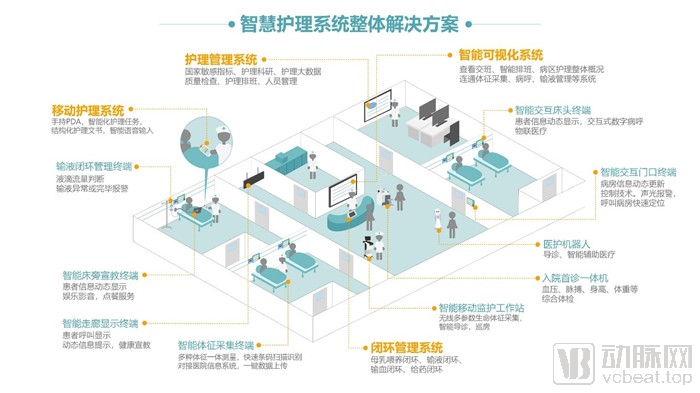
Depin Medical Smart Nursing System: Comprehensive Solution (Image provided by the company)
The development path of Depin Medical’s product line can be regarded as a successful implementation of the “Industry 4.0” concept in the field of medical care.
During the phase of developing its eco-friendly nursing product series, DePin Medical assumed the role of a Tier-3 medical process specialist, focusing on the construction of medical nursing infrastructure. Centered on the workflows of nursing staff, it designed scientific operational pathways and, in accordance with hospital healing space environments and infection control requirements, delineated sterile, clean, and contaminated zones, thereby developing a comprehensive solution for medical eco-friendly nursing systems. From 2010 to 2015, DePin Medical’s 1.0 eco-friendly nursing system solution was successfully implemented in more than 200 hospitals across China.
The emergence of the overall solution for the Smart Nursing System marks Depin Medical’s formal transition from basic nursing to smart nursing, significantly enhancing the work efficiency of nurses. By adopting the “Internet of Things+” concept and model, Depin Medical has achieved interconnectivity among devices, information exchange between items, and big data integration between equipment and the cloud-based management platform.
Nursing staff can use handheld mobile terminal devices (PDAs) to deploy intelligent nursing terminals and software platforms in ward areas and at nurse stations, while integrating with hospital information systems to achieve intelligent patient monitoring, mobile rounds, and closed-loop medication management. Taking the Depin Life Data Acquisition System as an example, this system enables continuous, automatic collection and secure monitoring of patients’ pulse rates and body temperatures. It effectively reduces the workload of nursing staff, prevents fluctuations in vital signs from affecting monitoring results, and lowers the error rate.
# Smart Nursing System: Comprehensive SolutionThe Smart Nursing System comprehensive solution marks a new phase for Depin Medical, transitioning from single-point item connectivity to an Internet of Things (IoT) platform integrating people and objects. Adhering to standards for tertiary hospital accreditation—such as "Interconnectivity," "Electronic Medical Record (EMR) Maturity," and "Smart Services"—and based on standardized nursing languages, the system implements a patient-centered structured EMR system and a closed-loop nursing assessment information system centered on patient care plans.
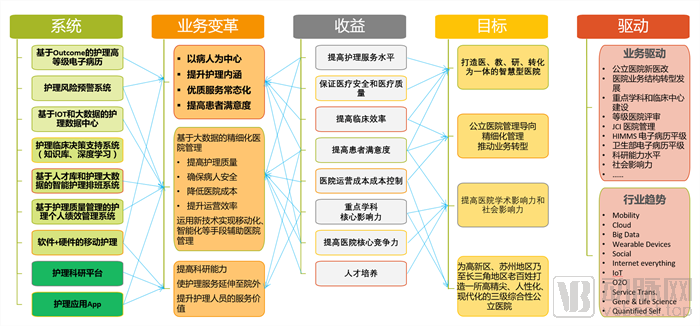
Depin Medical Smart Nursing System: Comprehensive Solution (Image courtesy of the company)
In addition, the Depin Smart Nursing System leverages big data and artificial intelligence to perform fully automated data aggregation and assessment. It covers the entire workflow—from patient admission, physician order management, and medication dispensing, to nursing task decomposition, personalized nurse task reminders, nursing assessment and diagnosis, as well as the completion and generation of documentation—enabling one-click scheduling and truly realizing the “Internet of Everything.”
The smart medical care system covers the most critical areas affecting the diagnostic and treatment capabilities of healthcare institutions, such as the main service desk, nurse stations, treatment rooms, procedure rooms, and patient wards. By leveraging the Depin Smart Nursing Platform and the central control console at the nurse station for monitoring by medical staff, nursing personnel can rapidly integrate information, effectively link nurse stations with patient wards, and achieve real-time integration with the smart nursing software system, significantly enhancing the work efficiency and safety of healthcare professionals.
According to Ge Qiuju, Depin Medical’s in-hospital nursing system solutions have currently been implemented in more than 300 Grade A tertiary hospitals across China. In the future, Depin Medical will establish a Nursing 4.0 big data platform and a specialized nursing knowledge base to promote smart nursing research at hospitals of all levels.
Extended nursing care is one of the hallmarks of modern nursing, primarily evolving in two directions. The first is the extension of nursing service functions, such as expanding from disease treatment services to rehabilitation medical services, and from biomedical services to psychosocial medical services. The second is the extension of care settings, such as extending inpatient services to post-discharge care, and transitioning from hospital-based nursing to community or home-based nursing.
During the “11th Five-Year Plan” period, Shanghai took the lead in proposing the “9073” elderly care model, wherein 90% of seniors receive self-care within their families, 7% benefit from community-based home care services, and 3% utilize institutional care services. With the continuous deepening of tiered diagnosis and treatment in China, the accelerating aging of society, and growing public awareness of health preservation, demand for in-home services has surged.
In this context, in February 2019, the National Health Commission issued the “Notice on Launching Pilot Programs for ‘Internet + Nursing Services’” along with the corresponding pilot implementation plan. This policy has become a significant driver for smart nursing care outside hospital settings.
Driven by market demand and policy incentives, DePin Medical has strategically extended its in-hospital nursing solutions to community and home settings, successfully developing an integrated “hospital-community-home” smart nursing system. This solution aims to enable postoperative patients and the elderly to receive professional nursing or elder care services in familiar environments.
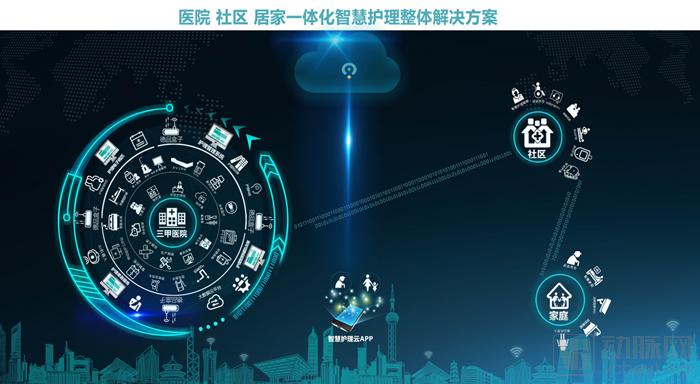
"Hospital-Community-Family 'Three-in-One' Smart Nursing System Comprehensive Solution (Image from the enterprise)"
Depin Medical’s Comprehensive Solution for Extended Out-of-Hospital Care Includes a Series of Products Such as Home Hospital Beds, Shared Nurse Workstations, and the “Internet +” Remote Nursing Command Center.
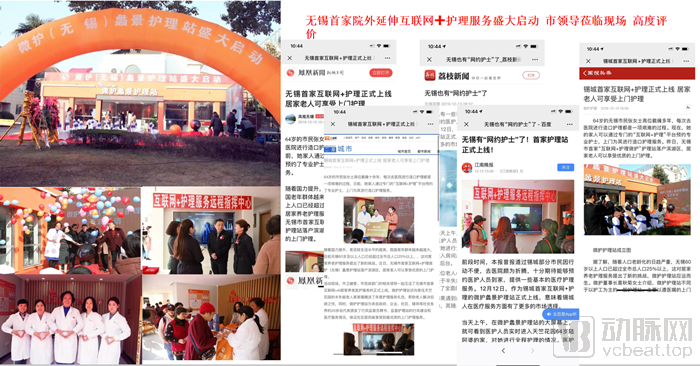
Home hospital beds are equipped with vital signs acquisition systems, enabling nurses to monitor patients’ health status based on their activity trajectories and provide timely interventions. Furthermore, Depin Medical has partnered with communities and sub-district community health service centers to establish nursing service stations. These stations leverage the expertise of retired nurses and deliver services to community and home-based populations in strict accordance with in-hospital nursing standards. In early 2019, Depin Medical developed an “Internet + Nursing Services” platform. By November of the same year, the platform was implemented in 11 pilot hospitals and 19 primary healthcare institutions in Nanjing, providing online services to nearly 2,000 discharged patients.
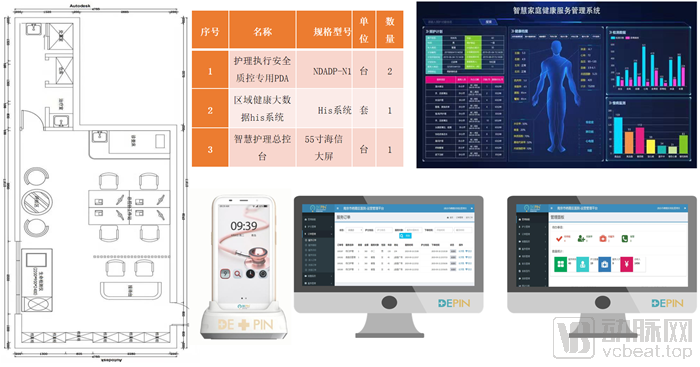
Depin Medical’s Comprehensive Solution for Extended Care Beyond Hospital Settings (Image provided by the company)
Ge Qiuju introduced that Depin Medical strives to build an ecosystem connecting patients, medical resources, and healthcare institutions, ensuring that patients receive the care they seek, medical professionals utilize their skills to the fullest, and healthcare institutions optimize resource utilization. This approach aims to further expand the ecosystem, creating a positive cycle within a symbiotic framework.
Looking to the future, Ge Qiuju is full of confidence. She stated that Suzhou Depin Medical Technology Co., Ltd. will uphold the corporate spirit of “Virtue Spreads Across the World, Quality Casts Brilliance,” continuously innovate its IoT-plus mindset and development model, integrate big data resources, strengthen case data analysis, enhance the level of intelligent medical nursing, build a high-quality third-party cloud data service platform for nursing care, focus on the development of smart nursing, and become a respected century-old enterprise.