

Kymera Therapeutics Secures $102 Million Series C Financing to Advance Targeted Protein Degradation Therapies

Kymera Therapeutics
Developer of Novel Small Molecule Therapies
Recently,U.S. biotechnology company Kymera Therapeutics announces the completion of a $102 million Series C financing round. The round was led by Biotechnology Value Fund and Redmile Group, with participation from Bain Capital Life Sciences, Rock Springs Capital, and others.Meanwhile, Kymera also received funding from the Leukemia & Lymphoma Society’s (LLS) Therapy Acceleration Program, aimed at advancing the company’s work in treating blood cancers.
Kymera Therapeutics is an emerging player, having completed its Series A and B financing rounds just one to two years ago. On October 30, 2017, Kymera Therapeutics announced that it had raised $30 million in Series A funding to advance a transformative new therapeutic approach and discover breakthrough medicines for patients with previously untreatable diseases. On November 13, 2018, Kymera Therapeutics further announced that it had secured $65 million in Series B financing to accelerate the development of targeted protein degraders in oncology and immunology.
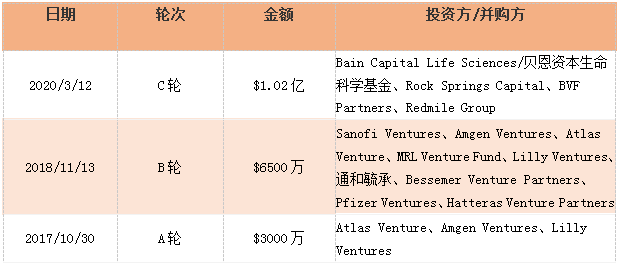
Kymera Therapeutics Financing History
In the high-tech field of biotechnology, innovation serves as an ever-present driving force for development, yet it is fraught with uncertainty and challenges.
What is it about Kymera Therapeutics that consistently allays investor concerns, enabling it to stand out among numerous biotechnology companies and earn the favor of top-tier investment institutions, thereby securing substantial financing from a multitude of investment firms?
Headquartered in Cambridge, Massachusetts, USA, Kymera Therapeutics has been dedicated to the development and application of leading tools in the biotechnology industry since its establishment in 2016, specializing in the field of targeted protein degradation.
It has pioneered a transformative new approach to treating certain previously incurable diseases. This method leverages the body’s intrinsic protein recycling machinery to degrade dysregulated pathogenic proteins, thereby treating associated diseases. This novel therapeutic mechanism also mitigates the pain and risks associated with surgical interventions required for some conditions.
Once this novel therapeutic technology matures, it will undoubtedly bring new hope to patients with various diseases and improve their quality of life. Meanwhile, it harbors substantial commercial interests, signaling high returns on investment.
However, high returns often come with high risks; investors are never mere dreamers.
Moreover, Kymera Therapeutics is not alone in the field of protein degradation; other companies, such as Celgene, C4 Therapeutics, Arvinas, and Cedilla Therapeutics, are also pursuing therapies in this area.
However, judging from the overall scale of Kymera Therapeutics’ financing to date and the progress of its technological development, the company is advancing with considerable momentum. Thus, Kymera Therapeutics is not merely a pioneer in concept.
Kymera Therapeutics has not been particularly active in the public eye since its inception.
Beyond reviewing basic corporate information on the company’s official website, tracking its latest experimental advancements presented at various academic conferences through the news section, and assessing its financing status on investment and funding platforms, there is limited information available from other channels. This inevitably raises the question: What kind of team underpins the company’s rapid growth?
Nello Mainolfi, Co-founder, President and Chief Executive Officer of Kymera Therapeutics, is the company’s President and former Chief Scientific OfficerOn November 20, 2019, the company announced the promotion of Nello Mainolfi to Chief Executive Officer. Mainolfi will continue to lead the company, driving a pipeline of novel targeted protein degraders into clinical development and expanding the reach of its innovative Pegasus™ platform.
As for Nello Mainolfi himself, he began his drug discovery career at the Novartis Institutes for Biomedical Research. The team he leads has achieved remarkable results in late-stage clinical development across various indications.

Co-Founder, President & CEO Nello Mainolfi
Image source: Kymera Therapeutics official website
Prior to founding Kymera, Mainolfi led discovery research at the cancer metabolism startup Raze Therapeutics. With a robust professional background, he has authored more than 60 papers and patents and contributed written commentaries in the fields of medicinal chemistry, drug discovery, and protein degradation.
Of course, an excellent leader is not the entire answer to the problem.
Kymera Therapeutics boasts an excellent management and operations team. This team comprises scholar-entrepreneurs with strong professional backgrounds and extensive experience in oncology and immunology, such as Nello Mainolfi and Jared Gollob, as well as financial experts like Bruce Jacobs, who graduated from top-tier universities and possess deep expertise in financial operations and investment.
In addition, Kymera Therapeutics is bolstered by a robust scientific advisory board.
The members of Kymera’s Scientific Advisory Board are world-class scientists and clinicians,including David Spiegel, Professor of Chemistry at Yale University; Steven Carr, Senior Director of Proteomics at the Broad Institute; Jean-Laurent Casanova, Professor at Rockefeller University and Investigator at the Howard Hughes Medical Institute; Dr. Nick Keen, Chief Scientific Officer at Bicycle Therapeutics; Dr. Ning Zheng, Professor of Pharmacology at the University of Washington and Investigator at the Howard Hughes Medical Institute; and Owen O’Connor, Professor at the American Cancer Society and Director of the Center for Lymphoid Malignancies at Columbia University, among others., they have achieved remarkable success and wield significant influence in fields such as proteomics, human genetics, chemistry, E3 ligase biology, and translational and clinical research.
Kymera Therapeutics, as a provider of targeted protein degradation approaches, owns the proprietary integrated degradation R&D platform Pegasus™, with a particular focus on non-drug nodes within effective pathways that conventional drugs are currently unable to access.
Kymera’s ability to stand out by virtue of its unparalleled capacity to target and degrade the most intractable proteins is a direct result of the robust support provided by its Pegasus™ platform.
The Pegasus™ platform (a game-changing integrated degradation platform) was created by a team of seasoned drug hunters to enhance the efficiency of targeted protein degradation and discover novel therapies for previously undruggable diseases.
The platform comprises informatics-driven target identification, novel E3 ligases and ligands, proprietary predictive models, and novel degradation modalities, with current R&D focused on therapies for oncology, immuno-oncology, autoimmune diseases, and inflammatory conditions.
In Kymera’s lead program, KYM-001, the primary focus is on aggressive B-cell lymphoma. Kymera has previously disclosed two targets: the scaffold kinase IRAK4 and the transcription factor STAT3.。
IRAK4 is a well-known protein that plays a critical role in IL-1 receptor-mediated inflammation. Kymera believes that by tracking patients with IRAK4 mutations, it can identify those most likely to benefit from treatment, thereby enhancing the likelihood of clinical success.
STAT3 is a non-druggable oncogenic transcription factor and a driver of inflammation and fibrosis. The development of novel protein degrader therapies targeting the STAT3 protein holds promise for treating various cancers and chronic diseases.
Kymera is rapidly mobilizing by leveraging its team’s cutting-edge research insights and preclinical data packages to accelerate the advancement of multiple candidate drug programs in oncology and immunology across other therapeutic areas.
Kymera Therapeutics stated that it is developing best-in-class protein degraders, which have the potential to deliver truly breakthrough therapies for patients with no known treatment options. The company has also been actively showcasing its latest research progress.
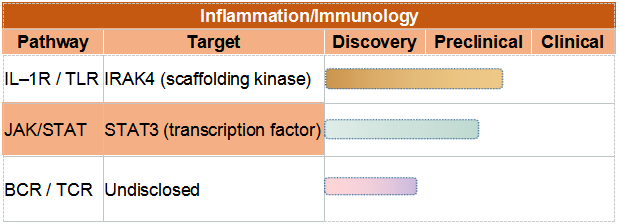
Inflammation/Immunology Pipeline
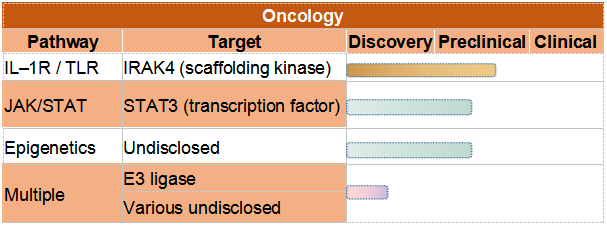
Oncology Pipeline
On December 3, 2018, Kymera Therapeutics first demonstrated the efficacy of an IRAK4 protein degrader in MYD88-mutant lymphoma. The data were presented at the 60th Annual Meeting of the American Society of Hematology (ASH) in San Diego.
On April 3, 2019, Kymera Therapeutics presented new preclinical data on its best-in-class oral IRAK4 degrader for MYD88-mutant lymphoma at the American Association for Cancer Research (AACR) Annual Meeting evening session. The company’s research demonstrated that KYM-001, either as monotherapy or in combination with a BTK inhibitor, induced highly selective degradation of IRAK4 and tumor regression following oral administration.
On October 17, 2019, Kymera Therapeutics presented preclinical data at the AACR-NCI-EORTC International Conference on Molecular Targets and Cancer Therapeutics to demonstrate the potency and antitumor activity of its selective STAT3 degrader.
On November 11, 2019, Kymera Therapeutics presented preclinical data for its best-in-class IRAK4 degrader, demonstrating broad and potent inhibition of the Toll-like receptor (TLR) and interleukin-1 receptor (IL-1R) pathways both in vitro and in vivo. These pathways underpin the pathogenesis of many inflammatory and autoimmune diseases.
On December 9, 2019, Kymera Therapeutics presented preclinical data at the American Society of Hematology (ASH) Annual Meeting, further characterizing a novel, highly selective, and potent STAT3 degrader to demonstrate its effective antitumor activity in hematologic malignancies.
Distinctive technology and rapidly advancing research results—this is the response delivered by Kymera Therapeutics with professional rigor.
Exploring the Story Behind Kymera Therapeutics’ Use of Transformative Technology to Pioneer New Disease Treatment Approaches: The Fruit of Reverse Thinking in Scientific Experimentation。
In line with the company’s slogans of “New way” and “New rules,” Kymera Therapeutics is not blindly pressing forward along old paths; instead, it stands on the shoulders of giants to survey the landscape, seeking unconventional routes with greater potential for breakthroughs.
“New way”This novel approach shifts the focus from protein production to a reverse strategy: leveraging the body’s natural cellular processes via targeted protein degraders to eliminate disease-causing proteins, thereby potentially targeting previously “undruggable” and non-drugged proteins. Moreover, these targeted protein degraders proactively destroy target proteins rather than merely inhibiting them gently. In addition, while traditional small molecules require binding to active sites on proteins, these targeted protein degraders do not. They also offer high specificity, selectivity, and practicality, are designed for oral bioavailability, and abolish the essential scaffolding functions of target proteins within many disease-associated signaling pathways.
“New rules“By designing new rules, Kymera Therapeutics not only employs conventional empirical approaches to rationally design best-in-class protein degraders but also establishes novel guidelines to accelerate discovery, mitigate risks, and optimize the efficiency of the discovery process. Meanwhile, Kymera is defining parameters that transform the ubiquitin-proteasome system (UPS) into a therapeutic platform for small-molecule-mediated protein degradation, applicable to a broad range of diseases.”
“Targeted protein degradation is one of the most promising new therapeutic modalities, with the potential to transform medicine,” said Bruce Booth, DPhil, Co-founder and Chairman of Kymera Therapeutics and Partner at Atlas Venture. “We know we are leading an incredible team. A robust drug discovery platform and a pipeline of important novel protein degrader therapies designed to address the most elusive drug targets are paving the way.”
In the realm of scientific research, collective efforts yield greater results. The convergence of diverse ideas unleashes new insights and creativity. Win-win cooperation is the main theme of global development. Kymera Therapeutics understands this well.
April 4, 2018Kymera Therapeutics Announces Collaboration with GSK, the two parties signed a two-year discovery collaboration agreement to advance new therapeutic modalities. GSK is a science-led global healthcare company that is leveraging innovations in small-molecule-based targeted protein degradation and encoded library technologies.
May 15, 2019,Kymera Therapeutics and Vertex Establish Strategic Partnership, the two parties reached a four-year R&D agreement to jointly develop small-molecule protein degraders targeting multiple targets. This collaboration will combine Kymera’s expertise in targeted protein degradation with Vertex’s scientific, clinical, and regulatory capabilities in developing “first-in-class” therapies, thereby accelerating the development of best-in-class drugs for patients with severe diseases.
Transformative technological vision, exceptional leadership, a top-tier team, robust external collaborations, and strong investor support are all propelling Kymera Therapeutics forward with remarkable momentum in the biotechnology sector.
In September 2019, FierceBiotech named Kymera Therapeutics one of its annual “Fierce 15” biotech companies, recognizing it as one of the most promising private biotechnology companies in the global industry.
Currently, Kymera Therapeutics is in the midst of its Series C financing round to advance the development of its protein degrader pipeline and platform. Kymera is poised to move its lead program, KYM-001, into clinical trials this year for the treatment of aggressive B-cell lymphoma.
Kymera Therapeutics is a pioneer in treating immune disorders, oncology, and other diseases through novel targeted protein degradation technologies. Even amidst the fierce competition and continuous emergence of innovators in the biotechnology sector, Kymera has garnered strong industry confidence thanks to its exceptional team, robust technology platform, and support from powerful investment partners. All these factors point to a promising future for Kymera Therapeutics.