Genmab
Differentiated Antibody Therapy Developer

Simcere
Innovative Drug Developer

Simcere Zaiming
Developer of Innovative Anti-Tumor Drugs

Qilu Pharmaceutical
Specialty Formulations and Active Pharmaceutical Ingredients (API) Developer

Johnson & Johnson
Medical Device R&D and Manufacturer

AstraZeneca
Pharmaceutical Technology Research and Development Provider

CHIATAI TIANQING
High-quality pharmaceuticals research, production, and sales provider

January 27, 2026Following Genmab's withdrawal, two more antibody-drug conjugates (ADCs) have entered clinical trials in humans.From the recent launch of the first human trials, the development of bispecific drugs targeting both EGFR and cMet is becoming a popular strategy.
These two ADCs that have entered the human clinical trial stage come from Chinese pharmaceutical companies, and they are:
SIM0610, a bispecific antibody-drug conjugate (BsADC) developed by ZAIMING, an innovative drug subsidiary of Simcere., the first patient has been enrolled in the Phase I clinical trial on January 19, 2026, at the Cancer Hospital Affiliated to Shandong First Medical University (Shandong Provincial Tumor Hospital). This multi-center, open-label Phase I study, led by Academician Jinming Yu, aims to evaluate the safety and preliminary efficacy of SIM0610 in patients with locally advanced or metastatic solid tumors.
Qilu Pharmaceutical's Bispecific Antibody-Drug Conjugate QLS5316Its Phase I clinical trial (Registration No.: CTR20260037) was first disclosed on the China Drug Clinical Trial Registration and Information Public Platform on January 16, 2026, marking the official launch of the study. The trial aims to evaluate the safety, tolerability, pharmacokinetic characteristics, and preliminary efficacy of QLS5316 monotherapy in patients with advanced solid tumors.
Unlike Johnson & Johnson's marketed bispecific naked monoclonal antibody Rybrevant (amivantamab), both Simcere's SIM0610 and Qilu Pharmaceutical's QLS5316 are advancing clinically in the form of bispecific antibody-drug conjugates (BsADC).
Currently, multiple anti-EGFR×cMet ADC drugs have entered clinical stages globally, creating a highly competitive landscape.Among the most representative are AstraZeneca's tilatamig samrotecan (AZD9592) and BG-C0902 from BeiGene.
AstraZeneca has a deep presence in this field, with its AZD9592, a bispecific ADC developed using the DuetMab platform, already entering global Phase I clinical trials. It aims to enhance tumor selectivity and reduce off-target toxicity through dual-target synergy.
At the same time, multiple naked bispecific antibodies are also advancing in parallel: PM1080 (HS-20117) is an EGFR×cMet naked bispecific antibody that has entered Phase I clinical trials. It was independently developed by Prime Medicine and has now been incorporated into BioNTech's pipeline, with Hansoh Pharma holding development rights for Greater China.
CHIATAI TIANQING adopts a "dual-antibody + ADC" dual-track advancement strategy. Its TQB2922 (naked dual-antibody) and TQB6411 (ADC) have both entered the clinical trial stage, covering potential clinical needs across different technological approaches.
On the other hand, it is worth noting that,Genmab recently announced the discontinuation of its anti-EGFR×cMet ADC drug (code name GEN1286) originating from ProfoundBio.(Related reports: "Profound Bio's ADC Abandoned Three Times in a Row!》)Genmab itself has a historical connection with Rybrevant.
Genmab also holds another asset acquired through acquisition, MCLA-129 (a naked antibody EGFR×cMet monoclonal antibody originating from Merus).The R&D paradox of its potential competitor to Rybrevant continues, and whether this drug will be terminated in the future may just be a matter of time.
Recently Announced First-in-Human Trial Projects
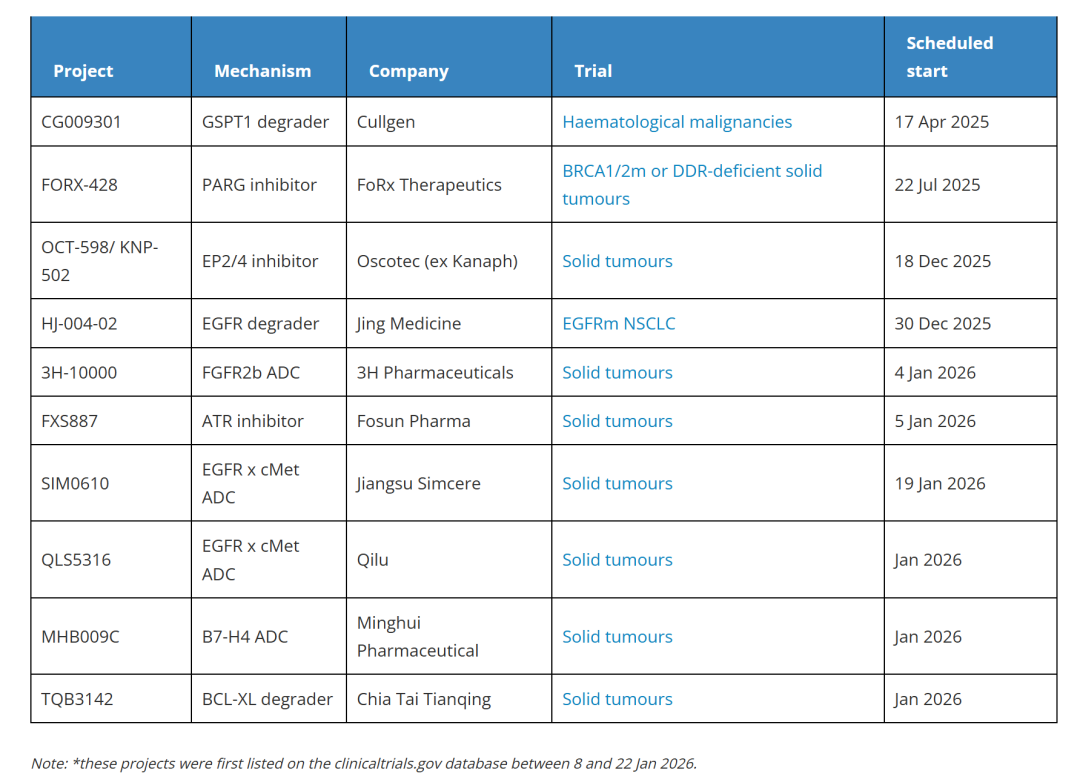
Note: All the aforementioned projects were first disclosed in the clinicaltrials.gov database between January 8 and 22, 2026.
Other Notable New Clinical Programs
FoRx Therapeutics' PARG inhibitor FORX-428 is noteworthy, marking the first clinical-stage asset for this Swiss private company.FORX-428The Phase I clinical study was initiated in August 2025 and first disclosed in December 2025, aiming to evaluate its safety, tolerability, and preliminary efficacy in patients with advanced solid tumors carrying BRCA1/2 mutations or DNA damage repair (DDR) deficiencies. FoRx completed a $50 million Series A financing round in December 2025. Currently, the global development of PARG inhibitors remains in the early stages, with Ideaya's IDE161 being another fast-progressing candidate drug.
At the same time, the development of two targets, FGFR2b and ATR, has experienced major setbacks. Bemarituzumab, a monoclonal antibody acquired by Amgen for $1.9 billion in 2021, had its pivotal Phase III Fortitude-101 study results announced in 2025: although progression-free survival (PFS) improved, overall survival (OS) did not. The company has terminated its global development in the gastric cancer field.
However, 3H Pharmaceuticals has chosen to continue exploring with a differentiation strategy. Its FGFR2b-targeted ADC drug, 3H-10000, launched Phase I/II clinical trials in China in November 2025 (CTR20254555) and initiated a global Phase I study in January 2026 (NCT07354711).
The ATR inhibitor space is equally challenging: AstraZeneca’s ceralasertib did not advance to Phase III, and the company halted its development in 2025; Repare’s camonsertib had its rights returned by Roche in 2024; Bayer’s elimusertib and Merck KGaA’s berzosertib completed early-stage studies but neither has progressed to the pivotal registration stage.
Against this backdrop, Fosun Pharma has entered the field with its self-developed ATR inhibitor FXS887, which was approved in December 2025 to commence Phase I clinical trials for advanced solid tumors in China.
Compiled from: ApexOnco