

Shenzhen Keya Medical Technology Submits IPO Prospectus Highlighting Pioneering AI Diagnostic System for COVID-19 Published in Radiology

KeYa
Developer and Manufacturer of Digital Medical Imaging Systems
On March 20 (Beijing Time), KeYa Medical’s original research paper, “Using Artificial Intelligence to Detect COVID-19 and Community Acquired Pneumonia based on Pulmonary CT: Evaluation of the Diagnostic Accuracy,” became the first globally to be accepted and published by Radiology, a top-tier international radiology journal. Recognized as an innovative AI-based diagnostic assessment technology capable of effectively differentiating between general pneumonia and COVID-19 pneumonia, the study was highlighted for its practical clinical significance and forward-looking research value.
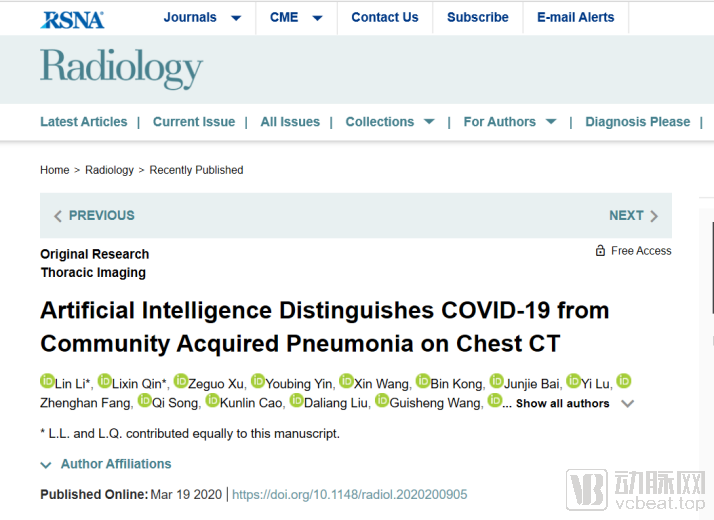
*Radiology* is widely recognized as the most authoritative journal in the field of radiology, featuring the latest, clinically relevant, and highest-quality content.
Research Findings: Evaluation Report on the Diagnostic Accuracy of AI in Effectively Differentiating Between General Pneumonia and COVID-19
Abnormal lung CT findings are the most typical imaging manifestation of COVID-19. In some patients, lung imaging changes precede clinical symptoms; therefore, CT is currently the primary method for screening and diagnosing COVID-19. This study by KeYa Medical aims to develop a fully automated artificial intelligence algorithm framework to assist in CT imaging examinations, automatically distinguishing patients with COVID-19 from other patients. This will help frontline physicians achieve more efficient and accurate screening of COVID-19 cases, while enhancing the image interpretation speed of radiologists and improving the diagnostic efficiency for COVID-19.
In this retrospective, multicenter study, KeYa Medical employed cutting-edge deep learning technologies to innovatively develop COVNet, a 3D detection neural network for COVID-19 (as shown in Figure 1), which extracts various imaging features from lung CT scans to identify COVID-19. To develop and validate the accuracy and robustness of this model, the study collected 4,356 CT datasets from 3,322 patients across six hospitals between August 2016 and February 2020. These datasets included CT examinations from patients with COVID-19, community-acquired pneumonia (non-COVID-19), and other non-pneumonia conditions. Validation on an independent test set demonstrated that KeYa Medical’s self-developed COVNet achieved a sensitivity of 89.76% and a specificity of 95.77% for identifying COVID-19, with an area under the receiver operating characteristic (ROC) curve (AUC) of 0.96. The study also validated the model’s accuracy in distinguishing community-acquired pneumonia, yielding a sensitivity of 86.85%, a specificity of 92.28%, and an AUC of 0.95. The results fully demonstrate that COVNet can accurately detect COVID-19 and differentiate it from community-acquired pneumonia and other pulmonary diseases.
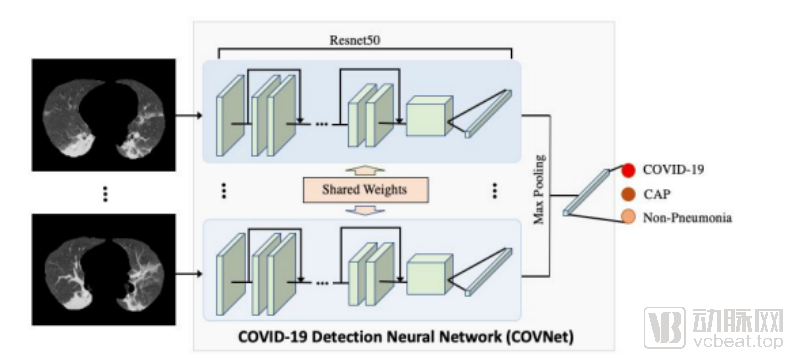
Figure 1. Framework diagram of COVNet, a neural network for COVID-19 detection
(COVID-19: Novel Coronavirus Pneumonia; CAP: Community-Acquired Pneumonia; Non-Pneumonia: Other Non-Pneumonia Conditions)
To enhance model interpretability, the research team at KeYa Medical employed a weighted gradient class activation mapping method to visualize the critical regions (automatically generated by the model) that drive the decision-making process of the COVNet deep learning model. Figure 2 presents heatmaps of suspicious areas in CT scans for cases of COVID-19, community-acquired pneumonia, and non-pneumonia conditions. These heatmaps demonstrate that COVNet focuses primarily on abnormal regions while correctly ignoring normal ones, thereby assisting the algorithmic framework in identifying lesions and achieving accurate differential diagnosis.
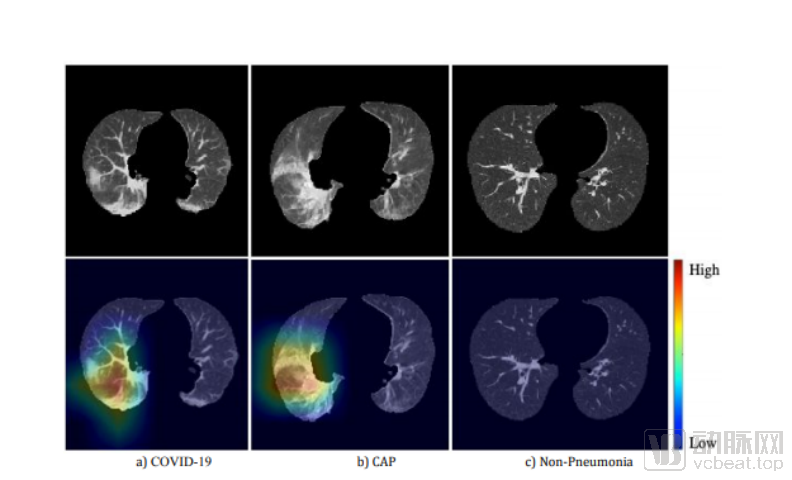
Figure 2. Heatmaps of key regions used by COVNet for decision-making. Columns a, b, and c display CT images (top) and heatmaps of suspicious regions (bottom) for COVID-19, community-acquired pneumonia, and other non-pneumonia cases, respectively.
Clinical Value – Highly Practical Innovative Design Optimizing COVID-19 Screening Workflow Through AI-Driven Efficiency Enhancement
Currently, the COVID-19 pandemic is raging globally. In the prevention and control process, the first step is the identification and diagnosis of suspected cases. At present, nucleic acid testing (NAT) is the "gold standard" for confirming COVID-19, as a positive NAT result is required for a definitive diagnosis. However, for patients with early-stage ordinary-type COVID-19, NAT has relatively low sensitivity. Clinically, multiple tests may be needed for confirmation, which is time-consuming. It is common for CT findings to appear before NAT yields a positive result. As a non-invasive imaging method, CT can reveal lung lesion characteristics associated with COVID-19, such as ground-glass opacities, consolidation, bilateral involvement, and peripheral and diffuse distribution. Nevertheless, there is a certain degree of overlap in imaging features between COVID-19 and other types of pneumonia on CT scans, which increases the difficulty for radiologists in differentiation and prolongs diagnostic time.
The research team at KeYa Medical has innovatively developed and designed COVNet using AI deep learning technology, which effectively addresses the aforementioned challenges. COVNet boasts powerful capabilities in extracting features from CT images and demonstrates high accuracy in differentiating between COVID-19 and community-acquired pneumonia. It can extract various imaging features from lung CT scans to automatically identify COVID-19 patients from other patient groups. While enhancing image display quality, COVNet assists clinicians in making early diagnoses of infected patients, significantly improving the diagnostic efficiency of frontline physicians, optimizing the COVID-19 screening process, achieving efficient and precise screening, reducing physicians' workload, and facilitating the rational allocation of medical resources.
KeYa Medical: Emphasizing Technology Application, Demonstrating Value Through Outcomes
It is reported that Keya Medical is the first company in China to obtain a Class III medical device registration certificate for an artificial intelligence product. Guided by the aim of meeting genuine clinical needs, the company has remained focused on the practical application of big data and AI technologies in the healthcare sector. Its certified product, “DeepVessel FFR,” was highly commended by the National Medical Products Administration (NMPA) as having “significant economic benefits and social value.”
Leveraging its research team’s extensive expertise and technological advantages in artificial intelligence and medical imaging, KeYa Medical responded swiftly to the national call during the pandemic by rapidly developing the “Intelligent Auxiliary Diagnosis System for COVID-19.” This system was deployed to support radiology departments on the front lines and donated to numerous hospitals in Hubei, Guangdong, Sichuan, Shandong, and other regions. Recently, as the COVID-19 pandemic has spread globally, the KeYa team has been engaging in close collaborations with dozens of hospitals and imaging centers across Europe and the United States, accelerating product localization and rapid implementation, thereby demonstrating the speed and strength of China’s AI technology application and development.