

Chinese Research Teams Highlight Nanomaterial-Based Strategies to Enhance CAR-T Therapy for Solid Tumors in Advanced Science
Editor’s Note: This article is reprinted from Polymer Science & Technology, with authorization granted to VCBeat.
CAR-T cell therapy is a novel form of tumor immunotherapy that follows surgical intervention, chemotherapy, and radiotherapy. It has currently achieved positive clinical outcomes in the treatment of B-cell malignancies; however, several challenges remain, primarily concerning CAR-T cell manufacturing, safety, and therapeutic efficacy against solid tumors.
Therefore, it is necessary to design new methods to generate more effective CARs and equip them with the capability to track their antitumor efficacy in CAR-T therapy.
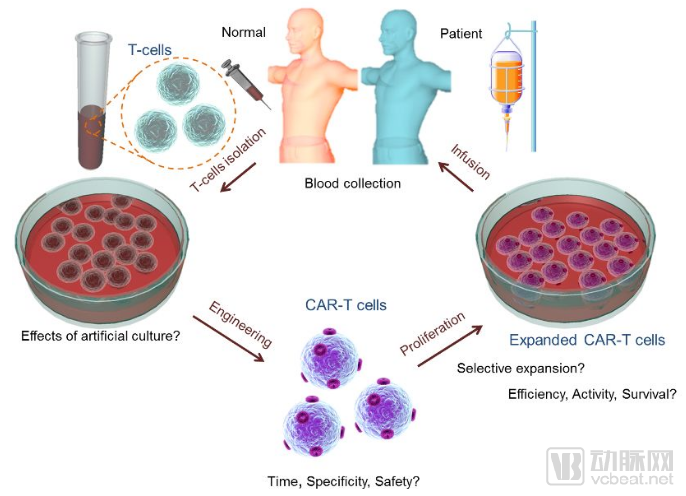
Schematic Diagram of the Main Process of CAR-T Therapy
Nanoparticles (NPs) typically refer to particles with a size range of 1–100 nm, such as lipid-based NPs, polymeric NPs, metallic NPs, and other inorganic NPs. They possess unique properties, including a large specific surface area, distinct shapes, ultra-small dimensions, and the ability to engineer their surfaces using biological entities (e.g., proteins and genes).
They not only possess the ability to target immune cells and stimulate innate immunity via Toll-like receptor (TLR) pathways, but also have the potential to enhance the efficacy of genetically engineered T-cell therapies for cancer. Exposing therapeutic cells, such as T cells, to nanoparticles (NPs) can improve gene silencing, enhance activity, increase T-cell stability and therapeutic efficiency, and mediate the intracellular delivery of gene vectors to T cells, all without compromising their proliferation. Furthermore, NPs can improve the delivery of immunomodulators, prevent tumor recurrence, and monitor therapeutic responses to cancer treatment.
Recently, Professor Yang Guang’s team from Huazhong University of Science and Technology collaborated with Professor Ouyang Chenxi’s team from Fuwai Hospital to publish a review article titled “Nanotechnology promotes genetic and functional modifications of therapeutic T cell against cancer” in Advanced Science.
Due to challenges such as the lack of suitable targets, cytokine release syndrome, neurotoxicity, and the high risks and costs associated with ex vivo manufacturing, CAR-T therapy still faces significant hurdles in treating most malignancies beyond B-cell tumors. This is particularly true for malignant solid tumors, where the physical barrier of dense tissue and the immunosuppressive tumor microenvironment severely limit CAR-T cell infiltration and immune activity within the tumor tissue.
Based on a discussion of the limitations of CAR-T therapy, this review systematically summarizes and evaluates the major strategies and current applications of nanotechnology in enhancing immune cell therapies, particularly CAR-T therapy, for precision oncology. It highlights significant advances in the design of functional nanoparticles to improve the manufacturing, proliferation, trafficking, targeting, activation, and detection of CAR-T cells, primarily covering the following aspects:
1) Serving as a gene transfection vector for the ex vivo and in vivo preparation of CAR-T cells;
2) Promote T cell expansion and persistence;
3) Improve T cell transport;
4) Enhance the activity of innate T cells;
5) Remodel immunosuppressive cells and the vascular microenvironment;
6) Monitor the efficacy of CAR-T therapy.
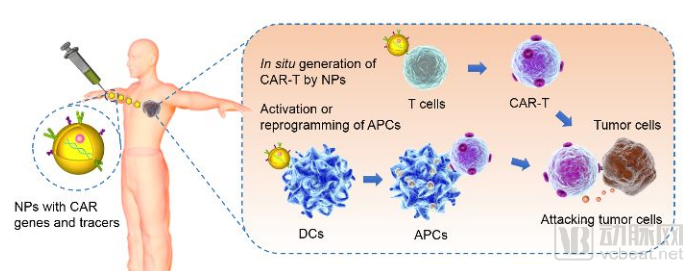
Nanotechnology-Assisted Immune Cell Therapy for Precision Oncology
Functional nanoparticle-assisted CAR-T therapy combines the advantages of nanotechnology and CAR-T, has achieved initial success in overcoming the limitations of CAR-T therapy and improving efficacy, and is rapidly becoming an important new direction for basic and clinical translational research on CAR-T therapy. It holds promise as a powerful and effective strategy to enable CAR-T therapy to combat a broader range of malignant tumors, including solid tumors.
Finally, this review also analyzes and provides perspectives on several important common issues, such as efficiency, safety, translational potential, and possible solutions.
Paper link:
https://onlinelibrary.wiley.com/doi/10.1002/advs.201903164