

Futong East Opens Core Functions of AI-Powered Smart Triage System to Hospitals
The number of staff at the Outpatient Service Center of a Grade A tertiary hospital in Beijing has decreased significantly compared to previous years. The once-common scenes of crowds of people of all ages gathering around the triage desks and long queues forming at the windows for appointment rescheduling and cancellations are now rarely seen.
A staff member told VCBeat (WeChat ID: vcbeat), “Most patients now complete triage and registration directly via our WeChat official account, with the system automatically recommending physicians. Upon arrival at the hospital, they proceed directly to the department entrance to wait for their consultation. This simplifies things for both them and us.”
Products designed to “save trouble” for users are known as intelligent triage products. Futong Oriental developed this product in 2017 in response to hospital needs. To date, its question-and-answer model has incorporated more than 3,000 diseases and mapped out consultation pathways linked to disease-related symptoms, attributes, triggers, and other factors. Among these, 423 common conditions relevant to routine triage and lightweight consultations are covered, spanning 31 triage departments, 17 anatomical sites, 263 primary symptoms, 639 associated symptoms, 151 disease triggers, and 166 items of relevant medical history, thereby essentially covering the common diseases encountered in the clinical departments of typical tertiary hospitals.
On March 5, 2020, Futong Oriental officially released the Intelligent Triage Product (2020 Standard Edition). In response to issues such as strained medical resources and public anxiety over seeking medical care during the COVID-19 pandemic, the Standard Edition has been comprehensively adjusted on the basis of the original version. By establishing a triage model tailored to novel coronavirus pneumonia, it helps the public distinguish between common illnesses and COVID-19. Meanwhile, it assists hospitals in rapidly collecting patient condition information through human-computer interaction technology, empowering large-scale population screening and reducing the workload of healthcare workers and disease control personnel.
Futong Technology Development Holdings Limited was founded in 1996. In 2009, Futong Technology Holdings was listed on the Hong Kong Stock Exchange, with the stock code: 00465.HK. Over the past two decades of development, the company has undergone a transformation from an enterprise-level IT system distributor to an enterprise-level system integrator, and further to a provider of enterprise digital transformation services.
Established in 2003, Futong Oriental is a wholly-owned subsidiary of Futong Technology Holdings. During the company’s overall transformation, Futong Oriental accumulated extensive hospital resources, successively providing integration services and building clinical data centers for hospitals, while also undertaking projects related to the translation of scientific research products into practical applications. In 2017, Futong Oriental, specializing in “AI + industry integration,” decided to focus on the smart healthcare sector. Wang Zhibin, General Manager of the Digital Intelligence Division at Futong Oriental, told VCBeat that the decision to concentrate on smart healthcare was made against the backdrop of the State Council’s 2016 issuance of the “Healthy China 2030” Planning Outline, which called for deepening hospital reforms and improving patients’ medical experience.
China’s healthcare service development is at a critical stage of transition from “informatization” to “intelligentization,” and the construction of smart hospitals has become a key driver for the high-quality development of healthcare services. Against this backdrop, Futong Oriental has gradually expanded its application capabilities in AI technologies such as machine learning (ML) and neural networks within the medical and health sector since 2017. It has successively launched an intelligent triage product providing end-to-end services across the pre-consultation, during-consultation, and post-consultation phases of outpatient care; single-disease risk prediction models; and a one-stop medical research solution for hospital data collection and governance.
Wang Zhibin stated that Futong Oriental’s three business directions are mutually reinforcing. The achievements and content developed in each single-disease domain are applicable to certain patient service models, while the knowledge accumulated through each research project can also be applied to intelligent triage products.
Currently, hospitals are continuously expanding in scale and disciplinary development, with increasingly complex departmental structures, making the patient care process time-consuming and cumbersome. In this context, a growing number of hospitals are embarking on digital transformation, leveraging technological means to enhance the patient experience and streamline unnecessary medical procedures.
Futong Dongfang’s Intelligent Triage Product is an AI engine that enables healthcare institutions to integrate precise intelligent triage services into the patient care journey, thereby enhancing medical service efficiency and improving the patient experience. It possesses independent intellectual property rights and patented technologies for advanced semantic understanding of medical texts.
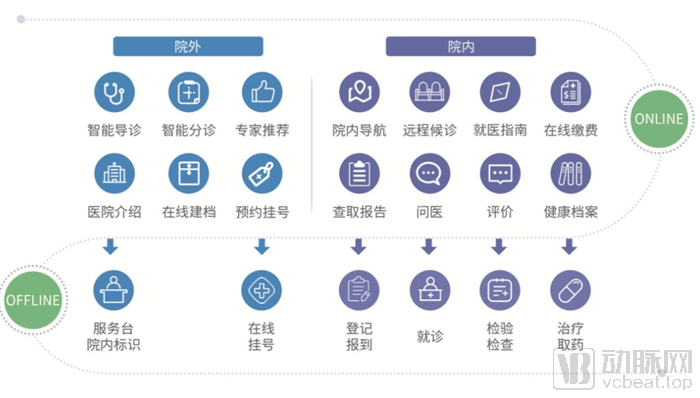
Functional Diagram of Futong Oriental Intelligent Triage Product
Futong Oriental leverages big data and artificial intelligence to address the mismatch between medical resources and healthcare demands. Through intelligent human-computer dialogue, patients can find suitable physicians, while doctors can screen for patients whose conditions align with their specialties, thereby enhancing the precision and efficiency of medical services at the source. Meanwhile, its intelligent triage products adhere to hospital smart service standards, offering an integrated smart outpatient solution aimed at facilitating the entire patient journey—pre-consultation, during consultation, and post-consultation—and improving the overall healthcare experience.
The precise alignment between patients and physicians relies on Futong Oriental’s capability to construct medical knowledge graphs. The Futong Oriental Medical Knowledge Graph features semantic processing capabilities and open interoperability. By leveraging natural language processing technologies, it extracts medical knowledge from vast volumes of literature and medical texts, facilitating machine learning and retention through training. It aligns professional medical terminology with patient language, infers the correlations between symptoms and diseases as well as question-and-answer logic, and conducts quality assessments of the established knowledge graph, enabling diverse application scenarios.
Wang Zhibin stated that the capability to construct the Futong Oriental Medical Knowledge Graph stems from the company’s AI Lab. The Futong Technology AI Lab comprises multiple experts with master’s degrees or higher, specializing in algorithmic modeling and data skills. Leveraging research in machine learning, deep learning, neural networks, and knowledge graphs, the lab enables AI to assist enterprises in their digital business transformation and foster business innovation. The Intelligent Medical R&D Center, responsible for developing intelligent triage systems, is composed of multidisciplinary, cross-field talent. In addition to teams focused on algorithms, product management, and R&D, a dedicated medical support team has been established to meet the specialized requirements of the healthcare industry. This team includes physicians with extensive clinical experience and talents from renowned domestic medical schools.
Unlike most platform-based triage products, Futong Oriental shares its core technology with hospitals, embedding it as a plugin into hospital service portals and providing services to both hospitals and patients as a third party. In this process, Futong Oriental has continuously improved product quality, helping hospitals build their own smart service systems.
On the one hand, leveraging natural language processing (NLP) techniques and medical knowledge graphs to rapidly develop a triage model for COVID-19, enabling the public to differentiate between common illnesses and COVID-19 and perform self-diagnosis at home.
On the other hand, during the pandemic, we provided free access to our intelligent triage platform and customized interfaces based on the specific needs of hospital users. This helped hospitals leverage human-computer interaction technology to enable pre-admission self-diagnosis for patients, rapidly collect clinical information, and empower large-scale population screening efforts.
Wang Zhibin introduced that the standard version of the intelligent triage system, launched in response to the pandemic, is a lightweight application that can be remotely deployed and installed at hospitals within one week. “Given its inherently lightweight nature as a ready-to-use tool-type product, this standard version will serve as a model for our future product deliveries and provide valuable reference for the development of other versions.”
Intelligent triage systems are a key focus for Futong Oriental’s next phase of development. Moving forward, Futong Oriental will integrate epidemiology and emergency care frameworks into its offerings, while incorporating projects currently in the research stage into its product portfolio, thereby continuously enriching its product ecosystem.