

AstraZeneca Elevates Internet Hospital to Strategic Priority in China, Appoints New Leadership for Digital Health Initiative

AstraZeneca Investment China
Pharmaceutical Manufacturer
Recently, AstraZeneca announced a notice to merge and restructure its cardiovascular and diabetes metabolism businesses. The two major therapeutic areas of cardiovascular and diabetes will be officially merged into the Cardiovascular, Diabetes, and Metabolism Business Unit. Mr. Zhu Tong, the current head of the cardiovascular business unit, will serve as the business leader overseeing the Cardiovascular/Diabetes and Metabolism Business Unit, whileMr. Guan Hong, the current head of the Diabetes Business Unit, will join one of AstraZeneca’s strategic initiatives—the Internet Hospital Strategic Project (iHospital)—and will assume full responsibility for product development management at iHospital.Reports directly to Ms. Xu Jing, Vice President of AstraZeneca China and Head of the Digitalization & Commercial Innovation Department.
During the pandemic, internet healthcare throughGuide patients to seek online medical consultations to avoid cross-infection risks associated with in-person hospital visits, while ensuring continuity of care for chronic disease management, including follow-up visits and medication access.Physical hospitals in multiple provinces and cities across China have launched internet hospitals, and during the pandemic, they urgently enabled medical insurance payment for online healthcare services.This completes the closed loop of online consultation, prescription issuance, payment settlement, and medication delivery. The internet healthcare sector ushered in an unprecedented opportunity for growth in early 2020. Although we do not yet know the exact nature of AstraZeneca’s iHospital project,But this is the first time we have seen major international pharmaceutical companies paying attention to internet hospitals.
Currently, AstraZeneca stated that it is not convenient to give an interview regarding the iHospital project.In fact, this is not the first time AstraZeneca has ventured into the field of internet healthcare. In November 2015, AstraZeneca entered into a strategic partnership with WeDoctor to jointly launch a series of integrated online-and-offline health management projects. Wang Lei, then President of AstraZeneca China and Hong Kong, positioned the collaboration as “a response to the national call for promoting tiered diagnosis and treatment. Adhering to its ‘expansion and grassroots penetration’ strategy, AstraZeneca is committed to further enhancing public awareness of diseases and providing the public with higher-quality integrated health management services.”
It is not uncommon for pharmaceutical companies to collaborate with internet healthcare enterprises, butAstraZeneca is the first to elevate its internet hospital project to a strategic level.For pharmaceutical companies, internet healthcare can bridge the gap between them and patients, facilitating relevant statistics and research. Meanwhile, internet healthcare can expand pharmaceutical companies' coverage of primary care patients with minimal resource consumption. This aligns with the strategy adopted by AstraZeneca in recent years.
In recent years, AstraZeneca appears to have gained a deep understanding of the Chinese market landscape. From the remarkable success of its nebulization centers to the successive launch of numerous IoT-based solutions, AstraZeneca has consistently leveraged digital technologies to penetrate grassroots healthcare settings, successfully capturing a substantial share of the long-tail market.
These achievements have also been reflected in AstraZeneca China’s sales performance. In 2019, AstraZeneca China’s total revenue reached $4.88 billion (equivalent to RMB 34.5 billion at current exchange rates), accounting for more than 20% of its global revenue. Meanwhile, senior executive positions within AstraZeneca China have been elevated repeatedly in line with the region’s strong performance, and Chinese executives have become an important part of AstraZeneca’s global management team.
So, what exactly has AstraZeneca done right in the past few years? What tactical strategies has AstraZeneca implemented in response to China’s unique environment? How has digital technology helped AstraZeneca expand its reach into the primary healthcare market?
In AstraZeneca’s financial reports in recent years, the word “China” has appeared with increasing frequency.
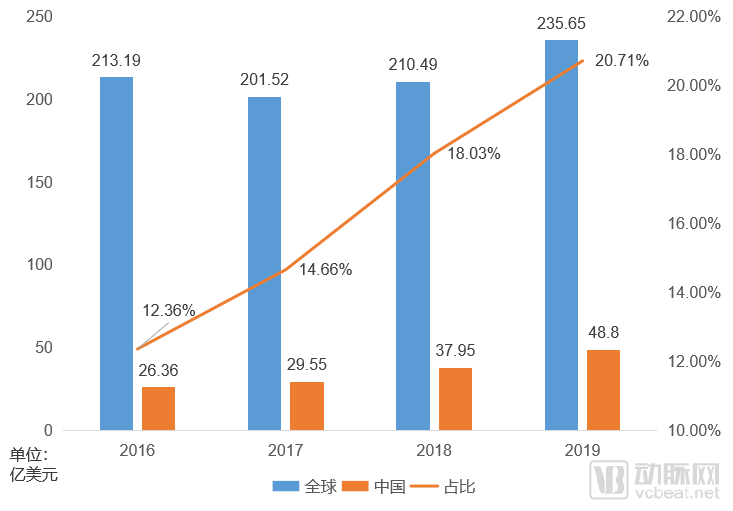
AstraZeneca’s Global and China Performance
In 2019, AstraZeneca’s overall business returned to a fast track, with annual revenue reaching $23.565 billion, a 12% increase from 2018. The oncology business grew rapidly from $4.024 billion in 2017 to $8.667 billion in 2019, representing a compound annual growth rate (CAGR) of 47%. Nine drug products achieved sales exceeding $1 billion each, while others, such as Nuvide and Fushide, approached the $1 billion mark.
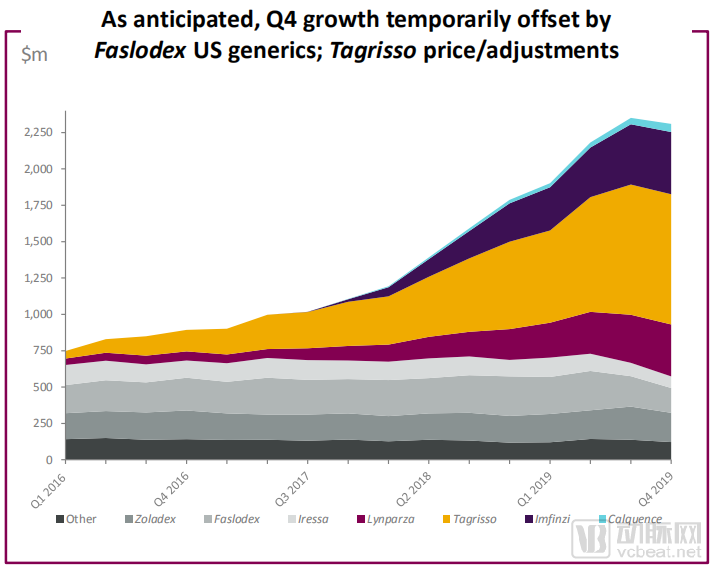
AstraZeneca's Oncology Product Sales
In the oncology drug pipeline,Tagrisso (Osimertinib)Its strong performance deserves the primary credit. The third-generation EGFR-targeted therapy, which was only launched in the United States in November 2015, achieved annual revenues of $3.189 billion by 2019.Ying FeifanandLynparzaalso continued to demonstrate strong performance, reaching $1.469 billion and $1.198 billion respectively, becoming two more blockbuster drugs in AstraZeneca’s portfolio.
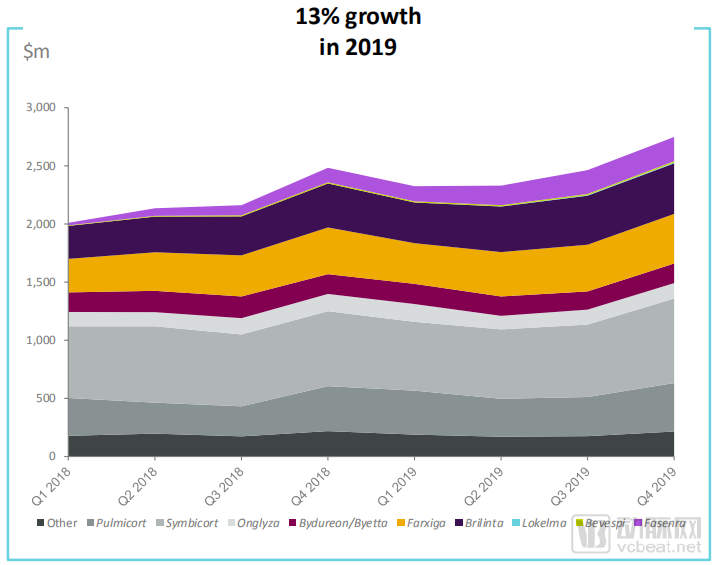
AstraZeneca's CVRM Business and Respiratory-Related Product Sales
In the CVRM (Cardiovascular, Renal and Metabolic) business area,ForxigaandBrilintacontinuing their previous strong performance, with sales each surpassing $1.5 billion.
Crestor, Nexium, Symbicort Turbuhaler, Pulmicort RespulesFour drugs that have already passed their patent expiration dates continue to maintain annual sales exceeding $1 billion. With the exception of Symbicort Turbuhaler, emerging markets account for more than 50% of total sales for the other three drugs, and Pulmicort Respules has even experienced growth. In its 2019 annual report, AstraZeneca specifically highlighted the driving effect of nebulization centers in China on the sales of Pulmicort Respules.
In fact, it was not only Pulmicort Respules that performed strongly; AstraZeneca’s China market continued the robust momentum of the previous year, further expanding to $4.88 billion, a 29% increase from 2018, accounting for 60% of its emerging markets revenue and 20.7% of its total revenue. As a result, the China market surpassed the European market to become the second-largest market after the United States. Moreover, within the revenue structure in China, new drugs have gradually become a key component, with their share rising from 11% to 19%.
In its detailed disclosure, AstraZeneca specifically highlighted that Iressa, Lynparza, and Forxiga were included in China’s National Reimbursement Drug List; Iressa was shortlisted for the national volume-based procurement program; and the growth of Pulmicort Respules and Onglyza was primarily driven by the Chinese market. Although this also included negative information such as “Crestor failed to win a bid in the volume-based procurement,” the positive news far outweighed the negative overall, signaling that AstraZeneca’s Chinese market will continue to maintain its growth momentum.
Over the past decade, AstraZeneca has faced significant challenges. In 2011, the company’s annual revenue reached a peak of $33.6 billion. However, in the years that followed, the expiration of patents for three blockbuster drugs—Crestor, Nexium, and Seroquel—allowed generic competitors to rapidly erode AstraZeneca’s market share, leading to a prolonged period of stagnation.
In 2013, AstraZeneca began to gradually adjust its product portfolio. Pascal Soriot, then CEO of AstraZeneca, stated that the company’s future R&D efforts would focus on three major therapeutic areas: oncology, cardiovascular and metabolic diseases, and respiratory and inflammatory diseases, while reducing investment in the anti-infective sector.
AstraZeneca China has also evolved in tandem with the transformation of its global operations. In 2013, AstraZeneca China announced that it would “adjust its business strategy in China by suspending investments in the branded generics market and redirecting resources toward China’s emerging hospital market, namely hospitals in small and medium-sized cities and county-level hospitals.” This move entailed two key initiatives: first, shifting AstraZeneca’s product promotion focus from generic drugs to originator drugs; and second, placing greater emphasis on China’s primary healthcare market, with the aim of uncovering new opportunities within the long tail.
This strategic shift was more than just talk. AstraZeneca promptly reduced resource allocation to its generic drug business while focusing on promoting its flagship products. The company’s $230 million investment in Taizhou, which established its largest independent production base globally, also pivoted from manufacturing generic drugs to producing the company’s existing portfolio.
This strategy created strong synergies with AstraZeneca’s product pipeline, driving rapid expansion in its China market. In 2013, AstraZeneca’s total revenue in China reached $1.84 billion, representing a 22% year-on-year increase. In the following years, AstraZeneca’s China business maintained robust revenue growth, reaching $2.636 billion by 2016, in stark contrast to the company’s declining global performance.
As its business in China continues to expand, AstraZeneca has invested an additional $40 million to establish the AstraZeneca China Logistics Center in Wuxi, which is used for storing and distributing medicines from AstraZeneca’s operations in China as well as from its global supply bases.
In 2017, AstraZeneca, facing consecutive years of declining performance, decided to further focus its business by restructuring its operations into three major divisions: Oncology, Respiratory, and Cardiovascular, Renal and Metabolism (CVRM), with Oncology being the top priority. Meanwhile, the priority of other therapeutic areas, such as anti-infectives, psychiatry, and anesthesia, was correspondingly reduced.
Following its business restructuring, AstraZeneca began to promote its products in a more targeted manner, particularly its oncology drugs, with initial results becoming evident as early as 2018. In 2018, the company’s revenue returned to growth; although the increase was only 4.5%, it finally broke free from the trend of declining annual performance.
Meanwhile, starting in 2018, AstraZeneca’s financial reports featured significantly more content regarding the Chinese market. In 2018, its revenue from China accounted for 55% of its total revenue from emerging markets, rising from $2.955 billion the previous year to $3.795 billion, representing a substantial growth rate of 28%.
As previously mentioned, by 2019, the Chinese market had become a cornerstone of AstraZeneca’s performance growth.
If AstraZeneca’s strategic choices served as the catalyst for growth in the Chinese market, then another key factor driving this growth was AstraZeneca’s identification of the optimal executor.
AstraZeneca’s culture has always been imbued with a down-to-earth pragmatism. Liu Qian, currently Vice President and Chief Marketing Officer of AstraZeneca China, wrote on his WeChat official account upon rejoining the company: “Although I had worked at AstraZeneca for many years before, I found that the company had changed significantly after my ten-year absence. In addition to the stringent management and specialized division of labor common among multinational corporations, AstraZeneca has developed its own unique characteristics, such as pragmatism, groundedness, and innovation.”
Such a team requires an equally down-to-earth executive to drive it forward, and Wang Lei, who has risen step by step from the grassroots level, is the ideal candidate.
In March 2013, Wang Lei, who had worked at Roche for 16 years, joined AstraZeneca China as Vice President of the Gastrointestinal, Respiratory and Anesthesia Business Unit.
At that time, AstraZeneca’s oncology business was just getting off the ground, while its respiratory, anesthesia, and pain management divisions remained a major source of revenue. The department led by Wang Lei was responsible for key products such as Nexium, Symbicort Turbuhaler, and Seroquel, all of which were blockbuster drugs for AstraZeneca. However, these medications faced varying degrees of challenges, including patent expirations and intense market competition, leading to a gradual slowdown in their growth in China. Boosting sales of these drugs was precisely the challenge confronting Wang Lei.
Wang Lei’s thinking was not confined to mere pharmaceutical marketing. Rather than focusing on how to sell products, he turned his attention to another question: What do patients need?
Wang Lei himself suffered from asthma as a child and deeply understands the struggles of asthma patients. After joining AstraZeneca Investment China in 2013, he witnessed many asthma patients traveling specifically to Shanghai for treatment, simply because their local primary care facilities lacked nebulization therapy rooms.
Patients need readily accessible nebulization therapy rooms, while hospitals in non-tier-one cities also hope to retain their patient base. The needs of patients and healthcare institutions are actually well-aligned; what is missing is merely a catalyst to bridge the gap between them.
Thus, AstraZeneca served as an intermediary bridge, initiating efforts to assist hospitals in establishing nebulization centers. By extensively building such centers at the primary care level, AstraZeneca successfully penetrated its respiratory-related products into the grassroots market, not only providing convenience for patients but also opening up vast opportunities in the primary healthcare sector.
Thanks to this successful marketing campaign, Wang Lei won the AstraZeneca International Region Grand Award, and the following year, he received the AstraZeneca Global President’s Award.
Less than two years later, in December 2014, Wang Lei was promoted to President of China. Just two years after that, he was promoted again to Executive Vice President of AstraZeneca globally, overseeing strategy and business development for the Asia-Pacific region.
Following the resounding success of its nebulization centers, AstraZeneca Investment China has launched a series of initiatives centered on IoT innovation.
AstraZeneca’s digital innovation is centered in Wuxi, with the application of Internet of Things (IoT) technology serving as a key focus. In June 2017, AstraZeneca established its China Commercial Innovation Center in Wuxi, leveraging IoT to build patient-centric, integrated diagnosis and treatment solutions covering the entire course of disease management.
From AstraZeneca’s perspective, AI- and big data-driven multidisciplinary diagnosis and treatment has become the trend of the future, and AstraZeneca is gradually bringing digital technologies closer to reality.
Why pursue the Internet of Things? This brings us to AstraZeneca’s “patient-centric” marketing philosophy.
“Patient-centricity” has been a mantra for pharmaceutical companies for years, but few have truly put this philosophy into practice like AstraZeneca.
Traditionally, pharmaceutical companies have focused on drug development and providing related education and training to physicians, while largely neglecting the patient aspect. However, under the new "patient-centric" paradigm, simply selling drugs to patients is no longer sufficient; pharmaceutical companies must also continuously monitor "after-sales" issues such as therapeutic efficacy, adverse reactions, and patient adherence.
According to Wang Lei, “I have to care about whether customers experience diarrhea after returning home from eating.”
AstraZeneca has even conducted dedicated research on this topic. In April 2017, AstraZeneca published a research article in BMJ Journals, specifically discussing the impact of patient-centricity on the biopharmaceutical industry. Following surveys of 470 patients in the United States and 703 patients in Europe, AstraZeneca redefined “patient-centricity” as “always putting patients first through their open and ongoing engagement, thereby delivering the best possible experiences and outcomes for patients and their families, grounded in respect and empathy.”
The success of the nebulization centers is built upon this “patient-centric” philosophy. By 2019, AstraZeneca had established more than 17,000 pediatric nebulization rooms across China. These facilities have significantly improved healthcare accessibility for patients with respiratory diseases, sparing them the need to travel extensively for nebulization therapy. Meanwhile, they have narrowed the gap between AstraZeneca and patients, enabling the company to gain insights into patients’ diagnosis and treatment conditions and further optimize its therapeutic solutions.
Correspondingly, AstraZeneca’s related products have seen wider adoption through the expansion of nebulization centers. In 2019, sales of Pulmicort Respules (budesonide inhalation suspension) grew by 20% in emerging markets, with particularly strong performance in China. As a respiratory medication whose patent has long expired, Pulmicort faces pressure not only from generic drugs but also from competing branded products vying for market share. Amid this dual competition, the key factor enabling Pulmicort to remain the top-selling inhaled formulation in China lies in AstraZeneca China’s strategic deployment in nebulization centers.
The role of AstraZeneca’s nebulization centers appears to extend even further. On January 11, 2020, AstraZeneca launched its novel triple therapy for chronic obstructive pulmonary disease (COPD), budesonide/glycopyrronium/formoterol pressurized metered-dose inhaler, in China, providing an important new treatment option for patients with stable COPD. Another drug, Fasenra, which has already been approved abroad for the treatment of severe eosinophilic asthma, generated $700 million in sales in 2019 and is likely to become another blockbuster product under AstraZeneca’s portfolio.
Leveraging the strong patient stickiness of its nebulization centers, AstraZeneca will hold a significant advantage in promoting these new respiratory drugs.
In 2018, AstraZeneca unveiled its eight integrated diagnosis and treatment solutions at the China International Import Expo (CIIE). These eight innovation hubs, covering disease areas such as respiratory, cardiovascular, metabolic, oncology, and digestive diseases, were launched by AstraZeneca in collaboration with more than 30 cross-sector partners, facilitating the implementation and comprehensive promotion of the Internet of Healthcare Things (IoHT) projects.
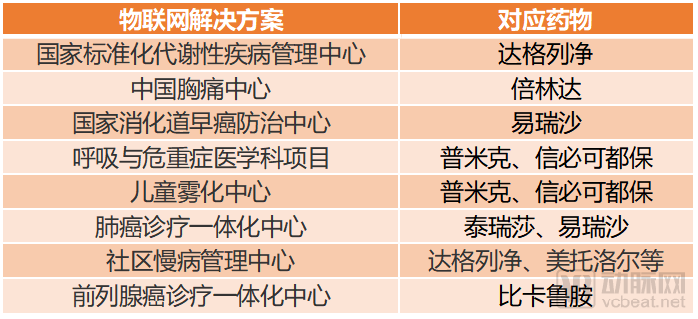
For China’s universal health insurance payment system, the primary care sector represents a vast long-tail market; capturing this segment is essential for establishing a true foothold in China. This is precisely AstraZeneca’s strategy. The fundamental purpose of these IoT initiatives is to rapidly extend AstraZeneca’s product footprint from first-tier cities into the primary care market.
A close examination of the specific scenarios targeted by AstraZeneca’s eight innovation centers reveals that its core marketed products are present in each of these settings. In other words, AstraZeneca is seeking to replicate the success it achieved with its nebulization centers, aiming to promote its pharmaceuticals by forging stronger ties with clinical care pathways, while simultaneously supporting the digital transformation of China’s healthcare system.
During the national medical insurance negotiations held at the end of 2019, a video clip went viral across the internet after a negotiator declared, “We are now negotiating on behalf of the entire country.” The drug under negotiation was dapagliflozin, manufactured by AstraZeneca.
The negotiation process for dapagliflozin epitomizes AstraZeneca’s strategy in the National Reimbursement Drug List (NRDL) negotiations. Under intense pressure from negotiation experts, AstraZeneca repeatedly lowered its bid. Each price reduction squeezed the company’s profit margins, yet it proceeded with little hesitation. Ultimately, dapagliflozin was successfully included in the NRDL at a price of RMB 4.36, setting a new global low for the drug.
AstraZeneca’s decisive stance on national health insurance reimbursement issues stems precisely from its deep understanding of the Chinese market.
Although China’s innovative drug industry is developing rapidly, the country’s pharmaceutical market remains dominated by generic drugs to date. This market landscape implies that most drugs have comparable alternatives. Consequently, the key to standing out from competitors lies in securing reimbursement coverage.
Therefore, AstraZeneca has been unequivocal in its approach to national medical insurance negotiations. Tagrisso (osimertinib), launched in 2017, was successfully included in the national reimbursement drug list during the negotiations at the end of 2018. In the new round of negotiations at the end of 2019, in addition to Forxiga (dapagliflozin), Lynparza (olaparib) was also successfully added to the national reimbursement drug list.
Meanwhile, in the volume-based procurement program, AstraZeneca’s first-generation EGFR-TKI targeted therapy, Iressa (gefitinib), won the bid after a substantial price reduction, thereby reinforcing AstraZeneca’s market position in EGFR-targeted therapies alongside Tagrisso.
At the 2019 China International Import Expo (CIIE), AstraZeneca once again showcased its innovative solutions, with its 800-square-meter booth becoming one of the largest in the healthcare sector at that year’s expo.
Several collaborations announced at the China International Import Expo (CIIE) also point to AstraZeneca’s strategic direction for its next phase.
In terms of investment, AstraZeneca has partnered with CICC Capital to jointly establish a global healthcare industry fund, leveraging the strengths of both institutions to promote the overseas introduction and local incubation of healthcare products.
In terms of external collaborations, AstraZeneca has partnered with local enterprises to advance the development of multiple drug molecules and welcomes innovative companies from both China and abroad to settle in the Wuxi International Life Science Innovation Park. Furthermore, AstraZeneca’s strategic cooperation with the Shanghai Municipal Government has been further upgraded, launching new collaborations in areas such as pharmaceutical R&D and artificial intelligence.
In terms of in-house R&D, the existing Shanghai R&D platform will be upgraded into a Global R&D Center to conduct research across multiple fields, including artificial intelligence, big data, bioanalysis, and translational medicine. Additionally, AstraZeneca will establish an AI Innovation Center to empower new healthcare service models with cutting-edge artificial intelligence technologies.
AstraZeneca’s strategy in China is rapidly converging on the integration of innovative pharmaceuticals and emerging technologies. The company has recognized the surging domestic demand for innovative drugs, while new technologies are driving unprecedented transformation in the healthcare industry. Well-prepared, AstraZeneca is poised to continue leading the trend in China’s healthcare sector over the next decade.