

ResApp Health Limited: AI-Powered Smartphone Application for Respiratory Disease Diagnosis – Prospectus Summary

ResApp Health
Developer of Disease Diagnosis and Health Management Applications
ResApp was founded in September 2014 and is headquartered in Perth, the capital of Western Australia, Australia. The company aims to commercialize technology developed by Associate Professor Udantha Abeyratne, which utilizes sound for the diagnosis of respiratory diseases. Abeyratne’s team has been engaged in the research and development of this technology since 2009, with funding from the Bill & Melinda Gates Foundation, the University of Queensland, and UniQuest. ResApp listed on the Australian Securities Exchange in July 2015 and was named “Australian Startup of the Year” at the Johnson & Johnson Innovation 2016 Industry Excellence Awards.
ResApp is developing digital health solutions to assist physicians in diagnosing respiratory diseases. The app is user-friendly and affordably priced, with its auxiliary diagnostic features clinically validated and approved by regulatory authorities. ResApp’s solutions are designed for seamless integration into existing telehealth platforms. It is understood that ResApp is also developing applications to deliver respiratory disease diagnostic results directly to consumers and healthcare providers.
ResApp Health completed three rounds of financing in June 2015, April 2016, and February this year, raising a total of $17 million.


CEO Tony Keating
Tony holds a Bachelor of Engineering, a Master of Engineering Science, and a Ph.D. in Mechanical Engineering from the University of Queensland. He also possesses an Advanced Certificate in Leadership from the MIT Sloan School of Management and is a Graduate Member of the Australian Institute of Company Directors.
Tony is the CEO and Managing Director of ResApp Health, with over 10 years of experience in technology commercialization. Tony formulated the initial business strategy for ResApp and led the commercialization of its technology. Previously, Tony served as Head of Business Development at UniQuest Pty Ltd, a global leader in university technology commercialization. During his tenure at UniQuest, Tony acted as interim CEO and non-executive director for several venture capital-backed private startups.
ResApp’s technology was originally developed by Associate Professor Udantha Abeyratne at the University of Queensland, based on the premise that cough and respiratory sounds carry important information about the state of the respiratory tract.ResApp was established to diagnose and measure the severity of various chronic and acute diseases, such as pneumonia, asthma, bronchiolitis, and chronic obstructive pulmonary disease (COPD).
Typically, physicians use stethoscopes to auscultate lung sounds, and any deviations in these sounds often serve as the initial indication of respiratory system disorders. However, the information derived from such auscultation is incomplete, as the sounds must first traverse chest muscle tissue, which attenuates the high-frequency components of respiratory sounds. In contrast, during activities such as coughing, the lungs are directly connected to the atmosphere. The resulting sounds contain significantly more information than those captured by a stethoscope. ResApp’s approach is automated, eliminating the need for manual interpretation of respiratory sound data.
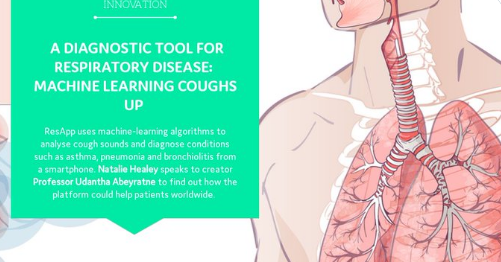
ResApp employs machine learning to develop high-precision algorithms for diagnosing diseases from cough and respiratory sounds.In ResApp's approach, characteristic signals of the respiratory tract are extracted from cough and breathing sounds.ResApp first matches information from a large database of audio recordings with known clinical diagnoses. Then, ResApp’s machine learning tools identify the optimal combination of these features to create an accurate diagnostic test or severity metric. Importantly, the research team at the University of Queensland believes that these features are consistent across the population rather than being individual-specific, thus eliminating the need for personalized databases.
Over the past five years, a research team led by Associate Professor Abeyratne has pioneered a unique set of feature extraction and classification techniques capable of accurately characterizing the respiratory tract. Their approach provides a robust platform for the diagnosis and management of respiratory diseases. This platform relies solely on acoustic analysis, requiring no physical contact with the patient. Given that modern smartphones are equipped with high-quality microphones, the platform can be deployed without the need for additional hardware.
Telemedicine delivers medical services via telephone or online video. It leverages modern technology to provide patients with convenient, accessible, and high-quality care. The development of high-speed internet and improvements in mobile networks have driven substantial growth in the telemedicine industry. According to Inc. magazine, telemedicine is currently the second-fastest-growing industry in the United States. The benefits of telemedicine extend to all stakeholders within the healthcare system. Patients gain access to convenient and high-quality medical services, while employers and insurance companies can more effectively alleviate cost pressures. For healthcare providers situated between these groups, telemedicine offers enhanced productivity and flexibility.
A 2014 study by Uscher-Pines and Mehrotra found that 31% of telemedicine users sought consultations for acute respiratory conditions. ResApp’s diagnostic tests provide telehealth users with clinically validated respiratory disease diagnostics either during or prior to consultations. As ResApp’s technology requires no additional hardware beyond a smartphone, telehealth providers can immediately deploy the tests to all their members.
“Global Asthma Report 2018”It is estimated that asthma affects approximately 339 million people worldwide, while the Global Burden of Disease Study reported 251 million cases of chronic obstructive pulmonary disease (COPD) in 2016. In the United States, approximately 13.6 million emergency department visits are diagnosed with respiratory diseases each year, including 4.6 million pediatric visits. Annual outpatient visits for respiratory diseases in the U.S. total 125 million, and ResApp estimates that this figure exceeds 700 million globally.。
As a clinical aid in emergency departments or general clinical consultations, ResApp’s rapid, low-cost, and accurate diagnostic test offers numerous advantages over traditional diagnostic pathways. Particularly for pneumonia, the ResApp test is significantly less expensive than chest X-rays and follow-up consultations, while delivering accurate results more quickly, thereby enabling physicians to initiate appropriate treatment immediately.
Approximately 339 million people worldwide have asthma, and 251 million have chronic obstructive pulmonary disease (COPD). Asthma and COPD are incurable; however, appropriate treatment can help alleviate symptoms, improve quality of life, and reduce the risk of mortality.
ResApp has developed a smartphone-based machine learning algorithm capable of accurately identifying acute exacerbations in patients with asthma or COPD.
ResApp’s algorithm demonstrated high accuracy in diagnosing acute respiratory diseases in a pivotal adult clinical study. The study showed that, compared with clinical diagnosis, the positive and negative predictive values for lower respiratory tract infections and pneumonia both exceeded 86%. The study also indicated that ResApp’s algorithm can accurately identify acute exacerbations in patients with chronic obstructive pulmonary disease (COPD) or asthma, and can effectively screen for COPD in the general population.
ResApp has developed a screening test for obstructive sleep apnea that uses a smartphone placed on the bedside table to record nighttime breathing and snoring sounds.
Sleep apnea is the most common sleep-related breathing disorder, affecting more than 3 in 10 men and nearly 2 in 10 women. Sleep apnea is defined as the cessation of airflow into the lungs for 10 seconds or longer during sleep. In some cases, this can occur more than 30 times per hour.
Studies indicate that 80% of patients with sleep apnea remain undiagnosed. Currently, sleep apnea syndrome is commonly diagnosed in clinical practice using polysomnography (PSG). During PSG, numerous contact sensors are employed to monitor cardiac, pulmonary, and cerebral activity, breathing patterns, limb movements, and blood oxygen levels during sleep. However, patients often find the procedure uncomfortable and struggle to fall asleep in this unfamiliar environment.
ResApp’s solution requires only placing a smartphone on the bedside table. ResApp’s machine learning algorithms analyze nighttime breathing and snoring sounds to identify obstructive sleep apnea (OSA). Results from a prospective, double-blind clinical study demonstrated that, compared with laboratory-based polysomnography (PSG) conducted concurrently in 582 patients, the sensitivity for detecting mild, moderate, or severe OSA (AHI ≥5/h) was 84%, with a specificity of 83%.。
With social progress and the rapid development of the internet, interpersonal connections have become increasingly reliant on digital platforms, bringing digital health into the spotlight. Although ResApp Health currently focuses primarily on research into respiratory diseases, it exemplifies the advantages of digital health: enabling individuals to monitor their health status anytime and anywhere, requiring only a smartphone to access personal physiological data. Such convenience better meets the needs of the majority of people.