

Maven Clinic: A Leading Digital Health Platform for Women and Families with Innovative Breast Milk Shipping Service

Maven Clinic
Developer of Online Diagnosis and Treatment Platform for Women's Health
Unlike other online telehealth companies, Maven Clinic focuses on women and families, providing services such as prenatal and postpartum care for pregnant women, and is a leading developer of digital health platforms for women in the industry.
On February 19 this year, Maven Clinic announced the completion of its Series C financing round, amounting to $45 million.. This round of financing was led by Icon Ventures, with participation from Sequoia, Oak HC/FT, Spring Mountain Capital, Female Founders Fund, Harmony Partners, and individual investor Natalie Portman.
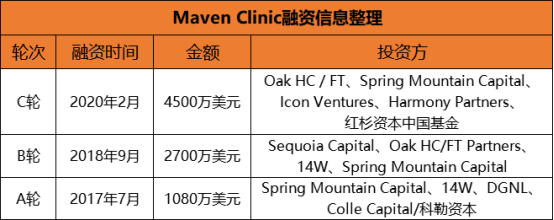
Maven Clinic's Financing Information
According to Katherine Ryder, founder and CEO of Maven Clinic, this is the largest funding round ever raised by a female founder in the women’s and family health sector. The funds will be used to support the company’s growth, increase investment in its digital platform, and expand its business into more areas and regions.
To date, the company’s total funding has reached $88 million. Following this round of financing, Tom Mawhinney, a partner at Icon Ventures, will also join the board of directors of Maven Clinic.
Maven Clinic is a women's digital health care company founded in 2014 and headquartered in New York, USA.
This company leverages internet-based healthcare to provide online diagnosis and treatment services for women’s health to both individuals and corporate employees, with a particular focus on addressing needs during pregnancy and the postpartum period. Its mission is to make healthcare services more accessible to women.
They describe themselves as “a personalized platform for every family.”
Maven Clinic operates similarly to other telehealth networks, enabling users to receive online medical consultations by messaging healthcare providers specializing in women’s health via its website or app, or by scheduling video appointments directly.. These healthcare professionals include obstetricians and gynecologists, midwives, therapists, psychological counselors, and nutritionists, who can provide users with advice around the clock or issue prescriptions online.
Recently, Katherine Ryder announced that Maven Clinic was ranked No. 1 by the renowned business magazine Fast Company as the most innovative company in the health sector and was included in its list of the World’s 50 Most Innovative Companies across categories.
Not long ago, Maven Clinic was named to FierceHealthcare’s list of the Top 15 Companies of 2020, which recognizes 15 “companies across the U.S. trying to change the world by transforming the healthcare industry.” Maven Clinic has also been featured in numerous other publications, including Fortune, and was dubbed a “healthcare technology disruptor” by Forbes magazine.
“Through this digital health network, the largest provider of women’s and family healthcare, Maven is addressing significant gaps in care.” Tom Mawhinney stated, “Leveraging their virtual care and services, Maven Clinic is committed to improving maternal health outcomes, reducing healthcare costs, and enabling more women to remain in the workforce while confidently embracing motherhood.”

Maven Clinic’s CEO and Founder: Katherine Ryder
Katherine Ryder studied at the University of Michigan in the United States and earned a Master of Science degree from the London School of Economics and Political Science.
Before founding Maven Clinic, Katherine Ryder was a business journalist. She later worked in digital health at the London-based venture capital firm Index Ventures.
During her tenure at Index Ventures, her friends began to increasingly face fertility challenges. Katherine Ryder observed that while many women make decisions regarding their family’s health and devote much to their households, few products are specifically designed to serve women.
She also discovered significant disparities in prenatal and postpartum care among different women and families. Anxiety and stress surrounding childbirth remain high among women in the new era, driving substantial demand for healthcare networks tailored to women. Drawing on her own childbearing experience, Katherine Ryder recognized the necessity of developing health services specifically for women, which inspired her idea to provide telemedicine services and applications for women.
“To provide high-quality care, we need highly skilled healthcare providers who can meet patients’ needs on their own terms: listening to the needs of families and advocating for the health of women and families within the healthcare system,” said Katherine Ryder.
Against this backdrop, Maven Clinic was established, focusing on digital health services for women.
From journalist to venture capitalist to CEO, it may sound like an unusual career path, but Katherine Ryder says entrepreneurship runs in her blood. Her father and aunt both founded their own companies, and she grew up witnessing their successful journeys.
Although Katherine Ryder had worked in venture capital, she still worried about funding in the early days. It was a male-dominated world, and she was told that no one would fund women’s health or her company.
“Many people don’t consider this a large market,” Katherine Ryder once stated. “But in reality, that is not the case. People need to recognize the fact that women dominate the healthcare industry.” According to data from the U.S. Department of Labor, women account for 57% of spending in physicians’ offices, and 80% of women serve as the primary healthcare decision-makers in their households.
So she turned her attention to seeking help from other female entrepreneurs and pitching to female investors. Katherine Ryder said, “When I was raising funds for this company, I found some female investors who truly understood the company’s value proposition and were passionate about it.”
Thanks to this, Maven Clinic has raised sufficient capital, paving a solid path for its future development.
Now a mother of two, Katherine Ryder continues to dedicate herself to running this fast-growing company. Her team has provided her with substantial support, including Suzie Grange, Co-founder and Head of Front-End Technology at Maven Clinic; Chief Product Officer Erik Lumer; Vice President of Engineering Eric Hurkman; and Director of Vendor Operations Jamie Meyerson, among others.
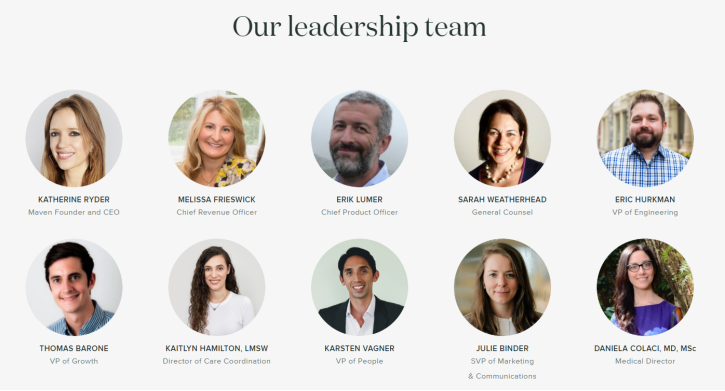
Maven Clinic’s Leadership Team Members
Maven Clinic primarily operates under two business models: first, it provides healthcare services to individual users through its platform, enabling online consultations with physicians; second, it sells its services to partner companies, thereby benefiting both the organizations and their employees. Employers can also purchase such coverage for their staff.。
Maven Clinic’s services improve health outcomes for women and families. Their offerings include in vitro fertilization (IVF), pregnancy care, prenatal care, egg freezing, postpartum care, pediatric care, adoption support, miscarriage management, maternal mental health counseling and psychological support, and return-to-work programs.
Furthermore, Maven Clinic has partnered with numerous companies to provide their female employees with a maternity program called Maven Maternity. This program offers a comprehensive 15-month plan covering every stage of pregnancy and childbirth, ensuring that female employees have healthier pregnancies and facilitating their smooth return to work after delivery. The program was launched in early 2016.
In a 2013 report, healthcare analytics firm Truven noted that the average total cost for pregnancy and newborn care was approximately $30,000 for vaginal delivery and $50,000 for cesarean section, with commercial insurers paying an average of $18,329 and $27,866, respectively. Furthermore, although 96% of mothers expressed a desire to return to work after childbirth, fewer than 60% actually rejoined the workforce within the first year.
Maven Clinic has stated that 90% of its clients return to work, compared with a national average of only 57%.。
The company also claims that its services can reduce emergency department visits and lower maternal healthcare costs. It now also offers benefits to LGBTQ+ families (including gay and bisexual individuals) and single-parent households.
Since 2014, Maven Clinic has served 5 million people, 61% of whom are new parents.Over the past year, Maven Clinic’s customer base has tripled, establishing partnerships with clients from more than 100 companies worldwide, including those in the Fortune 50. The company’s telehealth network has expanded to include 1,700 healthcare providers across more than 20 specialties, supporting 30 languages. They are filling critical gaps in the healthcare system.
A significant portion of the health insurance premiums that companies pay for their employees is spent on the maternity and pregnancy stages. It is evident that the services provided by Maven Clinic hold substantial economic significance for enterprises.
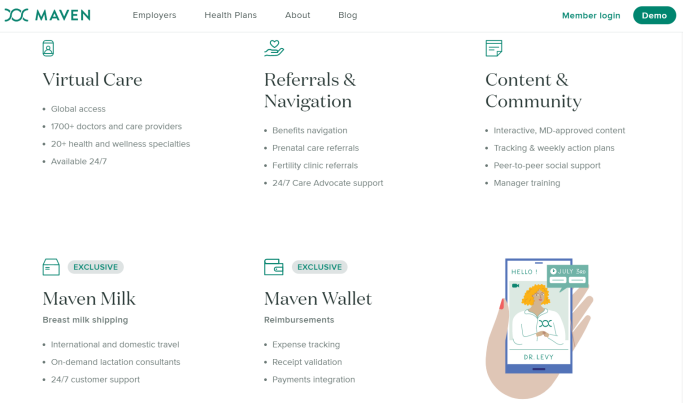
Services Provided by Maven Clinic
In addition to its website, Maven Clinic also has its own app.They have two apps: one is a patient-facing app with the same name, and the other is “MPractice,” designed for women’s health specialists.
For individual patients, the Maven Clinic app is available for free download; they can post questions on the forum and receive answers from healthcare professionals at no cost.
Maven Clinic offers users the choice between real-name registration and anonymity when they first use its platform services. If a user opts for real-name registration, healthcare providers on the platform can access the user’s personal health records and, where permitted by state law, issue online prescriptions. Choosing anonymity provides enhanced privacy protection for users.
Regarding the fee structure, they have set it up as follows: a 10-minute remote consultation with a nurse or midwife costs $18; a 20-minute online consultation with a dietitian, lactation consultant, or physical therapist costs $25; a 10-minute online consultation with a physician costs $35; and a 40-minute online session with a psychological counselor costs $70.
Maven Clinic also offers breast milk shipping services, known as “Maven Milk.” Maven Milk serves customers both within the United States and internationally, providing access to lactation consultants and guaranteeing 24/7 support.
This is highly beneficial for new mothers returning to the workforce. Companies that have benefited from this include IBM, Twitter, and Goldman Sachs Group.
However, Maven Clinic is not the only company offering breast milk transportation services. Milk Stork, a startup, also provides such services, aiming to help mothers transport, store, package, and ship their breast milk home through a comprehensive service platform.
In the telemedicine sector, Maven Clinic also faces numerous competitors. However, Katherine Ryder is confident that Maven Clinic’s international operations and its women-focused “one-stop shop” model are more appealing to both individual clients and enterprises.
Recently,Maven Clinic has launched a reimbursement management service called Maven Wallet, which helps users track expense information related to fertility and other services, calculate the costs of these services, and verify the authenticity of receipts.。
With the launch of Maven Wallet, Maven Clinic, a leader in women’s and family health, has expanded into the payments sector.
“Fundamentally, the payment models for these services suffer from many pain points because they are not integrated into core fertility care pathways,” said Katherine Ryder. “We recognized that we could support both employers and patients by incorporating reimbursement capabilities into our platform.”
Maven Wallet plans to connect to users’ bank accounts and provide access to employer-allocated funds for maternity care expenses. For example, if a company allocates $20,000 per employee for fertility and maternity healthcare services, users can use Maven Wallet to find providers, make payments, submit benefit claims, and monitor the remaining balance of their allocated funds.
Social gaming developer Zynga Inc. has proactively adopted Maven Wallet. By leveraging Maven Wallet’s products and services, the company has reduced employees’ job-loss anxiety, particularly stress related to fertility.
“Navigating the healthcare system can sometimes be truly confusing, so we aimed to address these pain points and provide real-time support to employees and their families throughout the process,” said Bryan Aycock, Senior Global Benefits Manager at Zynga. “Enabling employees to quickly access more than 20 different types of women’s and family health service providers made perfect sense for us.”
The number of women’s health technology products is on the rise. According to the latest market report from Research2Guidance, there are now more than 3,000 app-based women’s health products available on the market. The report shows that since 2011, the femtech industry has raised $220 million. By the end of 2019, women’s health had successfully evolved into one of the largest consumer-oriented segments in the digital healthcare market.
In such a market environment, many telemedicine companies have chosen to enter the field of women's health.
In the field of pregnancy management, there are also several corresponding apps in China, including BabyTree Pregnancy, Qinbaobao, Mama Community, Youyou Parenting, and Quyun.
The success of Maven Clinic offers many insights for professionals in China’s healthcare industry:
First, accurately define product positioning. Establish clear objectives and precisely identify your position in the market.
Second, a highly cohesive team is a crucial guarantee for the company’s development. The team must possess sufficient professionalism.
Third, the selection of investors is crucial. Identifying suitable investors can provide a company with a robust and sustainable source of capital. Katherine Ryder’s strategic decision to primarily seek out female investors proved highly prudent, securing ample funding for the company.
Fourth, prioritize user experience. By considering matters from the user’s perspective, meticulous and thoughtful service combined with a superior user experience can enhance user stickiness and generate sustained, long-term benefits. Maven Clinic places significant emphasis on this aspect, as evidenced by its consistently high ratings on the App Store.
Fifth, actively seek collaborations. Moreover, actively participating in and hosting seminars and other events is an excellent way to increase visibility.
Sixth, step out of your comfort zone and expand your technical expertise. Innovation is the primary driver of development. Only by raising technological barriers can one remain invincible in the market.
Seventh, monitor market trends and stay aligned with market demand. Market demand serves as the guiding force for industrial development and innovation.