

Intelligent Medical Customer Service Accelerated by 'New Infrastructure' Is No Longer Just a Cold Chatbot | QuickShangTong Overview and Product Insights
Central government sets the tone, investment ramps up: “New Infrastructure” goes viral as spring arrives.
The Central Economic Work Conference held at the end of 2018 pointed out, “Accelerate the commercialization of 5G and strengthen the construction of new infrastructure such as artificial intelligence, industrial internet, and the Internet of Things.” At that time, the concept of “new infrastructure” was not yet widely known.
As the epidemic was brought under control, addressing the economic downturn became an urgent priority. On February 3, the Political Bureau of the CPC Central Committee Standing Committee held a meeting and made initial deployments, calling for accelerated release of emerging consumption potential, active expansion of 5G technology application scenarios, stimulation of terminal consumption such as 5G smartphones, and promotion of increased consumption in e-commerce, e-government, online education, and online entertainment.
Over the following 30 days, the central government alone deployed tasks related to “New Infrastructure” at least five times, while local policy documents proliferated beyond count.
Among the seven key domains of new infrastructure, the development of artificial intelligence (AI) and its scenario-based applications is regarded as the primary arena for consumer investment. In the commercial deployment and practical application of AI, intelligent customer service systems have empowered numerous industries with technological capabilities, facilitating the intelligent transformation of customer service centers for many enterprises.
As a bridge between enterprises and customers, the importance of customer service is self-evident. The development of China’s customer service industry can be broadly divided into three stages: from traditional call center software to PC-based web online customer service, and then to cloud call centers and customer service robots. Throughout this evolution, the pain points of customer service have gradually become apparent.
From an enterprise perspective, the investment cost of customer service is disproportionate to its return on value; for customer service representatives, career growth opportunities are limited and skills are narrowly focused. The emergence of customer service chatbots has resolved some simple, repetitive issues. However, their mechanical response systems have also diminished customer experience. The implementation of artificial intelligence technology has made customer service chatbots “smarter.”
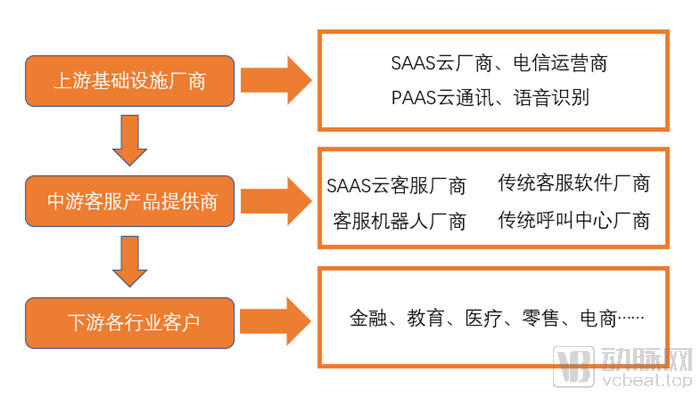
China’s Intelligent Customer Service Industry Chain (Source: Online; Graphic by VCBeat)
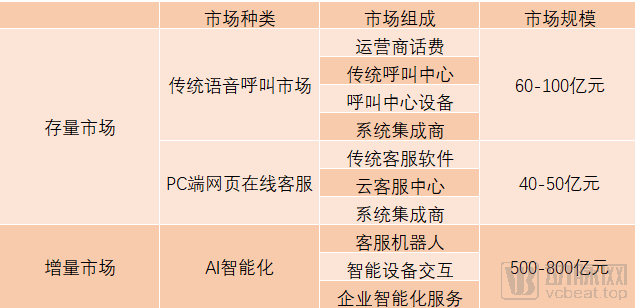
China’s Customer Service Industry: Existing and Incremental Market Size (Data sourced from the internet; chart by VCBeat)
Furthermore, according to statistics from the "Research Report on China's Intelligent Customer Service Industry" released in May 2018, customer service robots are replacing human customer service agents at a rate of 40%–50%. By leveraging technologies such as artificial intelligence and big data to enhance enterprise service functions like customer support and marketing, intelligent customer service providers are also capturing market share previously accounted for by labor costs, hardware equipment, and facility leasing.
In summary, the intelligent customer service market holds significant promise.
The peak period for the establishment of intelligent customer service companies was around 2013. Xiamen Kuaishangtong Tech.Corp.,ltd. (hereinafter referred to as "Kuaishangtong"), founded in 2009, also embarked on its second entrepreneurial venture during this time.
In 2009, Xiao Longyuan founded Kuaishangtong in Xiamen with entrepreneurial passion, launching a traffic agency business and quickly achieving a state of “contentment with modest prosperity.” In 2011, amid surging enthusiasm for artificial intelligence and internet-based startups, Kuaishangtong underwent restructuring to expand its comfort zone and venture into the field of medical AI.
When asked why Kuaishangtong has targeted the healthcare sector, Dr. Liu Xiaowei, Executive Director of Kuaishangtong’s “AI-Enabled Brain” initiative, stated: First, healthcare is an evergreen industry with sustained market growth potential. Second, the essence of medical practice is saving lives and healing the wounded, carrying significant social value. Third, the healthcare industry—particularly private healthcare—has strong marketing attributes, resulting in robust demand for intelligent customer service solutions. Fourth, since its inception, Kuaishangtong has placed great emphasis on talent development and strategic deployment, establishing a solid technological foundation.
Technology is the core advantage of Kuaishangtong.
In 2012, Kuaishangtong commenced research and development in artificial intelligence technologies, including natural language processing. To meet enterprises’ needs for differentiated marketing strategies tailored to diverse customer segments, and to optimize the allocation of service resources within its customer service system for varying customers and inquiries, Kuaishangtong initiated R&D in voiceprint recognition and speech recognition technologies.
Within just three years, its voiceprint recognition technology achieved an 80% top-1 identification rate in searches across a voiceprint database of 1 billion entries, surpassing the industry’s typical 60% identification rate.
In 2018, Professor Li Haizhou, former independent director of Baidu and former dean of Apple’s Speech Research Institute, officially joined Xiamen Kuaishangtong Tech.Corp.,ltd. as Chief Scientist to accelerate the industrial implementation of its artificial intelligence technologies. Professor Li serves as Chairman of the Asian Federation of Natural Language Processing (AFNLP) and was the first Chinese national to serve as President of the International Speech Communication Association (ISCA). He has been named an IEEE Fellow, the highest honor bestowed by the Institute of Electrical and Electronics Engineers, and is among the earliest scholars in China to conduct research on voiceprint recognition technology.
In January 2019, the establishment of the Natural Language Processing Standardization Research Base, jointly built by the China National Institute of Standardization and Xiamen Kuaishangtong Tech.Corp.,ltd., also served as a microcosm of Kuaishangtong’s technical prowess.
Currently, the technical team at Kuaishangtong has formed a R&D team of over 100 masters and doctoral researchers led by Professor Li Haizhou. The company holds more than 400 patents applied for or granted both domestically and internationally, and has received hundreds of industry and individual honors, including the Wu Wenjun Artificial Intelligence Science and Technology Progress Award, the highest honor in China’s artificial intelligence sector.
At this stage, Kuaishangtong has established a dual-brain business model based on technologies such as natural language processing, voiceprint recognition, and speech recognition: the perceptual intelligence “Intelligent Biometric Brain” and the cognitive intelligence “AI-Empowered Brain.” These solutions are widely applied in vertical sectors including finance, security, energy, transportation, healthcare, and public security and justice. Its intelligent customer service system, integrating “service + marketing,” covers over 360,000 enterprises.
During the pandemic, driven by emotions such as panic, many online consultation platforms faced a massive influx of inquiries amid a shortage of medical personnel. Xiamen Kuaishangtong Tech.Corp.,ltd rapidly launched an intelligent COVID-19 consultation chatbot and its accompanying customer service system. Using official accounts, websites, and mini-programs as access points, the system provided users with services including general preventive health education, medical guidance, psychological support, and counseling for return-to-work transitions.
This system enables robots to acquire epidemic-related professional knowledge, thereby developing the capability to analyze and assess inquiries from suspected patients, which reduces the workload of healthcare professionals during the initial consultation stage.
In Liu Xiaowei’s view, AI-powered consultation bots are essentially intelligent customer service agents. Using private healthcare as an example, he outlined the key demands for intelligent customer service in the medical sector:
First, reduce the operational costs of healthcare institutions.Traditional human customer service suffers from high staff turnover, elevated training costs, and inconsistent service quality, failing to meet the increasingly demanding needs of customers. Intelligent customer service systems can rapidly establish a comprehensive knowledge base, enabling faster and more effective interaction with users. This reduces labor costs for healthcare institutions, while AI-powered bots operate without time restrictions, providing 24/7 responsiveness to user inquiries.
Secondly, improve the work efficiency of medical staff.Simple, repetitive inquiries consume significant time and energy from human customer service representatives. Intelligent customer service systems can address common questions, allowing medical professionals to focus on complex and advanced medical challenges, thereby enhancing the quality of privately operated healthcare services.
Based on this, Kuaishangtong has launched an intelligent medical marketing solution capable of assisting with or even replacing manual responses to inquiries. During service delivery, the system leverages deep learning technology to autonomously learn customer service scripts for marketing purposes and update its knowledge base.
Dual Approach to Marketing and Operations
Pre-sales inquiries represent a challenging domain for intelligent customer service systems. Due to the diverse origins of pre-sales customers, their questions and requests are more open-ended, with pronounced personalized needs and higher technical requirements. However, this stage can directly drive marketing efforts and holds significant commercial potential. Consequently, this segment remains a “cake that many intelligent customer service companies want to eat but cannot.”
Kuaishangtong’s intelligent healthcare marketing solution delivers end-to-end services covering “pre-sales, operations, and after-sales.” By leveraging natural language processing to simulate conversations, it better understands the diverse intents behind user inputs. When necessary, it initiates follow-up questions, ice-breaking interactions, and multi-turn dialogues to achieve pre-sales business objectives.
In the healthcare sector, Kuaishangtong provides intelligent marketing customer service systems, simulated marketing customer service robots, and related services to leading enterprises across various fields, such as Mylike Group. Currently, Kuaishangtong’s intelligent medical marketing solutions cover more than 80% of aesthetic medicine companies in China.
The future customer service system is based on the integration of multiple channels. Whether it involves human agents or intelligent customer service, the ultimate goal is to resolve customer issues. Therefore, being “customer-centric” remains the essence of intelligent customer service.
With technological advancements, the development trends of intelligent customer service have gradually become apparent:
1. Gradually transition from business requirements to the fundamental needs of healthcare.Proactivity will be the next key focus in the development of intelligent customer service. How can we equip intelligent customer service systems with the ability to adapt flexibly to changing situations? Underpinning this capability requires a comprehensive medical knowledge graph, the construction of which demands significant investments of time, manpower, and technology from enterprises.
2. Significant changes have occurred in the organizational structure of private medical institutions.Customer service representatives and physician assistants will be replaced by AI trainers and specialized operations personnel for medical knowledge bases, leading to changes in the cost and profit structures of private medical institutions.
3. Horizontal expansion of industry coverage, with richer application scenarios.In the healthcare sector, intelligent customer service will not be limited to consumer healthcare and private medical institutions; rehabilitation and elderly care, health maintenance, and physical examinations will also emerge as new areas of growth.
4. Changes in the Platforms for Intelligent Customer Service.As previously mentioned, follow-up questioning and multi-turn dialogues are manifestations of the increasing realism in intelligent customer service. The mediums for information transmission in human society have evolved from text to images, then to audio, and finally to video. With technological advancements, the interaction modalities of intelligent customer service will similarly progress from text-based and voice interactions to image- and video-based interactions.
Building on the emerging trends in intelligent customer service, Xiamen Kuaishangtong Tech.Corp.,ltd. will continue to solidify its leading position in the medical intelligent customer service industry, identify more pain points within the sector, and provide comprehensive solutions. Looking ahead, the company will build an artificial intelligence engine platform, strengthen AI infrastructure development, expand the AI ecosystem, and strive to integrate AI into everyone’s daily life.
Government entry into a particular sector will undoubtedly channel resources toward it, generating positive impacts. However, this sector will also be subject to stringent government rectification and regulation. In Liu Xiaowei’s view, as the country advances the development of new infrastructure, the artificial intelligence industry will undergo a major reshuffle—a process akin to “winnowing the sand from the waves.” Only enterprises with genuine technological prowess will continue to shine.