

Peking University's Pathogen and Immunity Integrated Laboratory Files IPO Prospectus for 'Liquid Mask' Targeting Airborne Hazards

EGR HEALTH
Pharmaceutical R&D Developer
Recently, the National Health Commission issued the "Guidelines for Scientific Mask-Wearing by the Public," clarifying that members of the general public may forgo wearing masks when at home, outdoors, or in well-ventilated settings without crowds. Academician Zhang Boli also stated that, as projected, provinces across China except Hubei would basically be able to discontinue mask use and resume normal life by the end of April.
Since the outbreak of the pandemic, people have developed the habit of wearing masks. As the domestic epidemic situation has gradually come under control, a psychological dependence on masks has formed alongside their physiological necessity. Questions such as “Is it safe to take off the mask?” and “Are there any other issues besides the virus?” have emerged.
This epidemic has made us aware of the "hidden dangers in the air." Fine particulate matter (PM2.5) in the air, such as viruses, bacteria, and smoke, is mostly positively charged. Therefore, effective protection against PM2.5 can be achieved through positive charge repulsion.
Traditional physical protection methods involve wearing masks, which can effectively reduce the inhalation of PM2.5. However, mask-wearing is not recommended for children, pregnant women, and individuals with respiratory diseases. In recent years, air purifiers have gradually become common in households, but they are primarily used indoors.
To address "airborne hazards," the Peking University Laboratory of Pathogens and Immunology has developed a "liquid mask" that utilizes the principle of electrostatic repulsion to prevent positively charged fine particles in the air from approaching the face, thereby reducing the inhalation of PM2.5.
Peking University Laboratory of Pathogens and Immunology is affiliated with the Department of Immunology, School of Basic Medical Sciences, Peking University, and serves as a key component of the National Health Commission’s Key Laboratory of Medical Immunology. The laboratory is led by Professor Wang Yuedan, Deputy Director of the Department of Immunology, School of Basic Medical Sciences, Peking University Health Science Center, and Associate Professor Chu Ming.
In 2003, during the SARS epidemic, the Peking University Integrated Laboratory of Pathogens and Immunology undertook and completed a major national key research project, elucidating the immunomodulatory mechanisms of SARS virus infection. For this achievement, it was awarded the Second Prize of the National Natural Science Award, the First Prize of the Ministry of Education Natural Science Award, and the Second Prize of the Chinese Medical Science and Technology Award.
Since 2003, the Peking University Laboratory of Pathogens and Immunology has been dedicated to research in infection immunity, making preliminary explorations into the immune mechanisms underlying various diseases caused by viral infections, bacterial infections, and air pollution. During the 2008 Olympic Games, the Peking University Laboratory of Pathogens and Immunology collaborated with institutions such as the College of Environmental Sciences and Engineering at Peking University and the Duke University School of Public Health to investigate the impact of air pollution on human health, particularly the immune mechanisms by which PM2.5 contributes to the development of various diseases. This represented one of the early international multicenter collaborative studies on air pollution conducted in China.
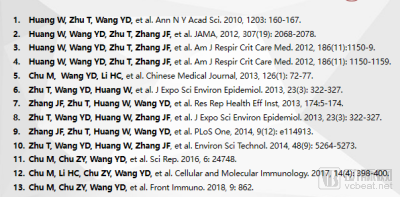
Research Findings from the Peking University Laboratory of Pathogens and Immunology (Source: Provided by the Enterprise)
These research findings have also been published in multiple influential academic papers internationally, elucidating the mechanisms by which PM2.5 causes diseases of the respiratory and cardiovascular systems. In 2013, China experienced a severe episode of air pollution, prompting the general public to truly become aware of PM2.5.
PM2.5, also known as fine particulate matter or "pulmonary-penetrating particles," primarily enters the human body through inhalation, leading to pneumonia. Notably, PM2.5 can also enter the body through skin pores; in particular, PM2.5 carrying lipid-soluble toxic substances is more likely to penetrate via the skin, causing dermatitis. Studies have shown that airborne PM2.5 consists mostly of positively charged particles, such as viruses, bacteria, and soot. Negative ion air purifiers work by generating large quantities of negative ions to neutralize and precipitate these positively charged PM2.5 particles from the air.
Currently, air quality in approximately 80% of the 254 cities across China exceeds national standards, affecting a population of 500 million. An estimated 30 million people are potentially exposed to air pollution, with urgent needs among vulnerable groups such as the 6 million newborns added annually, necessitating immediate solutions to mitigate the hazards of smog.
Negative ion air purifiers primarily work by releasing eco-grade negative ions into the air. These negative ions bind to positively charged fine particulates in the air, such as bacteria, viruses, and smoke particles. The neutralized particles then settle down under the influence of gravity, thereby achieving air purification.
Chu Ming stated, “In the course of our research on air pollution, we also found that fine particulate matter in the air tends to lose electrons during movement, thereby acquiring a positive charge. Consequently, the majority of PM2.5 in the air is positively charged.”
“Therefore, we began to consider whether it is possible to form a positively charged protective film on the surface of human skin, particularly on the face and around the mouth and nose. Through electrostatic repulsion, this film would hinder positively charged fine particulate matter in the air from approaching the face, thereby reducing the inhalation of PM2.5.”
In 2014, the Peking University Laboratory of Pathogen and Immunology independently developed a spray for PM2.5 prevention. This spray can isolate positively charged fine particulate matter through electrostatic repulsion, effectively protecting the respiratory system.
In this experiment, the Peking University Laboratory of Pathogens and Immunology demonstrated through air exposure studies that anti-smog sprays can effectively protect the respiratory system: exposing rats to highly polluted air for three months induced acute pulmonary inflammation; however, intervention with an anti-smog spray inhibited PM2.5-induced lung inflammatory responses, thereby effectively safeguarding the respiratory system.
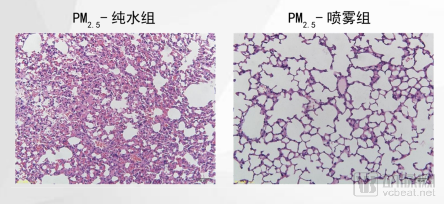
Experimental Group and Control Group (Source: Provided by the Company)
Studies have found that anti-smog sprays can effectively reduce the penetration rate of PM2.5, with an efficacy of 50%-80%, and remain effective for up to 12 hours under resting conditions.
Furthermore, to address the issue of PM2.5 adsorption onto the skin, the Peking University team has selectively incorporated specific active ingredients into their patented formulation. By leveraging active compounds with astringent, moisturizing, photoprotective, and anti-inflammatory properties, the formulation provides cutaneous protection and reduces the adsorption of PM2.5 onto the skin.
Chu Ming told VCBeat that the anti-smog market is worth approximately RMB 10 billion. From a product perspective, the combined market for air purifiers and masks currently stands at around RMB 20 billion. High-pressure spray products command a market size of RMB 30 billion.
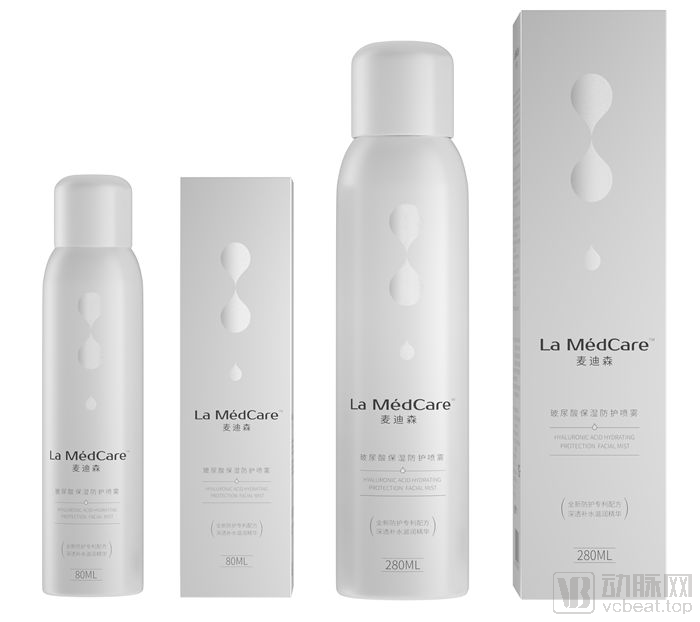
Product Image (Source: Provided by the Enterprise)
It is understood that, to date, no similar anti-smog spray products have appeared in China. The anti-smog sprays developed in Japan contain relatively high concentrations of alcohol and are not permitted for regular sale in the Chinese market.
Currently, high-pressure mist sprays available in China mostly consist of plain water, hot spring water, or mineral water, serving primarily as moisturizers. Madison, a protective spray independently developed by the Peking University Laboratory for Pathogens and Immunology, forms a cationic protective film on the face, providing both hydration and protection against smog.
Regarding future plans, the company will, on one hand, launch its products into the market to drive market expansion; on the other hand, it will continue to deepen its skincare product line with protective functions and develop more functional skincare products.
Currently, the project is seeking financing. Interested parties are invited to contact the financing assistant, Xiao Yun, at DongMai_Investent.