

Standardly Medical Secures Tens of Millions in Strategic Funding to Build a Hypertension Management Service Ecosystem
VCBeat (WeChat ID: vcbeat) has learned that Jiangsu Standley Medical Technology Co., Ltd. (“Standley”) recently completed a strategic financing round worth tens of millions of yuan, with WinX Capital serving as the exclusive financial advisor.
Founded in 2009, Standley has been dedicated to research in the prevention, diagnosis, and treatment of cardiovascular and cerebrovascular diseases. The company offers two major product lines: the Head-Up Tilt Test System and the Hypertension Chronic Disease Management System. The former targets the specific patient population with syncope, ensuring a stable customer base, with Standley currently holding over 90% market share. The latter serves the large population of patients with chronic hypertension, experiencing explosive growth in its customer base. Standley is currently an industry leader in this segment, which represents the company’s key focus for future development.
According to data published in The Lancet, a prestigious medical journal, 2.54 million deaths in China were attributed to hypertension in 2017. Among the top ten risk factors for mortality, high systolic blood pressure ranked first. Hypertension directly contributed to 62% of strokes, 49% of myocardial infarctions, and 40% of diabetes cases. Data from the 2018 China Hypertension Survey (CHS), conducted during the 12th Five-Year Plan period, indicated that 245 million people in China had hypertension, accounting for 23.2% of the total population. Worse still, this figure has been rising in recent years. The awareness rate among hypertensive patients was only 46.9%, the treatment rate was even lower at 40.7%, and the control rate was far from satisfactory, standing at merely 15.3%.
According to Mr. Xiao Yong of Standley Strategic Advisors, China’s current medical resources are primarily concentrated on the treatment of major diseases, with the bulk of the workload borne by just over 2,000 tertiary hospitals, leading to severe overextension of resource utilization. Meanwhile, the more than 900,000 primary healthcare institutions distributed across the country suffer from both extreme scarcity of medical resources and significant deficiencies in clinical capacity, hindering the effective implementation of chronic disease management. In response, the government has introduced numerous policies to encourage the development of internet-based healthcare, tiered diagnosis and treatment, and precision medicine, while shifting healthcare payment incentives toward primary care and chronic disease management.
The novel coronavirus pandemic has once again highlighted this contradiction: a large number of underlying conditions have constituted significant causes of death from COVID-19, while the concentration of medical resources on epidemic control has further exacerbated the unmet treatment needs of patients with chronic diseases.
Standley leverages the ABCD+R framework—utilizing A (Artificial Intelligence), B (Blockchain), C (Cloud Computing), and D (Big Data)—to reengineer the R (Route) of healthcare resource allocation, thereby serving hypertensive patients with diverse needs.
The user composition of the hypertension chronic disease management system is shown in the figure below:
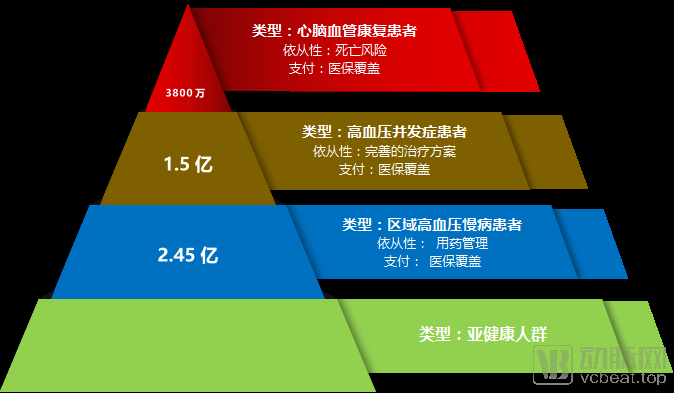
Among them, the 38 million patients undergoing rehabilitation for cardiovascular and cerebrovascular diseases face an imminent threat of death, resulting in extremely high adherence to treatment; as their care is largely covered by medical insurance, they will become the system’s most loyal users. The 150 million patients with hypertension-related complications are mostly receiving treatment for other conditions but rely heavily on effective hypertension prevention and control; given their clear medical instructions and extensive medical insurance coverage, they will constitute a significant user base for the system. The 245 million individuals with hypertension are a key focus of local disease control and prevention efforts, with substantial annual government funding allocated to this area; this group will form the system’s broadest user population. Furthermore, as healthcare consumption upgrades, an increasing number of individuals in a sub-health state are paying closer attention to their blood pressure trends, and they will ultimately be incorporated into the system’s management scope.
According to Ms. Xiao Min, CEO of Standley, by the end of 2019, the system had been deployed in nearly 100 Grade A tertiary hospitals, serving a population of 300,000 patients with chronic hypertension management and accumulating over 10 million clinical data records. Currently, we only provide basic services such as ambulatory blood pressure measurement, ambulatory blood pressure diagnostic reports, ambulatory blood pressure monitoring, and regional hypertension data analysis, yet our revenue has exceeded tens of millions of yuan. The current revenue composition is approximately 1:1 between sales of ambulatory blood pressure monitors and service fees, with an overall gross margin exceeding 80%. With the support of strategic investors during the pandemic, Standley will gain access to more resources.
Ms. Guo Shuying, Chairwoman of Standley, first expressed her gratitude for the strong recognition from strategic investors. She predicted that the hypertension chronic disease management industry would enter a period of rapid growth, driven by the increasing market share of Standley’s Hypertension Chronic Disease Management System in tertiary hospitals, the expansion and maturation of regional medical consortia, the launch of new service features, and enhanced market maturity. The direct industry scale is projected to reach the tens of billions level within the next five years. When incorporating the value of the digital economy and financial derivatives, the total industry scale is expected to exceed one hundred billion. At that time, coverage in tertiary hospitals is anticipated to surpass 50%, coverage in primary healthcare institutions will exceed 60%, and more than 70% of patients with hypertension-related chronic diseases will be served.
Dr. Zou Guowen, Partner at WinX Capital (Kaicheng Capital), stated that as population aging intensifies and hypertension affects younger demographics, the market will continue to expand. By extending its offerings from hypertension devices to services, Stanley has established a closed-loop chronic disease management system that enhances patient compliance. This strategy is expected to enable rapid market share gains while maintaining a steady gross margin above 80%.
WinX Capital is a leading investment bank in China’s healthcare sector. Five members of its founding team hold Ph.D. degrees in Global Finance from the PBC School of Finance at Tsinghua University, while its frontline professionals boast an average of over 10 years of experience in management, investment, and M&A, with cumulative transaction values exceeding RMB 30 billion. Headquartered in Beijing and Shanghai, with offices in Shenzhen and Suzhou, WinX Capital covers more than 3,000 active institutional investors and industrial groups.