

Five-Year Policy Analysis Reveals 88 Internet Hospital Regulations; 2026 Sees Most Intensive Reforms as Industry Enters Deep Development Phase
In 2020, the COVID-19 pandemic struck suddenly. While frontline hospitals struggled to treat patients, internet healthcare emerged as a “second battlefield” in epidemic prevention and control by guiding patients to seek medical care rationally and meeting the urgent needs of those with chronic diseases through online free consultations, follow-up visits, health insurance payments, and medication delivery services.
On February 4 and 7, the National Health Commission consecutively issued two policies supporting internet-based diagnosis and treatment; on March 2, the National Healthcare Security Administration introduced a policy to include internet-based diagnosis and treatment services in medical insurance reimbursement. This recent period has become the most intensive phase of national policy issuance since the emergence of the internet healthcare industry.
To conduct an in-depth analysis of the impact of policies on internet hospitals, we have compiled 88 relevant policies issued from 2015 to the present. By analyzing these policies from spatial (central to local) and temporal (developmental trajectory) dimensions, we have released the “Research Report on Internet Hospital Policies.”
The report is divided into five major sections:
1. The 2-4 Model for Policy Analysis: Examining Policy Evolution from a Corporate Perspective
2. Analysis of the Window of Opportunity: A Potential Market Size Worth Hundreds of Billions Emerges
3. Intervention Phase Analysis: Develop a Robust Market Access Plan to Seize First-Mover Advantage
4. Analysis of the Expansion Phase: Gradual Establishment of Guidance, Payment, and Regulatory Systems Across Regions
5. Future Policy Trends: Nationwide Rollout and Breakthroughs in Payment
Meanwhile, we have excerpted the key content of the report and released it in two parts. This article is Part I, covering the first three sections of the report.
Scan the mini-program code below to access the full report.

First, we must clarify the concept of internet hospitals and the scope of policy research.
In 2018, the General Office of the State Council’s “Opinions on Promoting the Development of ‘Internet + Healthcare’” clarified the service boundaries of internet-based healthcare. Under this framework, the National Health Commission’s “Notice on Issuing Three Documents, Including the Administrative Measures for Internet Diagnosis and Treatment (Trial),” defined internet-based healthcare as comprising three categories: internet diagnosis and treatment, internet hospitals, and telemedicine.
Among these, internet-based diagnosis and treatment refer to medical institutions utilizing physicians registered with their institution to conduct follow-up consultations for certain common and chronic diseases, as well as provide “Internet+” family doctor contract services, through information technologies such as the internet.
An internet hospital refers to a model in which a physical medical institution independently or in collaboration with third-party organizations establishes an information platform and utilizes physicians registered at its own facility or other medical institutions to conduct online diagnosis and treatment activities; or a model in which a third-party organization, relying on a physical medical institution, independently sets up an internet hospital to carry out online diagnosis and treatment activities.
Telemedicine refers to medical activities in which a healthcare institution (the inviting party) directly extends an invitation to another healthcare institution (the invited party), and the invited party provides technical support for the diagnosis and treatment of the inviting party’s patients via technologies such as the Internet.
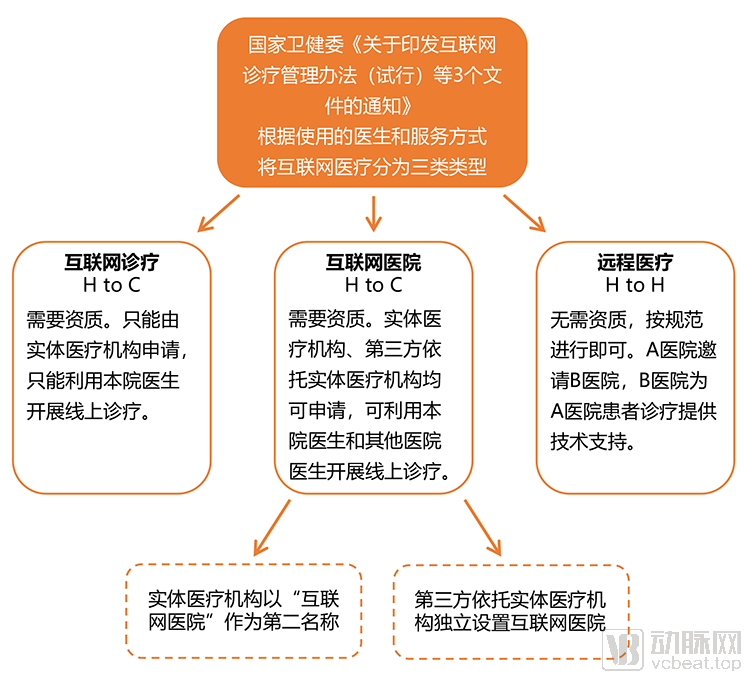
Concepts Related to Internet Hospitals
Source: Three documents including the Administrative Measures for Internet-based Diagnosis and Treatment (Trial)
VCBeat.
The commonality among the three lies in their reliance on internet-based text, image, or video communication; the primary difference resides in the participating entities. Specifically: Internet diagnosis and treatment services can only be licensed to physical medical institutions, which are restricted to using their own physicians for online consultations. In contrast, internet hospitals may be established by either physical medical institutions or third parties partnering with such institutions, allowing them to utilize both their own physicians and those from other hospitals for online care. Meanwhile, telemedicine does not require specific licensing but is strictly limited to interactions between medical institutions.
In contrast, internet hospitals can connect with the largest number of participants, accommodate a wider variety of service models, and encompass the scopes of both telemedicine and online diagnosis and treatment. Their evolution more accurately reflects the development of the internet healthcare industry. Therefore, when studying the impact of internet healthcare policies on the industry, we have chosen to focus on policies related to internet hospitals.
88 Policies Have Been Issued in the Field of Internet Hospitals
The Artery Orange Database compiles healthcare policies issued by the State Council, the National Health Commission, the National Healthcare Security Administration, and relevant local government departments. According to the Artery Orange Database, a total of 110 internet healthcare-related policies have been released at both national and local levels from 2011 to March 2020. Among these, telemedicine exploration began as early as 2011; Guizhou and Yinchuan initiated pilot policies for internet hospitals in 2015; and regulations concerning internet-based diagnosis and treatment emerged starting in 2018.
Among these policies, 88 are directly related to internet hospitals. This report will analyze them from a spatial dimension (central to local) and a temporal dimension (development history).
The full version of the report will present a detailed list of policies, which is not included here due to space constraints.
Policy Analysis 24 Model: Internet Hospitals Are in the Expansion Phase
From a spatial perspective, the central government has issued top-level design policies, while local governments have successively introduced detailed implementation rules. The “two” in the Policy Analysis 24 Model refers to these two levels.
From a temporal perspective and through the lens of enterprises, the development trajectory can be divided into four distinct phases with clear time boundaries: the Opportunity Phase, the Entry Phase, the Expansion Phase, and the Stabilization Phase. These “four” stages represent the key developmental periods.
Opportunity Window: From the release of pilot documents to the issuance of official national policies, companies that strategically position themselves during this period can gain a first-mover advantage;
Intervention Phase: The state has issued official documents, and there is still a certain opportunity to enter at this stage;
Expansion Phase: From the issuance of implementation guidelines by the first province to their adoption by all provinces, this stage will be characterized by intense competition;
Stable Phase: Continuous regulatory policies across all provinces, with the industry entering a mature stage.
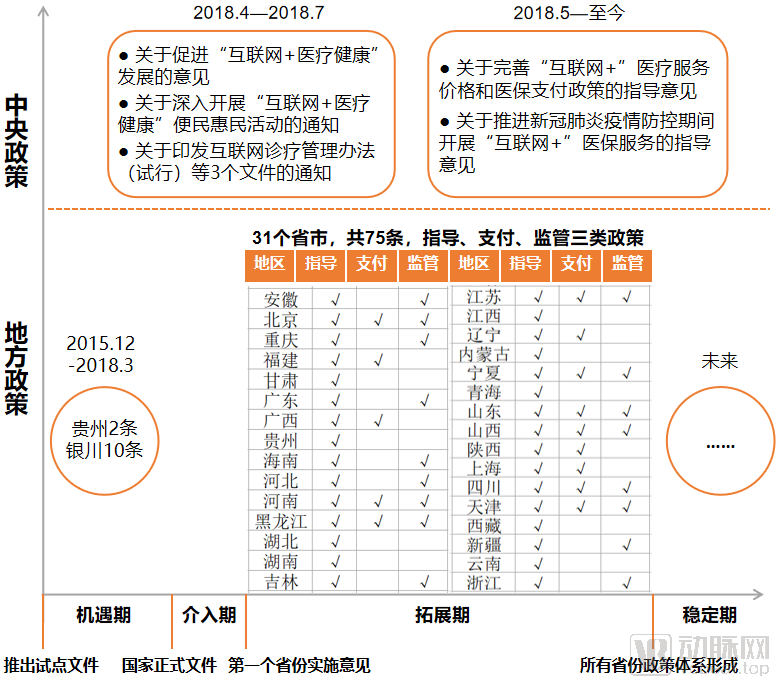
Panoramic View of Internet Hospital Policies, Chart by VCBeat
Window of Opportunity: December 2015 – March 2018, Pilot Programs in Guizhou and Yinchuan
In December 2015, Guizhou Province took the lead in issuing the policies “Implementation Plan for the Pilot Program of Internet Hospitals in Guizhou (Trial)” and “Detailed Rules for the Implementation of the Pilot Program of Internet Hospitals in Guizhou (Trial),” and launched a pilot program for internet hospitals in collaboration with Langma Information. The pilot program ran from July 2015 to December 2016, during which preliminary explorations were conducted into service models, operational mechanisms, policy frameworks, and management measures.
From August 2016 to April 2017, the Yinchuan Municipal Government conducted large-scale pilot programs and issued ten policies, including the “Notice on Printing and Distributing the Administrative System for Yinchuan Internet Hospitals,” covering guidance, payment, and regulation. Yinchuan emerged as a pioneer in leveraging this window of opportunity for先行先试 (pilot implementation).
By May 2017, drafts of the “Administrative Measures for Internet-based Diagnosis and Treatment (Trial) (Draft for Comments)” and the “Opinions on Promoting the Development of Internet Medical Services (Draft for Comments)” were circulating in the industry. The stringent regulatory stance imposed by these policies dealt a significant blow to the sector’s development.
Intervention Period: April 2018 – September 2018, Official Central Government Documents
However, the two circulating documents were not officially endorsed. In contrast, in April 2018, the General Office of the State Council issued the “Opinions on Promoting the Development of ‘Internet + Medical Health,’” establishing the government’s supportive stance toward the development of internet hospitals. In September of the same year, the National Health Commission released the “Notice on Issuing Three Documents, Including the Administrative Measures for Internet Diagnosis and Treatment (Trial),” which provided specific guidance on market entry and regulatory oversight.
Expansion Phase: May 2018 to Present, Local Governments Have Issued Supporting Policies
Following central government endorsement, local governments successively issued detailed implementation rules. In May 2018, Jiaozuo City in Henan Province took the lead by releasing the “Implementation Opinions of the General Office of the People’s Government of Jiaozuo City on Promoting the Development of ‘Internet + Healthcare’ in Jiaozuo City.” In June, the “Action Plan for Promoting the Development of ‘Internet + Healthcare’ in Guangdong Province (2018–2020)” was published, proposing that all tertiary A hospitals should fully roll out “Internet +” medical services by 2020.
From a corporate perspective, internet hospitals are still in an expansion phase. As of March 2020, 31 provinces and municipalities across China had issued 75 local policies, most of which were guidance and regulatory in nature, with relatively few policies addressing medical insurance reimbursement.
Guidance-oriented policies mainly refer to the “Implementation Opinions of [Province/City] on Promoting the Development of ‘Internet + Healthcare’” issued by various provinces and municipalities, which set development goals for the industry. Such policies have been rolled out in all 31 provincial-level administrative regions across China.
Regulatory policies mainly consist of the “XXX Province/City Internet Hospital Management Measures (Trial)” issued by various provinces and cities, which specify measures for market access and supervision. To date, 21 provinces and cities have promulgated such regulations.
Payment-related policies are primarily those introduced to implement the National Healthcare Security Administration’s Guiding Opinions on Improving Price and Medical Insurance Payment Policies for “Internet+” Medical Services, which include certain service items in medical insurance coverage; to date, only 14 provinces and municipalities have issued such policies.
Although all provinces and municipalities have issued guidance-oriented policies, regulatory and reimbursement policies remain incomplete. Once all local policies are fully released, the industry is expected to enter a phase of stability.
Evolution of the Industry Landscape: Diversified Leading Enterprises and Active Participation from Physical Hospitals
The refinement of policies will inevitably influence the number and depth of corporate participation. By analyzing the timing of the establishment or preparatory construction of the first internet hospitals by selected enterprises and physical hospitals, as well as the forms of online services they offer, we have developed an industry map that visually illustrates the sector’s evolution under policy influence.
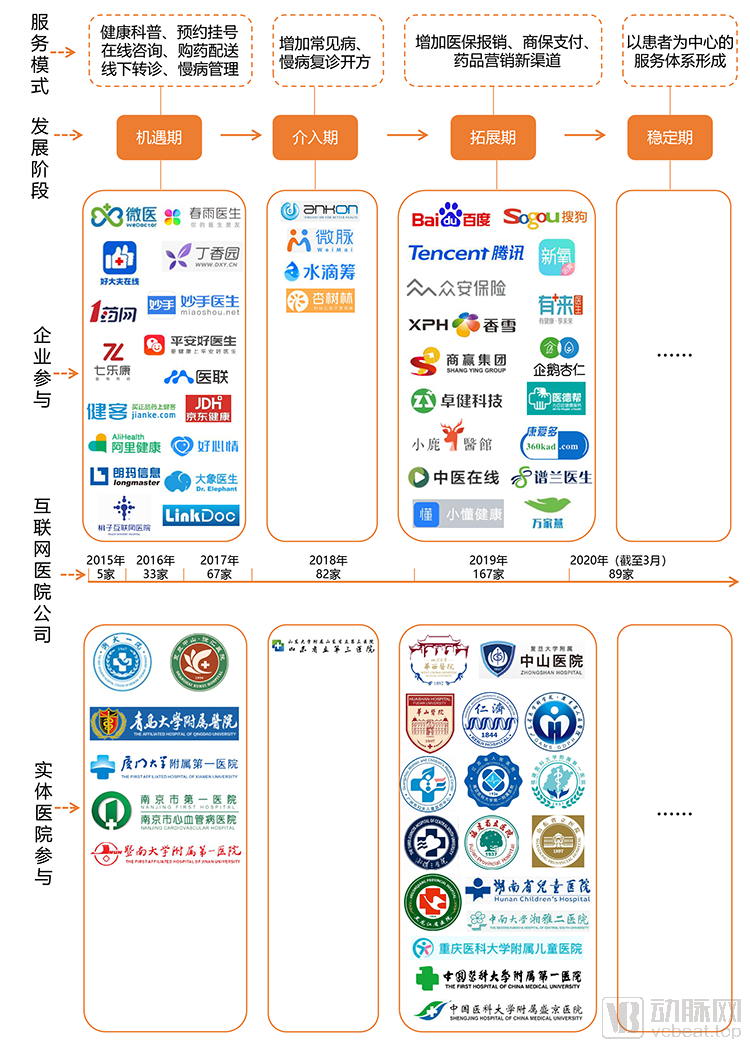
Policy-Driven Industry Landscape: Companies and Hospitals Listed Are Incomplete
Source: Public reports, Qichacha; Chart by VCBeat.
Among the enterprises that established internet hospitals during this window of opportunity, WeDoctor, DXY, Ping An Good Doctor, Chunyu Doctors, and Miaoshou Doctors have emerged as industry representatives, each developing distinct characteristics over time. The participants during this period were primarily internet companies, pharmaceutical e-commerce platforms, and health informatics firms.
During the intervention phase, companies such as Anhan Technology and Shuidi Inc. also joined the fray. In the expansion phase, participants became even more diversified. Building on their prior investments in internet healthcare, internet giants such as Tencent, Baidu, and Sogou began establishing internet hospitals. Meanwhile, companies from various niche sectors, including ZhongAn Insurance, Xiangxue Pharmaceutical, Shangying Group, and So-Young (a medical aesthetics platform), have either already built or are in the process of setting up internet hospitals.
During the opportunity phase, a cohort of internet healthcare companies engaged in continuous exploration, laying the foundation for internet hospital services. In the intervention phase, with the concept of internet hospitals clearly defined, online diagnosis and treatment acquired a distinct positioning for follow-up consultations and prescription issuance for common and chronic diseases. During the expansion phase, supplemented by medical insurance policies, the service loop for online consultations became more comprehensive. Influenced by other pharmaceutical policies, internet hospitals have also emerged as a new channel for pharmaceutical marketing.
Meanwhile, physical hospitals are also an indispensable force in the exploration and development of internet hospitals. During this period of opportunity, the First Affiliated Hospital, Zhejiang University School of Medicine (FAHZU) Internet Hospital was officially launched in 2016, becoming China’s first online campus of a public Grade A tertiary hospital.
During the brief intervention phase, physical hospitals were primarily in the preparatory stage. For instance, after Shandong Provincial Third Hospital became the first pilot unit for internet healthcare in Shandong Province in April 2018, it accelerated the development of its internet hospital platform. Upon entering the expansion phase, the Shandong Provincial Internet Medical Service Supervision Platform was established in November, and institutions such as Shandong Provincial Third Hospital, Shandong Provincial Hospital, and the Affiliated Hospital of Qingdao University rapidly obtained their internet hospital licenses in early December.
Since 2019, the establishment of internet hospitals by physical hospitals has entered a peak period. In 2020, driven by the needs of epidemic prevention and control, physical hospitals across various regions further accelerated their construction efforts.
As can be seen, among the physical hospitals that have established internet hospitals during the expansion phase are many well-known institutions, including West China Hospital, Zhongshan Hospital Affiliated to Fudan University, Huashan Hospital, The Second Xiangya Hospital, and The Third Xiangya Hospital.
These changes fully demonstrate the strong impetus provided by policy.
On March 20, 2020, at a press conference held by the Joint Prevention and Control Mechanism of the State Council, Mao Qun’an, Director of the Planning Department of the National Health Commission (NHC), stated that during the epidemic period, internet-based medical consultations had become an important component of healthcare services. The volume of such consultations at hospitals directly under or administered by the NHC increased 17-fold compared with the same period in the previous year. At certain third-party online service platforms, the number of consultation inquiries rose more than 20-fold, while the number of prescriptions issued grew nearly 10-fold over the same period.
Mao Qun’an stated that the National Health Commission would work with relevant departments to conduct further research, institutionalize these best practices and effective policies, and drive the in-depth development of “Internet + Healthcare” services.
As follow-up policies evolve, enterprises with diverse backgrounds and various types of brick-and-mortar hospitals will continue to establish internet hospitals in the future. The long-term developmental direction of the industry is to achieve deep integration among healthcare services, pharmaceuticals, and medical insurance, as well as seamless convergence of online and offline services and those provided within and outside hospital settings, thereby forming a patient-centric service system.
In the initial stage of an emerging industry, enterprises deciding whether to enter this field must address two core questions: Is it worthwhile? Is it feasible? The former determines potential returns, while the latter determines resource alignment. Only when both conditions are met should further action be taken.
From Yinchuan to a National Potential Market Worth Hundreds of Billions
Given that Yinchuan’s pilot program is the most representative, the analysis of the opportunity window will be based on the 10 key policies issued by Yinchuan. In 2016, following the approval of the Yinchuan Smart Internet Hospital, the “Notice on Issuing the Administrative Regulations for Yinchuan Internet Hospitals” was formally promulgated, marking the launch of the pilot initiative. During this phase, the viability of participation can be assessed from two perspectives: market potential and policy sustainability.
“Notice of the Yinchuan Municipal People’s Government on Issuing the Administrative Measures for Internet Hospitals (Yin Zheng Fa [2016] No. 249)” explicitly stipulates that the scope of business services of Internet hospitals comprises two components: online operations and offline services.
Online Services: Triage and patient guidance, consultations, referrals, appointment scheduling, telemedicine (including video consultations, telephone consultations, text-and-image consultations, e-prescriptions, pricing and payment, and access to diagnostic reports), medication guidance, health counseling, post-discharge follow-up, chronic disease management, and contracted family physician services.
Offline Services: Providing patients with video consultation venues at internet hospitals, health consultations, pharmaceutical sales and delivery services through retail pharmacy enterprises, and various medical services conducted in collaboration with offline medical institutions.
Service Scope: The target users of the internet hospital include the following four categories: patients with common and frequently occurring diseases; patients with clear diagnoses who are stable after treatment, do not require hospitalization but need long-term management for follow-up visits; patients with diagnosed chronic diseases requiring follow-up care; and patients who need rehabilitation or regular follow-up visits after various surgeries or standardized treatment for critical illnesses.
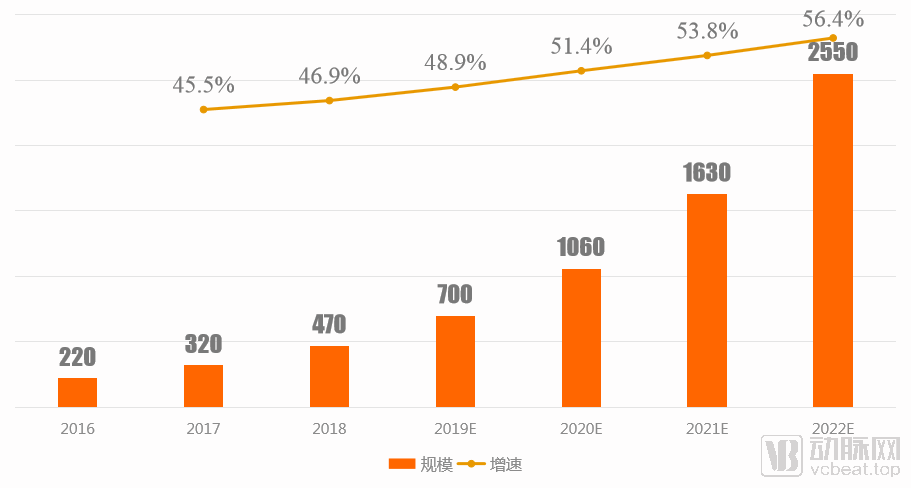
Market Demand for Internet Hospital Services, 2016–2022
Source: China Industry Information Network, VCBeat
During the pilot phase of internet hospitals, public awareness was limited and skepticism prevailed regarding the medical services they offered. Consequently, market demand remained modest, with the market size reaching approximately RMB 22 billion in 2016.
As internet hospitals expand across multiple regions, their service offerings have evolved from lightweight consultations to encompass online consultations, remote multidisciplinary consultations, and medication delivery, leading to a gradual expansion of market demand. With the ongoing launch of internet hospitals nationwide, their service coverage is reaching a broader population. Furthermore, as technologies such as 5G and artificial intelligence are increasingly integrated, the services provided by internet hospitals will become more diversified, accelerating the growth of market demand.
By 2022, the market demand for internet hospitals is projected to reach RMB 255 billion.
Each new policy issued by the government is often a continuation of the previous policy framework (higher-level policy). The sustainability of a new policy can be comprehensively assessed based on the hierarchical level of the higher-level policy and the duration of the new policy’s validity. For example, Yinchuan’s pilot policy for internet hospitals demonstrates greater sustainability compared to Guizhou’s policy.
Only policies with strong sustainability can provide long-term support for industry development. The higher-level policies underpinning the “Notice of the Yinchuan Municipal People’s Government on Issuing the Administrative Measures for Internet Hospitals (Yin Zheng Fa [2016] No. 249)” are primarily derived from the State Council’s “Administrative Measures for Internet Information Services” and Yinchuan City’s “Regulations on Promoting the Construction of Smart Cities in Yinchuan.”
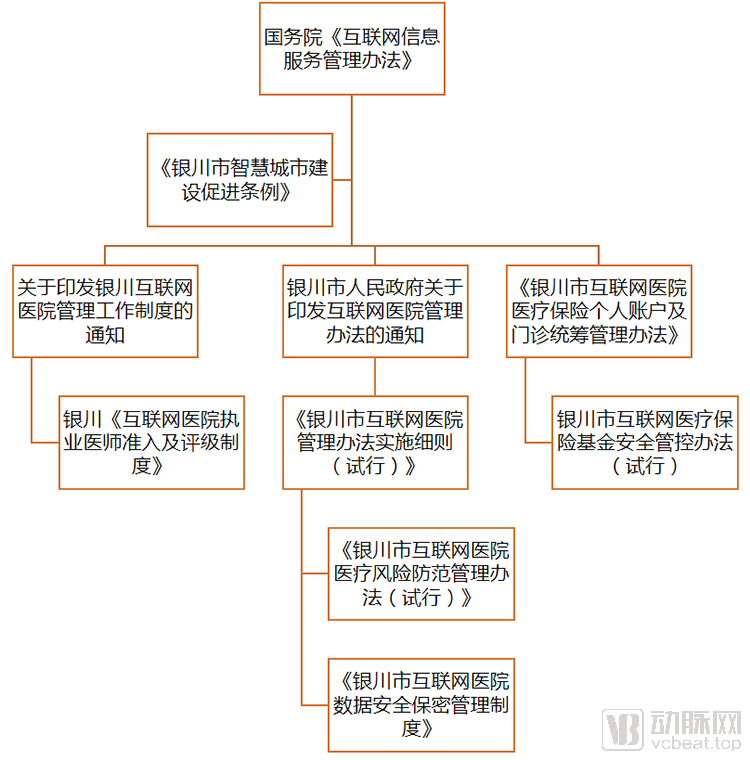
Yinchuan Pilot Policy Relationship Map
Source: Yinchuan Municipal People's Government; Chart by VCBeat
The Measures for the Administration of Internet Information Services are primarily intended to regulate internet information service activities and promote the healthy and orderly development of internet information services. The Regulations of Yinchuan City on Promoting Smart City Construction stipulate that people's governments at the city, county, and district levels shall incorporate smart city construction and its management into their national economic and social development plans, advance the intelligent application of information technology in agriculture, commerce, tourism, finance, logistics, culture, and other sectors, build smart application platforms for healthcare, health management, elderly care, education, and other fields, and integrate various types of information resources.
Furthermore, most of the internet hospital policies issued by Yinchuan are currently in effect (no expiration date was specified upon issuance) and shall remain enforceable until superseded by new policies of the same category.
Overall, the potential market for internet hospitals is vast. With top-level planning in pilot policies and supporting measures at the implementation level, the model demonstrates strong sustainability, making this period a worthwhile time to participate.
There are five core stakeholders in internet hospitals.
After determining from an industry perspective that participation is worthwhile, it is also necessary to assess from a corporate perspective whether there are relevant resources to match, whether participation is feasible, and which types of enterprises are suitable for involvement.
First, regarding the entry barriers for internet hospitals, the “Detailed Implementation Rules of the Administrative Measures for Internet Hospitals in Yinchuan City (Trial)” set forth specific requirements for establishment approval and registered capital. The core barriers to entry for internet hospitals in Yinchuan are having access to physician resources, a service platform, offline physical institutions, and sufficient funding.
Policies are guiding opinions issued by the government to steer the healthy development of the industry. Different policies affect market players in different segments; only by clarifying the relationships among various participants can we conduct targeted analysis of relevant policies. Internet hospitals primarily involve five categories of stakeholders: beneficiaries, users, providers, supporters, and partners.
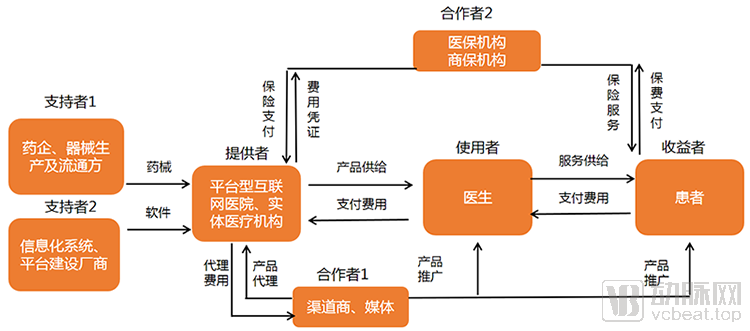
Internet Hospital Stakeholders, Source: VCBeat
Beneficiaries of Internet Hospitals: Patients, who obtain medical services online through internet hospitals;
Users of Internet Hospitals: Physicians who provide online services to patients through the internet hospital platform;
Providers of Internet Hospitals: Platform-based Internet hospitals and physical medical institutions, which provide professional medical services to users;
Supporters of Internet Hospitals: Pharmaceutical and medical device manufacturers and distributors, as well as health IT system vendors, primarily providing pharmaceutical and medical device products, digital platforms, and related services;
Partners of Internet Hospitals: Channel service providers and medical insurance institutions (including both public and commercial insurers). Channel service providers offer product promotion services to help reach end users, while medical insurance institutions primarily provide payment support.
These five types of roles are the core participants in internet hospitals, and enterprises possessing these resources have the greatest opportunity to enter this field first.
In April 2018, the General Office of the State Council issued the “Opinions on Promoting the Development of ‘Internet + Healthcare’.” In July of the same year, the National Health Commission released the “Notice on Deepening the Implementation of Convenient and Beneficial ‘Internet + Healthcare’ Activities,” followed in September by the “Notice on Issuing Three Documents, Including the Administrative Measures for Internet-Based Diagnosis and Treatment (Trial).”
These policies delineate the service boundaries of internet-based healthcare, establish development goals for a specified period, and clarify the specific rules governing the accreditation, construction, and practice of internet hospitals.
Clear Directions and Goals Bring Certainty to the Industry
Development Guidelines and Actions for Public Convenience and Benefit primarily outline plans at the macro level of internet healthcare, proposing development directions and phased objectives. From a long-term planning perspective, the state encourages medical institutions to leverage information technologies such as the internet to expand the scope and content of medical services, thereby establishing an integrated online-offline healthcare service model that covers pre-consultation, during-consultation, and post-consultation phases.
However, a relatively cautious approach is advised in the short term, starting with follow-up visits for common and chronic diseases, and gradually expanding to other areas.
The scope of incentives in convenience and benefit initiatives for the public is broader, covering not only follow-up visits for common and chronic diseases but also multiple scenarios such as follow-up management, home-based rehabilitation, and mobile nursing.
The convenience and benefit initiatives for the public have also set phased development goals, with 2020 as a milestone. The main objectives are as follows:
By 2020, hospitals at Level II and above generally provided online services such as time-slot appointment scheduling, intelligent patient guidance and triage, waiting reminders, query of laboratory and examination results, point-of-care settlement, and mobile payment.
By 2020, achieve interconnectivity and integration between the electronic health record (EHR) database and the electronic medical record (EMR) database to comprehensively record and manage residents' health information;
Tertiary hospitals shall achieve interoperability and sharing of in-hospital medical service information by 2020, and those with the necessary conditions shall do so as soon as possible;
By 2020, telemedicine services will cover all medical consortia and county-level hospitals across China, with gradual extension to community health service institutions, township health centers, and village clinics.
From the perspective of the overall development direction during the intervention period, policies encourage internet hospitals to provide structured and regulated services that cover the pre-consultation, intra-consultation, and post-consultation stages.
The pre-consultation phase primarily involves online appointment scheduling, time-slot-based booking, and intelligent triage, which fall mainly within the scope of healthcare informatization and have been gradually promoted in recent years.
During the consultation phase, online follow-up visits and prescription issuance for certain common and chronic diseases are permitted. This marks the first time that the legitimacy of online follow-up consultations has been established at the top-policy level, defining the scope of medical inquiries—a fundamental baseline. This represents a landmark breakthrough in internet healthcare policy.
In the post-consultation phase, patients are encouraged to utilize internet hospitals for chronic disease follow-up management and remote guidance, thereby facilitating home-based rehabilitation. Medical institutions with the necessary capabilities are encouraged to provide mobile nursing, online monitoring, and remote consultations. These measures aim to enhance the efficiency of medical services while strengthening the service capacity of primary healthcare institutions and family doctors. This approach primarily leverages internet-based healthcare to promote a tiered diagnosis and treatment system.
Standard Setting: Early Deployment Seizes the First-Mover Advantage
These areas represent the development directions encouraged by the state and the priority business focuses for leading enterprises. Once a decision is made to enter this new field, it is essential to make strategic preparations in advance to seize the first-mover advantage.
First, in accordance with the provisions of the National Health Commission’s “Administrative Measures for Internet Hospitals (Trial),” internet hospitals must meet a set of basic standards, with specific requirements for diagnostic and therapeutic services, departmental structure, personnel, and other aspects.
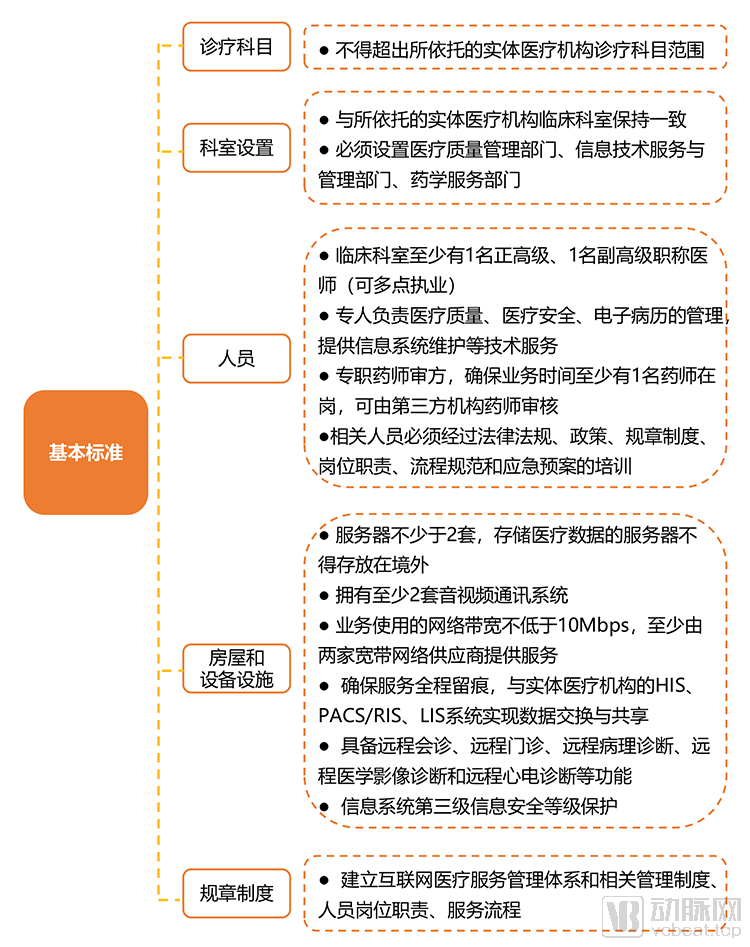
Basic Standards for Internet Hospitals, Source: National Health Commission, Graphic by VCBeat
Secondly, internet hospitals are categorized into two types based on the applicant entity: physical medical institutions that adopt “internet hospital” as their secondary name (i.e., entity-hospital-led internet hospitals), and third-party entities that independently establish internet hospitals in reliance on physical medical institutions (i.e., enterprise-led internet hospitals).
The application procedures for the two types of internet hospitals also differ. For a physical medical institution that adopts an internet hospital as its secondary name, only one step—application for practice registration—is required. In contrast, a third-party entity establishing an independent internet hospital in reliance on a physical medical institution must complete two steps: application for establishment and application for practice registration. Of course, if the physical medical institution is newly established and simultaneously intends to use the internet hospital as its secondary name, it must also undergo both steps: application for establishment and application for practice registration.
However, regardless of the type, internet hospitals must integrate their data with the provincial-level Internet Medical Service Supervision Platform during the application process to facilitate real-time oversight by health authorities at all levels. As the construction of this platform is led by the Provincial Health Commission, only provinces that have completed its development are eligible to approve internet hospitals, and enterprises can apply for an internet hospital license solely in these provinces.
The intervention period is relatively short, marking a phase in which internet hospitals are gaining certainty and the policy framework is gradually taking shape. Under policy guidance, enterprises can engage with clear objectives, pathways, and methodologies, enabling them to wage well-prepared campaigns and seize first-mover advantages in the market.
As the sector entered its expansion phase, provinces and municipalities intensively formulated relevant policies, while the National Healthcare Security Administration also issued reimbursement policies for internet-based medical services, resulting in a more complete industrial closed loop. At this stage, what are the differences among various provinces and municipalities in terms of development goals, application procedures, regulatory frameworks, and insurance reimbursement for internet hospitals? What might be the future direction of internet hospital policies? What challenges does the industry still face? We will present these insights in our next article—stay tuned.