AI Diagnosis, Digital Rehabilitation Therapy, and Companion Robots: Can the Autism Market Overcome Its Supply-Demand Imbalance?
The World Health Organization has designated April 2 each year as “World Autism Awareness Day,” aiming to raise public awareness of autism, related research and diagnosis, and individuals with autism.
On World Autism Awareness Day in 2009, American protesters left 150 baby strollers in Central Park, New York City, to raise public awareness. April 2 this year marks the 12th World Autism Awareness Day.
The concept of autism was first proposed in 1943 by Leo Kanner, an expert at Johns Hopkins University in the United States. Its medical term is “Autism Spectrum Disorder” (ASD), commonly referred to internationally as “ASD.” The core features of autism include impairments in social communication and social interaction, as well as restricted, repetitive patterns of behavior, interests, or activities. Currently, there is a consensus within the field that the etiology of autism remains unclear and there is no curative medication. However, the timing and methods of post-diagnostic rehabilitative intervention can lead to significantly different prognoses for patients. Earlier detection and earlier intervention are associated with more pronounced effects and better prognostic outcomes. Meanwhile, ages 3–6AgeIt is also considered the golden window for intervention.
In recent years, the prevalence of autism has risen significantly worldwide, with the generally accepted incidence rate ranging from 1% to 1.5%. On March 26, 2020, the U.S. Centers for Disease Control and Prevention (CDC) released the latest prevalence data on autism spectrum disorder (ASD) in the United States, indicating that 1 in every 54 children was diagnosed with ASD by age 8. This figure represents an increase of nearly 10% compared to the previous estimate, highlighting a concerning trend.
Fortunately, recent scientific research has made positive progress. With the continuous development of technologies in the field of genetics and the deepening of related studies, research on genetic loci associated with the risk of pervasive autism spectrum disorders has garnered increasing attention within the industry. Recently, in the largest-ever genetic study of autism spectrum disorder (ASD), researchers from more than 50 centers worldwide reported that 102 genes are associated with this condition, including dozens of previously unidentified genes.
This also provides a foundation for the early screening and diagnosis of autism.
VCBeat (WeChat Official Account: vcbeat) will examine the current state and industrial characteristics of the autism market from the perspectives of diagnosis, rehabilitative therapy, and medication, while also providing an outlook on its future trends.
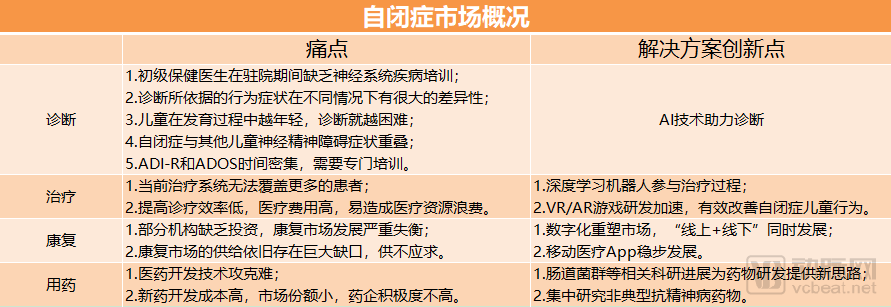
In July 2019, a paper published in the Proceedings of the National Academy of Sciences (PNAS) stated that, in terms of diagnosis and screening, AI-assisted measurement of pupillary dilation or spontaneous heart rate variability can enable earlier diagnosis of autism, Rett syndrome (a disorder that severely impairs children’s psychomotor development), and other neurodevelopmental disorders characterized by autistic behaviors.
In September of the same year, a paper on digital health published in The Lancet also highlighted the positive potential of AI-based diagnosis, stating that AI can diagnose diseases as successfully as specialist physicians. Researchers from the University of Birmingham analyzed data and found that deep learning AI correctly identified diseases in 87% of cases, compared with 86% for healthcare professionals. The FDA has approved numerous AI applications for healthcare, which are expected to assist physicians in improving work efficiency.
The continuous maturation of AI technology has brought more possibilities to addressing the various pain points in the early diagnosis of autism. In the field of AI-based autism diagnosis, Cognoa stands out as a representative company.
Cognoa is headquartered in Palo Alto, the “heart of Silicon Valley,” and is the world’s first company dedicated to applying machine learning to early screening for autism in children.
In fact, the American Academy of Pediatrics recommends that parents have their children undergo early screening for multiple developmental disorders between 9 and 36 months of age, with autism spectrum disorder being the most critical condition to screen for. Early screening can effectively prevent missing the golden window for intervention. Once this opportunity is missed, the impacts of these developmental disorders are likely to persist throughout the patient’s life.
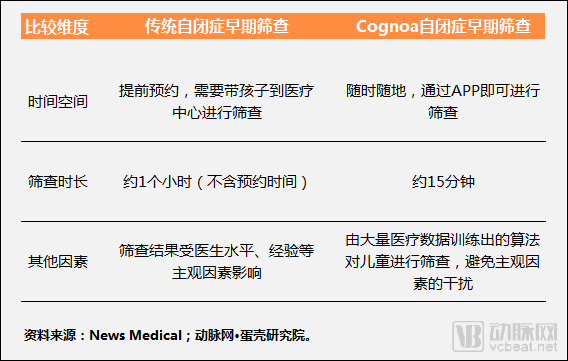
Even so, the early screening rate for developmental disorders in children, such as autism, remains low in the United States. The primary reasons are parents’ tendency to take chances and the cumbersome procedures associated with traditional U.S. screening methods, which require advance appointments, visits to healthcare facilities, and waiting for physician-led screenings, among other steps.
In this context, the emergence of Cognoa has greatly facilitated parents. After downloading the app from the app store, parents simply need to fill in their child’s basic information and answer 15 to 20 behavior-related questions based on the child’s specific circumstances, whereupon the system will automatically generate a screening plan.
Cognoa’s screening solution may appear simple, but it is the result of integrating authoritative medical research with cutting-edge AI technology.
The crux of the entire screening protocol lies in the reliability of the online questionnaire design and the accuracy of its results. The theoretical basis for these questions stems from Dr. Dennis Wall’s clinical research spanning more than five years. During this period, his team tracked the prevalence of autism among over 100,000 children at Harvard Medical School and Stanford School of Medicine.
Information generated in clinical studies is aggregated into massive databases. Cognoa leverages machine learning to analyze vast amounts of medical data, thereby training a proprietary algorithm. When users input behavioral information about children into the app, the system generates corresponding screening results based on the established algorithm.
II. Reimagining the Entire Autism Diagnosis and Treatment Landscape: What Digitalization Can Achieve
In addition to AI-enhanced early screening, the rehabilitation and treatment of autism spectrum disorder (ASD) have also ushered in opportunities for innovation driven by the rapid development of digital health in recent years. Telemedicine and AI technologies have expanded the reach of ASD screening to more patients, improving diagnostic and therapeutic efficiency while reducing medical costs. Furthermore, with the widespread adoption of smartphones and advancements in electronic technology, applications such as virtual reality (VR), augmented reality (AR), and mobile health apps are gradually gaining prominence.
1. Autism Treatment: Robots and VR/AR to the Rescue
Companion robots are often criticized by humans for being overly mechanical and clumsy, yet this very characteristic can provide a sense of security to children with autism, patiently guiding them without ever tiring.
MIT researchers have developed a companion robot to address the difficulty children with autism face in recognizing facial expressions. Since children with autism struggle to identify the facial expressions and emotions of neurotypical individuals, some experts have created a robot capable of displaying facial expressions, enabling these children to learn through imitation during interactive sessions.
A research team at Brigham Young University (BYU), the third-largest private university in the United States, has developed a robot named Benni, with the aim of having Benni serve as a friend to children with autism. The robot bears a strong resemblance to BB-8 from Star Wars and is designed to complement therapy for children with autism.
Robots are not merely companion toys; to achieve therapeutic effects, AI technology must be employed to enable interactive feedback with children on the autism spectrum. Integrating this feedback data provides support for developing customized treatment plans, a process that likewise relies on robust database infrastructure.
Google previously collaborated with Autism Speaks, a prominent autism advocacy and research organization, to establish an autism genetic repository. This repository collected and sequenced whole-genome data from 10,000 children with autism and their families worldwide, creating a database made accessible to autism research institutions around the globe.
BioSymetrics is another company focused on database and AI analytics. In the field of autism, BioSymetrics has developed big data tools for automated preprocessing, integrated analysis, and predictive modeling. These technologies can serve healthcare and hospital systems, biopharmaceuticals, new drug development, and precision medicine. In other words, BioSymetrics enables the integration of diverse biological data types and performs predictive analytics on combined datasets.
Children with autism struggle to connect with the real world, while neurotypical individuals find it difficult to decode the meaning behind their behaviors. Beyond AI, VR can also build a bridge between the two.
There are numerous ways in which VR is applied to the treatment of autism. Its efficacy lies in providing individuals with autism spectrum disorder (ASD) with more customized, safe environments. Specifically, in the context of treating children with ASD, VR games are particularly effective at lowering their defensiveness and facilitating the analysis of the underlying meanings of their behaviors.
As early as 2014, a study on VR games was conducted: researchers had children with autism wear head-mounted displays capable of capturing every facial expression and mapping it onto their in-game avatars. The virtual characters interacting with them in the game were also avatars of their therapists.
A randomized controlled trial conducted by Newcastle University involved 32 autistic children aged 8 to 14. Half received treatment in a “blue room” (a VR game developed by the research team), while the other half served as a control group and received delayed treatment after six months. Two weeks into the treatment, the study showed that 4 out of the first 16 participants (25%) had a positive response to the therapy. Meanwhile, the study also demonstrated that the VR game-based therapy is equally applicable to autistic adults.
2. Autism Rehabilitation Therapy: Online and Offline
Compared with the autism diagnosis and treatment markets in developed countries such as Europe and the United States, which started earlier, intervention and therapy for autism in China began relatively later and currently remain in a state of supply falling short of demand.
In the realm of speech and rehabilitation, the domestic autism rehabilitation market in China remains predominantly focused on the rehabilitation phase (early intervention), characterized by uneven development. This significant imbalance in the rehabilitation market is primarily driven by two factors: First, the government provides subsidies to early intervention institutions, such as Damihexiaomi, but offers no subsidies for the adult services market. Second, the government invests in establishing certain rehabilitation assistance programs, such as the "Colorful Dream" initiative, but currently does not invest in post-rehabilitation institutions.
There remains a substantial supply gap in China’s rehabilitation market, which calls for greater participation. Consequently, the performance of existing market players offers valuable insights. Furthermore, with the widespread adoption of mobile internet, rehabilitation institutions have developed both online and offline service models. Given that autism rehabilitation requires behavioral intervention, game-based interaction, and emotional communication, offline services are the most effective approach for children with autism. As such, the majority of rehabilitation institutions operate primarily through offline channels, including early pioneers like Xingxingyu and national chain providers such as Wucailu.
The representative company in online rehabilitation is Dami and Xiaomi. Dami and Xiaomi targets the early intervention market for children with autism aged 2 to 7. In terms of its business model, Dami and Xiaomi adopts a combination of online and offline approaches for autism rehabilitation training. Online, it disseminates basic educational knowledge about autism through courses to build brand influence; offline, its rehabilitation centers provide further rehabilitation training, where teachers offer one-on-one training and education to children with autism, covering various aspects such as language, social skills, motor skills, and self-care abilities.
At the end of 2019, Dami and Xiaomi completed a RMB 100 million Series B financing round led by Genesis Capital. Following this investment, Dami and Xiaomi will continue to increase its investments in intervention and rehabilitation technologies for children with autism, AI solutions, the development of the RICE framework, as well as the digitalization of intervention and rehabilitation data and the establishment of an outcome quantification system for children with autism in China. In addition, the joint laboratory established by Dami and Xiaomi with a domestic university will soon launch practical applications of its research achievements in AI-based multimodal approaches for autism.
In addition, due to the recent impact of the pandemic, other companies in China have also joined the online-offline integration efforts. For example, Dongfang Qiyin has invited international authorities on autism and speechTherapy experts joined the initiative, breaking through geographic limitations on in-person free screenings and training sessions to meet the demand for autism rehabilitation therapy during the pandemic.
3. Mobile Health App for Autism
In addition to AI-assisted therapy and speech/behavioral rehabilitation, the rise of mobile internet has diversified treatment models for autism, giving rise to autism-focused apps. According to 2016 statistics from VCBeat’s Eggshell Research Institute, which compiled data from Autism Speaks, there are currently over 500 mobile health applications for autism worldwide, among which 38 have been scientifically proven to benefit individuals with autism.
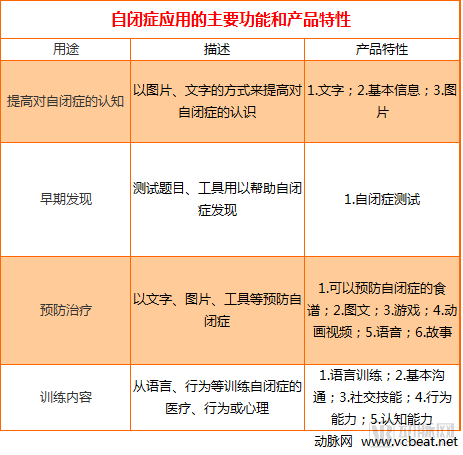
Among them, overseas autism apps focus primarily on treatment; in China, the sector is still in its early stages, with autism apps concentrating on prevention and cognitive enhancement.
Research on autism spectrum disorder (ASD) abroad began 40 years earlier than in China, resulting in a product landscape primarily focused on therapeutic interventions. In contrast, due to widespread misconceptions or a lack of awareness about ASD among the general public in China, products are mainly aimed at raising public awareness, often disseminating knowledge about ASD through public welfare initiatives.
Domestic autism apps in China are offered free of charge, with a primary focus on promoting and disseminating knowledge about autism. In contrast, international autism apps are typically priced between $0 and $4.99, with the most expensive costing $19.90. This difference may be attributed to the earlier development of autism apps abroad, which were designed primarily as commercial applications focused on therapeutic interventions for individuals with autism.
On the other hand, among the statistically analyzed autism apps, both domestic and international products primarily utilize text and graphics for presentation. International products, however, also incorporate audio and animated videos. As domestic products focus mainly on enhancing caregivers’ understanding of autism, they currently do not feature audio or animation.
Compared with the endless emergence of new methods, technologies, and models in the fields of diagnosis and speech/behavioral therapy, the field of pharmacotherapy for autism is far less active. Some pharmaceutical companies also believe that it is not cost-effective to invest huge amounts of capital in developing drugs with limited market share. Therefore, prescribed psychotropic medications or anticonvulsants are also used to treat autism in children.
Current research on pharmacological interventions for autism spectrum disorder (ASD) is primarily focused on atypical antipsychotics, particularly risperidone. Substantial and growing evidence demonstrates their efficacy in alleviating ASD-associated symptoms such as irritability and self-injurious behavior. The U.S. Food and Drug Administration (FDA) has previously approved risperidone for the treatment of irritability associated with autism in children and adolescents.
Several recent innovative products also warrant attention. First, neurotherapeutics startup System1 Biosciences is leveraging phenotypic screening to discover new drugs for complex neurological and psychiatric disorders such as epilepsy, autism, and schizophrenia. Its drug discovery platform uses stem cell lines derived from patients with brain diseases to cultivate brain organoids, so-called three-dimensional (3D) in vitro systems. By employing these 3D in vitro systems, researchers can identify potential compounds and compare their efficacy with that of standard pharmacological approaches, thereby uncovering more clinically effective neurotherapeutic strategies.
Axial Biotherapeutics, a company specializing in the treatment of neurological disorders, has clinical programs targeting the gut for Parkinson’s disease (PD) and autism spectrum disorder (ASD). Currently, the company’s lead candidate for ASD is AB-2004, which has demonstrated in animal models that it can repair leaky gut by removing key microbial metabolites, thereby improving ASD-related motor control behaviors. AB-2004 entered human clinical trials in the first quarter of 2019.
Furthermore, domestic companies are also tackling intractable diseases such as autism by targeting the gut microbiota. Shenzhen X-Biotics Co., Ltd. is China’s first AI-driven pharmaceutical company focused on gut microecology therapeutics. Tan Yan, founder of X-Biotics, stated that the company is committed to breaking through bottlenecks in the development of microecological drugs and creating therapies that address current unmet clinical needs.
In 2019, Xbiome and Shanghai Xinhua Hospital jointly launched a clinical study titled “Exploring the Efficacy of Fecal Microbiota Transplantation (FMT) in Treating Children with Autism Spectrum Disorder Accompanied by Gastrointestinal Symptoms.” Twenty participants were administered varying doses of FMT therapeutics based on age stratification. The study aimed to reconstruct the gut microecological environment in children with autism through FMT, achieve long-term remodeling of their gut microbiota, and thereby influence brain structure and function to alleviate autism-related symptoms.
In fact, a substantial body of research on the link between autism and gut microbiota has emerged over the past decade, with evidence indicating a strong correlation between autism and gut microbiota dysbiosis in patients.
Through a series of animal model experiments and human cohort studies, scientists have gained increasingly profound insights into how the gut microbiota influences the onset and progression of autism spectrum disorder (ASD). Currently, substantial evidence demonstrates that gut microbiota dysbiosis may be a significant contributing factor to the pathogenesis of ASD in a subset of patients.
The integration of AI and VR/AR, continuous breakthroughs in biogenetic technologies, and the support of mobile health have once ignited the autism market, attracting significant capital inflow. Since 2015, venture capital firms such as Fortune Capital, Northern Light Venture Capital, Sidao Capital, and F-Prime Capital have increasingly entered the autism rehabilitation and education sector, providing financing to institutions like Eastern Speech and Language Therapy and Damai and Xiaomi. This influx has abruptly accelerated industry growth, intensifying competition for qualified teachers and advanced technologies.
However, similar to the “Hundred Glucose Meters War” amid the digital health wave, after the industry’s fever subsides, the high-end market remains largely uncontested, while the low-end market is poised for a new round of reshuffling.
According to incomplete statistics from the Artery Orange database, a total of six financing events occurred globally in the autism field in 2019, with three in China and three overseas. Interestingly, domestic investment and financing activities all involved areas such as rehabilitation and intervention, whereas foreign cases were concentrated on pharmaceutical research and development, with disclosed amounts exceeding ten million U.S. dollars each.
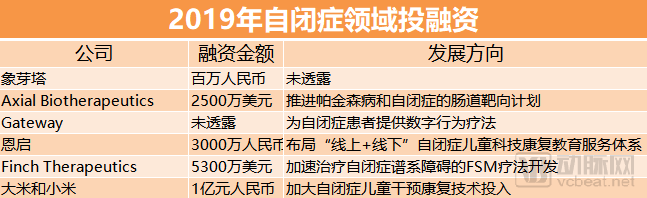
The rehabilitation and education sector for children with autism is currently undergoing a generational transition, while pharmaceutical R&D still awaits breakthroughs. Fortunately, a series of cutting-edge studies not only provide new avenues for autism drug development but also offer insights to the online disease management industry. Looking ahead, the autism diagnosis and treatment sector is poised to escape the current predicament of supply falling short of demand.
This article is compiled from VCBeat’s special Pro series, “World Autism Awareness Day: AI Diagnosis, Digitalization, Companion Robots… Updates in Autism Therapies,” with some case studies slightly abridged. We will continue to update developments in the autism field. For a comprehensive understanding of trends and access to more corporate case studies related to autism, please scan the QR code below to read via our mini-program!