

Alibaba Health Unveils Six-Pillar Healthcare Ecosystem in Recent Prospectus Filing

AliHealth
Medical and Health Services Network Service Provider
On March 31, Japan’s renowned medical technology institution JBC officially launched Alibaba Cloud’s AI-powered diagnostic technology for COVID-19, beginning to offer this service to Japanese hospitals to assist physicians in rapidly screening for COVID-19 using CT images.
This is the latest update on AliHealth’s efforts in the fight against the COVID-19 pandemic. During the outbreak, AliHealth launched a comprehensive response: Alibaba Cloud’s computing power and DAMO Academy’s AI technologies were deployed on the front lines, supporting various aspects of epidemic control, including public consultation, drug development, viral genomic analysis, and clinical diagnosis. AliHealth successively rolled out products such as pandemic science popularization resources, an epidemic map, and an online medical consultation platform. The company also provided services for patients with chronic diseases, enabling them to purchase medications without leaving home, and launched a dedicated “Medication Shortage Registration” section for Hubei Province. Additionally, an online health consultation platform for overseas Chinese was integrated into Alipay, which has already been used by hundreds of thousands of overseas Chinese individuals.
Behind the impressive performance in the all-out fight against the epidemic lies AliHealth’s comprehensive upgrade.
Previously, on the evening of March 15, AliHealth announced that its Board of Directors had appointed Zhu Shunyan as Chief Executive Officer, Executive Director, and Chairman of the Board. AliHealth stated that this move would strengthen organizational support and investment for future-oriented innovation, helping to accelerate the development of digital “new infrastructure” in the healthcare sector across society.
Alibaba has been laying out its health sector strategy for many years.
As early as 2014, Alibaba acquired CITIC’s 21st Century Healthcare. In October of the same year, it was renamed AliHealth, officially marking Alibaba’s entry into the healthcare sector.
In 2017, Jack Ma reiterated the “Double H” strategy (Health & Happiness) at the Davos Forum, positioning health as one of the two strategic pillars for Alibaba’s future and clearly demonstrating its ambition in the healthcare sector.
“In the years since entering the market, AliHealth has continuously increased its investments with the support of Alibaba Group. For instance, it completed the acquisition of the ‘Blue Hat’ certified health food business on the Tmall platform, establishing a key revenue pillar for health product sales; it also partnered with multiple hospitals to provide patients with one-stop services ranging from appointment scheduling and consultations to medication purchases. Coupled with its existing internet ecosystem, AliHealth has gradually formed an integrated online-to-offline pharmaceutical and healthcare service system. Meanwhile, support from Alibaba has provided greater potential for AliHealth’s broader healthcare layout. For example, last year Alibaba completed acquisitions and equity stakes in offline healthcare institutions such as iKang Guobin and Meinian Onehealth, thereby strengthening the depth of its healthcare services.”
In recent years, with technological support from Alibaba Cloud and DAMO Academy, AliHealth has continuously identified opportunities to foster new industrial applications, thereby achieving a comprehensive dimensional upgrade from “Internet+” healthcare.
For example, in 2018, AliHealth and Alibaba Cloud jointly strengthened their capabilities in image recognition, physiological signal recognition, and knowledge graph construction, rapidly solidifying the foundation for smart healthcare.
Notably, the DAMO Academy’s focus on fundamental research has shown AliHealth the immense potential for continuous transformation through the deep integration of foundational innovation with industrial ecosystems.
DAMO Academy possesses world-leading AI capabilities. As of September 2019, DAMO Academy had published nearly 450 papers at top international academic conferences and secured more than 40 world-first rankings in algorithms for fields such as natural language processing, intelligent speech, and visual computing. In the field of medical AI, DAMO Academy has been deeply engaged for many years, winning championships in multiple global competitions. Notably, it achieved first place worldwide in the Luna 16 pulmonary nodule screening competition in July 2017, and secured three world-first rankings in the MICCAI LiTS liver and liver lesion competition in February 2019.
During this outbreak, DAMO Academy’s medical AI demonstrated the power of its long-term accumulation: following the outbreak, DAMO Academy’s CT imaging AI was deployed in 168 hospitals across 16 provinces and municipalities, including Hubei, Shanghai, Guangdong, Jiangsu, and Anhui, diagnosing 340,000 clinical cases; DAMO Academy’s whole-genome analysis platform was also rapidly implemented at institutions such as the Zhejiang Provincial Center for Disease Control and Prevention and Wuhan Jinyintan Hospital, significantly shortening the time required for genomic analysis of suspected cases.
Artificial intelligence can provide answers for precision medicine, and is therefore regarded as the inevitable path to disruptive innovation in the healthcare industry. Industry observers believe that the remarkable achievements of DAMO Academy’s medical AI have opened a new “strategic pivot” for AliHealth’s transformation, offering immense potential for its future development.
The upgrade of AliHealth took place against the backdrop of a comprehensive explosion in business applications driven by these enabling technologies.
Driven by technological innovation, and building upon its early pharmaceutical distribution network represented by pharmaceutical e-commerce, AliHealth’s business has evolved into six major segments: regional medical cloud, medical artificial intelligence, internet healthcare, pharmaceutical distribution network, drug traceability system, and electronic health records.
AliHealth’s six business segments span a vast range, to the extent that they can even be regarded as entirely distinct “species.” However, by enabling these “species” to intertwine and integrate, a vibrant ecosystem can be formed, providing a continuous stream of nutrients and momentum to foster new applications for cutting-edge technologies such as medical AI.
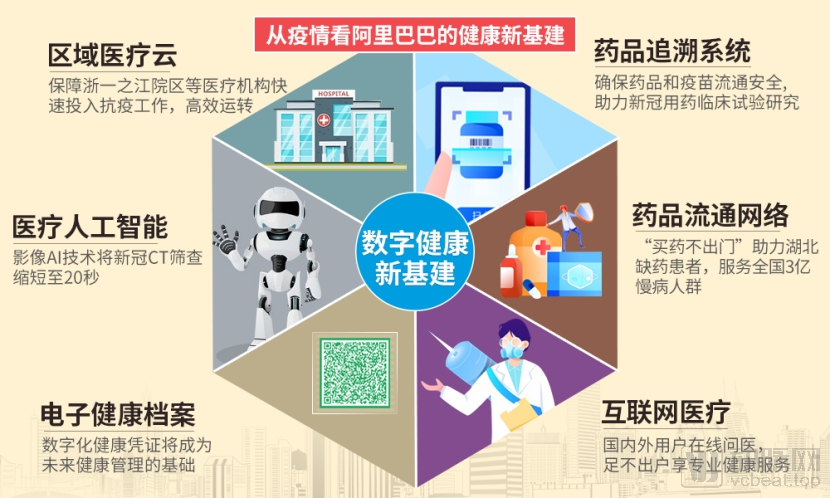
The recent epidemic serves as the best proof: this multidimensional, symbiotic, and highly collaborative healthcare “economy” has significantly improved efficiency across various domains, including diagnosis, surgery, retail, chronic disease management, and public health management, thereby rapidly providing solutions to meet healthcare needs in multiple scenarios. This is the fundamental reason why AliHealth was able to launch a comprehensive response in the face of the urgent task of epidemic prevention and control.
In fact, due to the complexity of the healthcare industry, remaining at a superficial level of user engagement or merely applying patches to individual systems is considered the key factor holding back the internet healthcare sector. With this upgrade, AliHealth is shifting from the industry’s traditional vertical approach of “building silos” to a horizontal strategy of “creating platforms,” committing itself to building healthcare infrastructure that serves the entire industry.
Industry observers believe that with Zhu Shunyan at the helm of AliHealth, the move clearly signals a further strengthening of internal synergy within the healthcare “ecosystem” and an acceleration of AliHealth’s new infrastructure development.
In fact, the technological foundation for Alibaba to build new healthcare infrastructure is already in place.
Over the past two decades, Alibaba has built a new infrastructure comprising cloud computing, data intelligence, the Internet of Things (IoT), and mobile collaboration technologies. This digital economy infrastructure demonstrated robust support capabilities during the pandemic. Leveraging this new infrastructure, a digital epidemic prevention system was established to support hundreds of millions of people in pandemic control and the resumption of work and production. The transformation of AliHealth represents the implementation and practical application of Alibaba’s digital economy infrastructure within the healthcare industry.