

Keros Therapeutics Secures $56 Million Series C Financing and Files for IPO to Advance Rare Disease Pipeline Targeting TGF-β Pathway

Keros Therapeutics
Developer of New Drugs for Neuromuscular Disease Treatment
Recently, VCBeat (WeChat ID: vcbeat) learned that U.S. biotechnology company Keros Therapeutics, Inc. announced it had secured $56 million in Series C financing. The round was led by new investors Foresite Capital, OrbiMed, Cowen Healthcare Investments, and Venrock, with participation from certain existing investors of Keros, including Pontifax, Arkin Bio Ventures, Partners Innovation Fund, Global Health Sciences Fund, and Medison Pharma.
To date, Keros Therapeutics, Inc. has raised a total of $90 million in funding. Its first two rounds of financing were secured in 2017 and 2019, respectively.
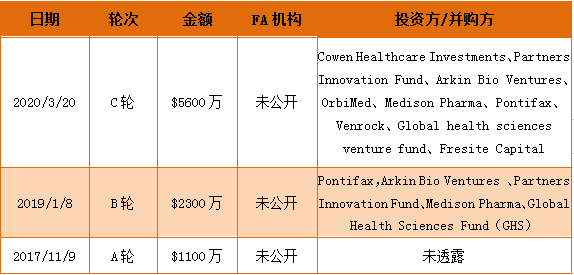
Keros Therapeutics' Historical Financing Record
How Did a Startup, Only a Few Years Old, Quickly Win the Favor of Multiple Investment Firms? What Strengths and Charisma Does It Possess?
Keros Therapeutics, Inc. was founded in 2015 and is headquartered in Lexington, Massachusetts, USA. Keros is a biopharmaceutical company focused on hematologic and musculoskeletal disorders, dedicated to discovering and developing differentiated therapies that modulate the TGF-β (transforming growth factor-beta) signaling pathway to treat conditions with high unmet medical needs.
Keros Therapeutics is recognized as a leader in the discovery, development, and commercialization of novel therapies, leveraging its deep understanding of the function of TGF-β family proteins—key regulators of erythropoiesis and thrombopoiesis, as well as the growth, repair, and maintenance of muscle and bone.
Keros Therapeutics is led by Dr. Jasbir S. Seehra, who serves as the company’s President and Chief Executive Officer. Dr. Seehra earned his Ph.D. in Biochemistry from the University of Southampton in the United Kingdom and completed his postdoctoral fellowship at the Massachusetts Institute of Technology.

President & CEO of Keros Therapeutics: Jasbir S. Seehra
Image source: Keros Therapeutics official website
Prior to joining Keros, Dr. Seehra served as Chief Scientific Officer and a member of the Board of Directors at Ember Therapeutics, and was Co-Founder and Chief Scientific Officer of Acceleron. He also held the position of Vice President of Biochemistry at Wyeth and led small-molecule drug discovery efforts at the Genetics Institute. There, he helped establish their small-molecule drug discovery platform, encompassing medicinal chemistry, high-throughput screening, structural biology, and more.
Other members of Keros’ management team are also highly accomplished, holding advanced degrees from world-class universities and bringing extensive management experience.。
Jennifer Lachey (Chief Scientific Officer)Earned a Ph.D. in Biology from Indiana University and completed postdoctoral training at Beth Israel Deaconess Medical Center. Prior to joining Keros, served as Senior Director at Seres Therapeutics and as Associate Director of Preclinical Pharmacology at Ember Therapeutics and Acceleron Pharma.Claudia Ordonez (Chief Medical Officer)Earned an M.D. from the University of California, San Francisco. Prior to joining Keros, served as Vice President at Akcea Therapeutics and Chief Medical Officer at Flatley Discovery Lab, and previously held senior medical director roles at Biogen, Vertex Pharmaceuticals, and other companies.
Keith Regnante, who joined recently, is the new Chief Financial Officer (CFO) of Keros Therapeutics. Regnante holds a Bachelor’s degree in Economics from Tufts University and an MBA from the MIT Sloan School of Management. He has previously served as CFO of Wave Life Sciences and Vice President of Finance at Shire, and began his career as a consultant at Boston Consulting Group. With over 20 years of financial experience, he has helped build and lead high-performing teams to define and execute strategy. Currently, Regnante oversees finance and information technology operations at Keros, manages investor relations and fundraising efforts, and works alongside other leaders to support the company’s long-term growth.
Similarly, byThe Scientific Advisory Board, comprising Professor Mary L. Bouxsein, Professor Vicki Rosen, and Associate Professor Paul Yu from Harvard University, is also providing strategic guidance to Keros Therapeutics.。
True to its name—derived from a remote, hard-to-reach Greek island—Keros Therapeutics, Inc. directs its biotechnology research toward niche patient populations with rare diseases. In contrast to the recent surge of interest in novel oncology therapies within the biotech innovation sector, Keros is dedicated to developing treatments for patients with rare diseases, offering them new hope for life.
Due to the complex pathophysiology, small patient populations, high risk of misdiagnosis, and limited market share associated with rare diseases, investors are often deterred from funding research into therapeutic approaches and related drug development for these conditions. Consequently, patients frequently lack access to optimal treatment regimens and corresponding medications, effectively rendering them a neglected population—isolated like islands adrift on the sea.
However, it is well known that research in the field of new drug technologies is characterized by long development cycles, substantial capital investment, stringent regulatory approval processes, high failure rates, and significant risks. Even though successful R&D outcomes can yield unimaginably huge profits, capital must proceed with caution and careful deliberation in this sector. It is therefore understandable that investors tread on thin ice when facing rare disease research, which accounts for only a tiny fraction of the market.
In response to this situation, the U.S. government introduced relevant policies to encourage capital inflow into the field by shortening the approval cycle for related drugs and launching priority privileges for rare disease research. Thus, “hope,” “mission,” and “capital” have intertwined and borne fruit in this sector. Keros Therapeutics has undoubtedly taken up the mantle and led the way.
Keros Therapeutics, Inc. is recognized as a leader in the discovery, development, and commercialization of novel therapies, leveraging its deep understanding of the role of the TGF-β protein family.
In the human body, aged and damaged cells in normally functioning organs are typically replaced by new cells. These new cells originate from stem cells. When provided with appropriate signals to maintain tissue homeostasis, stem cells have the capacity to differentiate into cells with specific functions. Members of the TGF-β protein family, including activins and bone morphogenetic proteins, provide the necessary signals for processes of self-renewal and repair. It can be stated that the TGF-β protein family serves as the primary regulator of erythrocyte and platelet production, as well as the growth, repair, and maintenance of muscle and bone.
Developing novel drug candidates for diseases with clinical validation or biological rationale targeting the TGF-β signaling pathway has been Keros’ primary focus.
Keros’ proprietary molecules are designed to selectively target specific proteins in the TGF-β signaling pathway, delivering therapeutic benefits while potentially minimizing safety risks. Notably, the TGF-β family proteins studied by Keros are highly conserved across evolution, enabling the use of animal models to predict therapeutic benefits in patients with high confidence.
Keros focuses on the role of members of the TGF-β protein family in hematopoiesis, muscle, and bone development. Its pipeline includes KER-050, a protein therapeutic candidate; KER-047, a clinical-stage small molecule candidate; and KER-012, a preclinical protein therapeutic candidate. All are under development for the treatment of different diseases and have achieved encouraging progress to date.
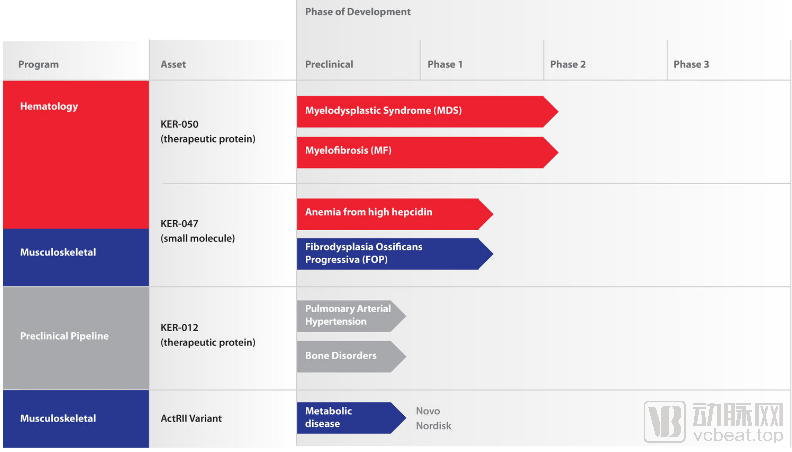
Keros Therapeutics Product Pipeline
KER-050
KER-050, Keros’ clinical-stage protein therapeutic candidate, is an engineered ligand trap consisting of a modified ligand-binding domain of the type II activin receptor, a TGF-β receptor, fused to the Fc domain of a human antibody.
KER-050 is designed to promote hematopoiesis by inhibiting the signaling of a subset of TGF-β family proteins, thereby increasing the production of red blood cells and platelets. In terms of therapeutic applications, Keros Therapeutics is developing KER-050 for the treatment of cytopenias, including anemia in patients with myelodysplastic syndromes (MDS) and thrombocytopenia in patients with myelofibrosis.
KER-047
Keros’ small-molecule candidate, KER-047, is designed to selectively and potently inhibit activin receptor-like kinase 2 (ALK2), also known as the TGF-β receptor ALK2. ALK2 is a human protein that serves as the genetic driver of fibrodysplasia ossificans progressiva (FOP). The Keros small-molecule ALK2 program, which has been cleared by Massachusetts General Hospital and the National Center for Advancing Translational Sciences (NCATS) at the U.S. National Institutes of Health, has now completed preclinical safety studies.
In the field of disease applications, Keros is developing KER-047 for the treatment of anemia caused by elevated hepcidin levels, as well as refractory iron deficiency or IRIDA, which are direct consequences of increased ALK2 signaling.
In addition, Keros is developing KER-047 for the treatment of fibrodysplasia ossificans progressiva (FOP). FOP is a rare genetic disorder caused by activating mutations in the ALK2 receptor, wherein patients’ skeletal muscles and connective tissues—such as muscles, ligaments, and tendons—are progressively replaced by bone. Due to FOP, patients typically have a life expectancy of around 40 years. Currently, however, there are no curative or approved treatments available. Keros’ research advancements in this disease area offer new hope for patients. Meanwhile, conservative estimates place the healthcare value of the ALK2 program at over $1.5 billion.
KER-012
KER-012 is a preclinical protein therapeutic candidate and a ligand trap, composed of a modified ligand-binding domain of ActRIIB fused in part to the Fc domain of a human antibody.
KER-012 is designed to bind and inhibit the signal transduction of TGF-β ligands, including activin A and activin B, thereby potentially increasing bone mass. Meanwhile, KER-012-mediated inhibition of activin A and activin B also has the potential to enhance BMP signaling pathways. Therefore, Keros can treat diseases characterized by reduced BMP signaling due to inactivation of BMP receptors.
Currently, Keros is developing KER-012 for the treatment of diseases associated with bone loss, such as osteoporosis and osteogenesis imperfecta, as well as for the treatment of pulmonary arterial hypertension (PAH), a condition linked to reduced BMP signaling.
On March 4, Keros Therapeutics, Inc. announced that it had secured $56 million in Series C financing. The funds raised will be used to advance Keros’ pipeline of candidate products through multiple clinical data readouts, thereby progressing its hematology and musculoskeletal disease programs. Additionally, as part of the Series C financing round, Nima Farzan, MBA, a biopharmaceutical executive, and Dr. Carl Gordon, CFA, Executive Partner at OrbiMed, will join the Board of Directors of Keros.
“This additional funding will enable us to rapidly advance our lead programs through Phase 2 clinical trials, thereby providing proof of concept for novel therapies that may address the limitations of current treatments for diseases associated with dysregulated TGF-β signaling,” said Dr. Jasbir S. Seehra, President and Chief Executive Officer of Keros.
On March 16, biotechnology company Keros Therapeutics filed its S-1 registration statement with the Nasdaq for an initial public offering (IPO), aiming to raise $86.25 million. The proceeds will be used to advance Keros’ candidate product pipeline and to generate data from multiple clinical trials.
Currently, most domestic research in the field of TGF-β biology remains confined to universities and major research institutes, with few pharmaceutical companies incorporating this area into their drug development and production R&D efforts. This also indicates, to some extent, that the field indeed presents significant technical barriers.
Since the release of the coordinated policy in late 2015, the National Medical Products Administration (NMPA) has consecutively issued multiple related policies and established a priority review mechanism. These measures have accelerated the clinical and marketing approval processes for innovative drugs, thereby encouraging many pharmaceutical companies to increase their investment and strengthen their commitment to accelerating drug research and development.
Meanwhile, following China’s accession to the International Council for Harmonisation of Technical Requirements for Pharmaceuticals for Human Use (ICH), national drug review and approval policies have increasingly aligned with international standards to facilitate interoperability between domestic and global new drug regulatory systems. Although the influx of numerous global new drugs into the Chinese market has intensified competitive pressure on domestically developed innovative drugs, this regulatory harmonization also lays a solid policy foundation for Chinese innovative drugs to ultimately expand into international markets.