

Traditional Chinese Medicine as a Vital Force in Pandemic Response: Regulatory Framework and Product Landscape
China’s traditional Chinese medicine (TCM) culture has a long and rich history, making positive contributions to the healthcare of the Chinese people. Since the outbreak of the COVID-19 pandemic in China, TCM has been widely used in treatment efforts.
As early as January 28, 2020, the fourth edition of the Diagnosis and Treatment Protocol for Novel Coronavirus Pneumonia, updated by the National Health Commission and the National Administration of Traditional Chinese Medicine, advocated for integrated traditional Chinese and Western medicine treatment and published a regimen incorporating traditional Chinese medicine. During its 26 days of operation from February 14 to March 10, the Jiangxia Fangcang Hospital, which employed traditional Chinese medicine as the primary therapeutic approach, admitted a total of 564 patients; among them, 392 were cured, 172 were transferred out as required, and there were no fatalities.
Before the outbreak of the epidemic, the state had already recognized the immense value of Traditional Chinese Medicine (TCM). On October 20, 2019, the State Council issued the "Guiding Opinions on Promoting the Inheritance, Innovation, and Development of Traditional Chinese Medicine," ushering in the most favorable policy environment for the TCM industry since the founding of the People's Republic of China. Following the outbreak, at a press conference held by the State Council Information Office on March 23, 2020, the role of TCM in the prevention and treatment of COVID-19 was introduced. Experts present stated that Jinhua Qinggan Granules, Lianhua Qingwen Capsules, and Xuebijing Injection demonstrated efficacy in treating COVID-19. According to recent reports, China’s anti-epidemic aid supplies to countries such as Italy, the United Kingdom, and Pakistan included substantial quantities of TCM products; among these, China alone donated 100,000 boxes of Lianhua Qingwen Capsules to Italy.
To help readers quickly understand China’s regulatory framework for the traditional Chinese medicine (TCM) industry, we present this overview in three sections: Chinese herbal medicines, TCM institutions, and practitioner qualifications. This article focuses on the regulation of Chinese herbal medicines.
I. Basic Classification of Traditional Chinese Medicine
Distinct from Western pharmaceuticals, traditional Chinese medicine (TCM) products are available in a variety of finished forms. Under Chinese law, TCM is classified into five categories for regulatory purposes: raw TCM medicinal materials, TCM decoction pieces, TCM formula granules, hospital-prepared TCM formulations, and proprietary Chinese medicines.
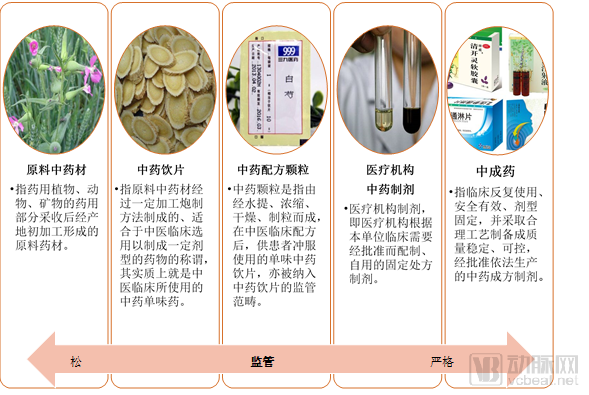
Figure: Legal Classification of Traditional Chinese Medicine
In addition to the five major finished product forms mentioned above, there exists a special category of items that are both food and medicine, known as "medicine-food homology" substances. As a special type of "crop," traditional Chinese medicine (TCM) raw materials inherently share significant overlap with food items. For instance, common ingredients such as Chinese yam, hawthorn fruit, jack bean, and white hyacinth bean can be served on the table as ordinary food or used for medicinal purposes.
Pursuant to legal authorization, the health administrative departments and food safety authorities jointly issue the "List of Substances That Are Both Food and Drugs," permitting the addition of items on this list to food products. Currently, robust demand for health supplements among the middle-aged and elderly population has made the field of medicine-food homology a prominent opportunity for entrepreneurship:
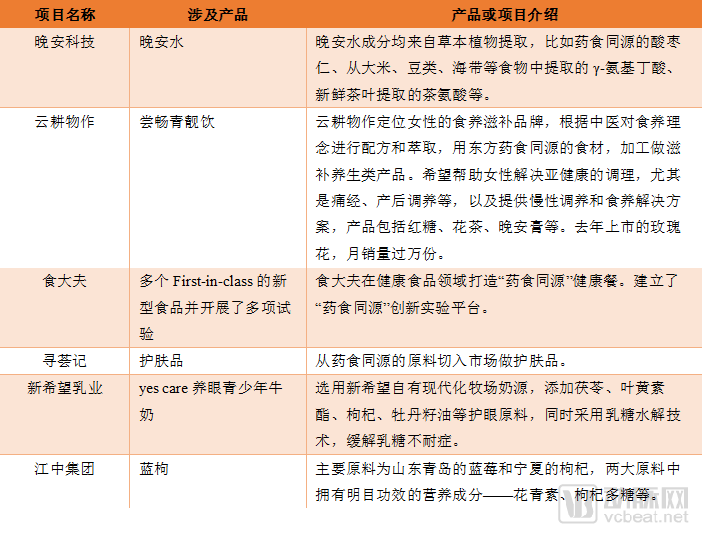
Table: Summary of Recent Entrepreneurial Projects in the Medicine-Food Homology Sector
II. Regulatory Policies on Traditional Chinese Medicine
The Challenges of Regulating Traditional Chinese Medicine: Difficulties in Supervising the Production of Raw TCM Materials and TCM Decoction PiecesThe primary challenge in regulating Traditional Chinese Medicine (TCM) lies in overseeing the production of raw TCM materials and TCM decoction pieces. The current production landscape is characterized by dispersed origins, low levels of intensification, and a large number of manufacturers. The cultivation of raw TCM materials closely resembles agricultural practices, while the processing of TCM decoction pieces constitutes only rudimentary processing of raw materials with limited technological content. Consequently, the overall qualification rate is significantly lower than that of other pharmaceutical products. According to the National Annual Report on Drug Sampling Inspection (2018), the specific qualification rate for TCM decoction pieces was 87.8%, whereas the qualification rate for other essential medicines was 99.3%, indicating a substantial disparity between the two.
We have summarized the regulatory policies and current status of traditional Chinese medicine across different fields as follows:
1. Products Based on the Concept of "Medicine and Food Homology"
In terms of regulatory authority, the production and distribution of products that are both food and medicine should theoretically comply with both the Food Safety Law and the Drug Administration Law. However, in practice, enforcement may encounter issues such as unclear regulatory jurisdiction and ambiguous application of laws. The competent authorities will determine the responsible regulatory body based on the intended subsequent use of the dual-use (food and medicine) products.
Therefore, it is necessary to continuously improve and revise the list of substances that are both food and medicine, in order to define them more scientifically and effectively. Currently, the regulatory classification of these substances as either drugs or foods is use-oriented, with stricter oversight applied to those intended for medicinal purposes. Accordingly, it has been proposed that the intended use (medicinal or edible) of such products be strictly defined at the initial stage of production, and that any change in intended use be prohibited without prior approval.
2. Raw Medicinal Materials
Prior to being processed into pharmaceutical products, traditional Chinese medicinal (TCM) materials are managed as agricultural by-products and are not subject to any specialized regulatory framework. The regulation of raw TCM materials remains a domain with minimal direct legal oversight; competent authorities instead exercise regulatory control by supervising the production and outcomes of downstream applications, subsequent-stage products, or later-process derivatives.
The state is progressively guiding the establishment of production bases for authentic traditional Chinese medicinal (TCM) materials. Standards, specifications, and information traceability systems for TCM materials will be gradually established, incorporating information from the entire industrial chain—including cultivation, collection, initial processing at the place of origin, and distribution—into the traceability system to ensure clear traceability and well-defined responsibilities. In light of this, many enterprises have begun developing and establishing information traceability systems and standards, aiming to provide technical support for the traceability of raw medicinal materials and TCM decoction pieces.
3. Traditional Chinese Medicine Decoction Pieces
All traditional Chinese medicine (TCM) decoction pieces are prescription-only medicines, and hospital-prepared TCM formulations may only use TCM decoction pieces as ingredients. It is explicitly stipulated that the processing of TCM decoction pieces (i.e., the transformation of raw medicinal materials into single-herb TCM products through specialized techniques) constitutes drug manufacturing activity; manufacturers must obtain a Drug Manufacturing License and produce in accordance with statutory Good Manufacturing Practice (GMP) standards.
Article 28 of the new Drug Administration Law stipulates: “Drugs must comply with national drug standards.” Article 44 provides: “Traditional Chinese Medicine (TCM) decoction pieces shall be processed in accordance with national drug standards; where no such national standards exist, they shall be processed in accordance with the processing specifications formulated by the drug regulatory departments of the people’s governments of provinces, autonomous regions, and municipalities directly under the Central Government.”
Due to the complex processing procedures involved in the production of traditional Chinese medicine (TCM), some enterprises with Good Manufacturing Practice (GMP) certification outsource the processing of medicinal herbs, resulting in inconsistent quality of TCM decoction pieces. The national authorities are likely to intensify law enforcement efforts.
4. Traditional Chinese Medicine Formula Granules
Since December 1, 2001, TCM formula granules have remained in the stage of scientific research, with research, production, and clinical use restricted to approved pilot enterprises and hospitals. From 2002 to 2004, the former State Drug Administration approved six pharmaceutical manufacturers, including Guangdong Yifang, as pilot producers of TCM formula granules through a filing and approval process, and no additional pilot enterprises were added for over a decade. Upon completion of the scientific research phase, these products will be subject to management via approval numbers.
Although the number of pilot enterprises is limited, due to varying interpretations of the policy across provinces, there are numerous pilot hospitals in each province. In some regions, even primary care hospitals (i.e., township health centers and community health service centers) have been granted permission to use these services.
The “13th Five-Year Plan for Scientific and Technological Innovation in Traditional Chinese Medicine” explicitly stipulates: systematically study the extraction processes and quality standards for 100 types of single-herb TCM formula granules; conduct research on online quality control during the production of formula granules; and establish unified national production processes and inspection standards. Evaluate the efficacy and safety of water decoctions, formula granule combinations, and whole-formula granules for 20 classical prescriptions, verifying the therapeutic consistency between TCM formula granule combinations and traditionally “co-decocted” herbal soups. Carry out preparation and standardization research on 30–50 clinically used classical famous formulas as standard granules; establish production process and parameter control systems that meet industrial-scale manufacturing requirements; and develop stable market supply capacity.
TCM formula granules have altered the physical form of traditional Chinese medicine (TCM). Further research is needed to confirm whether their efficacy is consistent with that of TCM decoction pieces, and adverse reactions to TCM formula granules should be monitored more closely. Standards must also be established to provide quantitative references for the active ingredients in TCM formula granules, thereby strengthening regulatory oversight.
5. Traditional Chinese Medicine Preparations in Medical Institutions
Preparation of medical institution preparations is subject to access management. Traditional Chinese medicine (TCM) preparations compounded by medical institutions shall obtain a preparation approval number in accordance with the law. However, TCM preparations prepared exclusively using traditional techniques may be compounded after filing with the drug regulatory department of the people's government of the province, autonomous region, or municipality directly under the Central Government where the medical institution is located, without the need to obtain a preparation approval number.
Applicants for medical institution preparations shall be medical institutions that hold a Medical Institution Practice License and have obtained a Medical Institution Preparation License. Medical institutions in the “hospital” category that have not obtained a Medical Institution Preparation License, or whose Medical Institution Preparation License does not cover the corresponding dosage form, may apply for traditional Chinese medicine (TCM) preparations for medical institutions, but must simultaneously submit an application for entrusted preparation of such preparations. The entity accepting the entrustment for preparation shall be either a medical institution that has obtained a Medical Institution Preparation License or a pharmaceutical manufacturing enterprise that has obtained certification for Good Manufacturing Practice (GMP) for Drugs.
According to relevant studies, research on traditional Chinese medicine (TCM) preparations in medical institutions is insufficient. In some provinces and municipalities, the application of such preparations remains relatively backward, predominantly relying on simple formulations such as pills, powders, capsules, and mixtures. There is a scarcity or even absence of dosage forms with rigorous quality control, despite their complex manufacturing processes.
6. Innovative Traditional Chinese Medicine Drugs
The registration process for innovative traditional Chinese medicine (TCM) drugs is largely consistent with that for Western medicines. However, due to the unique characteristics of TCM, the *Supplementary Provisions on the Registration and Administration of Traditional Chinese Medicines* specifically outlines the differences between TCM registration management and the principles and procedures applicable to Western medicines. It further stipulates that the approval of TCM registrations must ensure the stability of medicinal herb sources and the sustainable utilization of resources, while also taking into account impacts on environmental protection and other relevant factors.
The State adopts an encouraging attitude toward innovative traditional Chinese medicine (TCM) drugs. However, a lenient policy exists for the registration of TCM products derived from classical formulas: TCM compound preparations sourced from ancient classic prescriptions that meet the conditions stipulated by national regulations may submit only non-clinical safety study data when applying for drug approval numbers. Specific administrative measures shall be formulated by the drug regulatory department under the State Council in conjunction with the competent authority for traditional Chinese medicine.
The relaxed regulatory policy for classical famous formulas is a double-edged sword: on one hand, it facilitates their market entry; on the other hand, the absence of clinical safety data has raised concerns among users regarding their safety.
Despite the government's continuous encouragement of innovation in traditional Chinese medicine (TCM) drugs, the limited inclusion of these innovative TCM drugs in the national medical insurance system or hospital procurement lists has resulted in insufficient incentives for their research and development.
III. The Close Relatives of Traditional Chinese Medicine—The Development of Japanese Kampo Medicine
The sales share of Japanese Kampo medicines has captured the majority of the global traditional Chinese medicine (TCM) market outside of China, a reality that is truly embarrassing for China, the birthplace of TCM. The success of Japan’s Kampo industry can be attributed to the following key factors:
First, the adoption of novel formulation methods facilitates the portability, preparation, and administration of Kampo medicines.
Traditional Chinese medicine (TCM) generally requires prolonged decoction before administration, making it significantly less convenient than Western medicine. In contrast, Japanese Kampo granules, which correspond to TCM granule formulations, have been widely promoted in Japan due to their ease of use. Meanwhile, TCM granule formulations in China have remained in a prolonged experimental phase, with limited research on their efficacy and administration methods. Therefore, greater investment should be directed toward researching TCM granule formulations to promote their adoption while ensuring equivalent therapeutic efficacy. Furthermore, although TCM is often characterized by the adage “good medicine tastes bitter,” this bitterness deters some patients from using it. Similarly, Japanese Kampo medicines have sought to improve palatability to minimize adverse experiences during medication intake.
Second, deeply promote the standardization of medicinal herb production and management.
Japan has established quality control standards for traditional Chinese medicinal materials. According to reports, Tsumura & Co., Japan’s largest Kampo pharmaceutical company, has set up more than 70 Good Agricultural Practice (GAP) planting bases for traditional Chinese medicinal materials in China. In comparison, there remains a significant gap between these efforts and the GAP planting bases operated by China’s domestic ethnic pharmaceutical enterprises.
The prescription of Japanese Kampo medicines based on Western medical theories, rather than their administration guided by Traditional Chinese Medicine (TCM) syndrome differentiation, has sparked academic controversy. Nevertheless, the international recognition of Japanese Kampo medicines can be attributed to two key factors: first, effective quality control of medicinal materials; and second, the development of dosage forms and palatability that enhance patient convenience without compromising therapeutic efficacy. This approach represents an inevitable path for the globalization and broader acceptance of TCM, offering valuable lessons for China to learn from and emulate.
In subsequent articles in this series, we will also analyze and summarize regulatory compliance for TCM practitioners and TCM medical institutions. Stay tuned.

Anjie Health Team Contact WeChat: Contact WeChat ID: zjqc111111
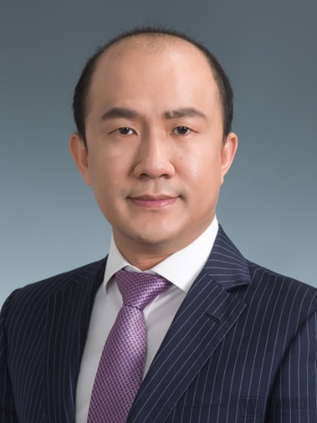
Introduction to Lawyer Cai Hang: For over a decade, he has specialized in investment and financing services within the healthcare, TMT, and artificial intelligence sectors, wielding significant influence in the field of venture capital legal services in China. *China Business Law Journal* has named him one of the “Top 100 Legal Elite in China,” recognizing him as one of the country’s most outstanding commercial lawyers. He has also been repeatedly recommended by leading legal ranking agencies such as The Legal 500 and Legalband in the fields of TMT and venture capital. In addition to venture capital work, he is highly proficient in mergers and acquisitions and capital markets. Lawyer Cai Hang is the Managing Partner of AnJie Broader Law Firm’s Shanghai office.

Introduction to Lawyer Yao Ting: She has represented renowned domestic and international funds and industrial investors in completing a substantial volume of legal services for domestic and overseas project investments, mergers and acquisitions, and post-investment management. Meanwhile, she has represented well-known domestic enterprises in financing and restructuring transactions, with practical experience in dual-currency structure investments and the establishment of red-chip structures for outbound financing by domestic projects.

Miao Jingyu Profile: Primarily engaged in private equity investment and financing, mergers and acquisitions (M&A), restructuring, and compliance matters. She has provided advisory services to numerous renowned investment institutions for domestic and cross-border private equity investments, and facilitated corporate restructuring transactions. Her expertise spans various industries, including healthcare, artificial intelligence, education, and new retail.