

Post-Pandemic MR Transformation: GE Healthcare's SmartSimplified AI Platform Offers a New Path Forward
Given that CT scans offer distinct imaging features of COVID-19, are readily accessible, and can more accurately reveal the true clinical status of patients than RT-PCR testing, this category of imaging equipment has indeed played an irreplaceable role during the pandemic. However, behind its widespread adoption today lies the technological barriers inherent to the equipment itself, as well as the rapid advancement of medical artificial intelligence.
In the early 1990s, annual sales of CT imaging equipment in China stood at only around 200 units; by this year, that figure has exceeded 4,000 units, representing more than a 20-fold increase. By 2018, the number of CT scanners per million population had reached 16.8. Although this still lags behind the United States’ figure of 32.2, it proved sufficient to meet the demands of fever clinics during the recent pandemic, with AI helping to offset the shortage of radiologists.
In contrast, the installed base of MR scanners is slightly insufficient. The only available data shows that there were 8,289 units by the end of 2017, which translates to just 5.9 units per million people. Particularly in first-tier cities like Shanghai, residents in urban areas once had to wait a month for an MR scan.
Why Is There a Huge Disparity in the Adoption Rates of MR and CT in China, Despite Both Being Mainstream Large-Scale Imaging Equipment?
From the perspective of imaging technology development, we have progressed from two-dimensional X-rays a century ago to three-dimensional CT scans, and further to magnetic resonance imaging (MRI), where different sequences generate different images. MRI provides more functional information, resulting in an ever-increasing volume of images. Consequently, the amount of information requiring visual interpretation by radiologists has grown substantially, yet the human brain’s processing capacity is limited. “If relied upon solely for image interpretation, the human brain would be overwhelmed; therefore, it is essential to leverage big data and artificial intelligence for assistance,” stated Tian Jie, Chief Scientist of the National Key Basic Research Development Program (973 Program) from the Chinese Academy of Sciences.
Despite the significant advantages of MR in functional imaging, the number of companies conducting artificial intelligence research on this type of imaging remains scarce due to limitations in data volume and complexity. Currently, among more than 1,800 AI enterprises in China, 280 are focused on medical and imaging AI; however, fewer than five of these companies possess the capability to develop AI products for magnetic resonance medical imaging.
Zhao Xia, General Manager of the MRI Product Division at GE Healthcare China, stated that compared with equipment such as CT and X-ray systems, MR imaging principles and devices are relatively complex, with numerous influencing factors and dimensions. Consequently, its development has been relatively slower, which places greater demands on equipment manufacturers to provide higher-quality images, ensuring high-quality input and high-quality output of information.
Unlike X-ray and CT, MR (Magnetic Resonance) can provide patients with more detailed information related to soft tissues. In simple terms, the principle of magnetic resonance is that a computer captures the transitions of particles after they gain energy from their equilibrium state. During the imaging process, the computer must process multidimensional data under different sequences, and many environmental factors can affect the quality of the images.
“Peristalsis in the gastrointestinal tract, and even swallowing movements, along with surrounding interference signals, can all cause artifacts. Such images prevent physicians from making accurate diagnoses,” said Zhao Xia. “Therefore, removing artifacts from MRI scans to provide clinicians with truly high-quality images is essential, which in turn reduces operational costs associated with repeat scans. Another critical issue is speed. While a CT scan typically takes less than a minute, an MRI examination requires dozens of times longer. This slow acquisition speed has long been one of the bottlenecks limiting its widespread application.”
According to statistics, nearly 20% of MRI scans require repeat examinations due to image artifacts. “This places significant strain on healthcare delivery and wastes resources, both in terms of hospital operational costs and patients’ time spent seeking care. Therefore, our focus is on helping hospitals obtain higher-quality images while reducing the time patients spend undergoing examinations,” Zhao Xia added in an interview with VCBeat.
On March 28, GE Healthcare unveiled its “IntelliSimple” AI platform, which could offer a win-win solution for hospitals and patients. Unlike conventional AI applications that focus on analyzing imaging data, GE Healthcare has shifted its attention to the front-end imaging process—developing AI technologies that span signal acquisition, data processing, and original equipment manufacturer (OEM) image reconstruction. This approach enables GE Healthcare to optimize image accuracy and enhance imaging efficiency at the source.
From the dual perspectives of quality and speed, the Zhijian AI platform employs highly intelligent deep neural network algorithms to learn from over 100,000 cases of raw magnetic resonance imaging (MRI) data. Upon completion of this training, the platform can extract features from the raw data acquired by each coil unit during the imaging process, identify and process noise and artifacts, and promptly eliminate impurities such as noise to obtain high-quality raw image data. Meanwhile, during the image reconstruction optimization process, AI-based algorithms are used to suppress image artifacts and significantly enhance the signal-to-noise ratio, thereby substantially accelerating imaging speed.
This means that, at the same magnetic field strength, MRI systems powered by the Zhijian AI platform can significantly reduce the probability of artifacts, increase scan success rates by 20%, and thereby lower hospital operating costs. Meanwhile, the platform can accelerate individual MRI imaging times, generating incremental value for hospitals. As a result, residents in urban Shanghai may no longer need to wait up to a month for an MRI appointment.
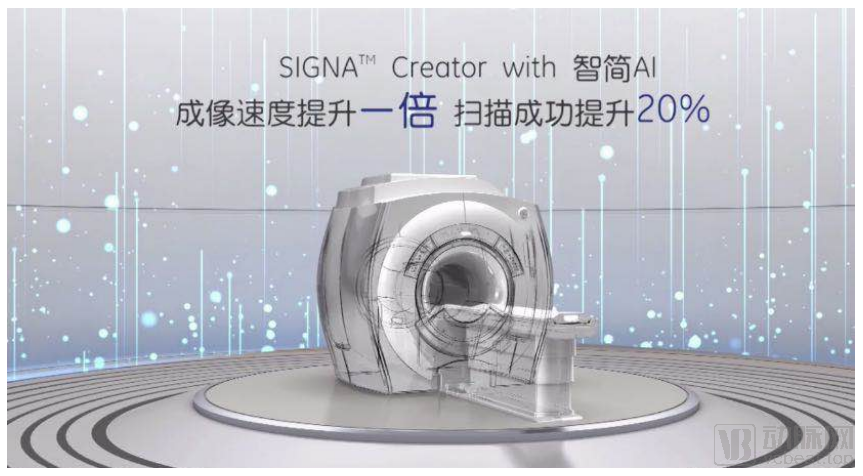
SIGNATMCreator Takes the Lead in Deploying the Intelligent and Simplified AI Platform
If the intelligent transformation of MRI workflows, such as automated anatomical region recognition and automated continuous scanning, is regarded as the MRI AI 1.0 era; and if various intelligent analyses and computer-aided diagnosis in the post-processing stage of image reconstruction are considered the MRI AI 2.0 era; then today’s return to fundamentals—introducing AI into the imaging phase itself to enhance the accuracy and efficiency of the entire imaging process—marks the advent of the MRI AI 3.0 era.
Professor Tian Jie stated, “The development of artificial intelligence technology has created numerous opportunities to enhance the efficiency and accuracy of clinical diagnoses. Particularly as we enter the AI 3.0 era, empowered by AI technologies, we can extract more robust, imperceptible data from MRI scans and transform them into faster, high-definition imaging, thereby strengthening clinical practice. This work is highly significant.”
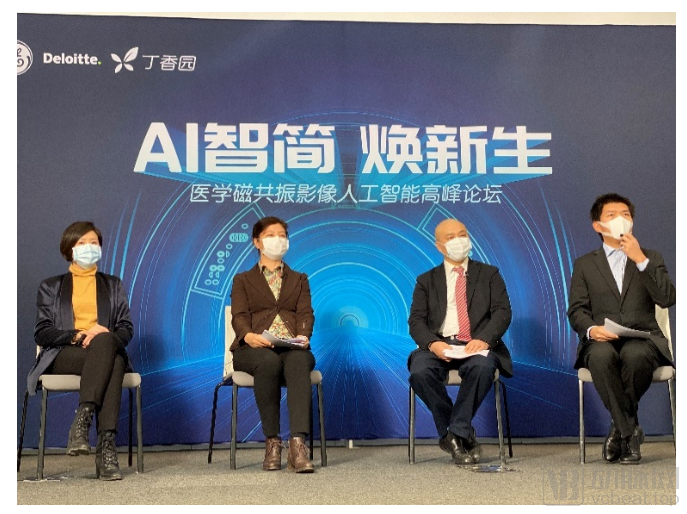
At the forum (from left to right): Li Jingjue, Vice President and Greater China CEO of Beijing Ande Yizhi Technology Co., Ltd.; Li Jingli, Director of the Medical Device Testing Institute at the National Institutes for Food and Drug Control; Professor Tian Jie from the Chinese Academy of Sciences, Chief Scientist of the National Key Basic Research Development Program (973 Program); and Wang Hao, Secretary-General of the Artificial Intelligence Medical Device Standardization Technical Committee under the Medical Device Appraisal Institute of the National Institutes for Food and Drug Control.
From this perspective, the “ZhiJian” AI platform can address at least two core healthcare challenges. The first is enhancing the supply of MRI services. Empowered by AI technology, the speed of MR examinations has been significantly accelerated, thereby reducing costs. This grants residents greater access to MRI scans, meaning that more severe diseases can be detected in their early stages. This outcome benefits both patient treatment and the control of health insurance expenditures.
Second, it provides AI enterprises with more standardized data, promoting the application of “AI+MRI” across the entire workflow. As Professor Liu Shiyuan, Director of the Department of Diagnostic and Interventional Radiology and Nuclear Medicine at Shanghai Changzheng Hospital, stated: “Currently, most artificial intelligence research and technologies for magnetic resonance imaging are limited to optimizing scanning procedures and assisting in post-processing image diagnosis. However, we envision that AI will not only be applied to data acquisition, reconstruction, and post-processing imaging, but also extend to downstream, full-cycle applications at the clinical end, such as examination, diagnosis, and structured reporting, thereby achieving comprehensive intelligence and enabling MRI to better serve clinical practice.”
By addressing these two issues, the “ZhiJian” AI platform has, to a certain extent, increased the service supply capacity and utilization efficiency of MR systems while reducing operational costs, thereby gaining broader recognition for this equipment among healthcare institutions.
Regarding the market outlook for MRI in the post-pandemic era, Yu Chao, Managing Partner of Deloitte’s Life Sciences and Healthcare Consulting practice, stated: “From the perspective of the existing market, medical equipment has its own lifecycle. As the core advantages of next-generation MRI systems become more pronounced—offering faster imaging speeds and superior image quality—their impact on improving operational efficiency is significant. In terms of incremental growth, as the foundational market continues to expand, an increasing number of primary-care hospitals are upgrading their equipment configurations. Coupled with the rise of emerging business models such as third-party imaging centers and the critical role of imaging equipment in the early detection of major diseases, the gap between China and developed markets is gradually narrowing. Overall, the market prospects for MRI are highly optimistic.”
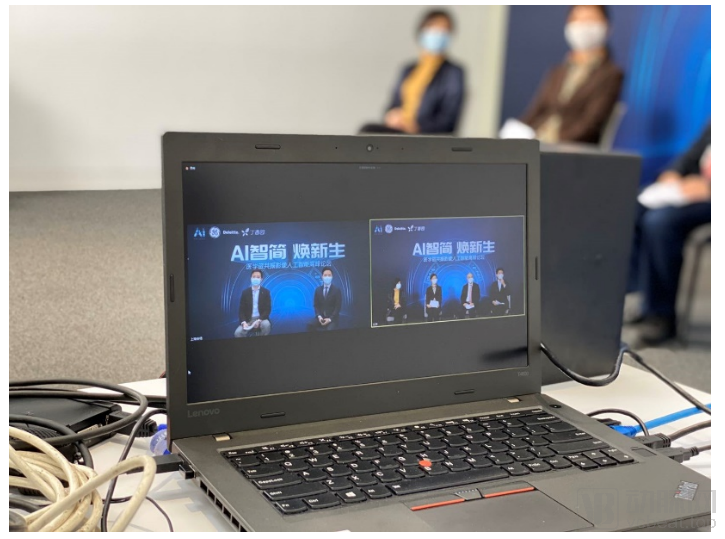
Yu Chao (left), Managing Partner of Deloitte’s Life Sciences and Health Care Consulting Practice
Participating in the breakout session with Chen Si (right), Product Marketing Director of GE Healthcare China's MRI Product Division
This epidemic has served as a major test for the responsiveness and service capacity of China’s healthcare system. It has not only made it clearer that there is an urgent need to strengthen medical infrastructure, promote the downward flow of high-quality medical resources, and advance tiered diagnosis and treatment, but it has also highlighted the pressing necessity of accelerating the development of digital technologies and telemedicine.
It is reported that GE Healthcare China is actively building a digital health strategy based on the Edison digital health intelligence platform, focusing on three key areas: asset operations management, patient clinical outcomes, and hospital capability development. AI is one of the key technologies enabling these three outcomes.
GE Healthcare currently offers a range of AI-enabled products across its device portfolio. In addition to the newly launched Intelligent Simplified MRI AI technology, its previous “DeepSight CT” solution leverages AI to automate patient positioning, thereby minimizing close contact between healthcare workers and patients and reducing the risk of cross-infection. Furthermore, ultrasound systems such as the LOGIQ E20 and Venue can automatically delineate and identify lesions.
"On the software side, we are also building an open ecosystem based on the Edison platform. This includes our own proprietary technology platforms, such as LK 2.0 Zhiying Xin Guan, the intelligent CT imaging analysis platform for COVID-19 that was recently launched. We are also collaborating with multiple domestic AI-focused enterprises to accelerate the deployment of digital health applications in clinical settings across various disease areas," said Zhao Xia.
These initiatives underscore GE Healthcare’s commitment to securing the “source” of medical imaging, as data quality at this origin is critical for the standardization of AI products. For years, many companies have developed AI solutions based on non-standardized data, rendering them difficult to apply in real-world clinical settings. Now, GE Healthcare is working to strengthen this “foundation.” If GE Healthcare can provide AI imaging researchers with more abundant, high-quality standardized data, we may be able to unlock greater value from source imaging data and redefine the value of radiology.