

Huayin Health Completes RMB 600 Million Series C Financing to Empower Primary Hospitals and Emerges as a Leader in Pathology Diagnostics
VCBeat (WeChat ID: vcbeat) has learned that Guangzhou Huayin Health Technology Co., Ltd. (“Huayin Health”) recently announced the completion of its C-round financing, raising RMB 600 million. The proceeds will be primarily used to expand the company’s business operations. This round was led by Defu Capital, with participation from Guangdong Zhutou Innovation, BOC Investment, Qianhai Fund of Funds, Yueyin Medical Fund, Langma Peak Ventures, and Chongqing Science and Technology Venture Capital Co., Ltd.
Previously, Huayin Health completed a $15 million (approximately RMB 106 million) Series A financing round and a RMB 130 million Series B financing round. The Series A round was participated in by investors including Zhongya Investment, while the Series B round was solely led by GTJA Investment.
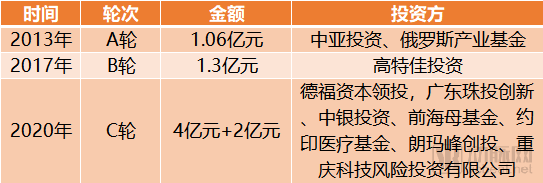
Huayin Healthcare's Historical Financing Activities
Guangzhou Huayin Healthcare Group Co., Ltd. is a comprehensive healthcare group specializing in medical testing services and high-tech development. Established in 2009, the company is headquartered in Guangzhou, China. Currently, its clinical services cover more than 2,000 hospitals across 27 provinces and regions in China, with five provincial-level laboratories and an annual diagnostic specimen volume exceeding 8.5 million cases.
How Did Huayin Healthcare Become a Leading Enterprise in China’s Pathological Diagnosis Sector? What Are the Unique Features of Its Products and Services? With These Questions in Mind, VCBeat Conducted an Exclusive Interview with Huang Chunbo, Founder of Huayin Healthcare.
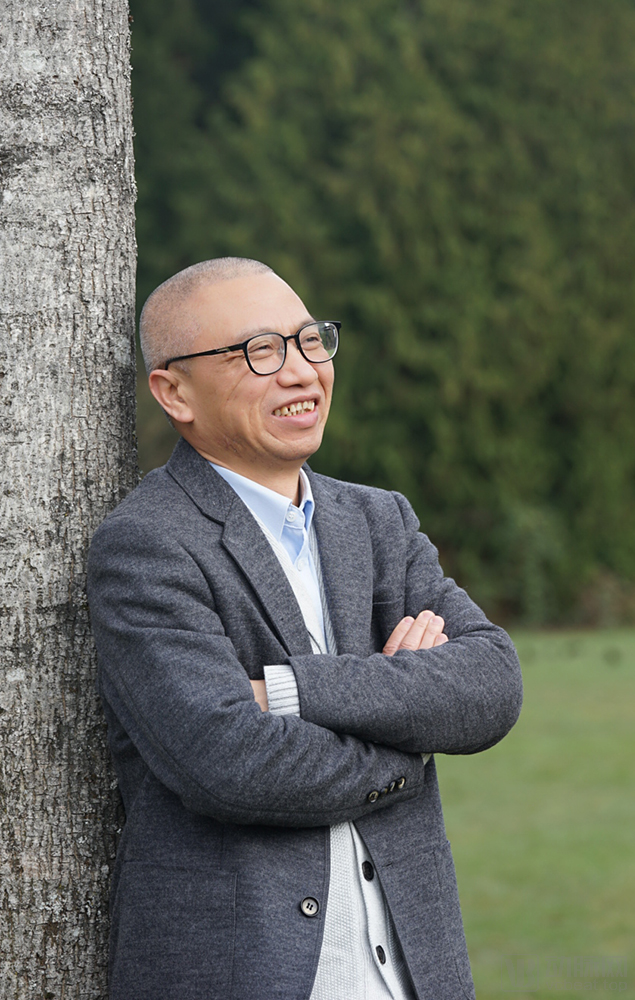
Founder of Huayin Healthcare: Huang Chunbo
In 1986, Huang Chunbo studied at South China University of Technology, where the strong entrepreneurial atmosphere profoundly influenced him.
In late 1992, Huang Chunbo co-founded Wondfo Biotech (SHE: 300482) with friends, becoming one of its founders. Wondfo Biotech has since grown into a leading enterprise in China’s POCT industry. During his eight-year tenure at Wondfo Biotech, through extensive engagement with and understanding of the industry and its customers, the idea of establishing a “third-party clinical laboratory” was planted.
In 2001, Huang Chunbo left Wondfo Biotech for the United States due to family reasons. During this period, he gained a deeper understanding of the independent clinical laboratory (ICL) sector in the U.S., which further strengthened his confidence in the future development prospects of China’s ICL industry. In 2004, Huang returned to China and joined Guangzhou Da’an Clinical Laboratory Center, a domestic third-party medical testing enterprise, where he was responsible for marketing. This role allowed him to gain more in-depth knowledge of the ICL industry while accumulating valuable industry experience and professional networks.
The opportunity that Huang Chunbo identified lay precisely in the weaknesses of basic laboratory testing within China’s primary healthcare institutions at the time. “Back then, many primary hospitals were even unable to independently perform chemiluminescence immunoassays properly,” Huang Chunbo recalled. “Primary healthcare institutions were even weaker in pathological testing, yet no domestic companies had focused on this area. Having long been well-versed in pathological testing, I believed this presented an excellent entry point for Huayin Healthcare to break into the independent clinical laboratory (ICL) market.”
In 2007, Huang Chunbo began preparing for the establishment of Huayin Health. In 2009, Guangzhou Huayin Medical Laboratory Center was officially established.
When asked about the core element of operating a third-party pathology laboratory, Huang Chunbo gave a two-character answer: experts. “Pathological diagnosis relies on interpretation by experts. While machines can generate standardized reports, it is the expert pathological interpretation that serves as the key to guiding patient diagnosis and treatment. This is why pathologists are often referred to within the industry as ‘doctors’ doctors,’” Huang Chunbo replied.
Huayin Healthcare has chosen to leverage collaborations with specialized medical universities in its strategic development of pathology services.
In 2010, the Company entered into a strategic partnership with Southern Medical University, and established the Huayin Pathology Diagnostic Center in collaboration with Southern Medical University in 2011. Furthermore, the Company has actively pursued international collaborations in pathology to advance the development of its pathology discipline and the construction of a high-end diagnostic and therapeutic service platform. It has engaged in multifaceted cooperation with prestigious institutions such as the University of Pennsylvania in the United States and the University of Bradford in the United Kingdom, including remote pathology diagnosis and scientific research.
The Huayin Pathology Diagnostic Center of Southern Medical University, led by experts including Professor Ding Yanqing, is a national-level comprehensive pathology service platform integrating medical care, education, research, and applications, and stands as one of the most influential pathology diagnostic centers in China.
In terms of business development, addressing the reality of a shortage of pathologists in China and the urgent need for pathological diagnosis in primary healthcare institutions, Huayin Healthcare leveraged the expertise of university-based pathologists to pioneer the establishment of a remote pathology diagnosis center. By extending remote pathology services to a broader range of primary healthcare facilities and establishing a regional collaborative network for remote pathology, Huayin Healthcare empowers the development of pathology departments in these institutions and meets their diagnostic needs.
Currently, the Huayin Health Telepathology Platform has evolved into a world-class pathology diagnosis platform with independent intellectual property rights and a rigorous telepathology quality control process. In 2017, it was invited to participate in a conference held by the National Health and Family Planning Commission, where it presented its practices and achievements in telepathology, establishing itself as an industry benchmark.
In terms of model construction, based on the current development status of pathology departments in primary hospitals in China, Huayin Health has proposed and implemented a growth-oriented service model. Its core value lies in supporting the development of clinical medical technology departments, thereby enhancing hospitals’ clinical surgical and diagnostic capabilities and driving overall institutional development.
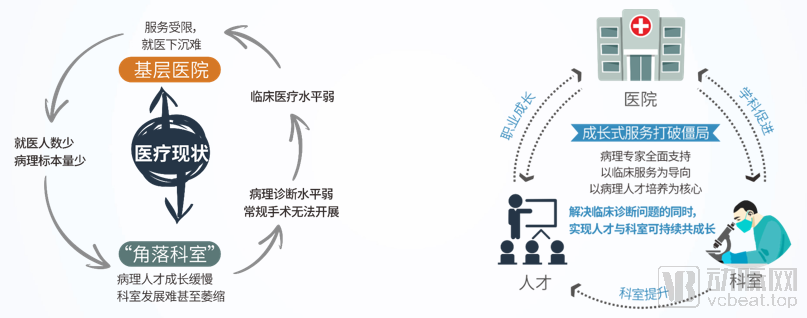
Schematic Diagram of the Growth-Oriented Service Model
Under the operational model of Huayin Health, the Group’s pathology discipline has established technical collaborations with over 500 hospitals. To date, it has completed more than 650,000 remote pathology diagnoses and over 30,000 remote intraoperative frozen section diagnoses. The accuracy rate for remote intraoperative frozen section diagnosis reached as high as 99.58%, with the shortest average turnaround time being 5 minutes and 52 seconds.
Having solidified its position as a leading enterprise in the field of pathology, Huayin Health is currently pursuing development along two major fronts. On one hand, it continues to deepen its customer service and technological advancements in pathology, with strategic investments in talent development, scientific research collaborations, and AI-driven pathology. On the other hand, it has introduced a “Pathology Plus” strategy, leveraging its strengths in pathology to expand its footprint and growth within the broader diagnostics sector.
About Defu Capital
DeFu Capital was established in 2010 and is a leading investment institution in China focused on the healthcare industry. It manages private equity funds and hedge funds in both US dollars and Chinese renminbi. DeFu Capital has been committed to becoming the most trusted partner for leading companies in the industry, continuously delivering excellent returns to investors, and jointly promoting the healthy development of China’s healthcare sector.
About BOC Investment
BOC Group Investment Company Limited is a wholly-owned subsidiary of Bank of China, incorporated in Hong Kong in December 1984. As Bank of China’s specialized investment management arm, BOC Group Investment conducts diverse investment activities across Hong Kong, Macau, mainland China, and overseas markets, with investments spanning sectors such as healthcare, consumer goods, energy, transportation, and finance. Through years of persistent effort and pioneering development, the company has leveraged Bank of China’s substantial financial strength and extensive business network, capitalized on its integrated collaborative advantages, seized emerging business opportunities, and actively expanded its operations, achieving remarkable results in equity investments in enterprises, fund investment and management, real estate investment and management, and non-performing asset investment. The company’s assets under management exceed HK$180 billion.
About Qianhai Fund of Funds
Qianhai Fund of Funds was successfully established in December 2015. It is currently the largest commercially raised fund of funds in China, as well as the single venture capital and private equity investment fund with the largest fundraising scale in the country. To date, it has completed a fundraising total of RMB 28.5 billion. The successful establishment of Qianhai Fund of Funds marks the completion of the fourth task among the eight financial innovation initiatives for Qianhai issued by the State Council. It holds epoch-making significance for promoting the development of qualified investor teams in China’s private equity investment industry, supporting the growth of emerging industries, facilitating the transformation and upgrading of traditional industries, and fostering mass entrepreneurship and innovation.
Qianhai Fund of Funds has gathered influential and well-resourced limited partners (LPs) with strong capabilities in China, primarily including government entities, insurance and financial investment institutions, renowned enterprises, and listed companies. Meanwhile, it has assembled the most insightful, experienced, resourceful, and capable fund-of-funds management team in the domestic private equity sector. The managing partners of the management company all come from top-tier investment institutions, with an average of over 20 years of investment management experience, overseeing assets under management exceeding RMB 100 billion, and delivering industry-leading investment performance.
About VB Healthcare Fund
Yueyin Medical Fund is an investment institution focused on the healthcare industry, established by professionals from the medical and investment sectors. It is dedicated to identifying China’s most high-growth and innovative teams and enterprises, striving to become a trusted partner for entrepreneurs and investors. With a patient-centric approach and healthcare services as its foundation, the fund strategically invests across three dimensions—disease categories, new technologies, and the industrial value chain—in fields such as healthcare services, medical devices, biopharmaceuticals, in vitro diagnostics, and smart healthcare. To date, it has completed investments in more than 20 leading companies in various medical sub-sectors.
About Langma Peak Venture Capital
Longma Peak Venture Capital is a venture capital firm dedicated to investing in world-class technology enterprises, with its investment reach spanning across China. To date, Longma Peak Venture Capital has cumulatively invested in more than 150 companies, focusing on high-tech sectors such as biopharmaceuticals, high-end equipment, new materials, and next-generation information technology. Its portfolio includes industry leaders in niche segments, such as Montage Technology (688008), ArcSoft Corporation (688088), Tianyi Shangjia (688033), and DBAppSecurity (688023). Adhering to the philosophy of value investing, Longma Peak Venture Capital emphasizes long-term returns. For founders within the Longma Peak ecosystem, the firm provides not only financial support but also established Longma Peak University to help entrepreneurs master the "way" of excellent corporate management.
About GTJA Investment Group
Founded in Shenzhen in 2001, GTJA Investment Group focuses on investments in the healthcare industry. Guided by strategic equity investments, its portfolio spans all stages, including PIPE, private equity (PE) buyouts, venture capital (VC), and angel investing. Boasting China’s largest professional healthcare investment team, the firm has built an ecosystem platform for healthcare industry investments and strives to become a globally influential healthcare investment institution. With assets under management exceeding RMB 20 billion, it manages 26 healthcare-focused funds and has invested in over 140 companies, including more than 70 in the healthcare sector. It has facilitated the successful listing of 16 portfolio companies, notably holding a controlling stake in Boya Bio-pharmaceutical Group Co., Ltd., a leading domestic blood products enterprise, and supporting its successful IPO.
About Pearl River Investment
Founded in 1993, the company has spent the past 26 years developing social investment projects with the goal of promoting sustainable development. It has established a nationwide presence across ten major business sectors: urban renewal, energy and infrastructure, commercial, industrial, residential, education, healthcare, culture, technology, and finance. Committed to serving and giving back to society, it proactively addresses social issues through innovative approaches and provides forward-looking solutions. Each step taken over these 26 years has contributed to realizing its grand vision of becoming “China’s Comprehensive Social Service Provider.”
About Chongqing Kefeng Investment
Chongqing Kefeng Venture Capital was established in January 1993 and is one of the earliest professional state-owned venture capital firms in China. It focuses on venture investments in high-growth technology enterprises, promoting the commercialization of scientific and technological achievements and fostering the integrated development of science, technology, and the economy. The company’s core businesses encompass equity investment and market-oriented fund-of-funds operations, with deep expertise in digital technology and biotechnology. It prioritizes strategic emerging industries such as general health, advanced manufacturing, big data, and artificial intelligence. In the biomedical sector, its portfolio spans multiple subfields, including cell therapy, digital medical devices, in vitro diagnostics (IVD), and smart healthcare.