

Penguin Almond Accelerates 'City Model' Strategy with Integration of Mammy Knows Pediatric Clinics in Shenzhen
News of Penguin Almond’s Expansion Keeps Emerging! Following the Acquisition of 25 Dental Clinics in December 2019, It Announced Today That the Pediatric Clinic Business of Mommy Knows Shenzhen Has Been Integrated Under Its Umbrella.
To date, Penguin Almond has independently established 47 outpatient and surgical centers, and acquired well-known clinics such as Beijing Youlin Clinic, Chengdu Ruoshui Clinic, and Shenzhen Zhengfu Dental Clinic. The group’s business model covers online consultations, general practice centers, surgical centers, and specialty centers, with family doctors serving as connectors to build a “city model” for primary care.
In 2020, the COVID-19 pandemic had a profound impact on multiple segments of the healthcare industry, including the primary care sector where Penguin Almond focuses. Why was Penguin Almond able to rapidly expand its business after the epidemic stabilized? How has its “City Model” strategy progressed? This article provides an overview and analysis.
# Mami ZhidaoMami Zhidao, established in 2014, is a well-known brand in the pediatric clinic sector. At its inception, the platform primarily offered online consultations, connecting users with pediatricians and obstetricians from top-tier (Grade A Tertiary) hospitals in key cities to form family doctor teams for user services.
In 2017, Mammy Knows incubated its first offline self-operated pediatric clinic in Shenzhen. After several years of development, it has established offline clinics in Shenzhen, Guangzhou, Shanghai, and Beijing.
Following the integration of Mami Knows Shenzhen Clinic’s operations into Penguin Almond, the respective medical teams will collaborate with the Penguin Almond team to jointly upgrade Penguin Almond’s pediatric product line. All existing benefits for Mami Knows members will remain valid at Penguin Clinics, and Penguin Doctor’s Shenzhen clinics will provide additional services tailored to Mami Knows members.
A representative from Penguin Almond stated that “Mommy Knows” has been deeply engaged in the maternal and infant healthcare industry for many years, assembling a large team of full-time pediatricians, multi-site practicing physicians, and medical professionals from renowned Grade 3A hospitals. The platform has earned considerable user acclaim and trust for its scale and brand reputation.
It is reported that since the second half of 2019, Penguin Almond has engaged in in-depth negotiations with Mommy Knows on multi-faceted cooperation. This integration involves two Shenzhen pediatric clinics operated by Mommy Knows. Meanwhile, Penguin Almond and Mommy Knows will establish a long-term, in-depth strategic partnership online, with Mommy Knows’ online platform providing pediatric operational resource support to Penguin Almond.
The executive explained that Penguin Almond would subsequently leverage its existing resource advantages to restructure its offline general practice services in Shenzhen. “This will involve integrating Mommy Knows’ pediatric care system into our current network, which includes general practice satellite clinics, corporate infirmaries, general practice centers, and surgical centers.”
Meanwhile, leveraging its existing online-to-offline one-stop medical service system, Penguin Almond will provide Mommy Knows members with one-stop health management and medical services, ranging from general practice and specialty care to online lightweight consultations and follow-up rehabilitation.
On December 19, 2019, when Penguin Almond announced its acquisition of 25 clinics under Shenzhen Zhengfu Dental, it stated that it was building a “city model” for primary care.
Following the integration of Mami Zhidao’s offline clinic operations in Shenzhen, Penguin Almond Group has deepened its specialized clinic network layout and refined the construction of its “City Model.”
“Urban Model” centers on family physicians, connecting various business formats under its umbrella to form a closed-loop service system. Specifically:
Primary care services are delivered through flagship and satellite clinics, offering general practice consultations, health management, chronic disease management, and follow-up care. In addition, Penguin Almond will collaborate with government authorities to empower community health centers, supporting the development of 100 such facilities.
Specialized medical care is provided by specialized centers, offering diagnostic and treatment services in specialties such as dentistry, rehabilitation, ophthalmology, pediatrics, and traditional Chinese medicine.
Surgical procedures are undertaken by the Ambulatory Surgery Center; patients requiring surgical treatment may undergo such procedures at the center.
Patients with complex and severe conditions that cannot be addressed through primary care, specialized care, or surgical interventions are referred to Grade 3A hospitals; meanwhile, patients discharged from Grade 3A hospitals can enter Penguin Almond’s primary care system for out-of-hospital management.
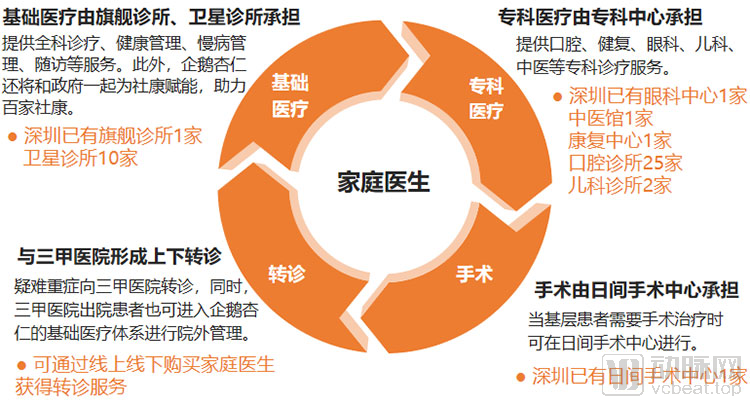
Penguin Almond’s “Urban Model” for Primary Care and Its Deployment in Shenzhen | Graphic by VCBeat
The figure above intuitively illustrates the operational mechanism of the “City Model” and highlights Penguin Almond’s layout across various stages in Shenzhen. This demonstrates that Penguin Almond’s “City Model” has been fully established in Shenzhen.
“We have already established a systematic and mature ‘city model’ across various business formats in Shenzhen,” said a relevant official from Penguin Almond. This serves as a benchmark for first-tier cities, while Chengdu has been developed as a benchmark for second-tier cities.
Currently, Penguin Almond operates one flagship clinic, two specialty centers, twelve satellite clinics, and one ambulatory surgery center in Chengdu. Although it has fewer clinics and specialty clinics than in Shenzhen, its comprehensive business layout still allows it to operate under the “city model.”
The representative stated that, moving forward, Penguin Almond will build upon these two benchmarks by integrating its effective offline clinical clinic network with efficient online mobile solutions, gradually replicating this model in more first- and second-tier cities to provide one-stop health management and medical services to a broader patient population.
From the perspective of short-term factors affecting clinic development, after the outbreak of the COVID-19 pandemic in 2020, most clinics suspended operations due to epidemic prevention and control requirements, encountering operational difficulties for a time. During this period, Penguin Almond’s clinics across various regions also temporarily ceased operations.
From a long-term perspective, challenges such as the sustainability of profit models, patient trust, and the development of talent systems are critical issues that clinics—especially chain clinics—must address.
In recent years, the procedures for establishing private medical institutions have been increasingly streamlined. In 2019, the National Health Commission of China, together with four other ministries and commissions, issued the "Opinions on Launching Pilot Programs to Promote the Development of Clinics," which were implemented in ten pilot cities for clinic reform: Beijing, Shanghai, Shenyang, Nanjing, Hangzhou, Wuhan, Guangzhou, Shenzhen, Chengdu, and Xi’an.
“The Opinion” further streamlined the process for establishing clinics and encouraged physicians to open clinics on either a full-time or part-time basis. However, no surge in clinic openings emerged following the pilot implementation, indicating that the industry is adopting an increasingly rational approach to the clinic sector.
As the pandemic stabilizes and clinics across various regions gradually resume operations, Penguin Almond, which has established a network of over 100 clinics, appears to have been largely unaffected by adverse external factors. Instead, it has swiftly returned to normal operations and embarked on business expansion, a success primarily attributed to its comprehensive strategic layout developed over many years.
Clinics Closed, Practice Open: Online Services Gain Wider Adoption
Unlike purely offline clinics, Penguin Almond’s online services constitute a vital component of its overall business. Following the suspension of offline consultations, physicians can transition to providing online services.
On January 22, Penguin Family Doctor launched a 7/24 online free clinic service, mobilizing offline clinic physicians to provide services online.
The Penguin Almond online platform has gathered 450,000 doctors across China. Since the outbreak of the pandemic, a total of 15,000 doctors have participated in online free clinics.
Correspondingly, users have shifted from offline to online channels. As of the end of February, the total number of registered users on Penguin Almond’s online platform reached 17 million. Notably, during the period from January 20 to February 29, the platform added 460,000 new users, representing a 1.6-fold increase compared to the same period in 2019, and it continues to maintain steady growth.
Meanwhile, online consultations have also reached a peak, with cumulative services provided to over 6 million patients since the onset of the pandemic.
Penguin Almond will also provide free clinic services to enterprises in need, including Tencent, various insurance institutions, telecom operators such as China Mobile and China Unicom, and real estate developers.
During the pandemic, internet healthcare became a vital component of medical services. Penguin Almond’s online platform facilitated the widespread adoption of family doctor services, with family doctors serving as a key connector in its service model.
Diversified Layout, Stronger Risk Resistance
In addition to online services, as of April 2020, Penguin Almond had established or was in the process of establishing more than 100 physical locations across 12 cities, including Beijing, Shenzhen, Chengdu, and Chongqing. These facilities encompass a variety of healthcare formats, such as general practice clinics, specialty clinics, surgical centers, and corporate infirmaries.
During the pandemic, 12 medical staff members from Penguin Almond Clinic volunteered to participate directly in community epidemic prevention and control efforts. As the situation stabilized and work resumption began, select Penguin Almond clinics were designated as screening institutions for returning workers.
Having withstood the test of the pandemic, Penguin Almond will further enhance its one-stop health management and medical services by leveraging its offline clinic network to build a comprehensive system spanning community health centers, general practice, specialty care, online consultations, and follow-up rehabilitation.
Therefore, from an overall perspective, the diversified business layout enables Penguin Almond to possess stronger risk resistance than purely small-scale or single-location clinics, allowing for flexible responses even when encountering short-term challenges.
Capital support from star investors such as Tencent and Sequoia China has also provided Penguin Almond with the financial backing needed for orderly expansion. Just one year ago, Penguin Almond completed its latest round of financing, raising $250 million. The round was co-led by Country Garden Ventures, Tencent, and Gaw Capital, with participation from CMB International, Harvest Wealth, the China-Russia Investment Fund, Sequoia China, Shengshijing Group, and AVIC Trust.
Since the merger of Penguin Doctor and Almond Doctor in 2018, Penguin Almond has continued to build on the synergy of “1+1>2” by consistently adding value.
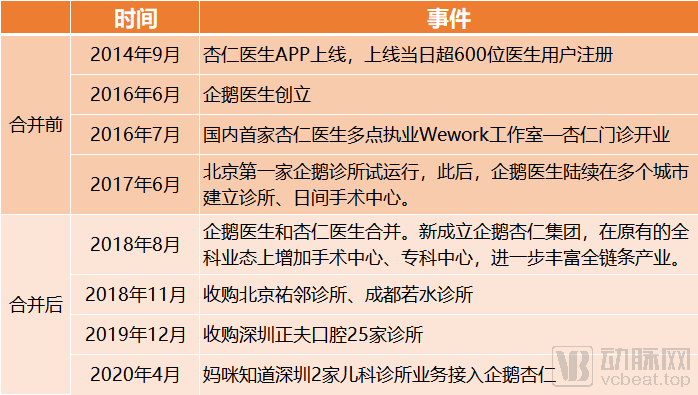
Penguin Almond’s Key Milestones, chart by VCBeat
The plan was to open 300 clinics across 30 cities by 2021. The likely development path involves supplementing existing footprints in cities where operations are already established, while selectively expanding into new cities as opportunities arise. The city-level development strategy is based on a “city model” for primary care.
Currently, among the 12 cities where Penguin Almond has established clinic networks, Shenzhen and Chengdu serve as benchmark models, indicating that its primary care “city model” has taken shape or reached maturity. The next step will be to replicate this model to supplement operations in the remaining 10 cities.
We have mapped out the strategic layouts of ten additional cities and, based on the key components of the “urban model” for primary healthcare, inferred their development trajectories in these respective markets—specifically, potential business lines to be built in-house or targets for acquisition and merger.
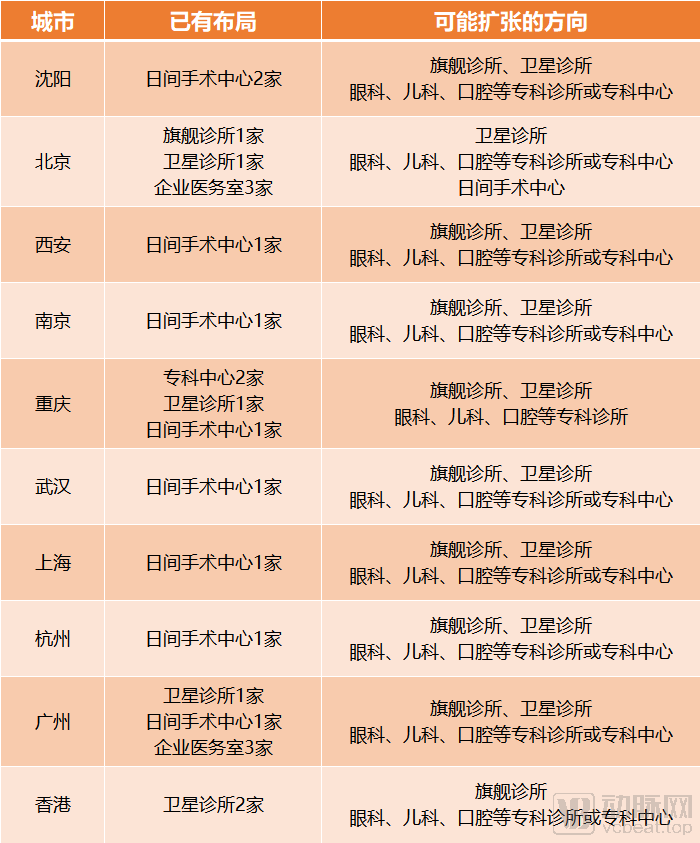
Potential Future Expansion Directions for Penguin Almond. Existing layout data sourced from the official website of Penguin Almond; graphic by VCBeat.
The flagship clinics shown in the figure above cover an area of approximately 800–2,000 square meters and are equipped with 6–15 consultation rooms, multiple treatment rooms, a DR room, a laboratory, and a doctors’ rest area.
The satellite clinic covers an area of approximately 400 square meters, equipped with six consultation rooms, two therapists, and examination and testing equipment;
The specialty center covers an area of approximately 300 square meters and is equipped with physician consultation rooms, examination rooms, and corresponding specialized diagnostic and treatment equipment, tailored to the specific medical specialty.
The Day Surgery Center covers an area of approximately 1,000 square meters and is equipped with 10 consultation rooms, two day-surgery operating rooms, a DR room, a laboratory, and a doctors' rest area.
It can be seen that among these 10 cities, most have yet to establish flagship clinics, satellite clinics, specialty clinics, or specialty centers. Currently, flagship and satellite clinics are primarily built in-house by Penguin Almond, while specialty clinics are mainly established through acquisitions or mergers.
In other words, in these cities, clinics of the corresponding types or scales may all collaborate with Penguin Almond.
Based on Penguin Almond’s previous target selection criteria, the key factors prioritized were brand, physician resources, and patient resources.
According to reports, Penguin Almond will continue to adopt a multi-pronged strategy of “self-construction, acquisition, and merger” to address patients’ personalized medical and health needs across diverse scenarios. The company aims to continuously expand its business portfolio, including general practice, specialized care, and surgical centers, thereby building a comprehensive medical service ecosystem.
Based on recent business expansions, its growth rate is accelerating, and the “city model” is being progressively refined and validated.