

Yihuan Medical: Pioneering Cross-Industry Innovation in Internet Healthcare with Nationwide Coverage Across 20+ Provinces and 300+ Institutions
Will Esports and Internet Healthcare Intersect? For Chen Houjun, the Answer Is Yes.
In 2000, Chen Houjun resigned from his public sector position to compete in the CPL Quake III IE Tournament qualifiers, where he won the China regional championship and became China’s first contracted professional gamer. After retiring in 2003, Chen has continuously pursued entrepreneurial ventures across industries including finance, gaming, and media, establishing himself as a daring, innovative, and resilient entrepreneur who never gives up.
Around 2015, plagued by distressing experiences in seeking medical care, Chen Houjun and his former supervisor and close friend, Yue Yifeng, began to ponder how to leverage the power of the internet to improve patients’ efficiency in accessing healthcare services and alleviate pain points in the medical industry, such as the uneven distribution of medical resources. With extensive experience in internet entrepreneurship, the two quickly found common ground. Guided by the principle that “righteousness embodies benevolence,” YiHuan Medical was born.
On October 25, 2015, Chengdu Yihuan Medical Technology Co., Ltd. (hereinafter referred to as “Yihuan Medical”) was established in Chengdu.
Esports and internet healthcare share many logical commonalities. At the core of esports is the integration of hand and brain. In the realm of internet healthcare, “hand” represents marketing and product capabilities, while “brain” serves as the controller and exporter of corporate development direction and unique industry insights. “The coordination of hand and brain determines the ceiling of a company’s growth.” The similarity lies in the fact that every moment in esports requires rapid decision-making by the brain and precise execution by the hands, just as it does in business. It is this high sensitivity to industry changes and agile operational mechanism that characterizes internet enterprises.
Yihuan Medical is grounded in the current healthcare landscape of China, where resources, brand reputation, and public trust are all centered around hospitals. It is committed to developing comprehensive and systematic “Internet + Healthcare” solutions for medical institutions and regional public hospital systems. With differentiated product positioning, high-quality resource support, and extensive industry expertise, Yihuan Medical has become a leading operator of smart hospitals and internet hospitals in China.
In the early stages of its founding, the company’s core management team was embedded within hospitals, conducting comprehensive and meticulous research across various medical scenarios. They carefully analyzed and understood industry dynamics, leveraging policy support to guide their strategic moves. After nearly five years of development, the Yihuan Medical team has expanded significantly, establishing subsidiaries in Xi’an, Xining, and Tibet, as well as branch offices in Beijing, Shenzhen, Wuhan, and other cities. Its business reach now extends to more than 20 provinces, autonomous regions, and municipalities directly under the central government across China.
Currently, Yihuan Medical’s core product offerings encompass comprehensive solutions for smart hospital development, internet hospital construction plans, electronic health card technical solutions, and electronic prescription circulation platforms, among others, thereby establishing a robust matrix of services and products:
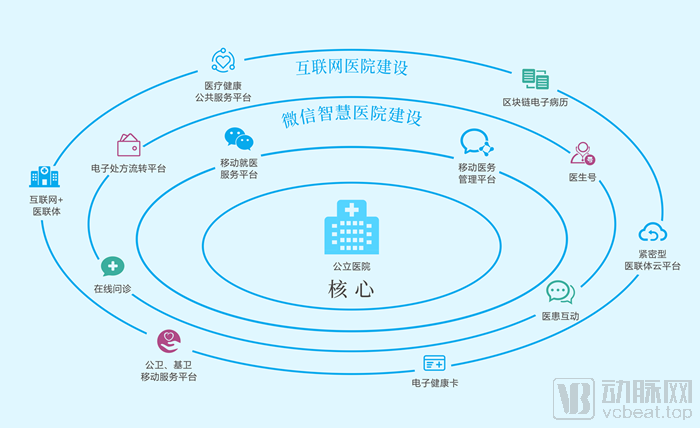
Yihuan Medical Business Map (Image from the company)
In recent years, Yihuan Medical has adhered to jointly exploring an innovative model that aligns “management” with “technology” alongside public Grade-A tertiary hospitals. Throughout this process, the company has closely followed national policy trends and maintained strong coordination with provincial and municipal health authorities. As of April 2020, Yihuan Medical had established collaborations with more than 70 Grade-A tertiary hospitals and over 300 medical institutions across China.
In 2014, Yihuan Medical undertook its first “Internet + Healthcare” project—the construction of the Internet Hospital for West China Second University Hospital (West China Women’s and Children’s Hospital) of Sichuan University.
West China Second University Hospital of Sichuan University is the largest specialized hospital for women and children in Southwest China, demonstrating a highly open mindset and innovative capabilities in the development of smart hospitals, internet hospitals, and regional medical consortium service portals. Yihuan Medical spent one year conducting research and engaging in discussions with the hospital to formulate a comprehensive product roadmap. Chen Houjun acknowledged that building an internet hospital requires efficient collaboration among departments and clinical units at various levels within the hospital; enabling them to rapidly leverage their efficiency and strengths constituted the primary focus of Yihuan Medical’s work over the past year.
In the second year, Yihuan Medical and the hospital’s information center staff integrated innovative internet thinking with traditional Health Information Technology (HIT) processes, pioneering China’s first WeChat ecosystem-based, end-to-end convenient healthcare service in the absence of any precedents. In 2016, the West China Women’s and Children’s Internet Hospital of Sichuan University was officially launched, marking the hospital’s realization of comprehensive online medical services, extending high-quality medical resources to grassroots levels, and ushering in a new model of “Internet + Healthcare.”
West China Women’s and Children’s Internet Hospital of Sichuan University is the first smart hospital to leverage the WeChat ecosystem for optimizing management processes. Nearly 3,000 staff members across the hospital have fully onboarded onto the “Yi Hutong” platform, with 80% of internal management processes digitized online. This initiative saves an average of 7,000–12,000 sheets of paper per month and improves operational efficiency by 7–8 times. Through the internet hospital platform, over 260 physicians’ clinics have been digitized, serving a total of 733,000 patient visits, with each physician attending to an average of 2,789 patients.
Following the development of smart hospitals and internet hospital platforms, Yihuan Medical has reached an agreement with West China Second University Hospital of Sichuan University to build the West China Maternal and Child Health Medical Consortium Cloud Platform. The project has received pilot approval from the Sichuan Provincial Health Commission. This initiative is a medical consortium cloud platform solution centered on the electronic resident health card, aiming to establish a regional, deeply integrated, and tightly-knit medical consortium.
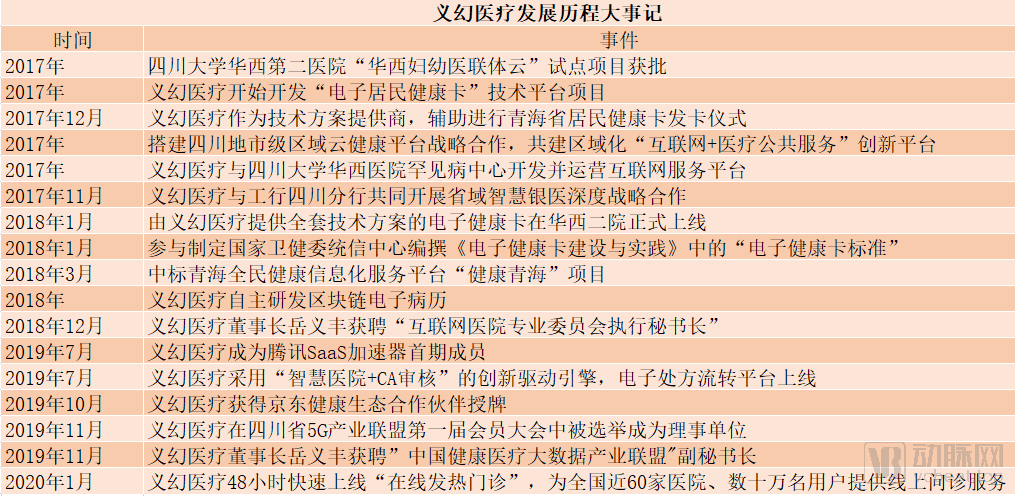
Yihuan Medical Milestones (Graphic by VCBeat)
The COVID-19 pandemic has rapidly spurred substantial user demand and application scenarios for internet-based healthcare: Internet hospital platforms have provided disease management guidance and psychological counseling to individuals staying at home for epidemic prevention by launching online fever clinics and services for special outpatient conditions, thereby effectively supplementing scarce medical resources; health information and science popularization platforms have enhanced public health awareness through real-time epidemic updates and knowledge dissemination; and e-commerce pharmaceutical platforms have delivered urgently needed medications via “contactless” methods, while also aiding in the triage and treatment of diverse populations through online mask reservation systems.
Addressing the recent geometric growth in the user base of internet hospitals, Chen Houjun shared his perspective. The pandemic brought a surge of new users to internet hospitals in an extremely short period, creating an outwardly appealing picture. However, the key question remains: can these users truly be retained? In his view, as a representative model of serious medical services, the essence of internet hospitals lies in addressing patient needs. Their strength and sustainability depend solely on the hospital’s academic and disciplinary capabilities, relying more on legal compliance, safety, and sustainability within the healthcare system. “We should view this rationally and not be dazzled by the data,” said Chen Houjun.
It is understood that Yihuan Medical will, in the short term, adopt a parallel approach of “consulting + management + technology” to revitalize the operational vitality of at least 10–15 public tertiary hospitals. This initiative aims to enable more internet hospitals to achieve autonomous operation, tailored to their specific institutional contexts. “The goal is to truly make internet hospitals the second brand portal and service platform for hospitals on the internet, rather than merely a superficial project.”
Looking ahead, Yihuan Medical will remain committed to its core strategy of focusing on public hospitals. By tapping into the public healthcare system—particularly high-quality secondary and tertiary hospitals—we aim to enable more hospitals to establish their own independently operated internet hospital portals. We will continuously cluster hospital process services, clinical operations, medical consortia, and related industries on these internet hospital platforms, and through effective measures, optimize resource utilization while iteratively reshaping the entire public healthcare system.