

JD Health and Peking University Third Hospital Advance PharmCoo AI Platform for Multi-Scenario Applications in Smart Pharmacy
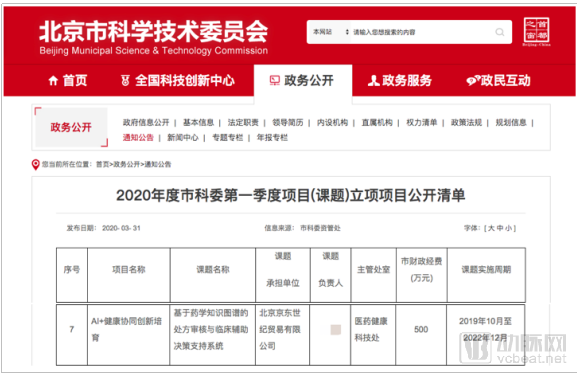
On March 31, the Beijing Municipal Science & Technology Commission announced the list of projects for the 2020 “AI + Health Collaborative Innovation Incubation Special Program.” The project titled “Prescription Review and Clinical Decision Support System Based on Pharmaceutical Knowledge Graph,” jointly submitted by JD Health and Peking University Third Hospital, was officially approved and received government funding support.
This project is poised to accelerate the advancement of smart healthcare: in government-level applications, AI-driven prescription review will help control health insurance costs; for medical institutions, more precise rational drug use systems will enhance the quality and efficiency of smart hospitals; and on the patient-facing medication supply side, the application of remote prescription review will expand pharmaceutical care services for pharmacies, delivering greater value to patients.
As a major breakthrough in recent scientific and technological innovation within the field of AI-driven pharmacy, the project’s implementation speed and the diversity of its application scenarios are poised to increase significantly, driven by the growing attention from both domestic and international markets toward the AI segment of the pharmaceutical industry.
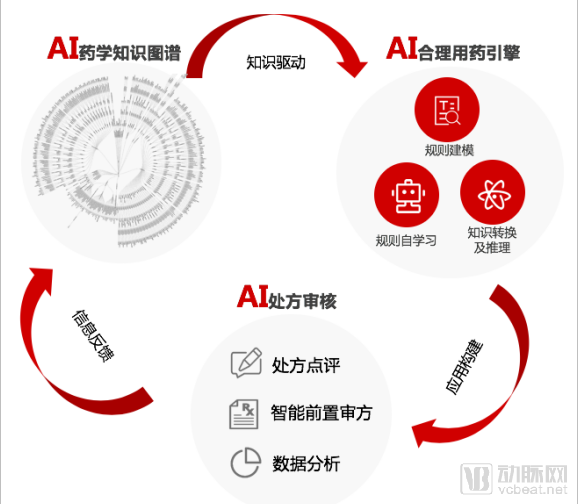
At the core of this project is PharmCoo, an AI-powered pharmaceutical knowledge graph jointly developed by JD Health and Peking University Third Hospital in 2019. The primary objectives are to construct a pharmaceutical knowledge graph and to develop a pre-prescription review system alongside a clinical decision support system. PharmCoo is built upon a pharmaceutical knowledge base and real-world data, leveraging artificial intelligence technologies such as semantic understanding and machine learning. Its related products provide efficient and convenient services for rational drug use and intelligent prescription review to various stakeholders.
The approval of this project reflects the government’s attention to the field of pharmaceutical AI in China and its determination to leverage technology to address industry challenges in rational drug use. It also signifies that JD Health’s AI capabilities have received recognition and support from the government and authoritative bodies for their pioneering application in pharmacy.
Rational drug use remains a persistent challenge in China’s pharmaceutical industry. Improving the level of rational drug use is closely linked to government efforts to control medical insurance costs, the quality of hospital medical services, and public health overall. In recent years, relevant national authorities have frequently issued guidelines, setting forth increasingly specific requirements for pharmaceutical management to encourage greater industry attention and prioritization. Wang Dongyuan, General Manager of Smart Healthcare at JD Health, stated that addressing complex challenges in the pharmaceutical sector through AI technology was the original motivation behind the development of PharmCoo.
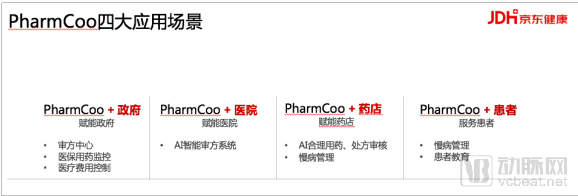
Built on a pharmaceutical knowledge graph and powered by a rational drug-use engine, PharmCoo’s innovative solution delivers substantial application value across four major scenarios: government, hospitals, pharmacies, and patients. JD Health has partnered with local governments and medical institutions to roll out and implement the PharmCoo system nationwide.
In government application scenarios, a regional prescription review and routing platform can be built based on PharmCoo to achieve unified management, review, and routing of prescriptions within the region, thereby further promoting the implementation of national policies such as the separation of prescribing from dispensing and zero markup on drug prices.
The Regional Prescription Review and Routing Platform will integrate with the information systems of hospitals within the region, providing unified functionalities such as pre-prescription review, prescription evaluation, and rational drug use management. Prescriptions issued by physicians are re-evaluated on the platform using AI technology, and any irrational prescriptions are fed back to the clinicians. Subsequently, downstream processes, including integration with the pharmaceutical supply chain, are carried out. Reviewed prescriptions are routed to downstream retail pharmacies, which can offer home delivery services. Meanwhile, prescriptions can also be directed to nearby pharmacies, automated medication dispensers, or community-based pickup locations for patient convenience.
By leveraging PharmCoo’s capabilities in rational drug use, it can also facilitate the control of health insurance expenditures. By integrating health insurance-related rules and knowledge into its underlying infrastructure through the PharmCoo knowledge base, applications built on PharmCoo function not only as rational drug use systems but also as health insurance cost-control systems. This helps local healthcare security administrations manage pharmaceutical expenses, thereby effectively curbing unreasonable spending.
Currently, JD Health has entered into strategic partnerships with the municipal governments of Beihai in Guangxi Province and Hebi in Henan Province, and is advancing the construction of related pilot projects. Notably, the regional prescription review and circulation platforms, jointly built by JD Health and the two localities based on PharmCoo, are currently being implemented.
In recent years, multiple documents on pharmaceutical care services issued by relevant national authorities have repeatedly emphasized the importance of “rational drug use.” The “Opinions of the State Council on Implementing the Healthy China Action,” released in 2019, mentioned “rational drug use” twice among the 15 special actions under the “Healthy China” initiative. As national policies impose increasingly specific requirements on pharmaceutical management, the demands for efficiency and accuracy in rational drug use within clinical medication management in hospital settings have become increasingly prominent.
In the traditional healthcare model, rational drug use faces challenges such as a shortage of clinical pharmacists, low efficiency in pharmaceutical care, and inconsistent review capabilities and standards among pharmacists at different levels. Informatics- and intelligence-based solutions can provide medication safety alerts, serving as complementary aids to physicians and pharmacists. A key feature of PharmCoo is its ability to promptly alert physicians regarding drug labeling information, drug–drug interactions, and contraindication checks, thereby preventing erroneous drug combinations and antibiotic misuse.
Meanwhile, the rational drug use system based on PharmCoo enables intervention and review during physicians’ prescribing process, provides clinical decision support during pharmacists’ prescription review, and intercepts irrational medication practices. It facilitates real-time, efficient intervention in prescriptions or medical orders and allows online literature searches during physician-pharmacist interactions, thereby providing timely alerts for potential irrational medication issues and helping physicians and pharmacists effectively master and utilize pharmaceutical knowledge throughout the medication process.
Currently, JD Health is collaborating with Peking University Third Hospital and Tianjin Nankai Hospital to integrate and implement rational medication use systems. Relevant features and services are set to be gradually launched at these two hospitals, leveraging smart technology to empower hospital pharmacists, enhance prescription review efficiency, and improve medication accuracy.
Future medication scenarios will extend beyond mere pharmaceutical retail to encompass a wide range of service-oriented contexts, such as health management. Consequently, there will be a growing demand for pharmaceutical care services underpinning drug sales. In response to this need, certain cities are piloting remote prescription review models in local pharmacies and promoting the establishment of remote prescription review centers.
In the context of pharmaceutical care services, JD Health has provided Future Pharmacies with a remote prescription review system built on PharmCoo. Designed as an information technology matching tool tailored to pharmacy operational needs, this system enables retail pharmacies to conduct remote prescription reviews. Furthermore, it significantly enhances the prescription review efficiency and pharmaceutical care capabilities of on-site pharmacists.
Currently, JD Pharmacy, under JD Health, leverages PharmCoo’s technologies and achievements to enable AI pharmacists to collaborate with offline pharmacists in delivering more precise and safe pharmaceutical care services to users online. Meanwhile, JD Health is continuously expanding and aligning its health management services more closely with user needs, building on its comprehensive pharmaceutical capabilities across the entire industry chain and its full-cycle health management expertise.
Wang Dongyuan stated that the pharmaceutical care service system built on PharmCoo will provide the general public with a series of more accurate, accessible, and convenient pharmaceutical services—including medication guidance and pharmaceutical science popularization—across various scenarios such as hospitals, pharmacies, pharmaceutical e-commerce platforms, and internet hospitals.