

Orion Star Expands into Medical Scenarios Amid New Infrastructure Boom and Files IPO Prospectus
On March 25, 13 scientists from the United States, China, Japan, Italy, and other countries jointly published an article titled “Fighting COVID-19: The Role of Robots in Managing Public Health and Infectious Diseases” in the journal Science Robotics. The article points out that robotics can play a significant role in combating the pandemic, and that this outbreak provides an opportunity that may drive further research into related technologies.
During the 2015 Ebola epidemic, robots already demonstrated three major roles they could play in pandemic outbreaks: clinical care (e.g., telemedicine and decontamination), logistical support (e.g., handling contaminated waste), and monitoring (e.g., tracking compliance with voluntary quarantine regulations).
It is worth noting that the article emphasizes that, in the response to the COVID-19 pandemic, the role of robots has extended beyond hospitals into daily life, playing a significant part in maintaining business continuity and socioeconomic functions. The pandemic’s impact on global manufacturing and the economy further underscores the need for increased research into remote operation systems.
The “Research Report on AI-Assisted COVID-19 Prevention and Control,” released by the China Artificial Intelligence Industry Development Alliance, points out that the AI industry is ushering in a rare opportunity from a trend perspective. Taking service robots as an example, their outstanding and comprehensive performance during the pandemic has been highly recognized and praised by both the market and users. From a market perspective, service robots have been deployed in “real-world” scenarios across many aspects of epidemic control, achieving notable application results. This helps related products gain greater trust among consumers, indicating a significantly promising market outlook for the future.
Service robots have become a key focus area of China’s new infrastructure initiatives. Under the impact of the pandemic, numerous intelligent robot R&D enterprises have begun to pay attention to healthcare as a specialized application scenario for robotics.
As a company possessing full-chain AI technologies in the service robotics industry, Beijing Orion Star Technology Co., Ltd. has deployed its intelligent delivery service robot, “Leopard Delivery,” in numerous hospitals. This robot is capable not only of delivering medications and meals but also of executing point-to-point distribution and transport of laboratory test reports, pharmaceuticals, medical protective supplies, disinfection tools, and medical waste. Meanwhile, its intelligent reception service robot, “Leopard Secretary,” enables unmanned triage by automatically responding to fever-related inquiries, guiding patients, and conducting preliminary assessments. It also facilitates remote consultations between doctors and patients, thereby minimizing the risk of cross-infection resulting from direct contact between healthcare workers and patients.
VCBeat learned that as early as January 27, Orion Star delivered two donated medical service robots to Peking University Shougang Hospital, which was under immense pressure from patient intake. These robots assisted in the preliminary diagnosis and treatment of fever patients and helped medical staff transport medications, thereby reducing healthcare workers’ exposure to infection sources and lowering the risk of cross-infection. Subsequently, Orion Star also donated intelligent delivery service robots to Huoshenshan Hospital.
As a leading intelligent service robot company in China in terms of service scale, Orion Star’s service robots entered mass production in December 2018. By 2019, the intelligent service robots developed by Orion Star had served over 150 million people, with daily voice interactions exceeding 4 million times, and more than 8,000 robots deployed to serve over 1,000 clients.
In the urgent fight against the epidemic, Orion Star completed the overall development of its “Epidemic Prevention and Control Solution” in just three weeks, and launched the remote consultation function in merely a few days. How did Orion Star achieve such a rapid transition and expedite the deployment of its products in hospitals? What impact has this outbreak had on the commercialization and industrialization of service robots in medical settings? VCBeat interviewed Wang Bing, CSO of Orion Star.
“This year’s Spring Festival, the epidemic struck suddenly. After we saw Academician Zhong Nanshan confirm that the virus could be transmitted from person to person, our executive team immediately responded to the forecast, recognizing that preventing healthcare workers from getting infected would be a major challenge. We should take immediate action to deploy our robotic products in hospitals. In the early stages, we had extensive communications with doctors to fully understand the issues our products might encounter in hospital settings and the directions for improvement.”
With the entire company on high alert, Orion Star was among the first service robotics companies to respond to the pandemic, deploying its products in hospitals as early as January 27. Building on its existing product line, Orion Star developed three new solutions specifically for hospital settings.
First, based on the intelligent reception service robot "Bao Xiaomi," Orion Star has launched the "Bao Xiaomi" intelligent epidemic prevention and control collaboration robot capable of remote consultations through software upgrades and customization for specific hospital functions. In hospitals, particularly in scenarios with a risk of viral infection, this robot enables remote interaction, observation, and communication between doctors and patients. It allows physicians to assess patients' conditions via video calls and upload real-time data to the central platform, thereby leveraging big data, artificial intelligence, and robotics to enhance the efficiency of screening, consultation, and treatment.

Figure: The intelligent epidemic prevention and control collaboration robot “Bao Xiaomi”
Orion Star has also upgraded its original intelligent delivery service robot, Leopard Delivery, into an intelligent epidemic prevention and control delivery robot. With a cargo capacity of over 150 liters and the ability to carry up to 30 kilograms, Leopard Delivery is used not only in hospitals but also in many quarantine zones. In hospitals, it transports medications and diagnostic reports; in quarantine zones, it delivers meals and daily necessities, thereby minimizing infection risks for staff and reducing their workload.
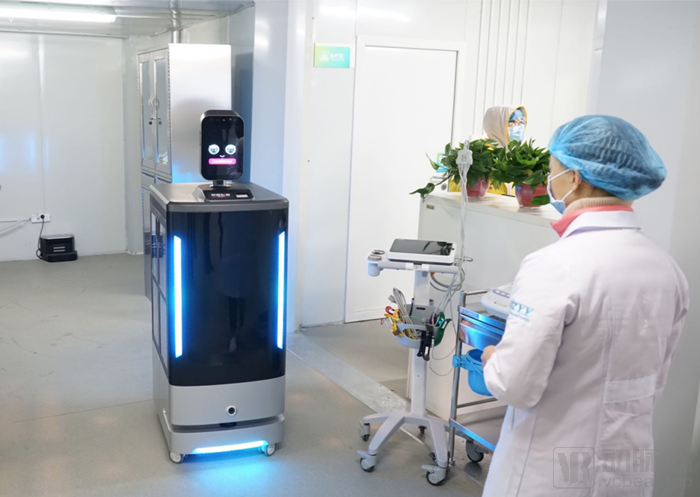
Figure: “Bao Xiaodi,” an intelligent epidemic prevention and control delivery robot
Beyond hospitals, the upgrade of intelligent epidemic prevention systems in public spaces is equally critical. To address this, Orion Star has developed an infrared thermometry-enabled intelligent service robot that facilitates “contactless temperature screening,” thereby helping medical institutions, commercial buildings, transportation hubs, and enterprises enhance their efficiency in resuming work and production. Currently, these infrared thermometry robots have been deployed in various public settings, including Xiamen Metro, iSoftStone, Yiche, and Jinyu Property Management.
“During the Spring Festival holiday, while many employees were on leave, our R&D team continued to work around the clock. Under remote working conditions, they urgently developed a product within three weeks and rapidly formulated the robot-based ‘Epidemic Prevention and Control Solution.’”
In addition to the investment in its R&D team, Wang Bing stated that Orion Star’s rapid response capability is inseparable from its full-chain layout. In the service robotics industry, Orion Star’s core competitiveness lies in possessing full-chain AI technologies for the sector. The company’s self-developed full-chain AI technology for robots integrates chips and algorithms (the “brain”), comprehensive visual perception and recognition (the “eyes”), end-to-end voice technology (the “mouth”), microphone arrays (the “ears”), six-axis consumer-grade robotic arms (the “hands”), and an indoor autonomous navigation platform (the “legs”).
“At its core, we are a full-stack AI technology company. We have independently developed all relevant algorithms—including speech, vision, and navigation—as well as other core technologies used in our robots, rather than relying on third-party solutions. For instance, in the realm of speech technology, everything from noise reduction and echo cancellation using microphone arrays to speech recognition, natural language understanding (NLU), and text-to-speech (TTS) synthesis is entirely self-developed. This enables us to deliver customized solutions for specific domains much faster than our competitors. That said, the healthcare sector is highly specialized; therefore, we collaborate with our existing partners in this field, leveraging their professional medical knowledge bases and knowledge graphs.”
During the peak of the pandemic, nationwide transportation came to a standstill and supply chains were disrupted, making it a significant challenge to deliver products to frontline hospitals.
In the absence of logistics and delivery services, technical support staff from Orion Star took matters into their own hands, handling packaging, shipping, and installation themselves; they loaded robots onto trucks at midnight. To ensure the successful delivery of medical protection robots to Huoshenshan Hospital, they even carried the equipment on their backs and shoulders to cover the final 200 meters where vehicle access was impossible.

(For the delivery of Orion Star medical service robots to Wuhan Huoshenshan Hospital)
“Although the process was extremely arduous, every member of our team felt it was well worth it, as it reduced the risk of infection among healthcare workers and alleviated their workload.”
Ultimately, frontline hospitals in the fight against the epidemic, including Peking University Shougang Hospital, Wuhan Huoshenshan Hospital, Beijing Haidian Hospital, and Zhengzhou Qibaishan Hospital, all received “New Year’s gifts” from OrionStar.
During this outbreak, the role played by hospital robots has enabled a genuine understanding of their value. In the future, hospital robots are likely to become an indispensable component in the automated upgrading of medical logistics systems.
Wang Bing believes that the performance of robots on the front lines of epidemic prevention and control has been impressive, providing a safe alternative that reduces risks for healthcare workers. This model is likely to gradually become mainstream in the future, continuing to play a significant role in hospitals at all levels even after the pandemic subsides. As the robotics industry is still in its early stages, having undergone this critical challenge, I believe its development will accelerate, with clearer and more defined directions. In the future, robots will be an indispensable component in facilitating the contactless economy and supporting new infrastructure initiatives. They will help healthcare providers address pain points related to technology and labor shortages through services such as patient guidance, delivery, and data-driven decision-making.
The “Research Report on AI-Assisted COVID-19 Prevention and Control” also notes that a wide range of artificial intelligence technologies were deployed in practical applications during this epidemic response. This fully demonstrates that new-generation information technologies, represented by artificial intelligence and big data, have become increasingly commercialized, market-oriented, and widespread through rapid development and accumulated practical experience in the early stages. It further indicates that China’s AI industry has continued to expand in scale, its integration with the real economy has deepened steadily, the form of an intelligent society is gradually emerging, and the digital economy is growing robustly, showing strong momentum for vigorous growth.
Moving forward, Orion Star will continue to strengthen its presence in the medical service robotics market, developing more truly useful robots for hospitals and replicating successful experiences from other sectors within healthcare settings.
“In the next phase, Orion Star will continue to gain deep insights into hospital market demands and closely align its products with hospital scenarios. As Orion Star is not merely an integrator of robotic solutions, we have built our capabilities from foundational technologies upward. Therefore, we are confident in delivering profound, in-depth customization and optimization for specific scenarios. Whether in terms of cost efficiency or supply chain optimization, Orion Star possesses distinct advantages.”