

Global Ventilator Shortage Reaches Critical Levels Amid Pandemic: Demand Tenfold Over Existing Supply, Tesla's Prototype Faces Component Constraints
As of April 9, the latest statistics from Johns Hopkins University in the United States show that the global cumulative number of confirmed COVID-19 cases has exceeded 1.51 million, with more than 88,000 deaths. The World Health Organization has defined the COVID-19 outbreak as a “global pandemic.” The worldwide surge of the epidemic has posed significant challenges to the supply of medical materials, leading to a global shortage of medical ventilators, which already have lengthy production cycles.
After the severe outbreak in the United States in late March, automakers including Fiat Chrysler, General Motors, Ford, Volkswagen, Ferrari, and Tesla have successively announced plans to shift theirproducing epidemic prevention supplies such as ventilators and protective face masks. It is reported that Volkswagen has established a working group to explore the use of 3D printing technology for manufacturing ventilators; Tesla has also begun collaborating with Medtronic to retrofit its production lines for medical ventilator manufacturing, and has developed a prototype ventilator using automotive components.
According to U.S. Fortune magazine, global demand for ventilators is ten times the current inventory held by healthcare institutions. Amid the global shortage of ventilators, attention has focused on automobile manufacturers pivoting to production and China’s ventilator manufacturing sector, often referred to as the “world’s factory.” During the peak of the epidemic in China, automobile companies also shifted production to face masks. However, unlike masks, medical ventilators are classified as Class III medical devices, imposing stringent requirements on manufacturers’ production qualifications and presenting significant technical barriers.
Automakers transitioning to ventilator production face challenges including patent issues, technical barriers, production line retrofitting, supply chain optimization, and quality inspection approvals. In early April, Medtronic publicly shared the intellectual property for its PB 560 non-invasive ventilator—including design blueprints, manufacturing specifications, user manuals, and software code—with the hope that capable companies could leverage these resources to accelerate ventilator manufacturing, thereby assisting healthcare professionals and patients in combating COVID-19. However, the issue extends beyond design and manufacturing capabilities; ventilator output is also constrained by shortages of components. Can the global collective effort of more than 5,000 companies resolve the ventilator shortage? What are the primary obstacles hindering increased ventilator production? VCBeat has compiled relevant information to address these questions.
From the perspective of demand, the recent COVID-19 pandemic has generated substantial demand for medical ventilators. A ventilator is a critical medical device that helps prevent and treat respiratory failure, reduce complications, and save and prolong patients’ lives. In modern clinical medicine, as an effective means of artificially replacing spontaneous ventilation, it is widely used in the management of respiratory failure due to various causes, anesthetic respiratory management during major surgeries, respiratory support therapy, and emergency resuscitation, occupying a highly important position in the field of modern medicine.
Ventilators assist patients who are unable to breathe spontaneously by mechanically delivering air into and out of the lungs through an endotracheal tube, thereby enabling passive ventilation.
Even in developed countries with advanced medical infrastructure, there has been a large-scale shortage of ventilators. This is primarily due to the unique characteristics of COVID-19, which severely impairs normal respiratory function in critically ill patients. While it was previously uncommon for general intensive care patients to require mechanical ventilation for more than one week, severe cases of COVID-19 often necessitate prolonged ventilatory support. In the absence of specific effective treatments, patients may remain dependent on ventilators until they either recover or succumb to other complications.
According to the "Clinical Management Guidelines for Severe Acute Respiratory Infections in Suspected Novel Coronavirus Infection" issued by the World Health Organization, severe cases of COVID-19 include severe pneumonia, acute respiratory distress syndrome (ARDS), sepsis, and septic shock. ARDS is a clinical syndrome characterized prominently by refractory hypoxemia and is associated with high mortality among patients infected with COVID-19. The treatment of acute respiratory distress syndrome (ARDS) falls into two major categories: mechanical ventilation and non-mechanical ventilation therapies.
The number of severe cases caused by the novel coronavirus is also substantial. On February 17, the Epidemiology Working Group for the Novel Coronavirus Pneumonia Emergency Response Mechanism of the Chinese Center for Disease Control and Prevention published an epidemiological study on COVID-19 in the Chinese Journal of Epidemiology. This study described and analyzed the epidemiological characteristics of more than 70,000 reported cases in mainland China as of February 11, 2020. Statistical data showed that among 44,672 confirmed cases, there were 1,023 deaths, resulting in a crude case fatality rate of 2.3%. Severe cases accounted for 13.8%, while critical cases accounted for 4.7%. The crude case fatality rate among critical cases was as high as 49%. This indicates that a large number of patients will require admission to intensive care units (ICUs).
Secondly, before the outbreak of the COVID-19 pandemic, ventilators were not widely equipped in hospitals. Only intensive care units (ICUs) and respiratory medicine departments in general hospitals were equipped with ventilators, which made the already limited number of ventilators extremely scarce during the epidemic, especially invasive ventilators.
Data indicates that prior to the novel coronavirus outbreak, the primary brands of ventilators used in China’s Grade 3A hospitals were Philips and ResMed. Notably, over the decade since its launch in the Chinese market, Philips’ V60 critical-care non-invasive ventilator achieved an installed base of just over 10,000 units.
In other countries around the world where the epidemic continues to surge, it has been reported that the UK’s National Health Service (NHS) has only 5,000 ventilators available, while the UK government states that 30,000 will be needed.
In the United States, the Society of Critical Care Medicine estimates that during the COVID-19 pandemic, as many as 960,000 patients may require ventilators, while the country currently has only approximately 200,000 units, leaving a substantial shortfall. New York Governor Andrew Cuomo also stated that New York State currently has 5,000 to 6,000 ventilators, but requires a total of 30,000.
The substantial gap between supply and demand has also driven a continuous rise in ventilator prices. According to a research report by Dongxing Securities, in 2013, the average unit price of mid-to-low-end medical ventilators in China was RMB 96,200, while that of high-end medical ventilators was RMB 332,100. By 2018, the average unit price of mid-to-low-end medical ventilators in China had risen to RMB 98,200, and that of high-end medical ventilators reached RMB 357,900.
Meanwhile, domestically produced medical ventilators are primarily mid- to low-end products, and their prices nearly doubled during the pandemic.
According to CCTV, New York State has ordered 17,000 ventilators from China at $25,000 per unit, equivalent to approximately 180,000 yuan.
On April 5, at a press conference held by the Joint Prevention and Control Mechanism of the State Council, Jin Hai, Director-General of the Department of Comprehensive Business of the General Administration of Customs, stated that from March 1 to April 4, China cleared exports of major epidemic prevention and control supplies valued at RMB 10.2 billion, including 16,000 ventilators worth RMB 310 million. Based on these figures, the average unit price was RMB 190,000.
Despite the high demand, can Chinese factories that have resumed work and production fill the gap in the short term by operating at full capacity? Judging from the current situation, expanding output is not as easy as imagined.
The ventilators required for this outbreak are primarily invasive ventilators, which are the most difficult to manufacture.
Ventilators required for the treatment of critically ill patients during the COVID-19 pandemic are classified as Class III medical devices, which differ from Class II home-use ventilators. Medical ventilators require maintenance and calibration by professional respiratory therapists, as well as the formulation and implementation of respiratory therapy plans during use.
Medical ventilators are classified into non-invasive and invasive ventilators. Compared with invasive ventilators, non-invasive ventilators have relatively lower manufacturing processes and requirements. The ventilator schematics released by Medtronic are also for non-invasive ventilators only.
Invasive ventilators primarily provide respiratory support to patients via endotracheal intubation or tracheostomy, with the circuit connected to the ventilator. They are mainly indicated for patients who are comatose, lack spontaneous breathing, or cannot tolerate non-invasive ventilation.
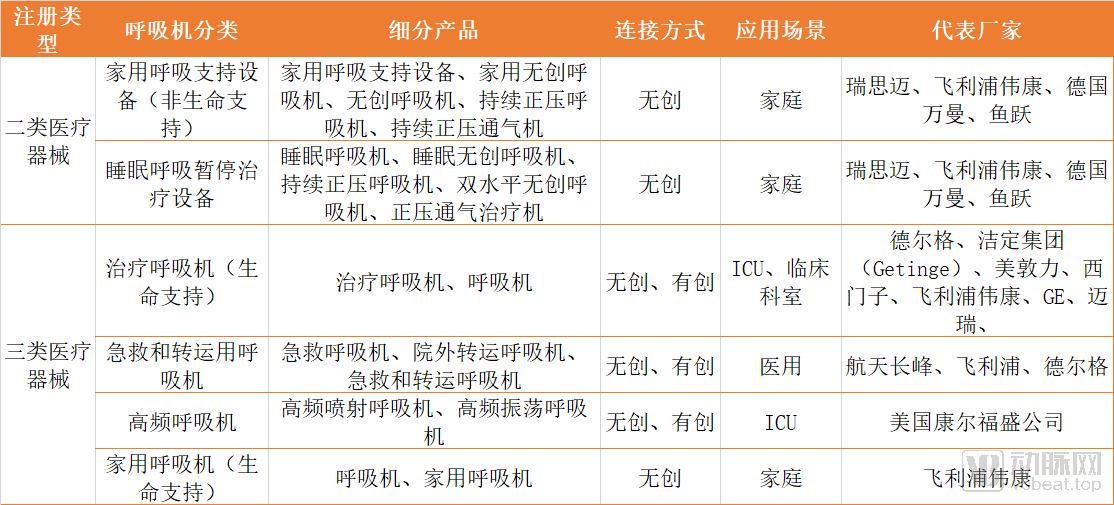
Classification and Major Brands of Ventilators
Existing ventilator manufacturers can be categorized into three groups: domestic manufacturers, foreign manufacturers, and companies diversifying from other industries. China’s ventilator production accounts for approximately one-fifth of the global output. In the traditional landscape, the global invasive ventilator market has been dominated by foreign brands. Companies such as Dräger, Sweden’s Getinge Group, Medtronic, Siemens, Switzerland’s Hamilton Medical, and Philips Respironics have occupied the mid-to-high-end segments of the global ventilator market. Other major global players include GE Healthcare (USA), Vyaire Medical (USA), Stephan GmbH (Germany), Vyaire Medical, Fisher & Paykel, Löwenstein Medical (Germany), and ResMed. In recent years, domestic brands such as Mindray, Aeonmed, and PBMS have emerged, securing a certain share in China’s primary healthcare market and expanding their presence in overseas markets.
For domestic ventilator manufacturers, many core components need to be imported. The explosive growth in demand for ventilators caused by the pandemic has led to a global shortage of materials and accessories for ventilators. The lack of core components has become the biggest bottleneck restricting production capacity.
In terms of the number of manufacturers, China has no shortage of ventilator producers. Xu Kemin, Director of the Department of Industrial Policy and Regulations, stated that there are currently 21 manufacturers of invasive ventilators in China. Among them, eight have obtained mandatory CE certification from the European Union for their main products, with a weekly production capacity of approximately 2,200 units, accounting for about one-fifth of the global capacity. As of March 31, signed orders totaled around 20,000 units, while a large volume of international letters of intent were still under negotiation on a daily basis.
VCBeat also compiled a list of domestic manufacturers holding ventilator registration certificates, based on the specific list of six categories of export-controlled materials—including COVID-19 test kits, ventilators, and protective suits—that have obtained domestic certification as published by the NMPA. As of March 29, 2020, there were 31 ventilator manufacturing enterprises in China holding a total of 61 medical device registration certificates.
Statistical data shows that half of the companies hold only one medical device registration certificate. Due to the complex design, manufacturing, and testing processes involved, ventilators require Class III medical device certification. Consequently, there has not been a surge in temporary or emergency approvals for ventilators as seen in the mask and protective clothing sectors, and no new licenses have been issued from 2020 to the present.
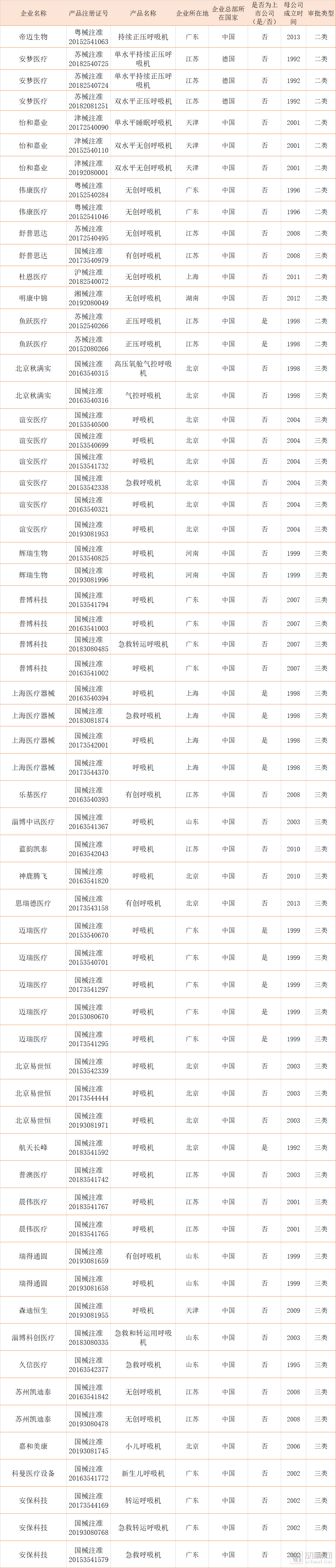
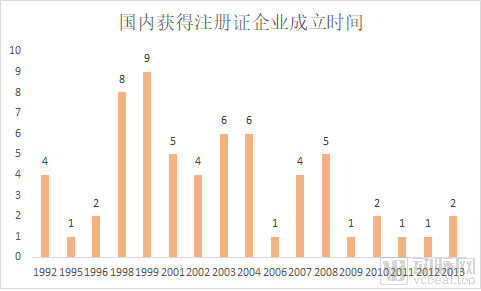
In terms of geographic distribution, manufacturers holding ventilator registration certificates are concentrated in Beijing, Guangdong, and Jiangsu. Regarding the establishment dates of these manufacturers, most domestic companies that have obtained registration certificates were founded around 1998–2002, with the most recently established ones dating back to 2013. This indicates that the barriers to entry in ventilator production are relatively high.
However, the factor constraining the increase in ventilator supply is not the production capacity of domestic ventilator manufacturers themselves, but rather the shortage of imported components. A single ventilator comprises over a thousand components, with major suppliers predominantly located overseas. Domestic ventilator manufacturers are primarily mid-stream original equipment manufacturers (OEMs), relying heavily on imports for core components such as turbine compressors, sensors, and chips from companies like Micronel in Switzerland, Honeywell in the United States, and SMC in Japan. Data indicates that Yuwell Medical sources more than 100 types of ventilator production accessories from over 100 suppliers worldwide.
Taking the flow sensor as an example, it is a critical component of the ventilator’s pneumatic system. It converts the flow rates of inhaled and exhaled gases into electrical signals, which are transmitted to signal processing circuits for real-time monitoring of respiratory airflow. This enables the calculation of inspiratory and expiratory tidal volumes as well as minute ventilation, allowing the monitoring system and medical personnel to detect any abnormalities. However, flow sensors currently need to be imported from abroad.
Moreover, to ensure the reliability and safety of ventilators, software and chips are key to big data processing in these devices. Replacing core components would affect chip computation. For mid-stream manufacturers, it is not permissible to arbitrarily change component suppliers. The shortage of core components has therefore constrained large-scale mass production.
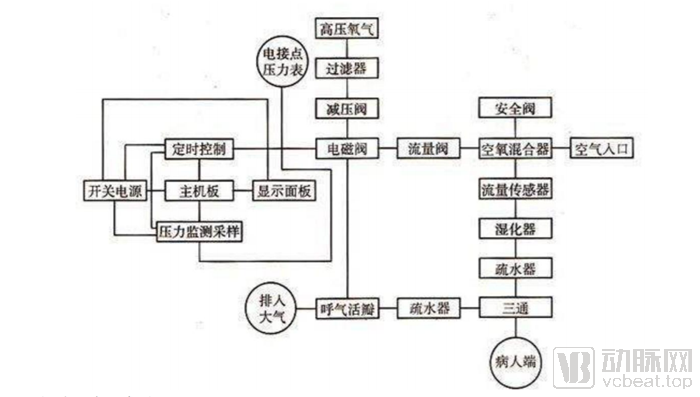
Source: Medical Device Network
In the short term, the COVID-19 pandemic has generated a surge in orders for ventilator manufacturers, with many companies receiving order volumes during the outbreak that nearly exceeded their total annual orders under normal circumstances. From a long-term perspective, the pandemic will drive increased investment in public health infrastructure, with ICU construction being the primary beneficiary. Consequently, life information and support solutions, including ventilators and patient monitoring equipment, are poised for growth. The pandemic will also stimulate the establishment of emergency reserves for public health.
Currently, China’s high-end medical device market remains dominated by imported brands. The recent recognition of domestic manufacturers will propel the Chinese medical device industry forward. A relevant executive from Yuwell Medical stated in an interview with Jiemian News that import substitution for ventilators would advance by five years.
In Mindray Medical’s 2019 annual report, Li Tingxi, Chairman of Mindray Medical, stated that in certain niche segments—such as hematology analyzers, anesthesia machines, ventilators, and large-scale imaging equipment—we have achieved technological breakthroughs but have not yet fully replaced imported products; in many other niche segments, we have not yet mastered core technologies, such as those for ultra-high-end color Doppler ultrasound systems and endoscopes.
During the COVID-19 pandemic, domestic brands actively supported epidemic prevention and control efforts by donating products to assist frontline healthcare workers in treating patients, thereby earning their recognition and facilitating the rapid market penetration of high-end products. Following the global outbreak of COVID-19, Chinese manufacturers became major suppliers, which will help enhance their brand awareness in overseas markets.
In terms of specific corporate impact, Yuwell Medical had previously achieved high penetration in the home-use ventilator market. Its performance during the pandemic has helped the company expand into the medical-grade market.
For Mindray Medical, which has long been strategically expanding its overseas presence, Europe has historically been the primary market for its ventilators. During the COVID-19 pandemic, Mindray urgently donated nearly 10,000 pieces of anti-epidemic equipment—including ventilators and patient monitors—to countries such as the United Kingdom and Italy. Its proactive contributions to the global pandemic response are expected to enhance brand recognition in international markets. Furthermore, Mindray’s recent acquisition of Emergency Use Authorization (EUA) from the U.S. Food and Drug Administration (FDA) may serve as a strategic opportunity for the company to expand into the U.S. market.
During this pandemic, the race against the virus directly tested the company’s R&D capabilities, organizational capabilities, and global capabilities. In fact, these capabilities all rely on advance planning and long-term accumulation.
There are also many foreign manufacturers of ventilators, and they are likewise facing parts shortages. Under these difficult circumstances, even if more automotive companies pivot to production, they still cannot produce enough ventilators.
In this scenario, they pursued two practical approaches: one was to retrofit other types of ventilators, and the other was to manufacture new ventilators.
Last week, the FDA issued an Emergency Use Authorization. Such temporary authorizations are effective when the United States is in a state of emergency. This emergency authorization permits the repurposing of devices, including anesthesia gas machines and continuous positive airway pressure (CPAP) ventilators, for use as ventilators.
This measure has significantly lowered the barriers to ventilator production, meaning that manufacturers holding registrations for other types of ventilators can increase their production capacity. Evaluate MedTech compiled statistics on manufacturers with ventilator registrations in the United States, noting that they have the opportunity to repurpose other types of ventilator products into medical-grade ventilators.
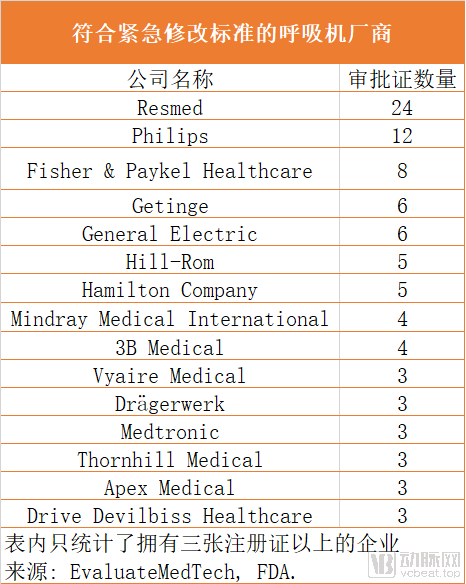
Another major approach involves various cross-industry companies attempting to design new ventilators. Groups including Mercedes, Dyson, and Tesla are collaborating with academic institutions to develop their own ventilators from the ground up. While this may initially seem implausible, Tesla has in fact succeeded in producing a ventilator prototype using parts from the Model 3.
For automakers crossing over into ventilator manufacturing, there are certain production barriers, and retrofitting production lines takes time. If numerous brands such as Volkswagen, Tesla, and Ferrari were to produce ventilators, they would need to address issues including patents, technical barriers, production line retrofitting, supply chain improvement, and quality inspection approvals. Unlike face masks, these companies entering the field may find it difficult to produce ventilators that meet demand in a short period. A research report by Dongxing Securities points out that cross-industry entrants starting from scratch may take 18 months to achieve mass production.
Converting automobile factories into medical device factories takes considerable time, but producing ventilators using other components has proven feasible.
Recent news has revealed that Tesla has already built a prototype ventilator using Model 3 parts. In the video released by Tesla, the prototype extensively incorporates automotive components; for instance, it uses the Model 3’s touchscreen as the ventilator’s monitoring display, and employs parts commonly found in the Tesla Model S suspension system, including air tanks and air pressure regulators, to construct the ventilator’s oxygen mixing chamber.
This approach can reduce the consumption of currently scarce medical device components while accelerating production schedules. However, this new product design may require re-approval from the FDA, and the transition from prototype to mass production could be time-consuming.
Meanwhile, Tesla is also producing components required for Medtronic’s ventilators and collaborating with Medtronic to expedite the manufacturing of proportional solenoid valves.
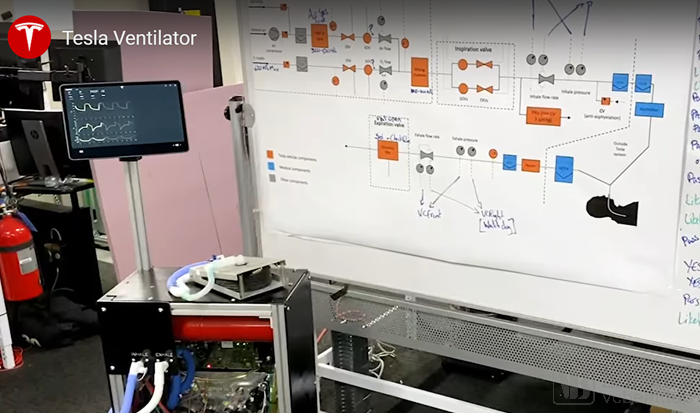
Tesla Engineers' Ventilator Prototype and Design Blueprints Built Using the Model 3
However, even experienced engineers face certain challenges in ventilator manufacturing. It remains uncertain whether other companies can successfully cross over into ventilator production.
According to statistics, approximately 5,000 companies worldwide responded to the global shortage of ventilators. The efforts made by enterprises across various countries to alleviate this shortage are commendable.
However, during the global COVID-19 pandemic, the number of ventilators was not the only bottleneck; there was also a shortage of professional respiratory therapists. After patients are placed on invasive mechanical ventilation, approximately one professional respiratory therapist is required for every ten ventilators to perform parameter adjustments and routine checks. There is also a significant shortage of other specialized medical personnel.
Reference Article:
Coronavirus: What is a ventilator and why is there a shortage?—NEW YORK POST
Chinese Ventilators Face Global Rush as Core Technical Issues Demand Urgent Resolution
Surge in Demand! Life-Saving Ventilators in Short Supply Worldwide! ——Winsen Sensing
China Has Provided Over 1,700 Invasive Ventilators to Foreign Countries, with Mindray Medical Accounting for More Than 60% — Economic Daily
Domestic Ventilators’ Turnaround: Surge in Overseas Demand, with Core Components Remaining Key—21st Century Business Herald
Pharmaceutical Industry: Why Ventilators Are in Such Short Supply — Special Report I, Dongxing Securities