

MedGenome Files Draft Red Herring Prospectus Following $55 Million Series D Funding Round

Medgenome
Genomic Solutions Provider
Recently, VCBeat learned thatBiotechnology company MedGenome announces the completion of a new $55 million funding round. The round was led by Leap Investments, with participation from existing investors Sofina and Sequoia Capital.。
According to a recent report by VCCircle, MedGenome raised $1.4 million in venture debt from InnoVen Capital in February. Prior to this round of financing, MedGenome had completed three rounds of funding totaling $64 million.
In light of the frequent overtures from capital markets toward MedGenome, we may gain insight into the reasons behind this trend by examining MedGenome’s development history.
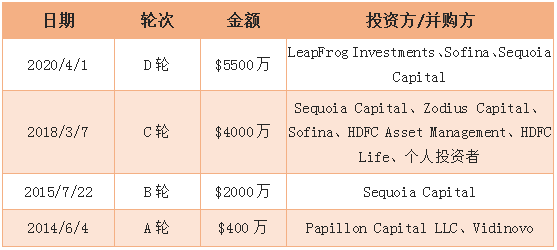
MedGenome's Previous Financing History
MedGenome, founded in 2013, is a genetic diagnostic testing company. Headquartered in California, USA, it maintains offices in Bangalore, India, and Singapore. Its headquarters houses next-generation sequencing (NGS) facilities, featuring Illumina sequencing platforms such as the NovaSeq, HiSeq X, HiSeq 2500, and MiSeq. Advocating for personalized medicine, MedGenome offers unique genomic solutions in immuno-oncology, diabetes, ophthalmology, cardiology, and other rare diseases.
Sam Santhosh is the Founder, Chairman, and Global CEO of MedGenome. In 2009, Sam founded SciGenome. In 2013, he restructured the company’s human genomics division, relocated its headquarters to Bangalore, India, and established MedGenome as it is known today, setting up an NGS laboratory. Prior to this, Sam was the Founder, CEO, and Board Member of Calsoft Inc.
Sam has nearly three decades of experience in business operations and is a science-savvy entrepreneur. He believes that technology was the primary driver of growth in the second half of the 20th century, and genomics will play a similar role in the 21st century. Through MedGenome, he has transformed the landscape of diagnostics and medical genomics in India. Currently, he also serves as an advisor and board member for companies including Impelsys Inc., ePay Healthcare, SciGenom Labs (Cochin), AgriGenome (Hyderabad), Emerge Ventures, and the Centre for Commercialization of Antibodies (CCAB).
Mahesh Pratapneni is the Co-founder and Board Member of MedGenome. He is primarily responsible for leading corporate strategy, partnerships, and business development. Additionally, he is the Founder and Managing Director of Emerge Ventures. Mahesh has extensive experience in product visualization, development, management, and establishing global delivery models.
As a genetic diagnostics company, MedGenome aims to significantly reduce the burden of genetic diseases in India and assist clinicians in implementing precision medicine. MedGenome is also one of the founding members of GenomeAsia 100K, an initiative that seeks to sequence 100,000 Asian genomes, thereby providing the world with unique genetic research resources.
MedGenome’s solutions accelerate early-stage drug discovery for pharmaceutical and biotechnology companies. Meanwhile, MedGenome also provides diagnostic solutions for researchers, physicians, and hospitals.
Currently, cancer immunotherapy has become an established mainstream treatment modality. In this field, the research challenge lies in identifying biomarkers that can provide definitive predictions for patients who may benefit from immunotherapy. These biomarkers can assess patients’ post-treatment responses and determine whether they will derive long-term benefits from immunotherapy.
Research has found that the tumor microenvironment ecosystem may be a major contributor to regulating responses to immune checkpoint inhibitors, with significant implications for immunotherapy treatment and the development of resistance. Compared with other cells possessing immunosuppressive properties, certain immune cells within tumors exhibit a higher state of immunogenicity; in-depth investigation of the composition of the tumor microenvironment helps predict responses to cancer immunotherapy. Furthermore, analyzing the mutational status of tumors can also help predict whether specific immunotherapies will be effective against target tumors.
MedGenome’s genomic approach facilitates comprehensive analysis of the tumor microenvironment and tumor mutational status. The genomic solutions provided by MedGenome serve both as tools for biomarker discovery and as strategic instruments to enhance the efficacy of cancer immunotherapy.Currently, MedGenome has developed several effective biomarker discovery pipelines: OncoPeptTUME, OncoPeptVAC, and OncoPeptTCR.
OncoPeptTUME
MedGenome’s OncoPeptTUME tumor microenvironment analysis solution is an NGS-based RNA expression method that provides objective insights into the tumor microenvironment beyond IHC/FACS analysis. With OncoPeptTUME, researchers can analyze the tumor microenvironment of samples at the cellular and molecular levels, thereby complementing IHC and FACS data.
Compared with traditional IHC/FACS methods, the use of genomics approaches for tumor microenvironment analysis offers multiple advantages and can complement the IHC/FACS methods currently employed by immuno-oncology researchers.
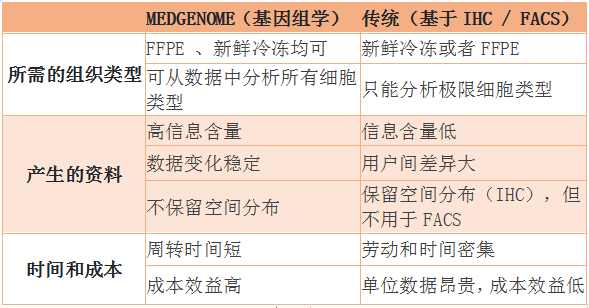
Comparison of the Advantages and Disadvantages of MedGenome’s Genomics versus Traditional IHC/FACS Methods
OncoPeptVAC
MedGenome’s OncoPeptVAC neoepitope prioritization and neoantigen prediction solution is based on NGS methods, enabling the analysis of exome data from patients’ healthy tissues and RNA-seq data from tumor tissues.
Neoepitopes are immunogenic tumor peptides capable of activating T cells and are typically specific to a particular patient’s tumor. Neoepitopes can be utilized in the development of cancer vaccines to achieve targeted killing of tumor cells by eliciting T-cell responses. Currently, MedGenome is filing a new patent application that combines TCR binding prediction with conventional HLA binding prediction to enhance accuracy in identifying, predicting, and prioritizing candidate vaccine targets.
Compared with traditional cell-based methods, MedGenome’s TCR–HLA combination approach offers multiple advantages in both preclinical and clinical studies.
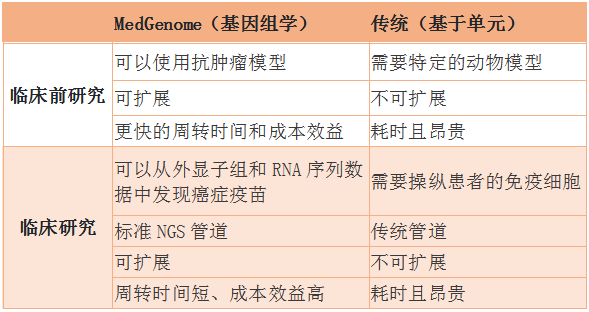
Comparison of the Advantages and Disadvantages of MedGenome’s Genomics and Traditional Cell-Based Methods
OncoPepTCR Sequencing
Identifying all potential clones within diverse T-cell receptor (TCR) repertoires requires highly sensitive detection methods, which are technically challenging to achieve. MedGenome’s next-generation sequencing (NGS) technology has recently enabled accurate detection of TCRs. When combined with other analytical methods, this approach allows for the assessment of patients’ TCR blood repertoires, thereby facilitating the early prediction of certain patient responses. TCR analysis holds significant potential not only for elucidating the mechanisms underlying normal immune responses but also for gaining insights into disease pathogenesis and advancing the development of novel therapies and treatment modalities for infectious diseases, autoimmune disorders, and immuno-oncology.
In addition to launching OncoPeptTUME, OncoPeptVAC, and OncoPeptTCR—three tumor microenvironment analysis solutions—MedGenome has conducted in-depth research in other areas of immuno-oncology therapeutics. These include somatic cancer mutation therapy, protein services, molecular DNA cloning services, custom monoclonal antibodies, and ELISA-based custom assay development services.
Currently, MedGenome offers more than 400 genetic tests in disease areas including oncology, neurology, cardiology, ophthalmology, and rare diseases.Through collaborations with over 500 hospitals in India, MedGenome has leveraged its extensive infrastructure to access samples and data from patient records, gaining deep insights into the population genetic diversity of more than 4,500 ethnic groups in India.
To date, MedGenome has completed over 200,000 genomic tests and obtained samples from more than 550 hospitals and 6,000 clinicians across India. MedGenome claims to have established the largest South Asian genomic variant database within genetic diagnostics and research partnerships in India.。
Today, MedGenome’s diagnostic tests have achieved numerous breakthroughs in genetic diagnostics, including OncoTrack, its proprietary liquid biopsy for monitoring cancer treatment; non-invasive prenatal testing (NIPT) for pregnant women; carrier screening for couples planning to have children; and whole-exome sequencing for cost-effective identification of rare mutations.MedGenome believes that, from a global perspective, the market is expected to more than double, potentially reaching $28.5 billion by 2026, up from $13 billion in 2019.
MedGenome has created a genomic analysis environment distinct from the rest of the world, providing unprecedented access to data. These data can unlock insights into disease biology, enabling new therapies with global impact. MedGenome is building bioinformatics pipelines for analyzing large-scale sequencing data, which will help identify novel human genes and medically relevant variants for drug discovery research.
In 2018, MedGenome received the MedTech Breakthrough Award in the field of biomedical research.。
In India and many emerging markets, the burden of complex diseases even exceeds that in Western markets. Genetics is enabling the prevention of genetic diseases, personalized healthcare, and the development of new therapies through early disease risk detection, which will have a transformative impact on families.
Currently, MedGenome’s primary competitor is MapMyGenome, a company based in Hyderabad. MapMyGenome strives to decode and understand individual DNA using state-of-the-art technologies, providing actionable solutions for healthier living to both individuals and physicians. The company offers a wide range of mapping tests in genomics, cardiology, oncology, gynecology, and neurology. However, it lags behind MedGenome in genomics and predictive testing.
On April 1, 2020, MedGenome announced that it had secured $55 million in a new round of financing. The company stated that the Series D funds would be used to expand its reach into tier-2 and tier-3 cities, thereby broadening its market for clinical genomic testing and accelerating its drug development programs.
In July 2018, the first tumor NGS companion diagnostic kit (developed by Burning Rock Biotech) was approved for production by the NMPA. Burning Rock Biotech’s product utilizes NGS technology with tissue samples. Compared to PCR technology, NGS can detect more gene loci, and large-panel testing can effectively shorten drug development time. In addition to Burning Rock Biotech, other companies such as Geneseeq, AmoyDx, and Novogene are also developing similar products.
With the annual increase in cancer incidence in China, continuous improvement in patient survival rates, ongoing domestic launches of targeted therapies, and the growing number of detected biomarkers and testing frequency, next-generation sequencing (NGS) is being increasingly widely applied in the field of oncology genetic testing due to its significant advantages of high throughput and high resolution. NGS-based oncology genetic testing is expected to gradually enter the hospital-based market.
The approval of Burning Rock’s NGS products in 2017 enabled the application of NGS in qualified hospitals and third-party testing institutions with adequate detection capabilities, facilitating its transition from external to internal hospital use and significantly expanding the industry’s market potential. Following the issuance of the production approval for Burning Rock’s NGS products, the regulatory review process for other pending products was further accelerated.
Due to the more complex operational workflow of next-generation sequencing (NGS) compared with polymerase chain reaction (PCR), non-standardized practices and procedural deviations can lead to inaccuracies in test results; therefore, standardization of both products and processes is particularly critical for clinical application. The cost of NGS testing is higher than that of PCR (with per-test prices ranging from several thousand to tens of thousands of yuan), creating uncertainty in the market adoption of new products by hospitals. Companies such as Burning Rock Biotech, Novogene, Amoy Diagnostics, and Geneseeq have gained significant advantages in quality system standardization, academic promotion, and after-sales service, owing to their earlier engagement in the research and development of NGS products.