

CanSino's COVID-19 Vaccine Advances to Phase II Trials Amid Global Landscape of 115 Candidates, Per Nature Reviews Drug Discovery
After paying a tremendous price, China has basically brought the COVID-19 pandemic under control. However, just as we were preparing to remove our masks and breathe a sigh of relief, we discovered that the novel coronavirus had already spread silently across the globe. In the face of this sudden outbreak, different countries and regions have adopted vastly different epidemic prevention strategies. The concept of “herd immunity” has entered our awareness for the first time.
Given the differing national contexts, we do not intend to evaluate the pandemic response measures of other countries and regions here. From a scientific perspective, however, “herd immunity” is clearly predicated on the availability of viral vaccines. So, what is the current status of research and development for SARS-CoV-2 vaccines? On April 9, 2020, Nature Reviews Drug Discovery published an article providing a statistical overview of the landscape of SARS-CoV-2 vaccine R&D. VCBeat (WeChat ID: Vcbeat) has compiled and translated the full text.

Timeline of the COVID-19 Outbreak Compiled by Xinhua News Agency. On January 12, the Chinese Center for Disease Control and Prevention, the Chinese Academy of Medical Sciences, and the Wuhan Institute of Virology under the Chinese Academy of Sciences, as designated institutions of the National Health Commission, submitted the genomic sequence data of the novel coronavirus to the World Health Organization and released it on the Global Initiative on Sharing All Influenza Data (GISAID) platform for global access. This move holds significant importance for the worldwide development of specific diagnostic tools and vaccines.
On March 16, both China and the United States announced that their respective coronavirus vaccines had entered clinical trials.
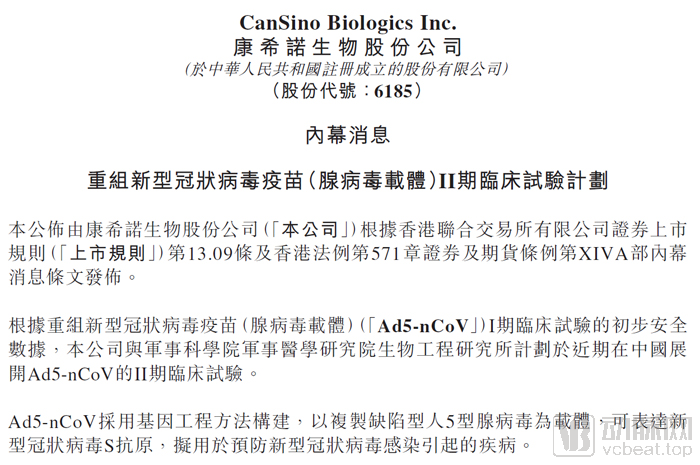
On April 9, CanSino Biologics issued an announcement on the Hong Kong Stock Exchange stating that the recombinant novel coronavirus vaccine (adenovirus vector), jointly developed with the Academy of Military Sciences, is scheduled to commence Phase II clinical trials in China in the near future.
The Coalition for Epidemic Preparedness Innovations (CEPI) is collaborating with global health authorities and vaccine developers to support the development of vaccines against the novel coronavirus. Nature Reviews Drug Discovery has compiled statistics on the global landscape of current vaccine development activities, drawing data from vaccine development programs reported in the World Health Organization’s authoritative and continuously updated list, as well as other projects identified from public and proprietary sources.
As of April 8, 2020, there were 115 candidate vaccines in the global research and development landscape for novel coronavirus (SARS-CoV-2) vaccines. Among these, 78 projects were confirmed to have been initiated, while the development status of the remaining 37 could not be verified through public or proprietary information sources. Of the 78 confirmed active projects, 73 were in the R&D or preclinical stages.
Currently, five vaccine candidates have entered clinical development. These include Moderna’s mRNA-1273, CanSino Biologics’ Ad5-nCoV, Inovio’s INO-4800 (developed in collaboration with Advaccine), LV-SMENP-DC, and the pathogen-specific artificial antigen-presenting cells (AAPCs) from the Shenzhen Institute of Gene Immunology and Medicine. Other vaccine developers have also announced plans to initiate human trials in 2020.
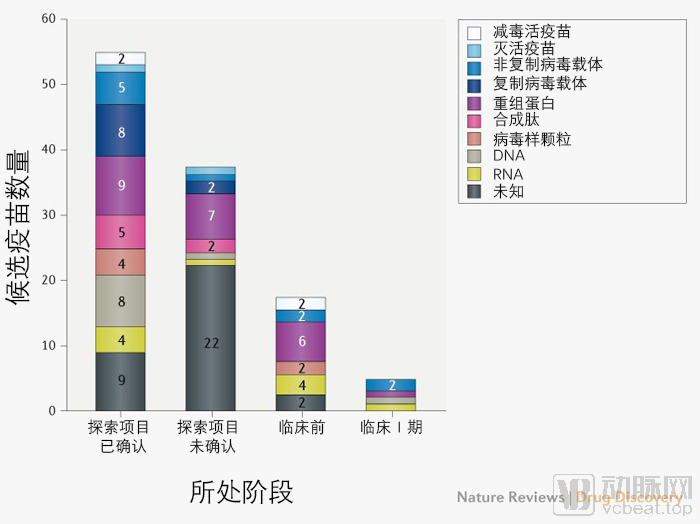
COVID-19 Vaccine Candidate Pipeline by Platform, Image from Nature Reviews Drug Discovery
Exploratory projects (categorized as confirmed and unconfirmed) are in the early planning stage, without in vivo testing; preclinical projects are in the stage of in vivo testing or production of clinical trial materials.
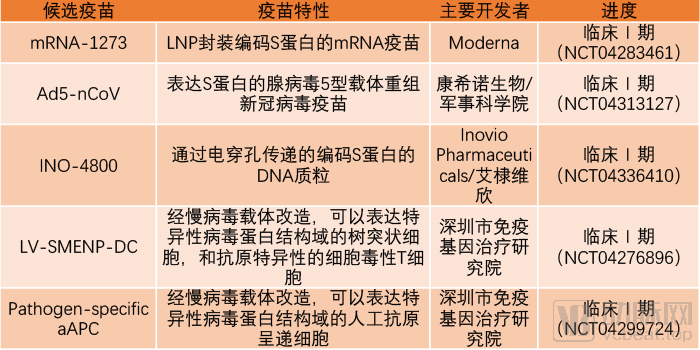
Vaccine candidates that have entered the clinical stage, data from Nature Reviews Drug Discovery
Diversity of Technology Platforms
A notable feature of the landscape of COVID-19 vaccine development is the wide range of technological platforms under evaluation, including nucleic acid (DNA and RNA) vaccines, virus-like particle vaccines, synthetic peptide vaccines, adenoviral vector vaccines, recombinant protein vaccines, live attenuated vaccines, and inactivated vaccines.
Some approaches are not currently part of the conventional vaccine development pathway, but experience in fields such as oncology has encouraged researchers to leverage novel methods to accelerate development and manufacturing. Among these, certain types of vaccines may be better suited for specific population subgroups, such as the elderly, children, pregnant women, or immunocompromised individuals.
Among these vaccine candidates, novel vaccines based on DNA or mRNA technology offer substantial flexibility in antigen engineering and development speed. Moderna initiated clinical trials for its mRNA-based vaccine, mRNA-1273, just two months after the SARS-CoV-2 sequence was identified.
Adenovirus vector vaccines exhibit high-level protein expression and long-term stability, and induce robust immune responses. Furthermore, as recombinant protein vaccines targeting other viruses have already been approved, recombinant protein vaccines can leverage existing large-scale manufacturing capabilities.
Vaccine adjuvants can enhance the immunogenicity of certain specific types of vaccines and reduce the dose required for immunization, thereby enabling more people to be vaccinated under the same production capacity without compromising immune efficacy.
Currently, at least 10 companies have announced plans to develop adjuvanted vaccines against the novel coronavirus. Vaccine manufacturers, including GlaxoSmithKline, Seqirus, and Dynavax Technologies, have confirmed that they will produce approved vaccine adjuvants. These adjuvants—AS03, MF59, and CpG 1018—are available for use in new novel coronavirus vaccines developed by third parties.
Publicly available information on the SARS-CoV-2 antigens required for vaccine development is very limited. Most candidate vaccines work by inducing neutralizing antibodies against the SARS-CoV-2 spike (S) protein, thereby preventing viral entry into human cells via the ACE2 receptor and achieving immunity.
However, it remains unclear how the different structures of the S protein and its variants used in various candidate vaccines are interrelated, or whether they are associated with the genomic epidemiology of the disease. Experience from the incomplete development of SARS vaccines indicates that different antigens have the potential to enhance immune responses, a controversial topic relevant to vaccine development.
Overview of Vaccine Developers
Among the confirmed vaccine developers in the R&D phase, 56 are enterprises, accounting for a significant 72%; the remaining 22 are led by academic institutions, public sector entities, and other non-profit organizations, representing 28%.
Although multinational pharmaceutical companies such as Janssen, Sanofi, Pfizer, and GlaxoSmithKline have participated in the development of COVID-19 vaccines, many other developers are smaller in scale and lack experience in large-scale vaccine manufacturing. Therefore, it is crucial to ensure that the manufacturing and supply capabilities of candidate vaccines can meet demand.
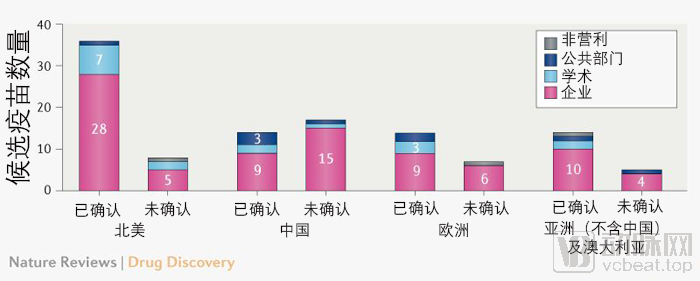
Classification of SARS-CoV-2 Vaccine Developers by Type and Geographic Location (Collaborative Developments Are Categorized Based on the Location of the Lead Developer). Image Source: Nature Reviews Drug Discovery
Geographically, the majority of COVID-19 vaccine development activities are concentrated in North America, which accounts for 36 candidates, or 46% of those confirmed to be in R&D. China has 14 candidates, representing 18%. Asia (excluding China) and Australia together account for 14 candidates, with another 14 in Europe.
According to reports, there are still some vaccine development efforts in China that are not included in the database. CEPI is seeking information from China's Ministry of Science and Technology.
The primary developers of confirmed COVID-19 vaccine candidates under development are distributed across 19 countries and regions. These countries and regions account for more than three-quarters of the global population.
Unfortunately, despite having vaccine production capabilities and regulatory frameworks in Africa or Latin America, there is currently no publicly available information on the development of COVID-19 vaccines. Since the epidemiology of COVID-19 may vary by geographic location, effectively controlling the pandemic may require greater coordination and participation from the Southern Hemisphere in vaccine research and development efforts.
The global research and development of COVID-19 vaccines is unprecedented in both scale and speed. Currently, speed is the top priority. There are indications that COVID-19 vaccines could be deployed under emergency use authorizations or similar agreements by early 2021. This would mark a fundamental shift from the traditional vaccine development pathway.
Typically, it takes more than 10 years on average for a vaccine to go from initial development to deployment. Even compared with the five-year timeline for the accelerated development of the Ebola vaccine, this represents a major breakthrough.
At the same time, this will also create new vaccine R&D models, including parallel and adaptive development phases, innovative regulatory processes, and scalable production capabilities.
Industry benchmarks for traditional vaccine development models indicate a failure rate exceeding 90% for approved vaccines. The approaches adopted in the development of COVID-19 vaccines—including novel viral targets, innovative vaccine technology platforms, and new vaccine development paradigms—may necessitate strengthening the vaccine approval process to mitigate risks, while also requiring careful evaluation of the efficacy and safety at each stage of the vaccine research and development process.
To evaluate vaccine efficacy, specific animal models for SARS-CoV-2 are being developed, including ACE2 transgenic mice, hamsters, ferrets, and non-human primates. For safety reasons, only biosafety level 3 (BSL-3) laboratories or higher-level facilities are permitted to conduct these animal experiments. This may require international coordination to ensure sufficient laboratory capacity during the development process.
Finally, robust international coordination and collaboration among vaccine developers, regulatory agencies, policymakers, funders, public health institutions, and governments are essential to ensure that successfully developed vaccines have sufficient manufacturing capacity and are distributed relatively equitably to affected regions, particularly resource-limited areas.
CEPI has recently also called for financial support to fund global COVID-19 vaccine development efforts, primarily guided by three key principles: speed, large-scale manufacturing and deployment capacity, and equitable global access.
In the face of infectious diseases, humanity is a community with a shared future. We must take collective action, mobilize necessary technical and financial support, successfully combat COVID-19 through global vaccination programs, and lay a robust foundation for responding to future pandemics.
As *Nature Reviews Drug Discovery* has not published a list of vaccines, VCBeat has compiled information from various publicly available official sources to summarize the current status of COVID-19 vaccine development. We have identified a total of 78 COVID-19 vaccines currently under development, consistent with the number reported by *Nature Reviews Drug Discovery*. Although there may be discrepancies in specific details, this represents one of the most comprehensive vaccine lists currently available.
Due to limitations in data sources and time, there may be omissions or errors. Readers are welcome to provide corrections so that we can improve our data.
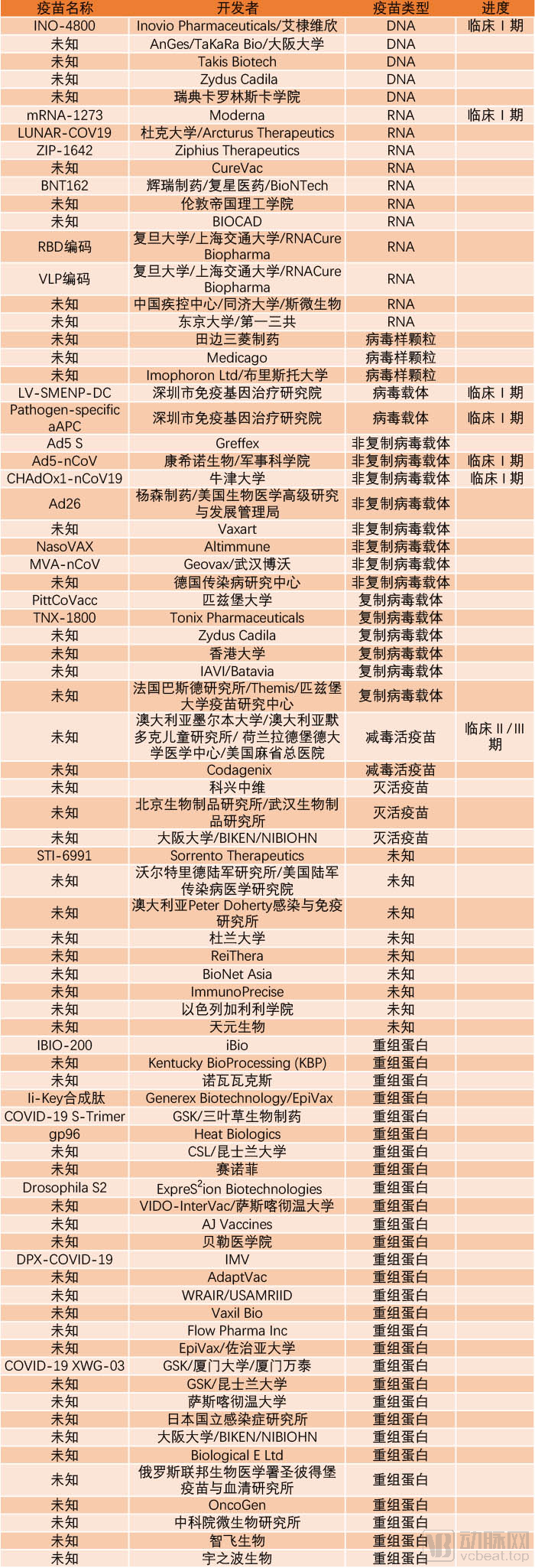
List of Current Statuses of Select COVID-19 Vaccines, Compiled by VCBeat from Publicly Available Information