

Mindfront Health Brings Australia's Evidence-Based Mental Healthcare Model to China, Targeting Mild-to-Moderate Conditions
In Australia, mental and psychological disorders rank third in disease burden, after cancer and cardiovascular diseases.
For many years, Healthe Care in Australia, under the Luye Medical Group, has been committed to providing patient-centered, personalized mental health services.ConstructedA Mature and Well-Established Evidence-Based Diagnosis and Treatment System, helping nearly one million Australian patients with mental and psychological disorders successfully reintegrate into family and social life. Today,The group has also grown to become Australia’s second-largest private provider of mental health services, with 14 of its 34 healthcare facilities across the country specializing in psychiatric and psychological care.
Globally, there is a greater need for psychiatric and psychological treatment services. China’s mental health market alone is substantial. According to the results of China’s first nationwide epidemiological survey on mental disorders, published in The Lancet Psychiatry, the lifetime prevalence of mental disorders in China is 16.6%, meaning that nearly 17 out of every 100 people will develop a mental illness at some point in their lives.
To help more patients with mental and psychological disorders return to normal life, Luye Medical Group has integrated resources from Australia’s Healthe Care and China to establish a new specialized mental health brand—Mindfront Health. Committed to introducing Australia’s mature, distinctive evidence-based treatment programs and integrated healthcare service systems into China, Mindfront Health aims to create a personalized, integrative, evidence-based treatment system for mental and psychological conditions tailored to the Chinese population, thereby providing value-oriented medical services to patients.
Currently, Manlang Medical has taken a substantive step in the Chinese market:On March 30, 2020, Manlang Medical (China) announced the acquisition of a private psychological healthcare institution—Guangdong Xinlin Doctor Group.Moving forward, Manlang Health will continue to expand its presence in China’s mental health market by establishing specialized hospitals and clinics in core Chinese cities. The company will actively develop innovative internet-based mental health service models, leveraging its dedication and expertise to better serve patients in China and help them lead healthier, more fulfilling lives.
Tang Dekai, CEO of Manlang Medical (China), told VCBeat that after extensive in-depth research, they identified several key pain points in China’s mental health care market:
The current healthcare system primarily covers patients with severe mental and psychological disorders. While the diagnostic and treatment needs of patients with mild to moderate conditions are becoming apparent, the supply remains far from sufficient, and the diagnostic and treatment service system requires further improvement.When mental illness is mentioned, many people’s immediate association is with psychiatric hospitals, reflecting a long-standing misconception about mental and psychological disorders. In reality, the majority of patients with such conditions suffer from mild to moderate forms; they may live among us, yet their pain and distress often go unnoticed. With systematic, evidence-based interventions, these individuals can regain social functioning. However, public medical resources in China are predominantly allocated to treating severe cases, leaving the demand for systematic treatment systems and services among mild-to-moderate patients largely unmet. This gap hinders timely access to appropriate interventions for this group and increases the risk of progression to more severe stages.
There is a lack of an effective evaluation system for the professionalism of psychosocial service institutions and personnel, coupled with a significant shortage of qualified professionals, necessitating concerted efforts from multiple stakeholders.According to the report delivered by Ma Xin, Chairman of the Chinese Association for Mental Health, at the 11th National Academic Conference on Mental Health in 2018, although China has made gratifying progress in the socialization of mental health services, there remains significant room for improvement in management. The industry anticipates the introduction of standardized management policies, and the mechanisms for ensuring service standards and quality are still inadequate. In terms of talent development, the national vocational qualification assessment for psychological counselors does not emphasize the evaluation of practical operational skills. Furthermore, there are gaps in continuing education and supervision after certification, resulting in most certified individuals lacking the competence to conduct psychological counseling in practice and having no learning pathways for continuous professional improvement. In contrast, in developed countries, clinical psychologists providing psychotherapy in medical institutions possess backgrounds in both psychology and clinical medicine and must undergo nearly ten years of education and clinical training to obtain licensure.
"Internationally, some mature diagnostic and treatment methods have low accessibility and urgently need to be converted and introduced."Within China’s healthcare system, the treatment of mental disorders remains predominantly reliant on pharmacotherapy and medical devices. However, the etiology of psychiatric and psychological conditions is inextricably linked to a multitude of factors, including social, familial, and individual dimensions. Consequently, therapeutic interventions should not be confined to medications and equipment alone. Internationally established diagnostic and treatment paradigms favor a comprehensive approach that identifies underlying causes by integrating multiple contributing factors. This results in more enriched and systematic treatment and rehabilitation processes, thereby better facilitating patients’ return to normal life.
There are significant differences between the treatment and service systems for mental and psychological disorders in Australia and China.According to Tang Dekai,At Manlang Medical’s healthcare facilities in Australia, every inpatient receives a systematic and integrated treatment plan.Taking hospitalized patients with postpartum depression as an example, physicians and healthcare professionals tailor multidisciplinary treatment plans to address the needs of mothers, infants, and families. These plans include group psychotherapy, psychoeducation sessions, expressive arts therapy, behavioral activation, exercise, and relaxation techniques. Each patient participates in no less than three hours of therapeutic activities daily during their hospital stay.
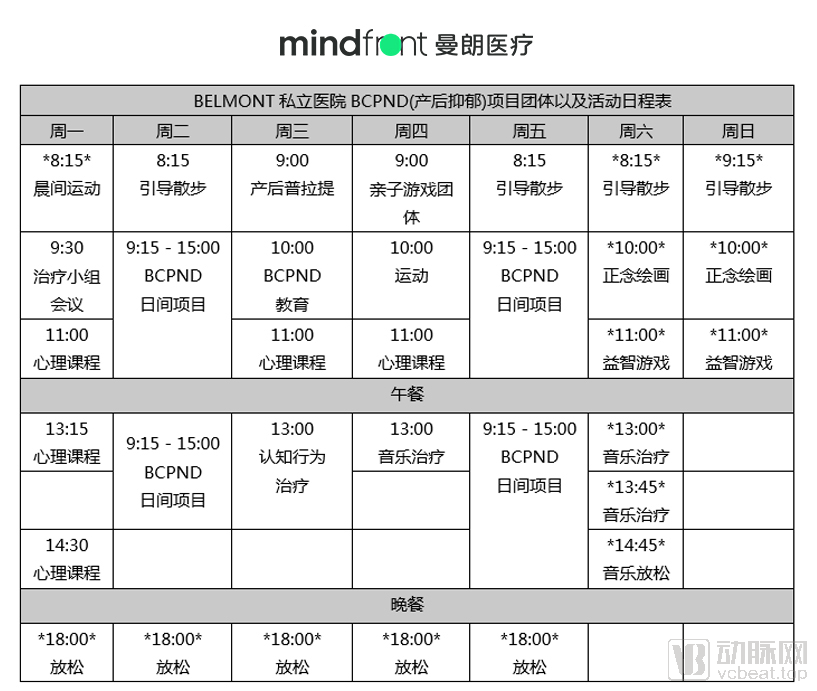
Manlang Medical Australia Inpatient Treatment Schedule
In addition, the hospital arranges activities such as family interactions and relaxation sessions based on patients’ individual circumstances, while also providing support and attention to their partners. This approach not only effectively promotes disease recovery but also helps patients establish and acquire the family relationships, knowledge, and skills necessary for reintegrating into family life and society.
Tang Dekai looks forward to introducing Australia’s mental health treatment system to China, stating, “When facing patients with mental and psychological disorders,Our goal is not merely to control symptoms with medication, but more importantly, to help patients return to their families and society through a systematic, evidence-based diagnosis and treatment framework.“We will make every effort to introduce Australia’s comprehensive diagnostic and treatment system for mental and psychological disorders to China, benefiting domestic patients with mild-to-moderate mental and psychological conditions.”
The Australian mental health treatment system to be introduced by Manlang Medical has also gained high recognition from Chinese psychiatric experts. In 2019, several Chinese psychiatric experts who attended academic conferences in Australia visited Manlang Medical’s hospitals in the country. These experts stated, “China’s social and economic development has reached a new stage, with growing demand for intervention and treatment of mental health disorders. Integrating Australia’s advanced treatment system with China’s local context and implementing it in the Chinese market would hold significant value for both industry development and patient care.”
While building a scientific and personalized treatment system, Manlang Medical (China) has also leveraged its strengths and the demands of the Chinese market to develop specialized programs for certain conditions, such asDepression and anxiety, attention-deficit/hyperactivity disorder (ADHD) in children and adolescents, internet addiction, perinatal psychological disorders, sleep disorders, trauma-related issuesetc. Tang Dekai stated, “Patients with these types of diseases have a strong willingness to undergo treatment, and Manlang Medical has accumulated extensive and mature therapeutic experience in these areas, enabling it to provide more robust support on their path to recovery and reintegration into society.”
Manlang Medical (China)’s team comprises senior psychiatrists from China and Australia, psychology professionals, and healthcare operations management personnel.CEO Tang Dekai has over 15 years of management experience in the healthcare industry, having served as a senior executive at publicly listed medical device and pharmaceutical companies. As a co-founder, he helped establish two internet healthcare companies, gaining deep insights into the development trends and business logic of the healthcare sector. Chief Clinical Services Officer Patrick McGurrin brings more than 20 years of experience in nursing management, medical operations, and hospital startup planning for specialized psychiatric hospitals. He previously served as Director of Clinical Services at Belmont Private Hospital (Australia) under Manlang Medical, and as CEO of the newly established Townsville Private Hospital.
Furthermore, the Manlang Medical (China) team includes several senior Australian psychiatrists and clinical psychologists who are comprehensively and deeply involved in overseeing the quality of project implementation and training professional staff for the company.
Within the Manlang Medical (China) team, there is also a dedicated technical operations team responsible for online products. Tang Dekai stated, “Certain mental health diagnosis and treatment services are highly suitable for delivery via the internet.” In addition to the currently common online services such as consultations, medical inquiries, follow-up visits, and prescription issuance,Manlang Medical’s internet hospital is piloting the digitization of select Australian treatment modalities and introducing additional internationally leading online therapeutic offerings, such as digital therapeutics, to provide patients with a more diverse and comprehensive range of online treatment and intervention options.
The on-ground team is primarily responsible for integrating valuable and differentiated therapeutic programs from Australia with China’s clinical requirements and sociocultural context. By collaborating with authoritative public mental health institutions and renowned expert teams, the team aims to develop a personalized, integrated, evidence-based mental health treatment system tailored to the Chinese population, and to establish and operate mental health care facilities in core cities across China.
Regarding strategic planning in China, Tang Dekai stated that Manlang Medical (China) would adopt a model combining self-built facilities and mergers and acquisitions to establish mental health diagnosis and treatment centers and specialized hospitals. “On March 30, Manlang Medical (China) completed its first acquisition. Moving forward, we will continue to seek M&A opportunities with mental health institutions that share our corporate vision and values. Meanwhile, we will prioritize establishing medical facilities in first-tier cities such as Beijing and Shanghai, as well as in cities with concentrated medical resources like Xi’an and Chengdu.”
While expanding its offline institutions, Manlang Medical (China) will also continue to advance its online services,“We plan to complete the development of our internet healthcare platform in the second half of this year and apply for qualification as an internet hospital.”Through a hybrid model combining online and offline services, as well as mergers and acquisitions alongside self-built facilities, Manlang Medical (China) has gradually established a firm foothold in the Chinese market, helping more patients across the country.