

Three Health Management Platforms from China, the U.S., and India Ride the Same Global Trend Amid Massive Funding Rounds
Lead: In March 2020, the Indian health management platform Cure.fit secured a single round of financing amounting to $110 million, emerging as a dark horse in the global healthcare sector. A closer examination of its lucrative business model reveals similarities to Welltok in the United States and Miao Jiankang (More Health) in China. In their health management strategies, all three companies address users’ multidimensional health needs, drive services with data, integrate online and offline operations, leverage technology to enable scenario-based implementation, and ultimately form a closed-loop ecosystem.
In March 2020, the global spread of the COVID-19 pandemic impacted the digital health capital market. According to incomplete statistics from the VCBeat Orange Database, the total global financing in digital health amounted to $640 million, representing a month-on-month decline of approximately 40%. The big data/informatics sector, which has always been favored by investors, ranked second in March, while health management surged to the top, becoming the subsector with the strongest capital attraction.
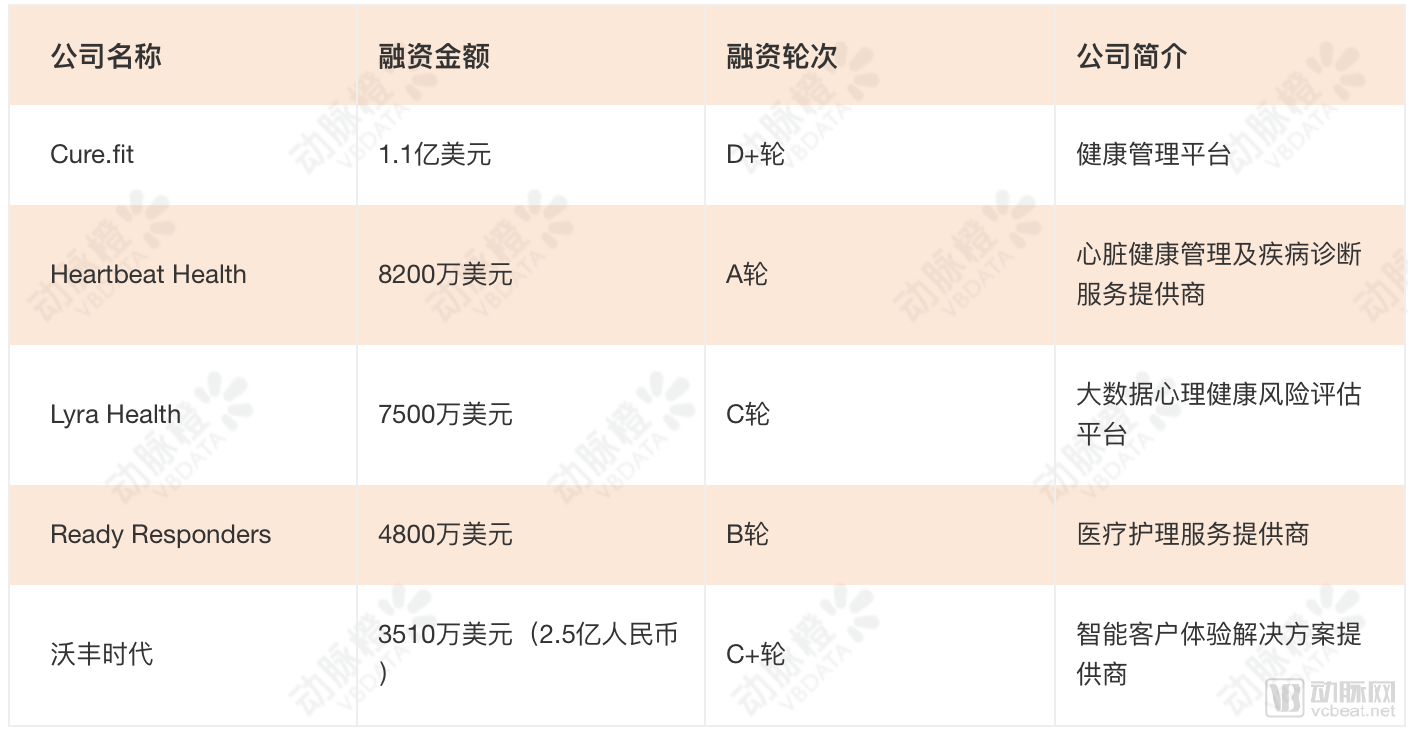
Top 5 Single Financing Amounts in March,Data Source: VCBeat Orange Database
Among the top five largest financing rounds, three were raised by companies in the health management sector. The largest single round was the D2 financing completed 17 days ago by Cure.fit, an Indian health tech company, amounting to $110 million. The round was led by Temasek, a renowned Singaporean venture capital firm, with participation from existing investors including Accel Partners, Chiratae Ventures, and Unilever’s global investment arm. Since its founding in 2016, Cure.fit has completed five financing rounds, raising a total of over $400 million. Following this latest round, its valuation stands at $575 million.
Health management emerged in the United States in the late 1950s, with the initial aim of intervening early in diagnostic and therapeutic processes to prevent disease, improve population health, and thereby control healthcare costs. The upstream segments of this value chain had long been overlooked by the market. However, as awareness and education around health management have gradually become more widespread in China over the past two years, capital interest in advanced foreign health management business models has continued to grow, while the emergence of similar domestic models has drawn particular attention.
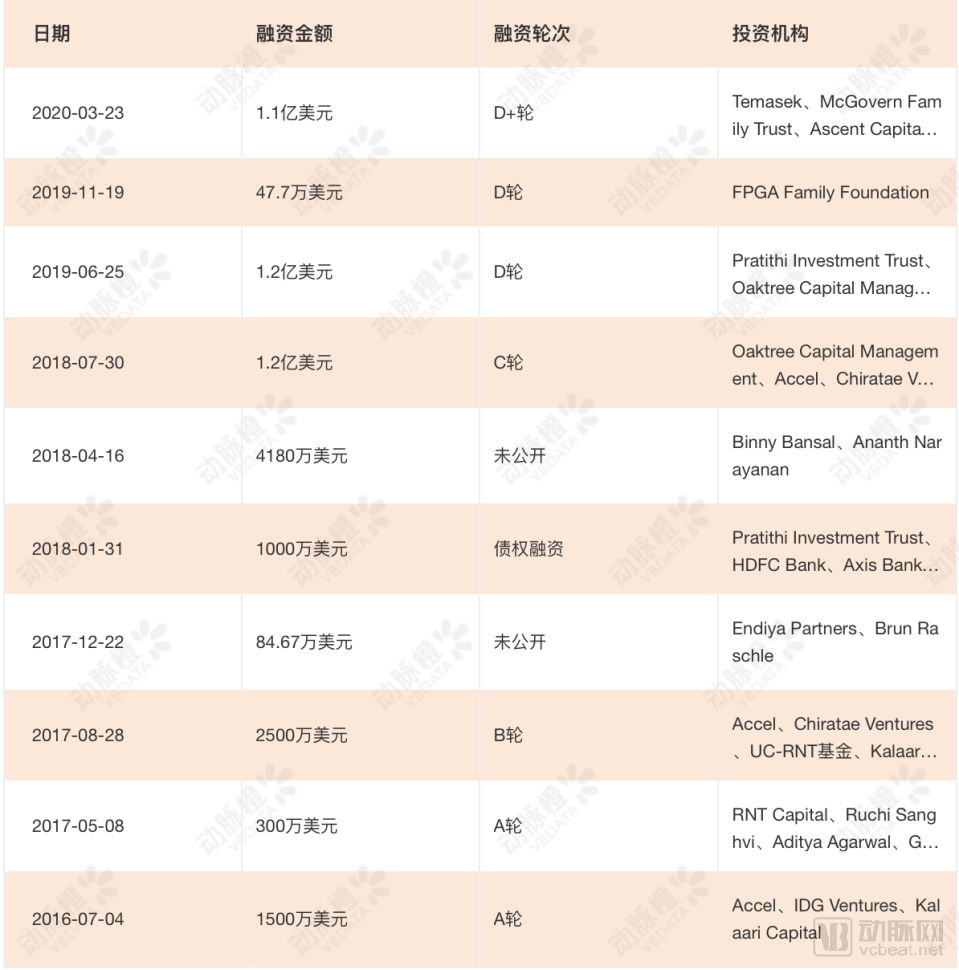
Cure.fit Funding History,Data Source: VCBeat Orange Database
Cure.fit, founded in 2016, has been defined by many media reports as a fitness chain company. In reality, however, it is an integrated service provider combining fitness, health technology, and medical services, with the goal of building a comprehensive health management platform.
According to Mukesh Bansal, founder of Cure.fit, in an interview with Forbes India, the healthcare market holds greater potential than the niche fitness sector. Currently, the fitness industry in India is valued at approximately $10 billion and is projected to reach $40 billion within the next five years. In contrast, the healthcare sector has already grown to a $100 billion market and could touch $300 billion over the same period.
As an integrated platform, Cure.fit comprehensively engages in user health management through four segments: the chain of fitness centers CultFit, the healthy food delivery service EatFit, the medical clinics CareFit, and the mental health services MindFit. These four categories encompass services related to physical fitness, nutritional health, medical care, and psychological well-being, which are essential components of lifestyle medicine advocated in health management.
Before founding Cure.fit, Mukesh Bansal stated, “In recent years, consumer health habits have evolved, and the demand for new technologies is essentially a demand for better consumer experiences.” Consequently, he decided to empower consumers to proactively leverage technology and data to manage their health. The overall design of Cure.fit aims to spark self-motivation among users, transforming what was once a tedious health management experience into an engaging one.
Since the launch of the Cure.fit app in 2017, users have been able to seamlessly access all features with a single account. The platform is committed to preserving customer autonomy by offering personalized course plans tailored to individual needs. By providing intuitive data insights, it empowers users to take full control of their health status, thereby improving quality of life and reducing long-term healthcare costs.
Online health management platforms are not a novel business model; many startups opt for this “asset-light” approach. However, their success and failure both hinge on the online channel. Customer acquisition, retention, and conversion pose significant real-world challenges. Purely online models suffer from weak user stickiness, with most companies exhausting their venture capital funding before succumbing in the fiercely competitive arena of internet traffic dividends.
In contrast, after achieving online success, Cure.fit actively expanded its offline presence, having opened more than 180 Cult.fit centers and 35 Mind.fit centers in Indian cities such as Bangalore, Mumbai, and Delhi, as well as in Dubai, United Arab Emirates. Meanwhile, it has vigorously developed Care.fit, which provides basic medical health services and chronic disease management.
Care.fit offers its members a “Stay Healthy” plan. For a monthly subscription fee of 500 rupees (approximately RMB 46.5), users can consult with general practitioners and nutritionists, and the package also includes basic laboratory tests. For members with chronic conditions such as diabetes, asthma, thyroid disorders, and obesity, the monthly subscription fee is 1,000 rupees (approximately RMB 93).
As Mukesh Bansal emphasized, “Cure.fit offers an ‘end-to-end’ closed-loop health ecosystem.” Cure.fit continues to explore the boundaries of its business and will leverage new funding to expand its operational scope, providing consumers with comprehensive health management solutions that span from product delivery to end-user engagement.
In 2020, Cure.fit is projected to open more than 800 offline service centers, expand into 15 cities, and serve over 500,000 active paying users through its offline channels.
On a global scale, as people’s attention to personal health continues to grow, many health technology companies are gradually emerging. Whether in Europe and the United States or in China, companies with business models similar to Cure.fit have sprung up, all demonstrating the same characteristic in their integration of technology and services: data-driven services.
Welltok: A U.S. Health Management Platform Offering Personalized Solutions Based on a Massive Database
When discussing population health management, Welltok in the United States is a notable example. Founded in 2009, Welltok focuses primarily on personal health management and lifestyle improvement. Its core product is the Café Well population health management platform, which assists health insurers and population health managers in guiding and incentivizing users to improve their health outcomes and overall well-being.
On the CaféWell health optimization platform, users can intuitively view all variable factors affecting individual health, and the platform designs personalized solutions based on these factors. Meanwhile, the platform integrates numerous health management programs, medical insurance plans, apps, and wearable devices for health tracking, with all sections working together to support users in their pursuit of better health.
Advanced analytics capabilities are powered by big data. Through its acquisition of the health analytics company Predilytics Inc., Welltok has gained access to a proprietary database covering 250 million Americans, containing more than 1,600 variables that enable the creation of predictive models tailored to specific consumers. This facilitates the development of personalized health management plans based on machine learning.
To optimize health and maximize returns, Welltok also integrates with other service providers, such as hardware vendors, content creators, application developers, insurance companies, and retail pharmacies, while assisting certain population health management companies in implementing corresponding management solutions.
More Health: Building a Closed-Loop Ecosystem of Health, Medicine, and Insurance to Integrate Online and Offline Services
In July 2015, Miaojiankang, a company with advanced health management concepts, was also established in China. Similar to the trajectory of Cure.fit, Miaojiankang started as a consumer-facing (C-end) personal health management platform. After accumulating extensive user health data, it continuously expanded its business boundaries and adopted a B2B2C model.
To date, Miao Health has evolved into a health technology group built upon three core capability platforms: the Big Data Platform for Health Behaviors (Miao+), the Intelligent Health Risk Management Platform (H Platform), and the Intelligent Health Intervention Platform (M Platform). It provides comprehensive health management solutions to insurers, enterprises, mobile phone manufacturers, government agencies, and other institutions.
In 2018, Miao Health entered into a strategic partnership with the Canadian Centre for Health Management (CWI), the leading chronic disease prevention organization in North America, establishing CWI (China) domestically. CWI (China) integrates cutting-edge health technologies—such as precise user assessment, big data on health behaviors, and artificial intelligence—with offline clinical expertise and intervention methods in lifestyle medicine, creating a one-stop, AIoT-based health management solution covering the entire lifespan. Since last year, this mature model has been implemented in offline settings, gradually achieving cross-industry collaborations with insurance companies, hospitals, real estate developers, and nursing homes, thereby enabling a multi-sector integrated layout.
Online, guided by lifestyle medicine across five dimensions—exercise, psychology, nutrition, sleep, and health literacy—Miao Health can provide light-touch health management. It can also combine health training camps to deliver moderate-intensity health management through a hybrid model of human specialists and AI. At offline centers, users can experience intensive health management services, which include on-site risk screening and health assessment, prescription issuance and implementation, chronic disease intervention, professional outcome evaluation and prescription adjustment, as well as remote health guidance after discharge. This high-intensity health management service primarily targets individuals with chronic diseases and sub-healthy populations with poor self-discipline.
From online to offline, Miao Health has gradually established a closed-loop system for full-scenario health management and chronic disease management services. In the construction of smart health cities in places such as Xingtai and Hefei, the presence of CWI (China) has been evident.
Over the past five years, Miao Health has continuously refined its closed-loop service ecosystem encompassing “wellness, medical care, pharmaceuticals, and insurance,” with high-frequency health management scenarios at its core. Starting from sustainable online-to-offline health management, it has gradually established a comprehensive, full-cycle closed-loop chain for chronic disease management across all scenarios. In the development of smart health cities in places such as Xingtai and Hefei, CWI (China) has been actively involved, leveraging technology to improve the health of the Chinese population with a focus on health-centric solutions.
From India’s Cure.fit to the United States’ Welltok, and then to China’s Miao Jiankang, tracing the development of these health management platforms reveals the increasingly prominent value of technological innovation and business model upgrades. Benefiting from the growing public emphasis on health, these health technology companies have leveraged technological means to revolutionize service experiences and employed data-driven approaches to deliver personalized health management. In doing so, they have addressed rigid market demands while making significant contributions to improving population health outcomes.
Health management itself is not an industry; it is merely a philosophy and lifestyle aimed at maintaining health. Only when health management is integrated with high-quality technologies and services, and organically aligned with both the immediate and latent health needs of consumers, can it truly form an industrial chain and unleash significant economic potential.
References:
https://yourstory.com/2020/02/future-of-work-2020-mukesh-bansal-curefit-health-tech-startup
https://www.welltok.com/portfolio_page/7331/?_ga=2.245090053.1443996645.1586329804-1259027930.1586329804
https://markets.businessinsider.com/news/stocks/20-of-health-transformation-alliance-members-select-welltok-s-total-wellbeing-solution-within-first-year-of-partnership-1028580881