

MedSight IPO Prospectus: Empowering Pharma Companies with Omnichannel and Digital Marketing Across Product Lifecycle
Changes in the business environment, driven by industry practices, healthcare reforms, and the pandemic, have made traditional pharmaceutical channels—such as sales representative visits and routine conferences—increasingly difficult to sustain. Companies are compelled to embrace the trend of digital transformation in their operations. Many pharmaceutical enterprises have shifted from a wait-and-see approach to actively increasing their investments in multichannel and digital marketing.
Today, digital marketing channels such as WeChat, video conferencing, and online visits have already occupied the time physicians spend acquiring information from pharmaceutical companies. The key issue is that user behavior has changed; companies that hesitate will soon be left behind by both customers and competitors. Everyone understands that “change is inevitable.” The current questions are “what to do,” “how to do it,” and “who should do it” to achieve this transformation.
“Establishing a customer-centric multichannel/digital marketing strategy and capability is the first priority. Our goal is to identify differentiated services, channels, and strengths to meet customer needs and deliver value to customers.”Zhang Zhiqiang, founder of Yimasi, stated that companies should first analyze interaction data generated from existing promotional activities to understand and learn customer preferences. Marketers then combine product strategies with customer preferences to make strategic and campaign adjustments until the product campaigns achieve greater success. This process must be built upon the company’s internal multi-channel/digital marketing capabilities, as service providers generally lack the internal resources and insights necessary to execute this effectively.“Be careful not to fall into the trap of digitalization for its own sake.”
Regarding the question of “how to execute,” there are many technology-driven service providers in the market that create tactical projects for pharmaceutical companies (such as interactive webpages, videos, and operational WeChat official accounts), with prices driven down by intense competition. However, few suppliers excel in both medical content and product content. Only a small number of project teams with strong professional expertise, learning agility, and adaptability can deliver higher-value services, such as integrating pharmaceutical product/medical-related brand strategies into these tactical initiatives. Result-oriented approaches and standardized management are the only reliable ways to ensure effectiveness.
In considering “who should do it,” when a company makes the firm decision to undergo digital transformation, the general manager must appoint a project leader with considerable authority.Pharmaceutical companies should recognize that digital transformation is an enterprise-level change management process, a task that demands both strong soft and hard capabilities.Sometimes, a top-down approach offers a quick and effective shortcut but may not be sustainable in the long run. Management can also consider engaging third-party consultants to assist with strategy formulation, project design, implementation, execution, and follow-up. As change agents, third parties can leverage greater advantages and achieve better outcomes in driving project awareness and establishing new operating models. Gaining internal stakeholders’ recognition of the impact of change and securing their buy-in requires both skill and time. This transformation process is inherently fragile, making strong and consistent support from internal management critical to success. After achieving initial success, these multichannel/digital marketing capabilities will be gradually integrated into routine marketing practices.
Nowadays, multi-channel/digital marketing in pharmaceutical companies is booming. However, many pharmaceutical executives lack a deep understanding of the core strategies behind multi-channel/digital marketing, resulting in numerous initiatives that remain merely formalistic and fail to achieve their intended outcomes. Zhang Zhiqiang, Founder and General Manager of Yimasi, stated, “Many pharmaceutical companies have not developed top-level strategies for multi-channel/digital marketing.”“Managers often believe that it is sufficient to establish a WeChat official account via digital channels, run campaigns on prominent physician communities or internet healthcare platforms, and publish content. However, the vast amount of data generated from customer interactions is scattered across various vendors.”
“Pharmaceutical companies must recognize that digital channels, such as WeChat official accounts and physician communities, are merely channels; the core of multichannel/digital marketing remains customer-centricity.” By analyzing data to understand customer needs, companies can adjust their strategies to better deliver value to customers. If a company has not yet established internal capabilities in this area, selecting a service provider capable of offering digital marketing strategic planning and project management is crucial for pharmaceutical enterprises.
Yimasi is a consulting and management firm dedicated to providing pharmaceutical companies with digital strategy and omnichannel marketing solutions.The company’s service offerings include assisting pharmaceutical companies with strategic integration (e.g., brand strategy, omnichannel strategy, digital marketing strategy, content strategy, and growth strategy), while providing systematic omnichannel/digital marketing solutions. These services enable pharmaceutical companies to deliver valuable omnichannel/digital marketing experiences to their customers, thereby enhancing overall marketing effectiveness.
Matthew Chang, founder of Yimasi, previously led the establishment and operation of the “Yiweida” project. MSD’s “Yiweida” is widely regarded as a classic case of multi-channel marketing implementation within the pharmaceutical industry. “Yiweida” is a medical information portal platform designed specifically for healthcare professionals. Through “Yiweida,” MSD provides users with high-quality, neutral medical news from both China and abroad, clinical medical tools, and online learning resources. The platform attracts user registrations through its professional content and services, and subsequently delivers tailored medical and product solutions via various channels, thereby providing valuable professional services to its users.
After leaving Merck & Co. in 2014, Zhang Zhiqiang founded Yimasi. The primary reason was his belief that the digitalization of pharmaceutical marketing would be a major trend over the next decade.“The omnichannel marketing consulting industry has at least five to ten years of golden development ahead; this opportunity must be seized.”Furthermore, at that time, there were virtually no companies in the market offering integrated services to help pharmaceutical enterprises formulate brand strategies and develop omnichannel/digital marketing strategies. YimaSi precisely targeted this niche for omnichannel/digital marketing consulting services, focusing on providing strategic consulting for omnichannel marketing to pharmaceutical companies, thereby meeting client needs through its professional expertise and first-mover advantage.
Zhang Zhiqiang holds a Bachelor of Applied Biology from Hong Kong Baptist University and an MBA from The Chinese University of Hong Kong, while alsoHe is also an expert in pharmaceutical sales/marketing and omnichannel marketing strategy, specializing in market insights, omnichannel strategy design, and solution development, with proven expertise in operations and maximizing the potential of drugs across all stages of their lifecycle.Zhang Zhiqiang has previously held roles in sales, marketing, performance management, training, research, and multichannel marketing at Merck & Co., bringing extensive insights and experience to the field of marketing.
“Establishing a customer-centric philosophy and possessing the ability to integrate strategy and operations are the keys to success in multi-channel marketing.”
According to reports, MedCode’s recently completed projects span multiple domains, including the development of multi-channel and digital strategies for pharmaceutical companies’ products, annual brand multi-channel marketing plans, annual product marketing plans, setup of online detailing programs, marketing and multi-channel marketing training, contact center strategy formulation and staff training, customer relationship management (CRM) strategic assessment and development, and social media management processes.
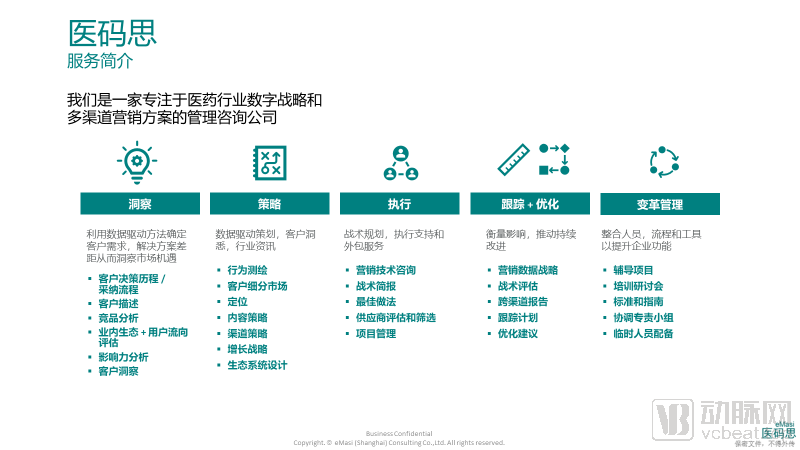
Currently, multiple pharmaceutical companies have partnered with Yimasi, including Sanofi, GSK, Bayer, BMS, Allergan, Chiesi, and Viatris.Among them, Willmar Schwabe is a world-renowned pharmaceutical company specializing in prescription phytopharmaceuticals, with its products primarily applied in the fields of neurology, cardiovascular and cerebrovascular diseases, and peripheral vascular disorders. Yimasi provided Willmar Schwabe with an omnichannel marketing solution, successfully helping it establish an omnichannel/digital marketing platform and services, thereby laying a solid foundation for its transition toward academic promotion.
Digital marketing has become an unstoppable trend. Discussing future plans, Zhang Zhiqiang stated, “In the short term, Yima Si will continue to deepen its roots in providing strategic consulting services for pharmaceutical companies’ multichannel and digital marketing strategies. Meanwhile, we will also seek opportunities to extend downstream, building a company that integrates strategic consulting with a service platform to provide comprehensive solutions for pharmaceutical companies’ multichannel marketing.”